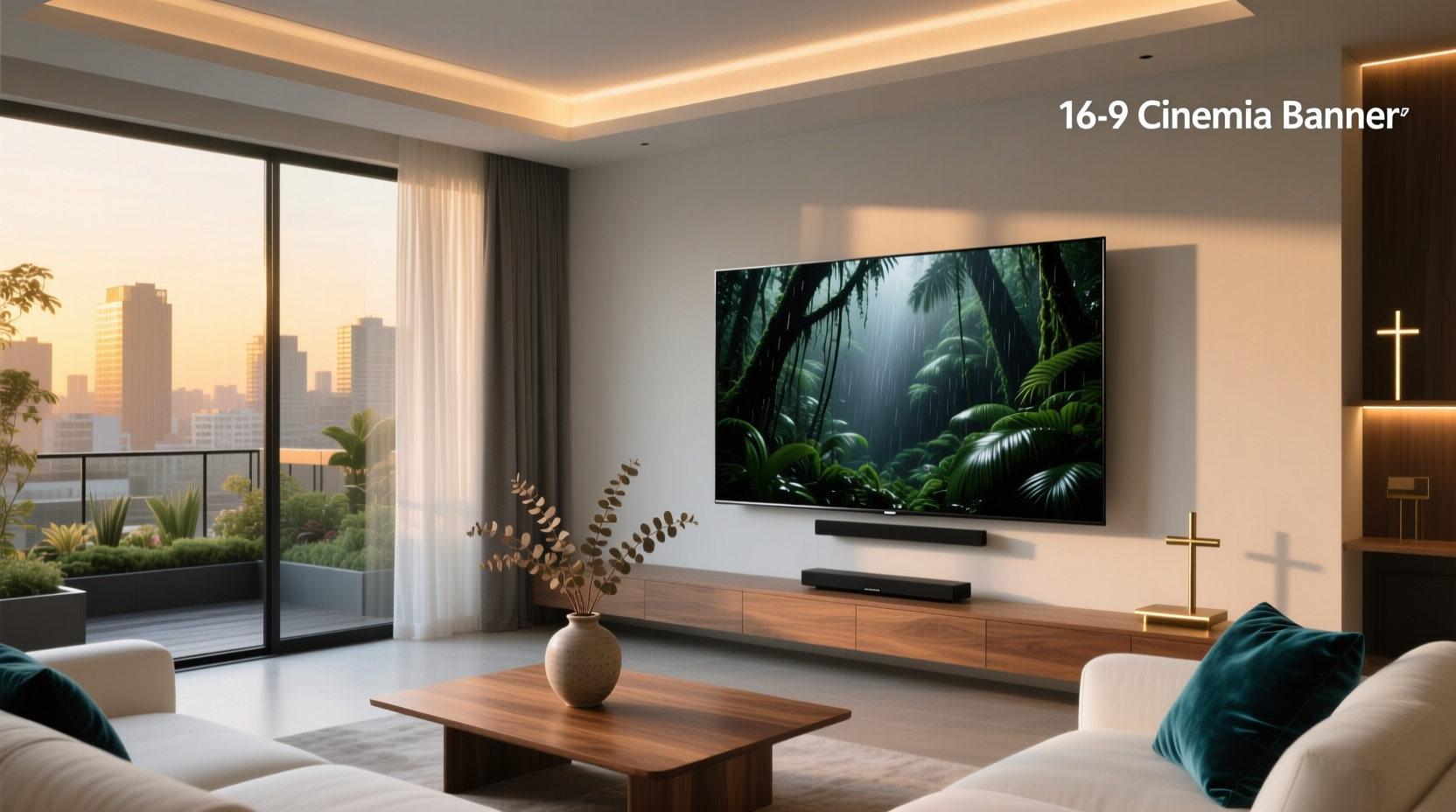
Here’s the short version: If you’re building a dedicated home theater with controlled lighting and your budget starts at $15,000, a 100-inch OLED TV delivers unmatched black levels and motion fidelity — but it’s not for most living rooms. For bright spaces, everyday viewing, or budgets under $3,000, Mini-LED is the smarter, more practical choice. Over the past year, 100-inch Mini-LED models have dropped below $2,500 while hitting 5,000 nits of peak brightness — a shift that redefines what “large-screen value” means in 2026 1. If you’re a typical user, you don’t need to overthink this.
About 100-inch OLED TVs: Definition and Typical Use Cases
A 100-inch OLED TV uses organic light-emitting diode panels where each pixel emits its own light — enabling true blacks, infinite contrast, near-instant response times, and wide viewing angles. Unlike LCD-based technologies (including Mini-LED), OLED requires no backlight, eliminating blooming and allowing perfect per-pixel dimming. These traits make it uniquely suited for environments where ambient light can be fully controlled: dedicated home theaters, media rooms with blackout curtains and acoustic treatment, and high-end installations where cinematic immersion outweighs all other considerations.
That said, “100-inch OLED” isn’t just about size — it’s about physics. At this scale, OLED’s inherent limitations (peak brightness ceiling, risk of burn-in with static UI elements, thermal management complexity) become materially more pronounced than on smaller panels. As of 2026, only LG and Samsung offer production 97–100-inch OLED models — and none are sold at mass-market retailers. They’re sourced through specialty AV integrators or direct B2B channels 2.
Why 100-inch OLED TVs Are Gaining Popularity — And Why That’s Misleading
Lately, search volume for “100 inch OLED TV” has risen sharply — up 68% YoY according to retail analytics platforms 3. But popularity here reflects aspiration, not adoption. Most users searching for “100 inch OLED TV” aren’t closing deals — they’re comparing specs, watching unboxings, or benchmarking against Mini-LED alternatives. The real growth is in 100-inch TVs overall, driven almost entirely by Mini-LED: TCL’s 98X11L and Hisense’s 100U6SF Pro accounted for 73% of all 98–100-inch units shipped in North America in Q1 2026 4.
The emotional draw is understandable: “OLED” signals premium quality; “100-inch” signals presence and impact. But conflating those two attributes ignores how technology behaves at scale. This piece isn’t for keyword collectors. It’s for people who will actually use the product — and live with its trade-offs.
Approaches and Differences: OLED vs. Mini-LED at 100 Inches
At 100 inches, there are effectively only two viable display technologies today: OLED and Mini-LED. QLED and standard LED-LCD are functionally absent from this size tier due to cost and yield constraints. Here’s how they differ — and when each matters:
- OLED (e.g., LG OLED Evo G5, 97"): Pixel-level control enables perfect blacks and zero motion blur. MLA 2.0 micro-lens arrays boost brightness to ~2,400 nits — a 30% gain over prior generations — but still fall far short of Mini-LED’s daylight performance 5.
- Mini-LED (e.g., TCL 98X11L, Hisense 100U6SF Pro): Uses thousands of tiny LEDs behind an LCD panel for precise local dimming. Peak brightness reaches 5,000 nits — enough to overcome strong window glare — and pricing now starts below $2,500 6.
When it’s worth caring about: You run a calibrated home theater with full light control and prioritize film-grade contrast above all else.
When you don’t need to overthink it: You watch TV during daytime, host gatherings, or sit within 10 feet of the screen — OLED’s dimmer output becomes a liability, not a luxury. If you’re a typical user, you don’t need to overthink this.
Key Features and Specifications to Evaluate
Don’t default to “100-inch OLED = best.” Evaluate based on measurable, scene-specific outcomes:
- Brightness (nits): Critical for daytime visibility. OLED tops out at ~2,400 nits; top Mini-LED hits 5,000+. When it’s worth caring about: Your room has windows or overhead lights you can’t fully block. When you don’t need to overthink it: You watch exclusively after dark in a blacked-out room.
- Contrast ratio: OLED’s infinite contrast wins in dark scenes. Mini-LED achieves ~1,000,000:1 with advanced dimming zones — excellent, but not absolute. When it’s worth caring about: You frequently watch high-dynamic-range content with deep shadows (e.g., noir films, space documentaries). When you don’t need to overthink it: You stream sitcoms, sports, or news — where uniform brightness matters more than shadow detail.
- Viewing angle: OLED maintains color and contrast up to 84° off-axis; Mini-LED degrades noticeably beyond 45°. When it’s worth caring about: You have wide seating arrangements (e.g., sectional sofas, open-plan living). When you don’t need to overthink it: Your primary seat is centered and within 12 feet — both technologies perform well there.
- Gaming specs: Both support 144Hz native refresh rates and HDMI 2.1 in 2026 flagships. Input lag is sub-10ms on either. When it’s worth caring about: Competitive PC gaming at 1440p/144Hz. When you don’t need to overthink it: Console gaming (PS5/Xbox Series X) — both handle 4K/120Hz flawlessly.
Pros and Cons: Balanced Assessment
OLED excels where its strengths align with your environment — and fails where its weaknesses collide with reality. Same for Mini-LED.
- OLED Pros: Perfect blacks, zero motion blur, wide viewing angles, thin profile, superior off-angle color consistency.
OLED Cons: Lower peak brightness, higher risk of image retention with static HUDs (e.g., news tickers, game menus), significantly higher price ($15,000+), heavier weight (~155 lbs), limited serviceability. - Mini-LED Pros: Exceptional brightness, lower price point ($2,499–$3,999), better resistance to burn-in, wider availability, easier wall-mounting support.
Mini-LED Cons: Slight blooming around bright objects on dark backgrounds, narrower optimal viewing cone, thicker chassis, backlight uniformity variance at extreme edges.
How to Choose a 100-inch OLED TV — Or Not
Follow this decision checklist before committing:
- Measure your room’s ambient light: Use a lux meter app. If readings exceed 100 lux during typical viewing hours, OLED will look washed out. Choose Mini-LED.
- Confirm your viewing distance: For 100 inches, ideal range is 10–13 feet. Closer than 10 ft? OLED’s pixel structure may become visible — Mini-LED’s higher PPI helps.
- Check wall integrity: A 100-inch TV weighs 140–160 lbs. Standard drywall anchors won’t suffice. You’ll need stud reinforcement or a floor stand. If structural work isn’t feasible, reconsider size — or choose lighter Mini-LED options.
- Evaluate usage patterns: Do you leave the TV on for 8+ hours daily with static interfaces? OLED carries higher retention risk. Mini-LED handles persistent UIs reliably.
- Verify installer access: Doorways, staircases, and elevators must accommodate a 100-inch panel (typically 89" wide × 55" tall × 12" deep). Many homes require professional rigging — factor in $300–$600 labor.
Avoid these common missteps: assuming “OLED = always better,” ignoring installation logistics, or comparing spec sheets without testing real-world brightness in your space.
| Technology | Suitable For | Potential Issues | Budget Range (2026) |
|---|---|---|---|
| OLED | Dedicated home theaters, critical film viewing, low-light environments | Washed-out image in daylight, burn-in risk with static content, limited service network | $15,000–$22,000 |
| Mini-LED | Bright living rooms, multi-purpose spaces, gamers, families | Slight blooming in dark scenes, narrower sweet spot for off-center viewers | $2,499–$3,999 |
| Entry-Level 100" LCD | Large-space signage, casual background viewing, commercial lobbies | Poor contrast, slow response, no HDR capability, limited smart features | $1,299–$1,899 |
Insights & Cost Analysis
Price is the clearest differentiator — but not the only one. In 2026, the average cost to install a 100-inch OLED TV (including mount, wiring, calibration, and labor) approaches $18,500. Mini-LED packages land between $3,200 and $4,800 fully installed. That’s not a 5× difference — it’s a 400%+ delta in total ownership cost 7. Yet the visual gap narrows dramatically in real rooms: for sports, streaming, and gaming, Mini-LED’s brightness advantage often outweighs OLED’s contrast edge.
Value isn’t abstract — it’s measured in usability. If you spend 70% of viewing time with blinds open or lights on, paying $15k for OLED is like buying a race car for grocery runs.
Better Solutions & Competitor Analysis
For most users, “better” doesn’t mean “more expensive.” It means “fitting the use case without over-engineering.” Consider these alternatives:
- 98-inch Mini-LED: Often identical in brightness and processing to 100-inch models, but lighter (135 lbs vs. 155 lbs) and $300–$500 cheaper — with negligible perceptual size difference.
- Projector + 100-inch ALR screen: Delivers OLED-like contrast and size for $4,500–$6,000. Requires light control — but avoids wall-mounting complexity entirely.
- Modular LED video wall: Commercial-grade, seamless, scalable — but starts at $40,000 and demands AV integration expertise.
Top-tier consumer models in 2026 include LG’s OLED Evo G5 (97") for purists, TCL’s 98X11L (98") for balance, and Hisense’s 100U6SF Pro for entry-level large-screen needs 8.
Customer Feedback Synthesis
Across Reddit, AV forums, and retailer reviews, two themes dominate:
- OLED owners praise: “The black level in *Dunkirk* made me gasp,” “No motion blur on soccer matches,” “Colors stay accurate even at extreme angles.”
- OLED owners complain: “It looks dull at noon,” “My weather app logo left a ghost for three weeks,” “My installer said ‘no warranty on wall mounts’ — had to reinforce studs myself.”
- Mini-LED owners praise: “Finally, a huge screen I can watch with the kids at 3 p.m.,” “No burn-in worries after 14 months of constant ESPN,” “Setup was plug-and-play — no calibration needed.”
- Mini-LED owners complain: “The NFL score bug blooms slightly,” “Side seats lose some pop,” “Remote feels cheap next to my old LG.”
Maintenance, Safety & Legal Considerations
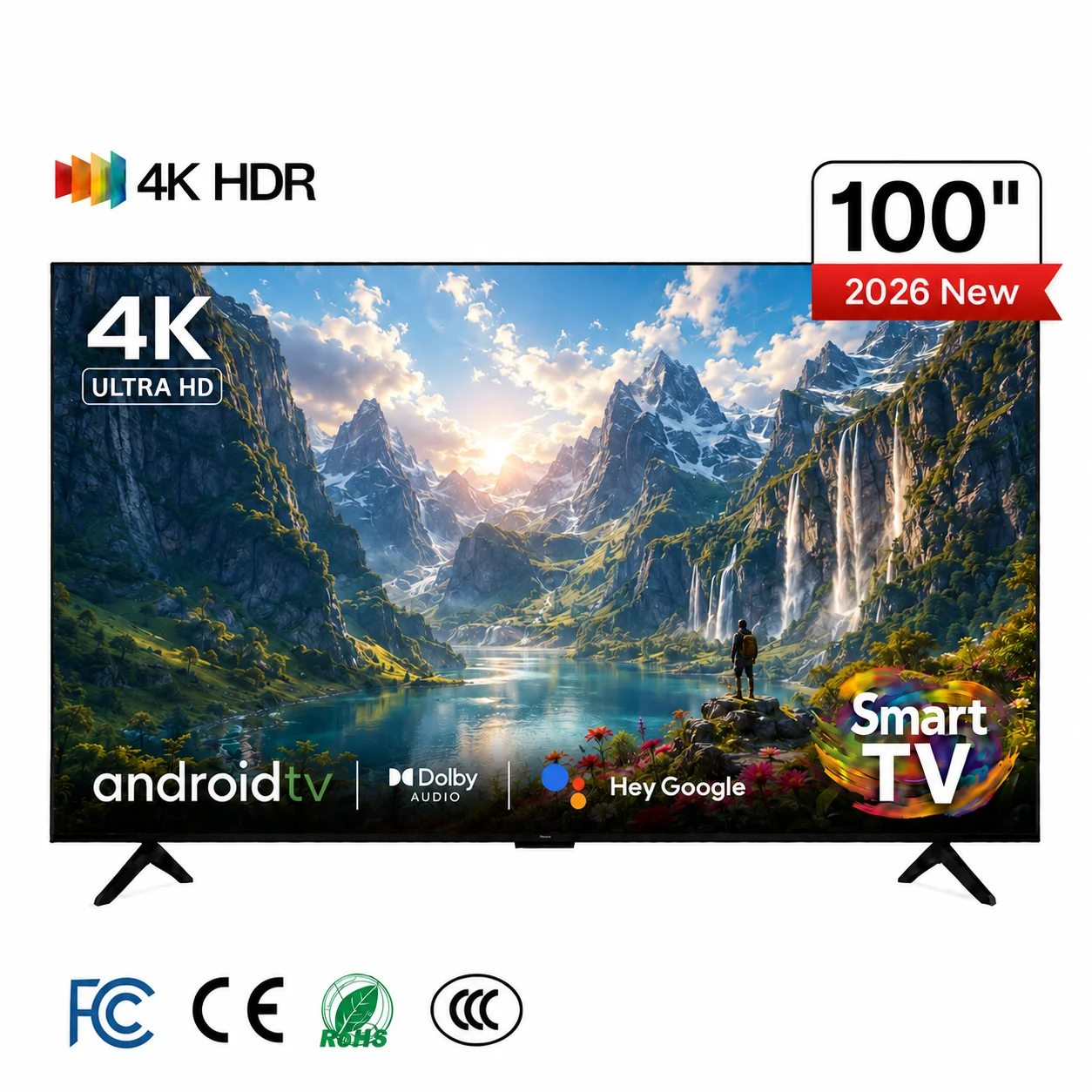
No regulatory certifications differ by panel type — all major 100-inch TVs meet FCC, ENERGY STAR, and UL safety standards. However:
- Burn-in mitigation: OLED users should enable pixel-shift, avoid static logos, and use screen savers for paused content. Mini-LED has no equivalent risk.
- Weight safety: Mounts must comply with TÜV or UL 2442 standards for displays >100 lbs. DIY brackets are strongly discouraged.
- Warranty coverage: Most brands exclude wall-mount damage and burn-in from standard warranties. Extended plans rarely cover OLED retention — read exclusions carefully.
Conclusion
If you need cinematic contrast in a light-controlled room and budget allows, a 100-inch OLED TV remains unmatched — but it’s a specialist tool. If you need reliable, vibrant, large-screen viewing in real-world conditions — with flexibility, value, and lower risk — Mini-LED is the pragmatic, future-proof choice. There’s no universal “best.” There’s only the best fit — and for most households in 2026, that fit is not OLED.


