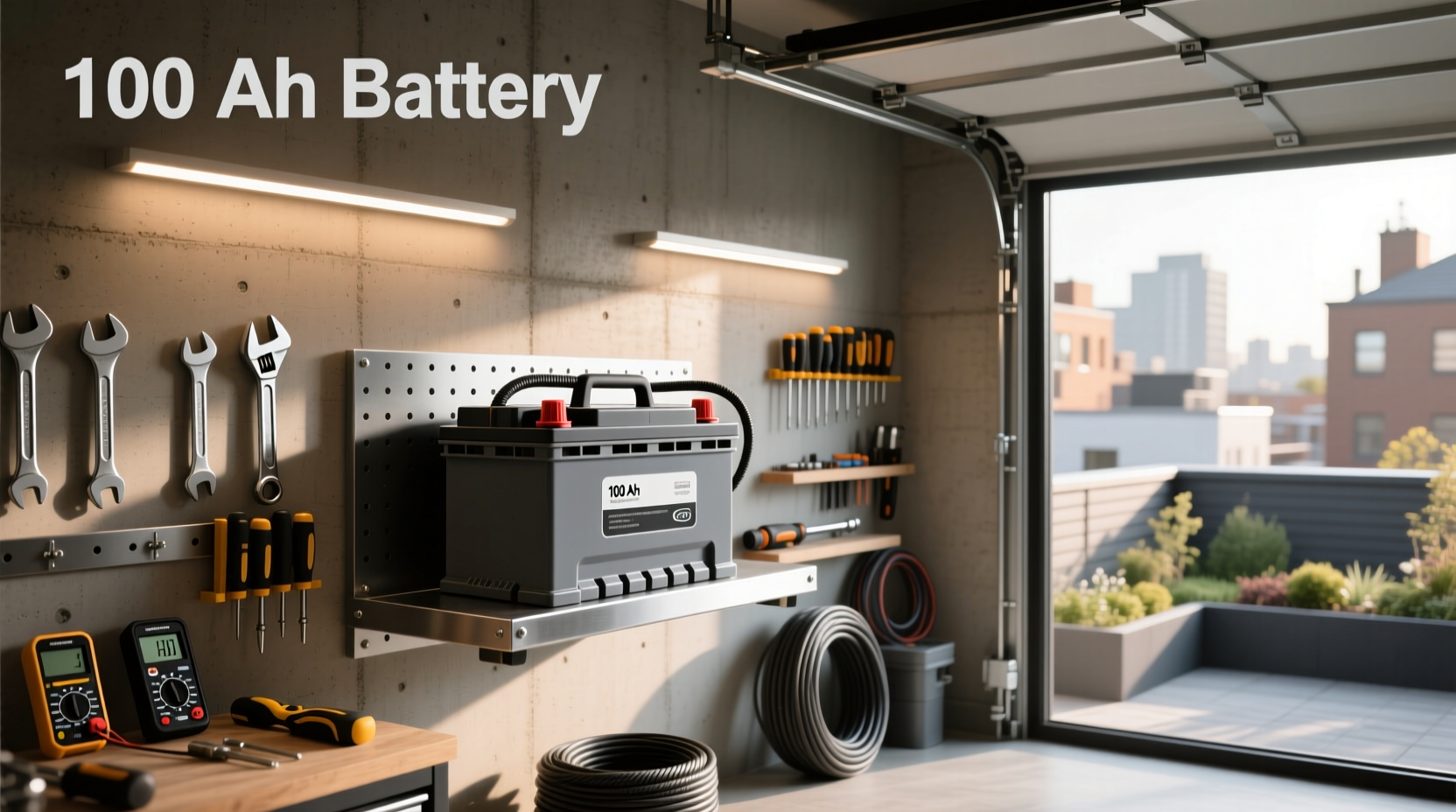
If you’re a typical user choosing a 100Ah battery for an RV, solar storage, or off-grid cabin — go with LiFePO4. Over the past year, lithium iron phosphate has become the default choice for deep-cycle applications: it delivers nearly double the usable energy of a 100Ah lead-acid unit, lasts 10+ years, and now costs only ~$125 on average1. You don’t need to overthink chemistry if your use case involves daily cycling — LiFePO4 is objectively better for longevity, safety, and usable capacity. This piece isn’t for keyword collectors. It’s for people who will actually use the product.
About 100Ah Batteries: Definition & Typical Use Cases 🔋
A “100Ah battery” refers to a power storage unit rated at 100 ampere-hours — meaning it can theoretically deliver 100 amps for one hour, or 10 amps for 10 hours, under ideal conditions. But real-world usability depends heavily on chemistry, temperature, discharge rate, and depth-of-discharge limits. In practice, a 100Ah rating alone tells you very little without context.
Common applications include:
- 🚐 RV house batteries: Powering lights, refrigerators, water pumps, and inverters during travel or boondocking.
- ☀️ Solar energy storage: Storing daytime PV generation for nighttime or cloudy-day use in residential or remote systems.
- ⚡ Off-grid cabins & tiny homes: Serving as the sole or primary DC power source for low- to medium-draw loads.
- 🚚 Light commercial mobile setups: Powering tools, signage, or monitoring equipment in field operations.
What matters most isn’t just “100Ah” — it’s how much usable energy that number translates to in your actual system. And that’s where chemistry makes all the difference.
Why 100Ah Batteries Are Gaining Popularity 📈
Lately, demand for standardized 100Ah battery units has surged — not because 100Ah is inherently optimal, but because it strikes a practical balance between capacity, physical size, weight, and compatibility with common charge controllers and inverters. More importantly, this capacity point sits at the sweet spot where lithium economics have finally tipped in favor of long-term users.
Three key drivers explain why 100Ah batteries are trending in 2026:
- Residential solar adoption: Batteries now account for 35–55% of total solar system cost2, and 100Ah LiFePO4 modules scale cleanly into 5–10kWh home storage arrays.
- RV electrification: Modern RVs run high-C-rate appliances like induction cooktops and rooftop AC — which require stable voltage and fast response, something lead-acid struggles with under load.
- Supply chain maturation: Mass production of LiFePO4 cells has driven prices down ~50% since 20203, making 100Ah lithium viable even for mid-budget buyers.
Approaches and Differences: LiFePO4 vs. Lead-Acid
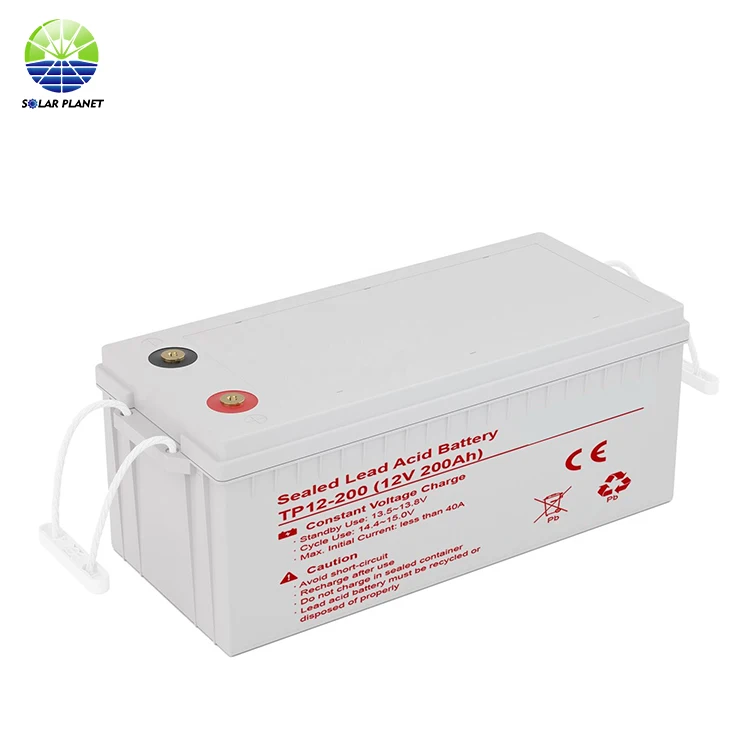
Two chemistries dominate the 100Ah market: Lithium Iron Phosphate (LiFePO4) and absorbed glass mat/gel (AGM/Gel) lead-acid. They aren’t interchangeable — they solve different problems.
✅ LiFePO4 (Lithium)
- Pros: 4,000–6,000 cycles, 80–100% usable DoD, lightweight (~30 lbs), stable voltage under load, no maintenance, cobalt-free, built-in BMS.
- Cons: Higher upfront cost (~$125 avg), requires lithium-specific charging profile, sensitive to sub-zero charging (though newer models include low-temp cutoff).
- When it’s worth caring about: Daily cycling, weight-sensitive installations (RVs, boats), long-term ownership (>3 years), or systems needing full 100Ah utilization.
- When you don’t need to overthink it: If you’re using it once a month for backup lighting — LiFePO4 is overkill. If you’re a typical user, you don’t need to overthink this.
⚠️ AGM/Gel Lead-Acid
- Pros: Lower initial price (~$85 avg), widely compatible with legacy chargers, tolerant of occasional overcharge, simple disposal/recycling infrastructure.
- Cons: 300–600 cycles, only ~50% usable DoD, heavy (~90 lbs), voltage sag under load, sulfation risk if undercharged.
- When it’s worth caring about: Occasional backup use (e.g., emergency sump pump), engine starting (SLI), or budget-limited pilot projects where replacement is expected within 2–3 years.
- When you don’t need to overthink it: If you plan to cycle it daily — lead-acid will degrade faster than you expect. If you’re a typical user, you don’t need to overthink this.
Key Features and Specifications to Evaluate 🔍
Don’t trust the “100Ah” label alone. Look beyond nominal ratings and assess these five technical parameters — each answers a real-world question:
- Usable Ah (not nominal Ah): What’s the actual energy you can draw before hitting the BMS cutoff? For LiFePO4, assume 80–100Ah usable. For AGM, assume ≤50Ah usable. When it’s worth caring about: Any application requiring predictable runtime. When you don’t need to overthink it: Short-duration, low-power tasks like LED lighting for 2 hours — both types perform similarly.
- C-Rating (continuous discharge): A 1C rating means it can safely deliver 100A continuously. Critical for microwaves, inverters, or air compressors. When it’s worth caring about: If peak loads exceed 500W. When you don’t need to overthink it: For USB charging, fans, or small fridges — standard 0.5C–1C is sufficient.
- BMS capabilities: Must include over-voltage, under-voltage, short-circuit, over-temperature, and low-temp charge protection. Active cell balancing is a plus for longevity. When it’s worth caring about: Any unattended or remote installation. When you don’t need to overthink it: Bench testing in a garage — basic protection suffices.
- Certifications: CE, UN38.3, and IEC62133 confirm safety compliance for transport and operation. When it’s worth caring about: Shipping internationally or installing indoors. When you don’t need to overthink it: Local, ground-level outdoor mounting — but still verify minimum UN38.3.
- Warranty terms: Look for cycle-based guarantees (e.g., 5,000 cycles @ 80% DoD), not just years. A 5-year warranty with no cycle count is meaningless. When it’s worth caring about: Systems designed for >7 years of service. When you don’t need to overthink it: Temporary setups lasting <2 years — focus on price and availability instead.
Pros and Cons: Balanced Assessment
| Factor | LiFePO4 | AGM/Gel Lead-Acid |
|---|---|---|
| Usable Energy (100Ah unit) | ~90–100Ah (≈1.2–1.3 kWh @ 12.8V) | ~45–50Ah (≈0.6–0.7 kWh @ 12V) |
| Lifespan (typical) | 10+ years / 4,000–6,000 cycles | 2–3 years / 300–600 cycles |
| Weight | 28–32 lbs | 60–95 lbs |
| 10-Year Total Cost of Ownership | ~₹1.9 Lakh ($2,300) | ~₹4.3 Lakh ($5,200)2 |
| Charging Compatibility | Requires lithium profile (often adjustable via app or dip switch) | Works with most legacy alternators and solar charge controllers |
How to Choose a 100Ah Battery: Step-by-Step Decision Guide
Follow this checklist — in order — to eliminate guesswork:
- Define your use pattern: Daily deep cycling? Weekly backup? Engine cranking? This decides chemistry first.
- Calculate required usable capacity: Multiply average load (watts) × runtime (hours) ÷ system voltage. If result > 500Wh, LiFePO4 becomes cost-effective.
- Verify charger/inverter compatibility: Does your existing solar controller support lithium absorption voltage (14.2–14.6V)? If not, budget for an upgrade.
- Check physical constraints: Measure available space and weight allowance. A 100Ah AGM may not fit where a LiFePO4 does — or vice versa.
- Evaluate true cost per usable Ah: Divide price by usable Ah (e.g., $125 ÷ 95Ah = $1.32/Ah vs. $85 ÷ 48Ah = $1.77/Ah). Lithium wins on value here.
Avoid these three common mistakes:
- Assuming “100Ah = 100Ah” across chemistries — it’s not.
- Prioritizing lowest sticker price without factoring in replacement frequency.
- Ignoring low-temperature charging limits — many LiFePO4 units disable charging below 0°C unless equipped with self-heating.
Insights & Cost Analysis
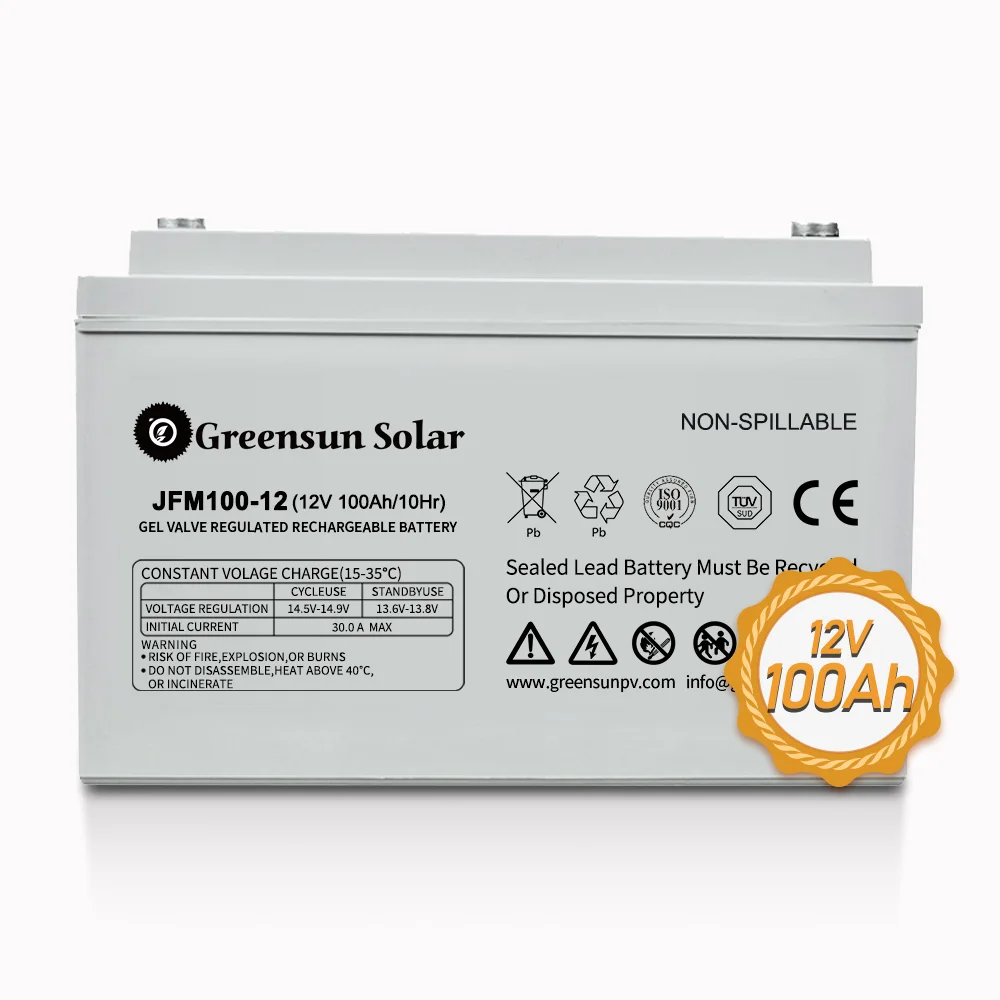
The biggest shift in 2026 isn’t just lower prices — it’s transparency in usable capacity. Consumers now compare based on kWh, not Ah. A 100Ah LiFePO4 delivers ~1.25kWh usable energy; a 100Ah AGM delivers ~0.6kWh. That’s a 108% difference in real output — yet both carry the same “100Ah” label.
Here’s how the math breaks down for a typical 5kWh solar storage requirement:
- LiFePO4 route: Four 100Ah units ($125 × 4 = $500) + compatible hybrid inverter ($1,200) = $1,700. Lifespan: 10+ years. True cost per usable kWh-year: ~$17.
- Lead-acid route: Ten 100Ah AGM units ($85 × 10 = $850) + robust inverter ($1,000) + two full replacements over 10 years = ~$2,850. True cost per usable kWh-year: ~$48.
This gap explains why LiFePO4 now captures 78% of new solar and RV installations4. The break-even point occurs around Year 3–4 — and keeps widening.
Better Solutions & Competitor Analysis
While 100Ah remains the dominant modular size, emerging alternatives address specific constraints:
| Solution | Best For | Potential Issue | Budget Consideration |
|---|---|---|---|
| 100Ah LiFePO4 w/ active BMS | Daily cycling, solar, RVs, longevity | Requires lithium-aware charging | Moderate ($120–$140) |
| 100Ah AGM/Gel | Infrequent backup, SLI, budget prototyping | Short lifespan under regular use | Low ($75–$95) |
| Sodium-ion (Na-ion) 100Ah | Extreme cold (-40°C operation), sustainability focus | Lower energy density (~85Wh/kg vs. LiFePO4’s 120Wh/kg) | High ($160–$190, limited availability) |
Customer Feedback Synthesis
Based on aggregated reviews across solar forums, RV communities, and B2B procurement platforms (2024–2026):
- Top 3 praises for LiFePO4: “No voltage sag when running microwave,” “Still at 94% capacity after 2 years of daily use,” “BMS alerts saved my inverter from overload.”
- Top 3 complaints: “Charger compatibility wasn’t clear from spec sheet,” “Low-temp cutoff triggered too early in garage winter use,” “Mounting hardware not included.”
- Top 3 praises for AGM: “Plugged right into my old RV converter,” “Held up fine for 3 years of weekend use,” “Easy to replace locally.”
- Top 3 complaints: “Died after 14 months of solar use,” “Swelled slightly after summer heat exposure,” “Couldn’t power fridge overnight without dimming lights.”
Maintenance, Safety & Legal Considerations ⚠️
Maintenance: LiFePO4 requires zero maintenance — no watering, equalization, or terminal cleaning. AGM needs periodic voltage checks and clean terminals to prevent corrosion.
Safety: LiFePO4 is thermally stable and non-combustible under normal conditions. AGM is safe but risks venting hydrogen if overcharged in enclosed spaces. Both require proper ventilation and fusing (per NEC Article 480).
Legal & Transport: All lithium batteries shipped by air must meet UN38.3 testing standards. AGM is generally exempt from hazardous material classification for ground shipping — but always verify local fire code requirements for indoor battery rooms.
Conclusion: Conditional Recommendations
If you need daily, reliable, long-term energy storage — choose LiFePO4. If your use is infrequent, short-term, or constrained by legacy charging infrastructure — AGM remains functional and economical. Sodium-ion shows promise for extreme environments but isn’t yet mainstream for 100Ah deployments.
There’s no universal “best” 100Ah battery — only the best one for your use case, timeline, and constraints. Prioritize usable capacity, cycle life, and BMS intelligence over headline Ah ratings. And remember: if you’re a typical user, you don’t need to overthink this.


