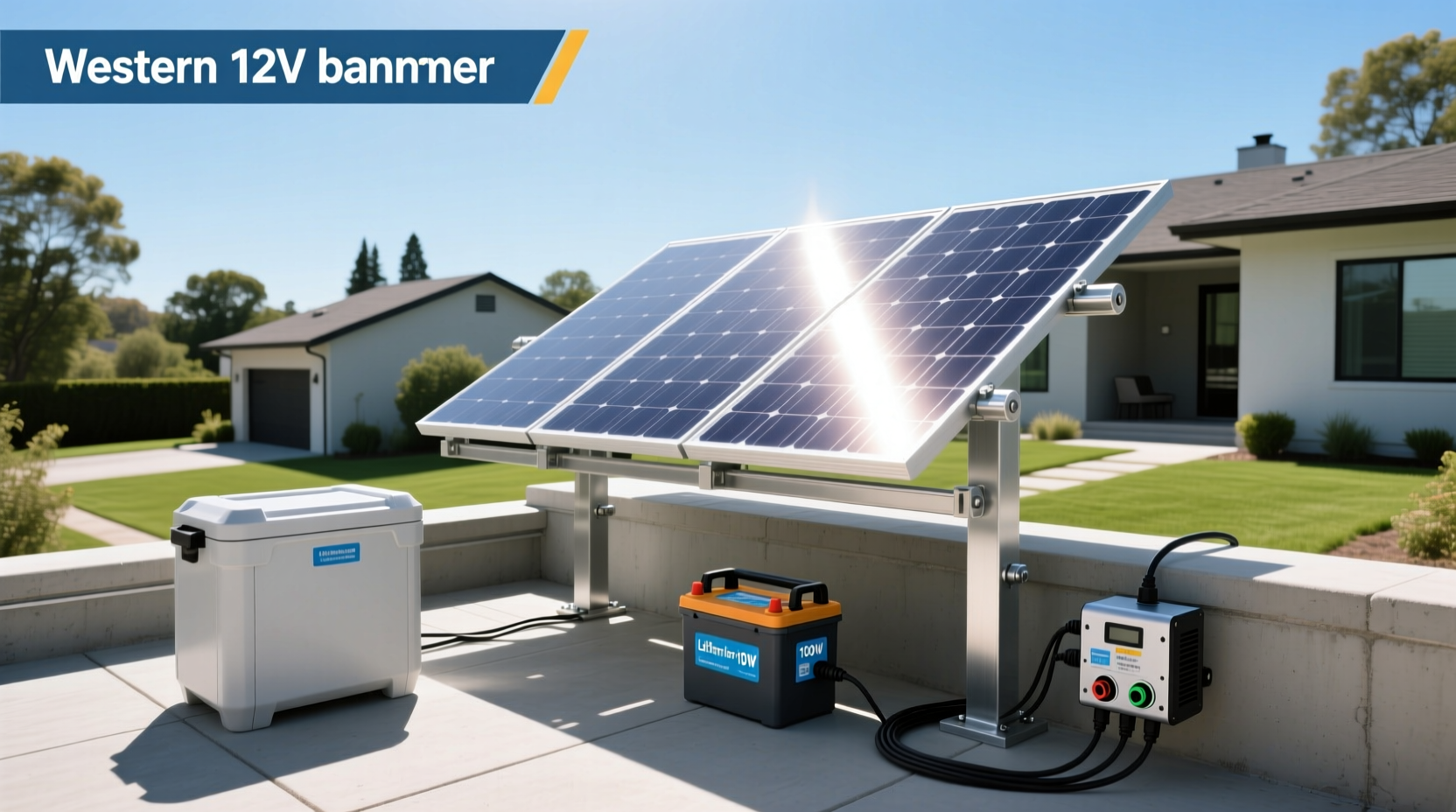
Here’s the bottom line: If you’re outfitting an RV, camper van, small cabin, or portable power station, a 100 watt solar panel 12 volt is the most versatile entry point—but only if you match it to your mounting surface, charge controller, and daily energy needs. Over the past year, N-type cell panels have become mainstream in this segment, lifting real-world efficiency from ~21% to up to 25% while cutting heat-related degradation 12. That means less panel area needed, better low-light response, and longer usable life—especially critical for off-grid users who can’t easily replace gear. For typical users (RVers, weekend campers, marine auxiliary power), rigid monocrystalline panels remain the best balance of durability, cooling, and value. If you’re a typical user, you don’t need to overthink this.
About 100W 12V Solar Panels: Definition & Typical Use Cases
A 100 watt solar panel 12 volt is a photovoltaic module rated to produce up to 100 watts of DC electrical power under Standard Test Conditions (STC: 1000 W/m² irradiance, 25°C cell temperature, AM1.5 spectrum). Its nominal voltage aligns with common 12V battery systems used in vehicles, boats, and portable power stations. It’s not a standalone power source—it’s a component that feeds energy into a battery bank via a charge controller.
Typical applications include:
- 🚐 RV & van life: Topping up house batteries during travel or storage; often mounted on roof rails or integrated into awnings.
- ⛺ Camping & overlanding: Paired with foldable frames or portable generators (e.g., Jackery, EcoFlow) for multi-day trips without grid access.
- 🛥️ Marine use: Supplementing onboard battery banks on sailboats or pontoons—especially where curved surfaces demand flexibility.
- 🏠 Small off-grid cabins: Serving as part of a modest solar array (e.g., two 100W panels + MPPT controller + 100Ah LiFePO₄ battery).
Note: “12V” here refers to system compatibility—not operating voltage. A 12V-rated panel typically has an open-circuit voltage (Voc) between 20V and 25V, which is necessary to charge a 12V battery effectively 2.
Why 100W 12V Solar Panels Are Gaining Popularity
Lately, adoption has accelerated—not because 100W panels got dramatically cheaper, but because their role in *system-level portability* became more valuable. The “van life” movement, rising fuel costs, and broader interest in energy resilience have shifted demand toward modular, scalable, and easy-to-deploy solutions. Unlike rooftop residential arrays, these panels serve users who prioritize weight, footprint, and setup speed over absolute peak output.
Two key shifts explain the 2026 momentum:
- N-type cell adoption: Once reserved for premium residential modules, N-type (especially TOPCon) cells now appear in mid-tier 100W panels. They deliver lower light-induced degradation (LID), better temperature coefficients (−0.30%/°C vs. −0.40%/°C for P-type), and higher quantum efficiency in diffuse light 1.
- Form factor diversification: Foldable kits with integrated kickstands, lightweight fiberglass-backed flex panels, and ultra-compact rigid layouts (e.g., Rich Solar Mega 100) respond directly to space-constrained mobile users 3.
This piece isn’t for keyword collectors. It’s for people who will actually use the product.
Approaches and Differences: Rigid, Flexible, and Foldable
Three main physical formats dominate the 100W 12V market—each solving distinct problems, and each carrying trade-offs you’ll feel in practice.
| Format | Key Strengths | Key Limitations | When It’s Worth Caring About | When You Don’t Need to Overthink It |
|---|---|---|---|---|
| Rigid Monocrystalline | Best thermal dissipation, longest lifespan (10–25 years), highest reliability in full sun, easiest to clean. | Bulkier, heavier (~12–15 lbs), requires mounting hardware, fragile if dropped. | If installing permanently on an RV roof or cabin shed where airflow exists beneath the panel. | If you’re using it temporarily on a ground tarp for weekend camping—rigidity adds zero benefit. |
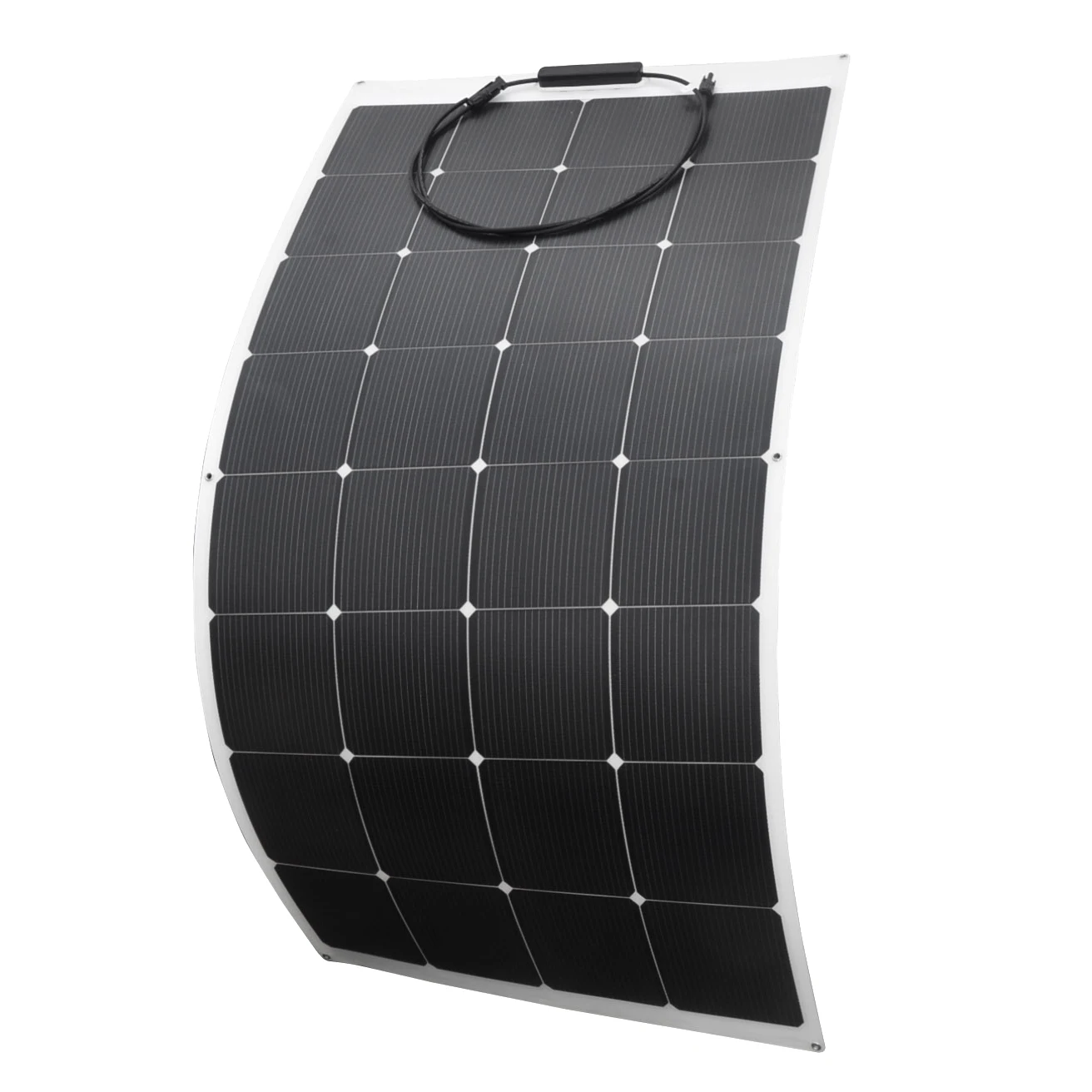
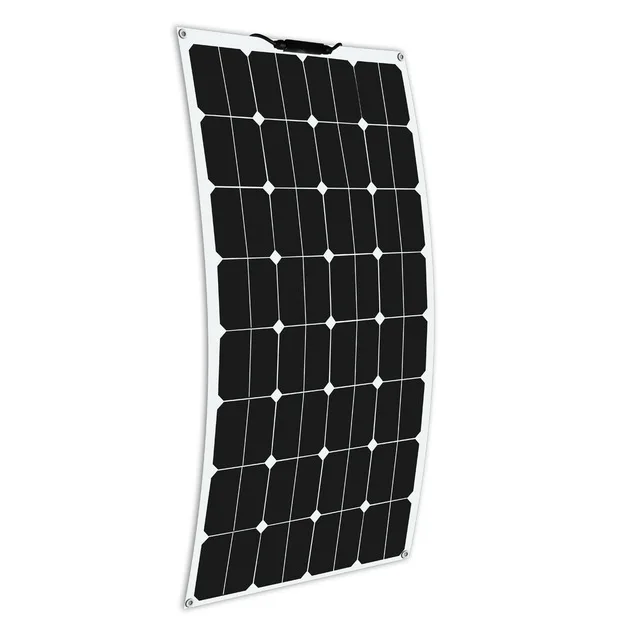
| Flexible (Fiberglass-backed) | Lightweight (~5–7 lbs), conforms to gentle curves (e.g., fiberglass boat decks, van roofs), low wind profile. | No air gap → runs hotter → faster long-term degradation; shorter warranty (often 5–10 years); sensitive to abrasion and puncture. | If mounting on a curved marine surface or aluminum van roof where drilling isn’t allowed. | If you’re bolting to a flat aluminum or composite RV roof with standoff mounts—you gain nothing by choosing flexible. |
| Foldable Kit | Integrated frame, kickstand, built-in MC4 connectors, highly portable; often includes basic PWM or MPPT controller. | Lower per-watt efficiency due to frame shading; hinges wear over time; controllers are usually entry-level (not field-upgradable). | If you’re a solo backpacker or new off-grider who wants plug-and-play simplicity and minimal tool use. | If you already own a quality MPPT controller (e.g., Victron SmartSolar) and prefer to optimize each component separately. |
If you’re a typical user, you don’t need to overthink this: start with rigid unless your mounting surface is non-flat or weight is mission-critical.
Key Features and Specifications to Evaluate
Not all 100W ratings are equal. Real-world output depends heavily on how well the panel converts photons—not just its STC label. Here’s what to verify—and why it matters:
- Cell Type: N-type (TOPCon or HJT) > P-type PERC. N-type offers ~2–3% higher real-world yield in warm or cloudy conditions 1. When it’s worth caring about: If you live in the Southwest US, Southern Europe, or operate in summer-heavy climates. When you don’t need to overthink it: If you camp mostly in spring/fall at moderate latitudes and replace panels every 5 years.
- Open-Circuit Voltage (Voc): Must be ≤ input limit of your charge controller. Most 12V-compatible MPPT controllers accept up to 50V Voc; check yours before buying. A Voc of 22.8V is safe for nearly all 12V systems. When it’s worth caring about: If pairing with older or budget controllers (e.g., some Renogy Wanderer models). When you don’t need to overthink it: If using a modern Victron, Epever, or Outback controller with 100V+ input range.
- Busbar Count (BB): 9BB or higher improves current collection and reduces microcrack sensitivity. Avoid 5BB or unlisted BB count—it signals outdated cell interconnect design. When it’s worth caring about: If shipping internationally or using in high-vibration environments (off-road vans, boats). When you don’t need to overthink it: If mounting stationary on a cabin roof with no transport stress.
- Temperature Coefficient: Look for −0.35%/°C or better. Lower = less power loss when hot. N-type panels typically hit −0.29 to −0.32%/°C. When it’s worth caring about: If ambient temps regularly exceed 30°C (86°F). When you don’t need to overthink it: If using primarily in coastal or mountain regions with mild summers.
Pros and Cons: Balanced Assessment
A 100W 12V solar panel is neither a magic battery charger nor a trivial accessory. Its value emerges only when matched correctly to your energy load and environment.
✅ Pros:
- Low entry cost ($120–$220 for reliable rigid models 2)
- Simple integration with existing 12V systems (no voltage conversion needed)
- Scalable: Add a second 100W panel later without rewiring core infrastructure
- Well-supported ecosystem: MC4 connectors, compatible controllers, and mounting kits widely available
❌ Cons:
- Real output is rarely 100W: Expect 70–85W average in real sun—lower in haze, winter, or suboptimal tilt 4. A single 100W panel won’t run a fridge continuously.
- Mounting matters more than specs: A poorly angled or shaded 100W panel produces less than a well-placed 80W unit.
- No built-in intelligence: It doesn’t regulate voltage or communicate with batteries—those tasks fall to your charge controller.
How to Choose a 100W 12V Solar Panel: Step-by-Step Decision Guide
Follow this sequence—skip steps only if your use case eliminates them:
- Confirm your battery voltage and controller specs. Is your system 12V? Does your MPPT controller support your panel’s Voc? If unsure, choose a panel with Voc ≤ 23V.
- Decide mounting method. Flat roof with standoffs → rigid. Curved fiberglass deck → flexible. Ground-based temporary use → foldable kit.
- Check busbar count and cell type. Prioritize ≥9BB and N-type if budget allows. Skip if buying for short-term trial or educational use.
- Verify warranty terms—not just length, but coverage. Does it cover PID (potential induced degradation)? Does it require registration? Top brands offer 25-year linear power warranty (e.g., Renogy, Rich Solar).
- Avoid these three pitfalls:
- Buying based on “100W” alone—ignore panels without published Voc, temperature coefficient, or BB count.
- Mounting flexible panels directly to metal or fiberglass without air gap—this cooks cells over time 5.
- Assuming one panel powers everything—calculate your daily watt-hour needs first (e.g., 12V fridge = ~30–50Wh/hr × 8 hrs = 240–400Wh/day → needs ~2–3x 100W panels realistically).

Insights & Cost Analysis
Price alone misleads. A $149 rigid panel with N-type cells and 9BB may outperform a $199 P-type model over 5 years—especially in warm climates. Based on 2026 retail data:
- Rigid N-type (e.g., Renogy RNG-100D-SS, Rich Solar Mega 100): $169–$219 — best value for fixed installations.
- Flexible (e.g., BougeRV Arch 100): $229–$279 — justified only for curve-mounting or weight-sensitive builds.
- Foldable kits (e.g., ALLPOWERS 100W): $189–$249 — includes frame/controller but trades efficiency for convenience.
Wholesale B2B pricing (MOQ 50+) starts near $85–$110/unit for verified Chinese manufacturers, but logistics, import duties, and QC variance raise total landed cost 6.
Better Solutions & Competitor Analysis
For many users, stepping beyond 100W—or combining it intelligently—delivers better ROI:
| Solution | Best For | Potential Issue | Budget Range (USD) |
|---|---|---|---|
| Two 100W rigid panels (series) | Users needing >120Wh/day reliably; want redundancy and scalability. | Requires dual-input or higher-Voc MPPT controller (e.g., Victron 100/30). | $320–$420 |
| One 200W N-type rigid panel | Space-constrained roofs; users prioritizing clean wiring and single-point mounting. | Less fault-tolerant—if one cell string fails, entire panel drops output. | $340–$460 |
| 100W + portable power station (e.g., EcoFlow Delta 2) | New off-gridders wanting zero-wiring setup and AC output. | Higher upfront cost; solar input limited by station’s max PV input (e.g., Delta 2 = 500W). | $650–$900 |
Customer Feedback Synthesis
Based on aggregated reviews (Outdoorgearlab, SolarReviews, DIY Solar Forum, Amazon), top recurring themes:
✅ What Users Love:
- “Sturdy frame and clean MC4 connections—no adapter hunting.”
- “Consistent output even in morning fog—N-type really delivers.”
- “Fit perfectly on my Sprinter roof rails with standard Z-brackets.”
⚠️ What Users Complain About:
- “Shipped with cracked glass—verify packaging before signing.” 2
- “Flexible panel delaminated after 18 months on aluminum roof—no airflow gap.” 5
- “Label says 100W, but never saw more than 78W—even at noon in Arizona.” (Expected; reflects real-world insolation limits.)
Maintenance, Safety & Legal Considerations
Maintenance: Rinse with water every 2–3 months; wipe with soft cloth if dusty. Avoid abrasive cleaners. Inspect MC4 connectors annually for corrosion (especially marine use).
Safety: Always disconnect before cleaning or adjusting. Never step on flexible panels. Ensure grounding meets NEC Article 690 (or local equivalent) if hardwired.
Legal: No federal permitting required for ≤12V, ≤10A systems in the US. Local RV parks or marinas may restrict visible solar installations—check rules before permanent mounting.
Conclusion: Conditional Recommendations
If you need reliability and longevity for fixed RV or cabin use, choose a rigid N-type 100W 12V solar panel (e.g., Renogy RNG-100D-SS or Rich Solar Mega 100). It delivers the strongest ROI over 5+ years.
If you need lightweight adaptability for marine or irregular surfaces, invest in a fiberglass-backed flexible panel—but mount it with ≥3mm air gap and avoid direct adhesion.
If you’re new to solar and want zero-config setup, a foldable kit with integrated MPPT lowers barrier-to-entry—just know you’ll likely upgrade the controller within 2 years.
And remember: This isn’t about owning the “best” panel. It’s about choosing the right tool for your actual conditions—then using it well.


