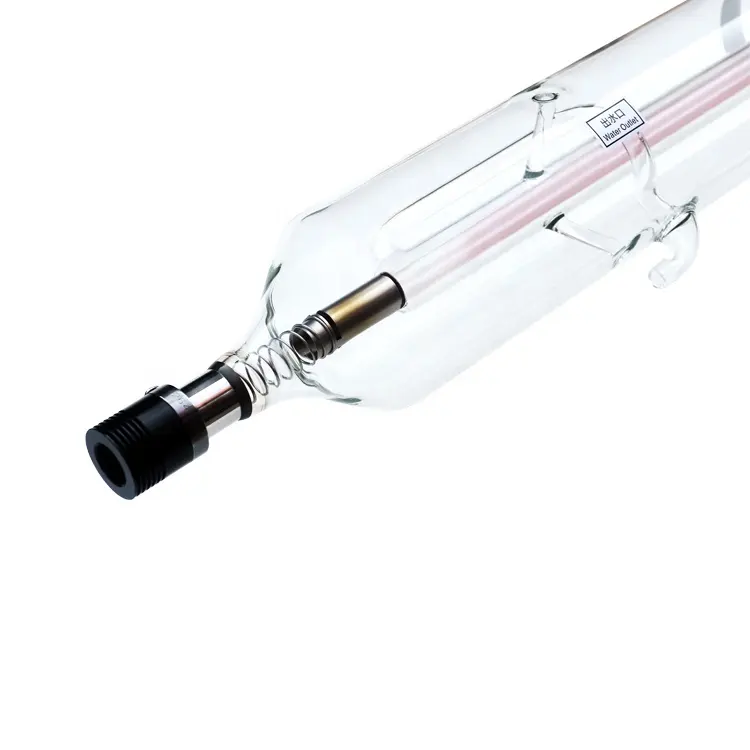
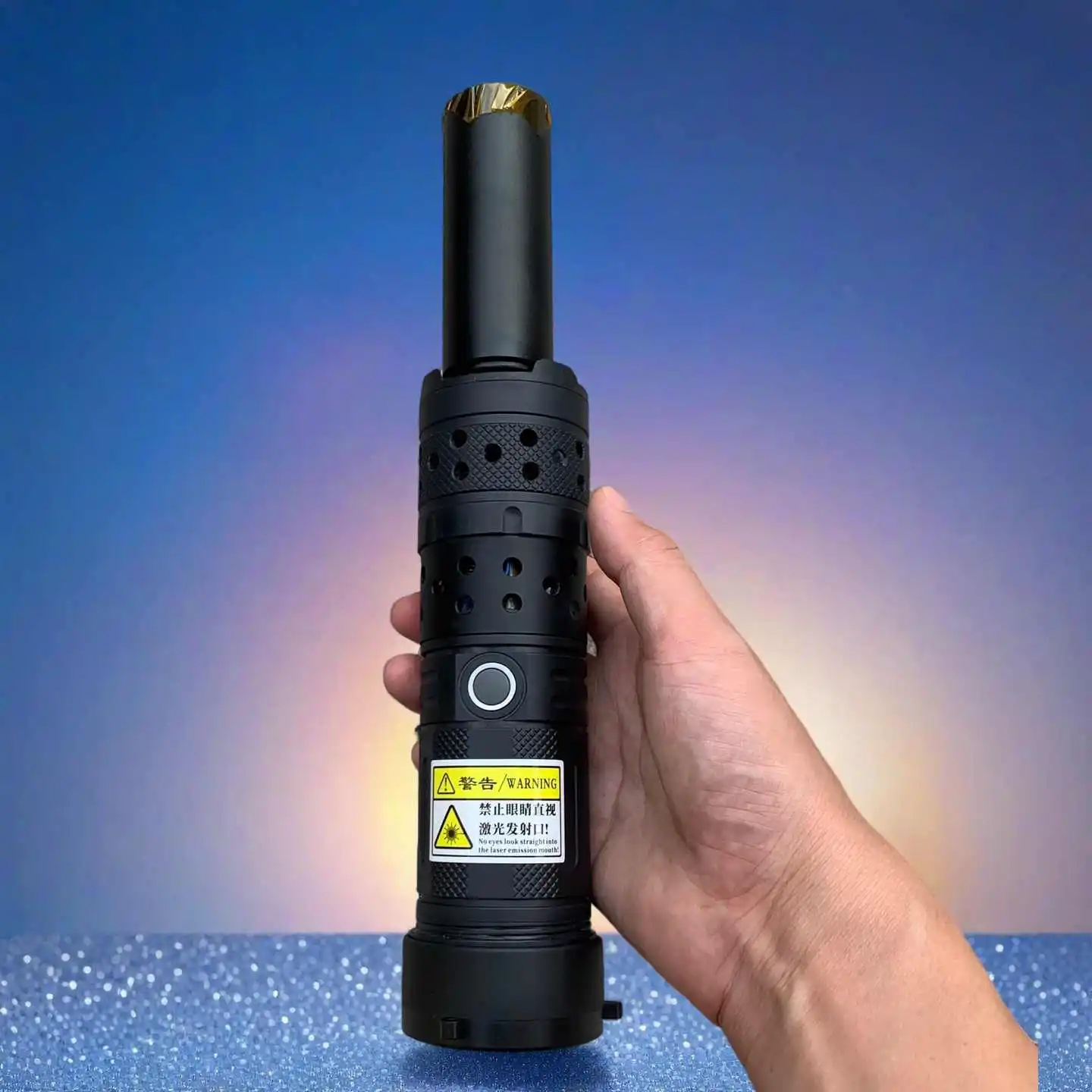
Over the past year, search volume for “100W laser pointer” has surged — but so have user reports of disappointment, safety incidents, and customs seizures1. The change signal is clear: more people are encountering misleading marketing, not more viable products. If you’re a typical user looking for a reliable tool — whether for outdoor burning, alignment, or hobbyist experiments — you don’t need a 100W laser. You need a verified 1–5W Class IV device with proper safety controls. True 100W output is physically impossible in a handheld form factor: it would require industrial cooling, 220V input, and rigid mounting — not a pocket-sized casing2. This piece isn’t for keyword collectors. It’s for people who will actually use the product.
About 100W Laser Pointers: Definition & Typical Use Cases
The term “100W laser pointer” is a misnomer — not a technical category. There is no standardized definition, because no consumer-grade handheld laser emits 100 watts of continuous optical power. In reality, devices labeled “100W” are almost always 1,000–5,000 mW (1–5W) diode lasers marketed with inflated wattage to suggest extreme burning capability3. These are used for:
- Burning demonstrations: igniting matches, popping balloons, charring wood or plastic
- Outdoor targeting: long-range pointing (e.g., astronomy outreach, surveying aids)
- Hobbyist experimentation: optics testing, thermal imaging calibration, DIY engraving trials
What they are not used for — and cannot safely do — is metal cutting, welding, or sustained industrial material processing. Those tasks require fiber lasers mounted on CNC platforms with water-cooling and interlocked enclosures4. When it’s worth caring about: if your goal involves fire-starting, controlled ignition, or visible beam projection at dusk/dawn, power between 1,500–4,000 mW offers real utility without excessive risk. When you don’t need to overthink it: if you only need to highlight objects in meetings or classrooms, a standard <5mW Class II/IIIa pointer remains the only legal and safe choice.
Why “100W Laser Pointers” Are Gaining Popularity
Lately, demand for high-power portable lasers has grown due to three converging signals: rising YouTube tutorials on laser ignition, expanded availability of low-cost Chinese OEM modules, and increasing visibility of handheld industrial tools like rust-removal fiber lasers5. But popularity ≠ legitimacy. The trend reflects marketing velocity, not engineering maturity. Sellers leverage “100W” as shorthand for “it burns things well” — a claim that resonates emotionally with users seeking dramatic visual feedback. Yet this framing obscures critical realities: thermal runaway, eye hazard escalation, and regulatory noncompliance. When it’s worth caring about: if you’re sourcing for professional field work (e.g., pyrotechnic ignition, emergency signaling), understanding actual radiant flux (in W/cm²) matters more than label wattage. When you don’t need to overthink it: if you’re buying for novelty or casual outdoor use, focus on certified output (via LIA or IEC test reports), not headline numbers.
Approaches and Differences
Three common approaches dominate the market — each with distinct trade-offs:
- “100W” labeled diode lasers (1–5W actual): inexpensive ($30–$120), compact, battery-powered. Pros: portable, instant-on, intuitive interface. Cons: inconsistent output, poor heat dissipation, zero regulatory compliance documentation.
- Lab-grade Class IV modules (500mW–5W, certified): priced $180–$450, often include driver boards, TEC cooling, and safety keys. Pros: stable output, traceable calibration, CE/ROHS markings. Cons: requires external power or large batteries, bulkier design.
- Industrial handheld fiber lasers (100W–3000W): not pointers — tools like the Handheld Laser Cleaner series. Pros: true high-power cleaning/ablation, air-cooled or water-cooled options. Cons: $3,500–$18,000+, 5–15 kg weight, requires training and PPE6.
If you’re a typical user, you don’t need to overthink this. Skip the “100W” listings entirely. Choose a lab-grade 3.5W green (532nm) or blue (450nm) diode laser with third-party power verification — not marketing copy.
Key Features and Specifications to Evaluate
Forget the “W” on the box. Focus instead on these five measurable criteria:
- Actual output power (mW/W): Measured with a calibrated thermopile sensor — not assumed from driver specs. Look for test reports dated within 6 months.
- Wavelength (nm): Green (532nm) appears brightest to human eyes; blue (450nm) delivers higher photon energy for burning; infrared (808/1064nm) is invisible and extremely hazardous.
- Divergence (mrad): Lower = tighter beam over distance. Below 1.5 mrad supports precision targeting beyond 100 m.
- Cooling method: Passive heatsinks suffice up to ~1.5W; active TEC or fan cooling needed above 2W for >60 sec duty cycle.
- Safety features: Key switch, aperture shutter, delay start, and beam indicator LED are mandatory for Class IV compliance.
When it’s worth caring about: divergence and cooling directly affect usability in wind, humidity, or extended sessions. When you don’t need to overthink it: minor wavelength shifts (e.g., 445nm vs. 450nm) won’t meaningfully alter burn performance — prioritize stable power delivery instead.
Pros and Cons
Pros of verified 1–5W lasers: effective burning at close range, visible beam in low light, portability, relatively low entry cost.
Cons: severe eye injury risk (instant retinal damage), fire hazard near flammable materials, legal restrictions in most countries, rapid battery drain.
Who benefits? Educators demonstrating optics principles, certified pyrotechnic technicians, researchers validating thermal thresholds.
Who should avoid? Students, children, untrained hobbyists, anyone without access to ANSI Z136.1-compliant eyewear.
If you’re a typical user, you don’t need to overthink this. Unless your workflow explicitly requires beam-induced thermal action — and you’ve completed formal laser safety training — stick with sub-5mW devices.
How to Choose a 100W Laser Pointer (Reality-Based Selection Guide)
Follow this 6-step checklist before purchase:
- Reject any listing using “100W”, “100,000mW”, or “industrial strength” without published test data.
- Verify Class rating: Must be labeled Class IV per IEC 60825-1 or FDA 21 CFR 1040.10.
- Confirm wavelength and power match: e.g., “450nm, 3200±200mW” — not “up to 5000mW”.
- Check for required safety hardware: key lock, emergency stop, beam shutter, interlock port.
- Review import eligibility: UK bans >1mW pointers; US FDA prohibits >5mW sales as “pointers”7.
- Require manufacturer-provided safety goggles: OD6+ at the operating wavelength — no generic “laser glasses”.
Avoid these red flags: vague “burning power” claims, missing serial numbers, no regulatory markings (CE, FDA, RoHS), seller refusal to share test reports.
Insights & Cost Analysis
Realistic pricing reflects engineering rigor:
- Uncertified “100W” diode units: $25–$85 (high failure rate, no warranty)
- Verified 3.5W modules with TEC cooling + safety kit: $220–$390
- Turnkey Class IV systems (driver, PSU, goggles, case): $480–$720
There is no value in paying more for false wattage. A $299 verified 3.5W unit delivers 3.5× the usable power — and 10× the reliability — of a $49 “100W” unit that measures 850mW in independent tests8. Budget allocation should prioritize safety gear (goggles, fireproof surface) over raw power.
| Category | Best For | Potential Problems | Budget Range |
|---|---|---|---|
| Uncertified “100W” listings | Short demos, one-time novelty use | Inconsistent output, overheating, no safety features, customs seizure risk | $25–$85 |
| Verified 1–5W Class IV | Repeatable burning, education, field testing | Requires strict PPE, training, and controlled environment | $220–$720 |
| Handheld industrial fiber lasers | Rust removal, paint stripping, on-site maintenance | Not portable in practice; heavy, expensive, requires certification | $3,500–$18,000 |
Better Solutions & Competitor Analysis
Instead of chasing “100W”, consider function-aligned alternatives:
- For ignition: Piezoelectric torches or ferrocerium rods offer safer, more reliable flame generation.
- For alignment: Dual-axis laser levels (e.g., rotary lasers with 1mW beams) provide precision without hazard.
- For thermal experiments: Benchtop 10W CO₂ laser cutters ($1,200+) deliver repeatable, controllable ablation in ventilated enclosures.
Competitors like Laserglow, OptoEngine, and CNI produce compliant Class IV modules — all publish full spectral and power data. Their units rarely exceed 5W, because physics constrains handheld thermal management. That’s not a limitation — it’s responsible engineering.
Customer Feedback Synthesis
Based on aggregated reviews (Reddit, BudgetLightForum, Alibaba buyer comments):
- Top praise: “Beam visible 2km at night”, “ignites matches in under 3 seconds”, “stable output after 90 seconds”.
- Top complaints: “shut down after 45 sec”, “no safety key included”, “measured 0.7W despite ‘5W’ label”, “confiscated by UK Border Force”9.
Maintenance, Safety & Legal Considerations
This isn’t optional: Class IV lasers demand procedural discipline.
⚠️ Critical Safety Constraints
• Never operate without OD6+ laser safety goggles matched to wavelength
• Always use on non-reflective, fireproof surfaces
• Maintain >100 m exclusion zone for bystanders
• Store locked, with batteries removed
🔒 Regulatory Reality
U.S.: FDA bans >5mW lasers sold as “pointers”7
UK: Importing >1mW pointers violates UKCA/CE rules10
Canada: Health Canada restricts public sale to Class I–II only11
Legal operation requires documented training, written SOPs, and site-specific hazard assessments. If you’re a typical user, you don’t need to overthink this — you need to recognize when your use case falls outside personal responsibility and into regulated activity.
Conclusion
If you need visible beam projection or classroom pointing, choose a certified <5mW Class II device. If you need controlled thermal interaction (e.g., ignition, charring, optics validation), choose a verified 1–5W Class IV laser — with full safety infrastructure. If you need metal ablation or industrial cleaning, invest in a fixed-mount fiber laser system — not a handheld. There is no scenario where “100W laser pointer” is the correct solution. Physics, regulation, and safety converge on one conclusion: real power comes with real responsibility — not marketing labels.
Frequently Asked Questions