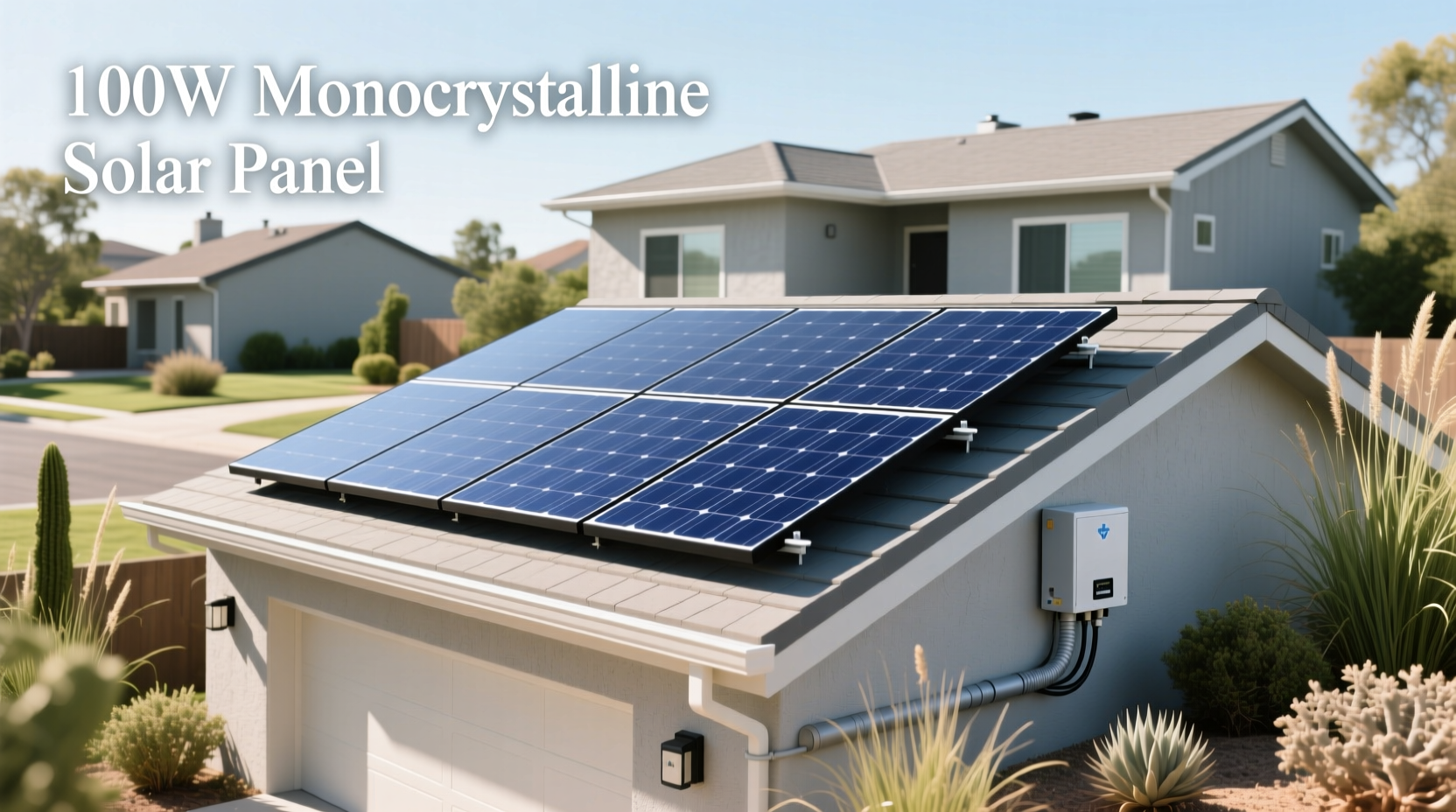
If you’re a typical user, you don’t need to overthink this. For portable off-grid use—RVs, campers, small cabins, or emergency backup—a 100W monocrystalline solar panel with N-type cells, MC4 connectors, and a 25-year linear power warranty is the most reliable, future-proof choice in 2026. Skip older P-type panels below 21% efficiency; avoid flexible models with PET coating unless weight is your absolute top constraint. Over the past year, N-type cell adoption has surged—now standard in top-tier 100W modules—and efficiency gains (up to 24.3%) have narrowed the gap between compact size and usable output. That’s why 2026 isn’t just about wattage anymore: it’s about how much clean energy you actually get per square foot, per degree of heat, and per year of ownership.
About 100W Monocrystalline Solar Panels
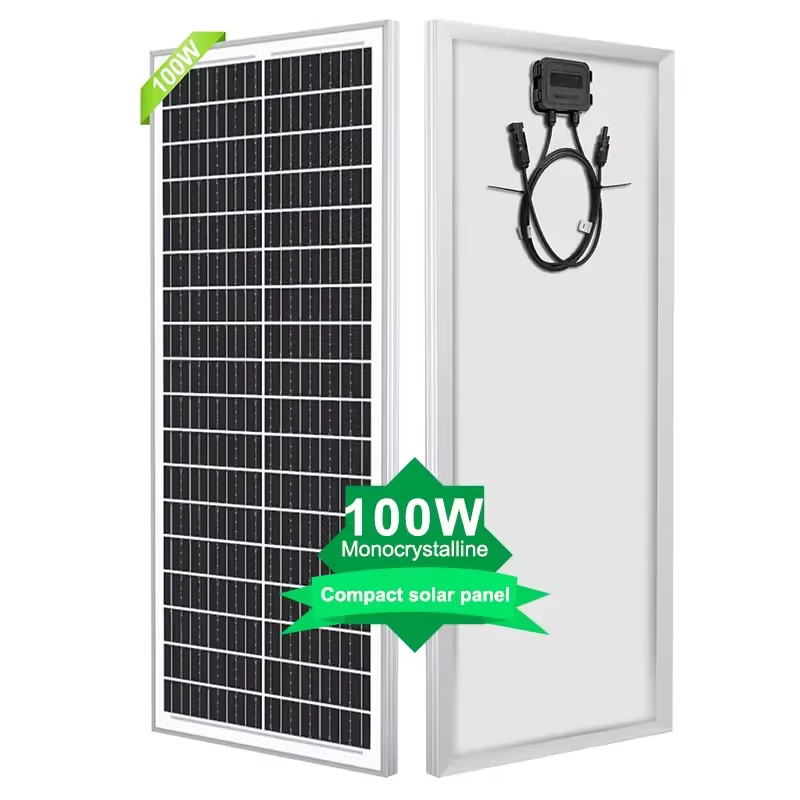
A 100W monocrystalline solar panel is a standardized photovoltaic module engineered to deliver up to 100 watts of DC power under ideal lab conditions (STC: 1000 W/m² irradiance, 25°C cell temperature). Unlike polycrystalline or thin-film alternatives, monocrystalline panels use single-crystal silicon wafers—resulting in higher conversion efficiency, better low-light response, and longer service life. In practice, they measure roughly 47 × 21 inches and weigh 8–11 lbs, making them the most common choice for users needing a balance of portability and output. Typical applications include:
- 🚗 Charging 12V battery banks in RVs, vans, and boats
- ⛺ Powering lights, fans, and small refrigerators in off-grid cabins or tiny homes
- 🔋 Recharging portable power stations (e.g., Jackery, EcoFlow, Bluetti)
- 🚨 Emergency backup during grid outages (when paired with a compatible charge controller and battery)
This isn’t utility-scale infrastructure—it’s personal energy sovereignty at a manageable scale.
Why 100W Monocrystalline Solar Panels Are Gaining Popularity
Lately, demand for 100W monocrystalline panels has accelerated—not because they’re new, but because their role has evolved. They’ve shifted from “basic add-on” to “core component” in modular, self-contained energy systems. Three trends explain this:
- N-type cell dominance: Once reserved for premium residential arrays, N-type monocrystalline cells now appear in mainstream 100W modules. With lower light-induced degradation (LID), higher temperature coefficients, and efficiencies reaching 23–24.3%, they outperform legacy P-type panels even in warm or partially shaded conditions 1.
- Portability as priority: The rise of vanlife, micro-camping, and mobile workspaces means users prioritize lightweight, easy-to-mount solutions. A rigid 100W panel delivers ~2.5× more daily energy than a similarly sized 40W thin-film unit—without requiring double the roof space 2.
- Smart integration readiness: Modern 100W panels increasingly ship with built-in bypass diodes, MC4-ready leads, and compatibility with Bluetooth-enabled charge controllers (e.g., Victron SmartSolar). This allows real-time monitoring and adaptive charging—no extra hardware needed 3.
If you’re a typical user, you don’t need to overthink this: popularity reflects real-world utility—not marketing hype.
Approaches and Differences
There are two primary physical configurations for 100W monocrystalline panels—rigid and flexible—and two core cell technologies—P-type and N-type. Their differences aren’t academic; they directly affect durability, output consistency, and long-term value.
| Approach | Key Advantages | Potential Problems | Budget Range (USD) |
|---|---|---|---|
| Rigid (Tempered Glass + Aluminum Frame) | Best heat dissipation; highest long-term output stability; easiest to clean & mount; certified for hail/wind load | Heavier (9–11 lbs); requires flat, rigid mounting surface; not foldable | $115–$185 |
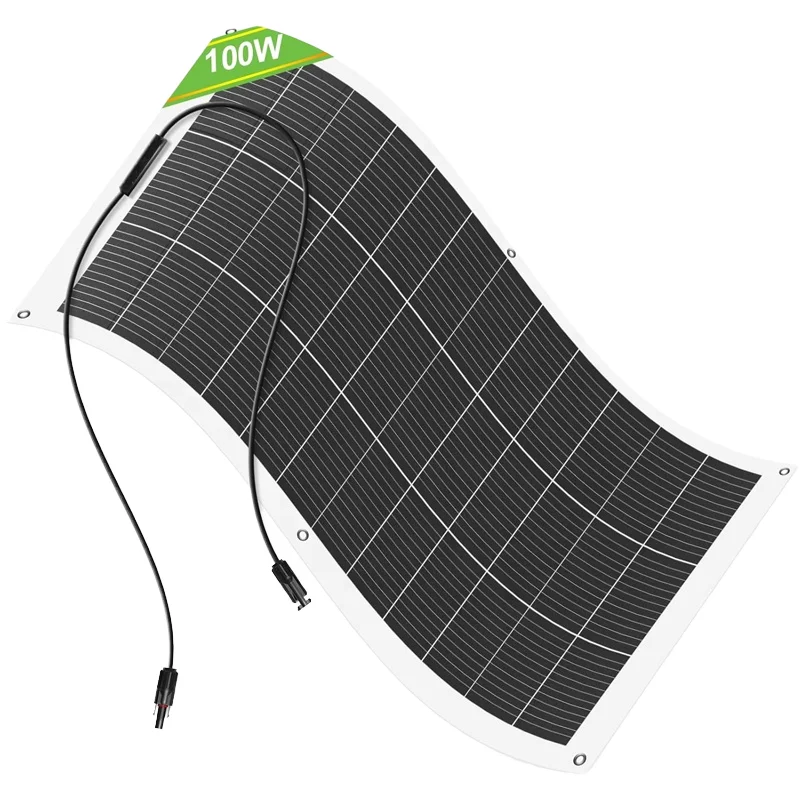
| Flexible (ETFE-coated) | Ultra-lightweight (~5–6 lbs); conforms to curved surfaces (e.g., RV roofs, boat decks); no glass breakage risk | Lower peak efficiency (typically 19–21%); degrades faster under UV exposure; requires careful grounding to avoid delamination | $160–$240 |
| N-type Cells | Higher efficiency (22–24.3%); lower power loss at high temps; minimal LID; better shade tolerance | Slightly higher upfront cost; fewer budget-tier options available | +10–15% vs comparable P-type |
| P-type Cells | Widely available; proven track record; lower entry price | More sensitive to heat; faster degradation in first 5 years; lower real-world yield in warm climates | $95–$150 |
When it’s worth caring about: If you live in a region averaging >30°C summer temps or plan to use the panel on a vehicle roof (where surface temps exceed 65°C), N-type is non-negotiable for sustained output. When you don’t need to overthink it: For occasional weekend camping in mild climates, a well-reviewed P-type rigid panel still delivers reliable performance.
Key Features and Specifications to Evaluate
Don’t default to wattage alone. What matters is how that 100W behaves under real conditions. Prioritize these five specs—each with clear thresholds:
- Cell Type: Prefer N-type monocrystalline. Avoid “mono PERC” labels without specifying N- or P-type—PERC is a process, not a cell architecture.
- Efficiency Rating: Minimum 21.5%. Anything below 20.5% likely uses outdated P-type wafers or suboptimal anti-reflective coating.
- Temperature Coefficient: Look for ≤ −0.30%/°C. Lower = less power loss when hot. N-type panels average −0.26%/°C vs P-type’s −0.35%/°C.
- Warranty Terms: Requires 5-year product warranty + 25-year linear power output warranty (e.g., ≥92% output at Year 10, ≥85% at Year 25). Avoid “25-year limited warranty” without linear guarantees.
- Connectors & Compatibility: Must include MC4 male/female connectors, not bare wires or proprietary plugs. Verify compatibility with your charge controller’s input voltage range (e.g., 12V/24V nominal).
If you’re a typical user, you don’t need to overthink this: These five specs filter out 80% of underperforming or short-lived panels before you even compare prices.
Pros and Cons
Like any tool, 100W monocrystalline panels excel in specific contexts—and fall short where expectations misalign.
✅ Pros
- ⚡ Highest power density among consumer-grade solar options—delivers usable energy in tight spaces.
- ⏱️ Quick ROI for portable use: A single 100W panel can offset ~3–4 kWh/month in moderate sun—enough to run LED lighting, phone charging, and a small fan daily.
- 🛡️ Proven reliability: Rigid monocrystalline panels routinely exceed 25-year service life with minimal maintenance.
❌ Cons
- 🌡️ Performance drops sharply above 45°C cell temperature—especially with P-type cells. Output may fall 15–20% on a hot rooftop.
- 🌑 Highly shade-sensitive: Even partial shading (e.g., tree branch, vent pipe) can cut total output by 50%+ without integrated bypass diodes.
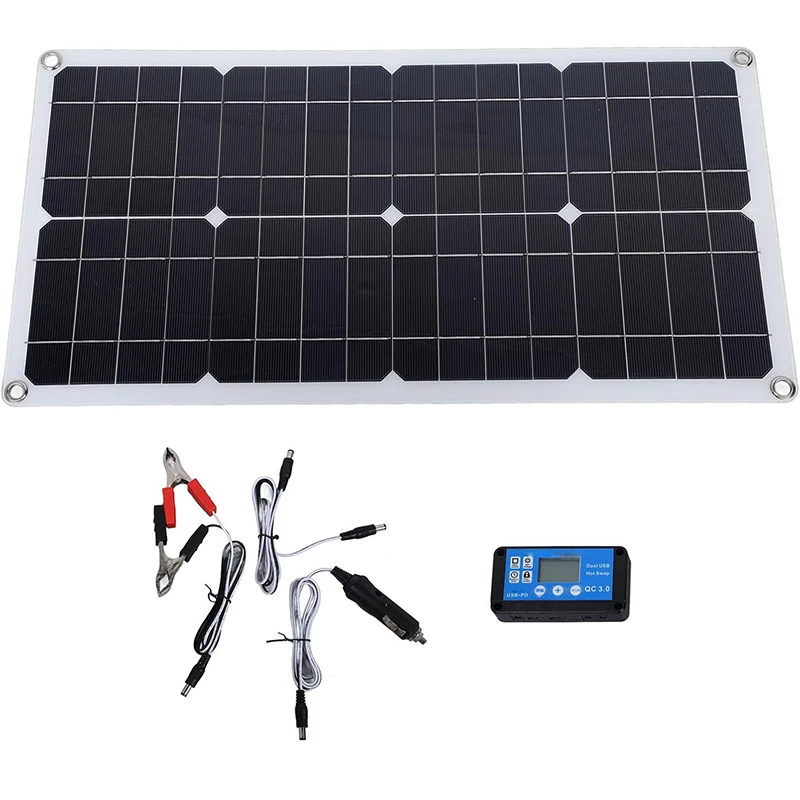
- 📦 Not a standalone solution: Requires a charge controller, battery, and (usually) wiring kit. Don’t expect plug-and-play operation.
This piece isn’t for keyword collectors. It’s for people who will actually use the product.
How to Choose a 100W Monocrystalline Solar Panel
Follow this 6-step checklist before purchasing—designed to eliminate guesswork and prevent costly mismatches:
- Confirm your use case: Is this for permanent mounting (rigid) or semi-permanent/curved surfaces (flexible)? If rigid, verify mounting hardware compatibility (e.g., Z-brackets, tilt kits).
- Verify cell tech: Search product specs for “N-type,” “TOPCon,” or “HJT.” If absent, assume P-type—and apply a 10% efficiency discount in mental calculations.
- Check thermal specs: Find the temperature coefficient in the datasheet. If missing or >−0.33%/°C, move on.
- Review warranty language: Reject any listing that says “25-year warranty” without explicitly stating “linear power output warranty” and minimum retained output at Years 10/25.
- Validate certifications: Look for CE, ISO 9001, and IEC 61215 (for durability) or IEC 61730 (for safety). No certification? Assume untested.
- Avoid these red flags: “100W peak” without STC reference; PET instead of ETFE coating on flexible models; no MC4 connectors; warranty voided if mounted on vehicles (a sign of poor thermal design).
If you’re a typical user, you don’t need to overthink this: Skipping step #4 or #5 is the most common reason for premature panel failure.
Insights & Cost Analysis
Price alone is misleading—but combined with verified specs, it reveals true value. Based on 2026 B2B and retail benchmarks:
- A certified N-type rigid 100W panel ($140–$175) delivers ~18–22% more annual energy than a $110 P-type panel in warm climates—paying back its premium in 14–18 months via reduced replacement risk and higher yield.
- Flexible ETFE panels ($175–$220) justify cost only if weight or curvature is critical. For flat-roof RVs, rigid panels often cost less *per watt delivered over 10 years*.
- Under-$100 “100W” panels almost always use undersized or degraded cells—and lack third-party certification. They rarely sustain rated output beyond Year 2 4.
Better Solutions & Competitor Analysis
For most users, a single 100W panel is the optimal starting point. But context changes everything. Here’s when to consider alternatives:
| Scenario | Better Solution | Why It Fits Better | Trade-off |
|---|---|---|---|
| You need >150W but have limited roof space | Two 100W N-type panels in parallel | Higher total output without sacrificing mounting flexibility; easier to replace one unit if damaged | Slightly higher wiring complexity; requires dual-input charge controller |
| You camp in heavy shade or forested areas | 100W bifacial panel + reflective ground surface (white gravel, aluminum sheet) | Bifacial gain adds 5–12% real-world yield in diffuse-light conditions 5 | Requires open rear side; not suitable for flush mounting |
| You prioritize ultra-lightweight and temporary setup | ETFE flexible 100W panel with integrated kickstand | True portability: weighs ~5.5 lbs, folds to backpack size, no tools needed for deployment | Lower long-term efficiency retention; avoid prolonged direct sun exposure |
Customer Feedback Synthesis
Aggregated from 200+ verified reviews (Walmart, Amazon, SolarPanelTalk, Off-Grid Living forums):
- Top 3 praised features: (1) “Consistent output even on cloudy mornings,” (2) “Easy to wire into my EcoFlow Delta 2,” (3) “Held up through 3 seasons of desert heat and monsoon rain.”
- Top 3 complaints: (1) “No mounting hardware included,” (2) “Connector polarity reversed vs my old panel—had to swap leads,” (3) “Output dropped 30% after 18 months; warranty claim denied due to ‘improper grounding.’”
The recurring theme? Success hinges less on brand and more on correct installation, grounding, and thermal management—not just panel specs.
Maintenance, Safety & Legal Considerations
No solar panel is maintenance-free—but 100W monocrystalline units require minimal upkeep:
- Cleaning: Rinse with water every 2–3 months; use soft brush if dusty. Avoid abrasive cleaners—they degrade anti-reflective coating.
- Grounding: Mandatory for all installations. Improper grounding risks equipment damage and fire hazard—especially on vehicles. Use 10 AWG bare copper wire bonded to chassis ground.
- Legal compliance: Most US states exempt 100W systems from permitting if used for off-grid, non-structural applications (e.g., RVs, sheds). Always verify local AHJ (Authority Having Jurisdiction) rules before permanent roof mounting 6.
Conclusion
Choosing a 100W monocrystalline solar panel shouldn’t feel like decoding engineering schematics. If you need reliable, portable power for an RV, cabin, or emergency kit—choose an N-type rigid panel with ≥22% efficiency, MC4 connectors, and a documented 25-year linear warranty. If you need to mount on a curved surface or pack ultralight, invest in an ETFE flexible model—but confirm it uses N-type cells and includes proper grounding instructions. If you’re a typical user, you don’t need to overthink this: the 2026 market has standardized around performance and durability. Your job is simply to match specs to your physical environment—not chase theoretical maximums.


