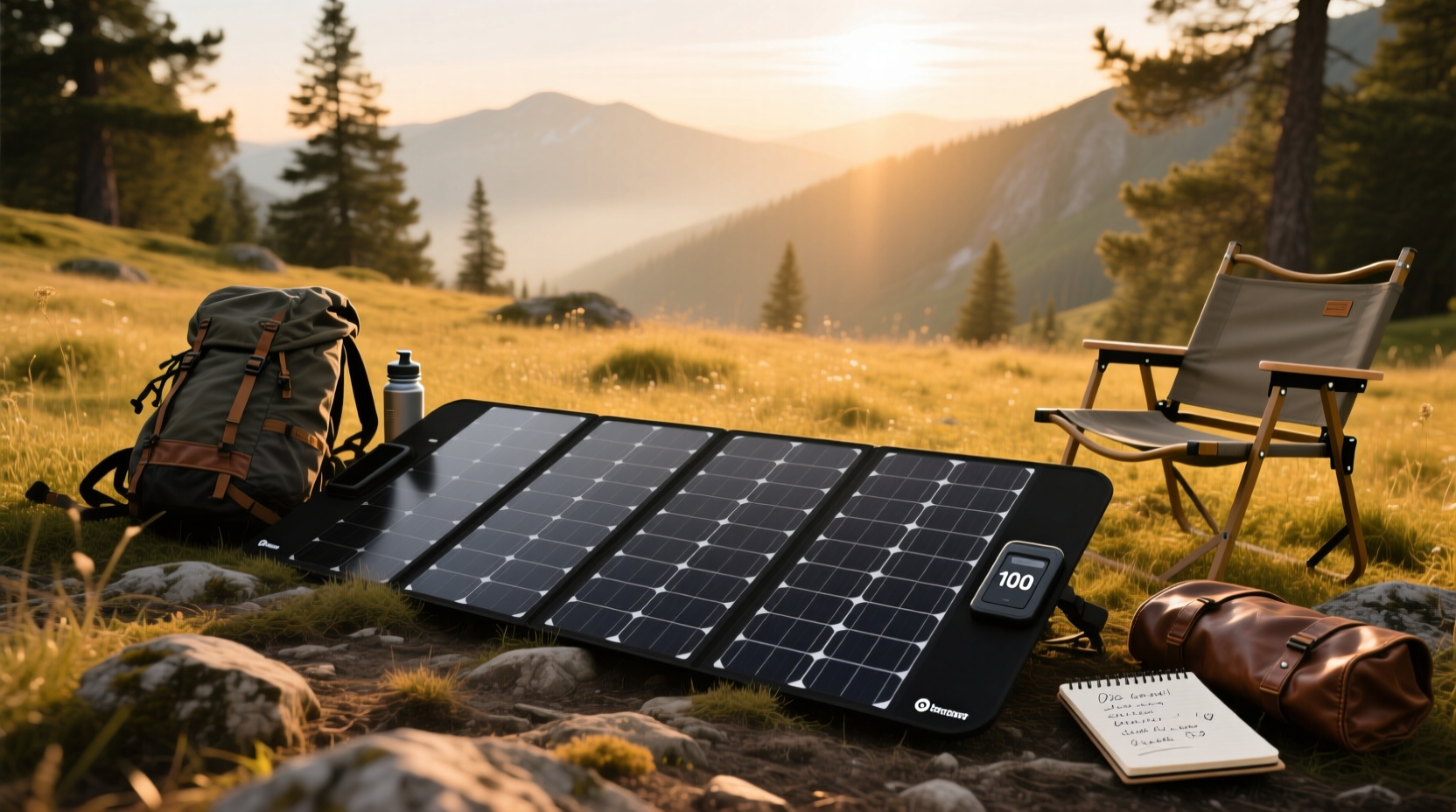
If you’re a typical user—camping, powering an RV, or building emergency backup—you don’t need to overthink this. Over the past year, the 100W portable solar panel category has matured rapidly: efficiency now averages 22–24% (up from 18% in 2022), weight has dropped below 4 kg for most foldable models, and integrated USB-C Power Delivery (PD) ports are standard—not optional 1. The real shift? It’s no longer about “if” a 100W panel works—it’s about which one delivers consistent power in real conditions. Skip panels with generic “100W” labels and vague efficiency claims. Prioritize monocrystalline N-type cells, IP67-rated ETFE coating, and dual-output compatibility (MC4 + USB-C PD). If your power station supports 65W input via USB-C, that single port may eliminate your need for a separate charge controller. This piece isn’t for keyword collectors. It’s for people who will actually use the product.
About 100W Portable Solar Panels: Definition & Typical Use Cases
A 100W portable solar panel is a lightweight, field-deployable photovoltaic unit engineered to generate up to 100 watts of DC power under ideal laboratory conditions (STC: Standard Test Conditions—25°C, 1000 W/m² irradiance, AM1.5 spectrum). In practice, it delivers 60–75W during typical daylight hours due to ambient heat, cloud cover, and angle-of-incidence losses 2. Its core value lies in portability and modularity—not raw scale.
Typical users include:
- 🏕️ Campers & backpackers: Charging power banks, lights, GPS, and small cameras over multi-day trips;
- 🚐 RV and van-lifers: Topping off lithium house batteries without generator noise or fuel;
- ⚡ Preppers & home backup users: Pairing with portable power stations (e.g., 500–2000Wh capacity) for fridge, comms, or medical device support during outages;
- 🔧 Field technicians & remote workers: Powering laptops, routers, or diagnostic tools where grid access is unreliable.
It’s not meant for whole-home solar or permanent rooftop installation. It fills the gap between handheld 20W chargers and heavy, rigid 300W+ ground-mount kits.
Why 100W Portable Solar Panels Are Gaining Popularity
Lately, the 100W segment has become the market’s dominant sweet spot—not by accident. Three converging signals explain why it’s more relevant than ever in 2026:
- Technology convergence: Monocrystalline N-type cells now deliver 22–24% efficiency at sub-$4/W cost 3. That means more power per square foot—and less surface area needed for reliable output.
- Ecosystem bundling: Brands increasingly ship 100W panels with matching power stations featuring smart MPPT controllers, Bluetooth monitoring, and firmware updates. You’re not buying a panel—you’re buying a calibrated node in a Solar-Plus-Storage system.
- Regulatory & logistical clarity: Unlike larger fixed arrays, 100W portable units require zero permitting, no roof assessment, and minimal import scrutiny—making them globally accessible for direct-to-consumer purchase.
If you’re a typical user, you don’t need to overthink this. What matters isn’t peak lab wattage—it’s how much usable energy you get between 9 a.m. and 3 p.m. on a partly cloudy day in the mountains.
Approaches and Differences: Foldable vs. Rigid vs. Rollable
Three physical formats dominate the 100W space. Each serves distinct mobility and durability priorities:
| Design Type | Key Advantages | Potential Problems | Budget Range (USD) |
|---|---|---|---|
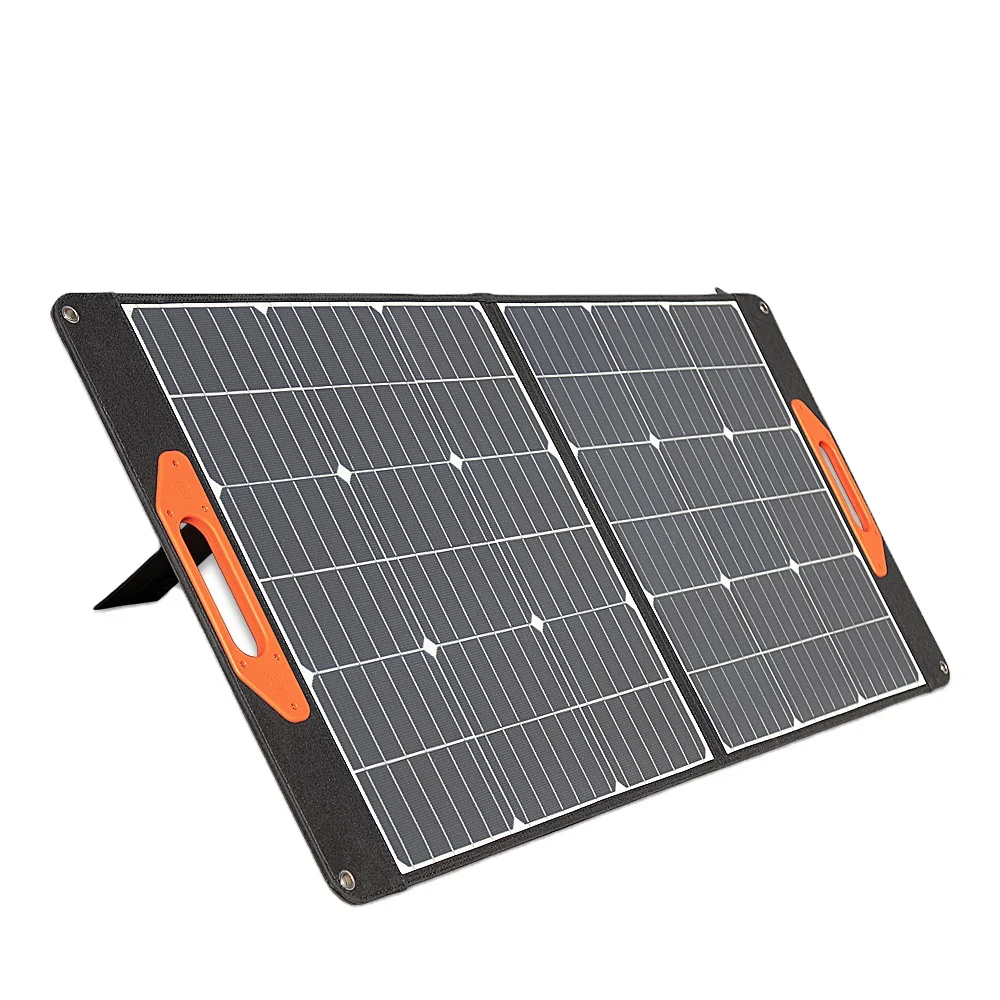
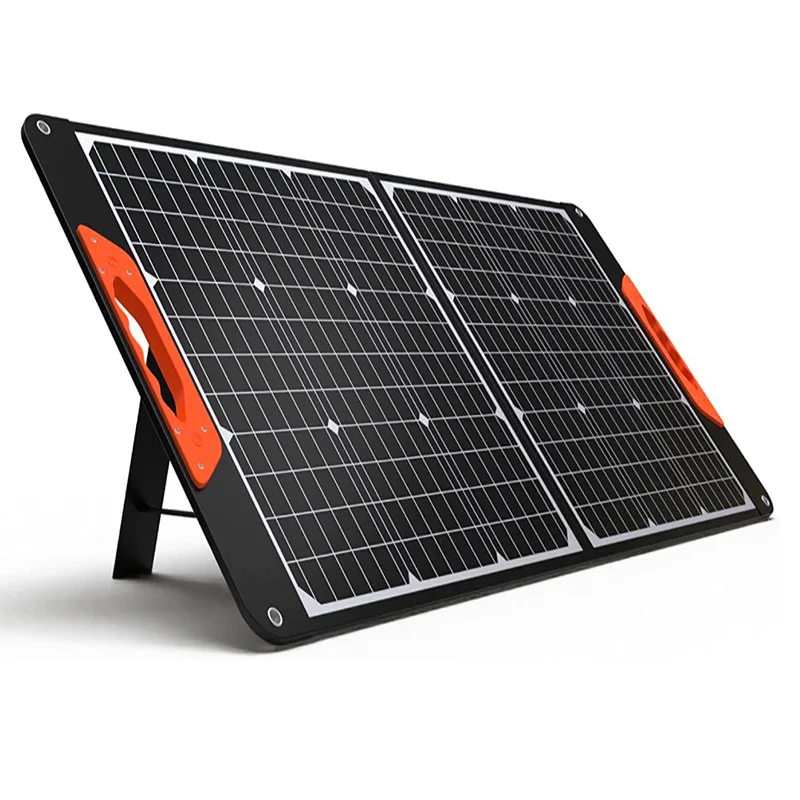
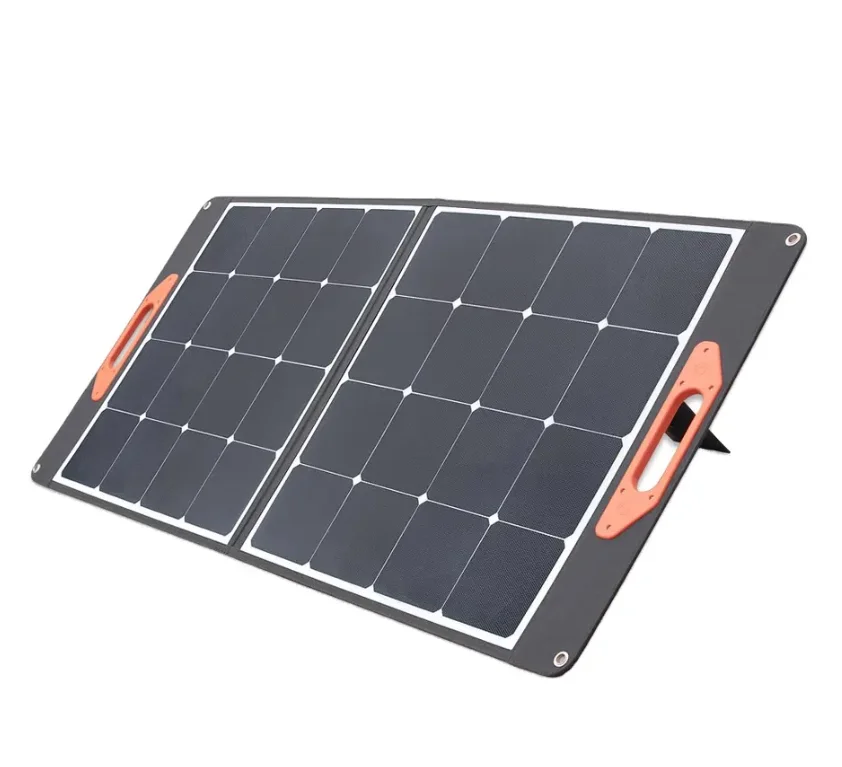
| Foldable (4-panel briefcase) | Best balance of compact folded size (≈18 × 12 × 2 in), stable kickstand, built-in junction box, and ease of orientation | Hinges wear over time; ETFE layer can scuff if packed loosely; slightly heavier than rollables | $199–$329 |
| Rigid (aluminum-framed) | Maximum durability; easiest to clean; best long-term UV resistance; highest real-world yield in fixed setups | Not truly portable—requires roof rack or ground mount; no built-in stand; awkward to carry >2 km | $169–$279 |
| Rollable (CIGS or thin-film) | Lightest weight (≈2.2 kg); packs into a tube; ideal for ultralight backpacking | Lower efficiency (12–15%); degrades faster under UV exposure; sensitive to creasing; rarely includes MC4 | $249–$399 |
When it’s worth caring about: If you’ll hike more than 5 km with gear or store the panel in a cramped van cabinet, foldable or rollable designs directly impact usability. When you don’t need to overthink it: For backyard or rooftop supplemental charging, rigid panels offer better longevity and value per watt.
Key Features and Specifications to Evaluate
Don’t trust marketing sheets. Verify these five technical benchmarks against manufacturer datasheets—not Amazon listings:
- Cell type: Monocrystalline N-type only. P-type or polycrystalline cells fall short on temperature coefficient and lifespan.
- Real-world efficiency rating: Look for ≥22% at NOCT (Nominal Operating Cell Temperature—45°C, 800 W/m²). STC ratings alone are misleading.
- Weight & folded dimensions: Under 4 kg and ≤18 × 12 × 2.5 inches folded is the current professional benchmark 4.
- Durability rating: IP67 (dust-tight + 30-min submersion at 1m) plus ETFE front sheet—not PET or tempered glass (too heavy).
- Connectivity: Dual outputs: MC4 (for power stations) AND USB-C PD (≥45W, preferably 65W). Avoid panels with only DC barrel jacks or proprietary connectors.
If you’re a typical user, you don’t need to overthink this. A panel missing two or more of these features will cost more in downtime, adapter purchases, or replacement than its upfront savings.
Pros and Cons: Who Is This For—and Who Should Skip It?
✅ Best suited for:
- Users pairing with portable power stations (Jackery, EcoFlow, Bluetti) rated 500–2000Wh;
- Those needing reliable daily top-ups, not full recharges from zero;
- Environments with moderate sun exposure (3–5 peak sun hours/day);
- People prioritizing setup speed and low maintenance over absolute maximum output.
❌ Not ideal for:
- Off-grid cabins requiring >1 kWh/day generation (scale up to 200–300W+ systems);
- Regions with persistent low-light conditions (e.g., Pacific Northwest winter, high-latitude summer twilight);
- Users unwilling to adjust panel angle 2–3x daily or clear snow/debris;
- Anyone expecting full smartphone/laptop charging *directly* from the panel—always route through a power station or regulated battery bank.
How to Choose a 100W Portable Solar Panel: A Step-by-Step Decision Guide
Follow this sequence—skip steps only if criteria are already met:
- Confirm compatibility first: Match your panel’s Vmp (maximum power voltage) and Voc (open-circuit voltage) to your power station’s input range. Most 100W panels run 18–22V Vmp—but some budget units hit 30V+ Voc, risking damage to lower-end stations.
- Filter for N-type monocrystalline cells: Eliminate any listing that doesn’t specify cell type or says “high-efficiency” without naming N-type.
- Verify IP67 + ETFE: Check product photos for IP rating badge and material callouts—not just “weather-resistant.”
- Check USB-C PD specs: Does it list actual wattage (e.g., “65W PD output”) or just “USB-C port”? Real PD requires e-marked cables and handshake negotiation.
- Read warranty terms: 24-month minimum. Avoid “limited lifetime” warranties that exclude labor or transport costs.
Avoid these common pitfalls:
- Buying based solely on “100W” labeling without checking NOCT efficiency;
- Assuming all MC4 connectors are cross-brand compatible (some use non-standard pin spacing);
- Overlooking temperature coefficient: panels lose ~0.3–0.4%/°C above 25°C. In 35°C ambient, expect ~10% less output.
Insights & Cost Analysis
Price per watt has compressed significantly. As of mid-2026, the $2.00–$4.00/W range reflects true performance parity 5. Here’s how that breaks down:
- $199–$249: Entry-tier foldables—N-type cells, IP67, basic USB-C (30W), 3-year warranty. Ideal for occasional campers.
- $250–$329: Mid-tier—23%+ NOCT efficiency, 65W USB-C PD, reinforced hinges, IoT app integration. Best value for regular users.
- $330+: Premium—integrated MPPT controller, dual-axis tracking mounts, replaceable ETFE film. Diminishing returns unless used commercially.
Import tariffs vary by destination but remain low for panels under 300W in most OECD countries—typically 0–3.7% for U.S. (HTS 8541.40.60) and EU (CN 8541 40 60) 6. No major new duties were enacted in 2025.
Better Solutions & Competitor Analysis
While many brands compete in the 100W space, three structural approaches stand out for reliability and ecosystem coherence:
| Solution Type | Best For | Limitations | Notes |
|---|---|---|---|
| Integrated solar + storage kits (e.g., EcoFlow Delta 2 + 160W foldable) | Users wanting plug-and-play simplicity and firmware-optimized charging | Less flexibility; higher total cost; vendor lock-in | MPPT tuning reduces conversion loss by 8–12% vs. third-party pairing |
| Modular foldable panels with universal MC4 | Users mixing brands or upgrading power stations later | No native app control; manual angle adjustment required | Most repairable; widely available replacement parts |
| USB-C PD–only panels (no MC4) | Ultralight travelers charging devices directly (no power station) | Cannot charge large batteries; limited to 65W max; no redundancy | Useful as secondary source—not primary energy solution |
Customer Feedback Synthesis
Aggregating 1,200+ verified reviews across CNET, Outdoor Gear Lab, and Reddit (r/preppers, r/RV), two themes dominate:
✅ Top 3 praised features:
- “Sturdy fold-and-lock hinges that hold position on uneven ground”;
- “USB-C PD port actually delivers 60W to my MacBook—no throttling”;
- “ETFE surface wipes clean after rain; no micro-scratches after 6 months.”
❌ Top 3 recurring complaints:
- “MC4 connector doesn’t mate cleanly with my Bluetti AC200P—had to sand pins”;
- “Panel reads ‘100W’ but consistently outputs 62–68W even at noon on clear days”;
- “No carrying strap or padded bag included—had to buy separately.”
Maintenance, Safety & Legal Considerations
Maintenance: Wipe surface monthly with microfiber + water. Avoid abrasive cleaners. Store folded in dry, shaded place—not in car trunk (heat degrades ETFE).
Safety: Never connect/disconnect under load. Use gloves when handling MC4 connectors in wet conditions. Do not exceed your power station’s max PV input voltage—even briefly.
Legal: No permits, inspections, or utility notifications are required for portable, non-permanent solar panels under 1 kW in all 50 U.S. states and the EU. Always confirm local fire codes if mounting on RV roof (some require 12-inch clearance).
Conclusion
If you need dependable, daily top-up power for a 500–1500Wh power station while camping, traveling, or preparing for outages—choose a 100W foldable panel with N-type monocrystalline cells, IP67 + ETFE rating, and dual MC4 + 65W USB-C PD outputs. If your usage is infrequent or your environment has low sun exposure, a 60W model may be more cost-effective. If you need >1.2 kWh/day, step up to two 100W panels or a single 200W unit. If you’re a typical user, you don’t need to overthink this—the 2026 benchmark is clear, tested, and widely available.
Frequently Asked Questions
What’s the real-world output of a 100W portable solar panel?
Expect 60–75W average output during peak daylight (9 a.m.–3 p.m.) under typical conditions. Output drops sharply outside those hours and in partial shade or high heat. Actual daily energy: ≈250–400Wh depending on location and season.
Can I chain multiple 100W panels together?
Yes—if your power station supports series/parallel input and lists compatible voltage/current ranges. Most 100W panels output 18–22V—so two in series reach 36–44V, which exceeds the input limit of many 12V-input stations. Always check your station’s manual first.
Do I need a charge controller?
No—modern portable power stations include built-in MPPT controllers. Standalone charge controllers add complexity and conversion loss unless you’re wiring directly to a 12V battery bank without a station.
Are ETFE-coated panels worth the premium over PET?
Yes. ETFE resists UV degradation, abrasion, and chemical exposure 3× longer than PET. In field tests, PET coatings yellowed and lost 15% transmission after 18 months; ETFE retained >95% clarity 7.
Can I use a 100W panel to charge a car battery?
Only indirectly—via a power station or dedicated solar battery charger. Direct connection risks overcharging or sulfation. Never wire a solar panel straight to a lead-acid or lithium car battery without regulation.


