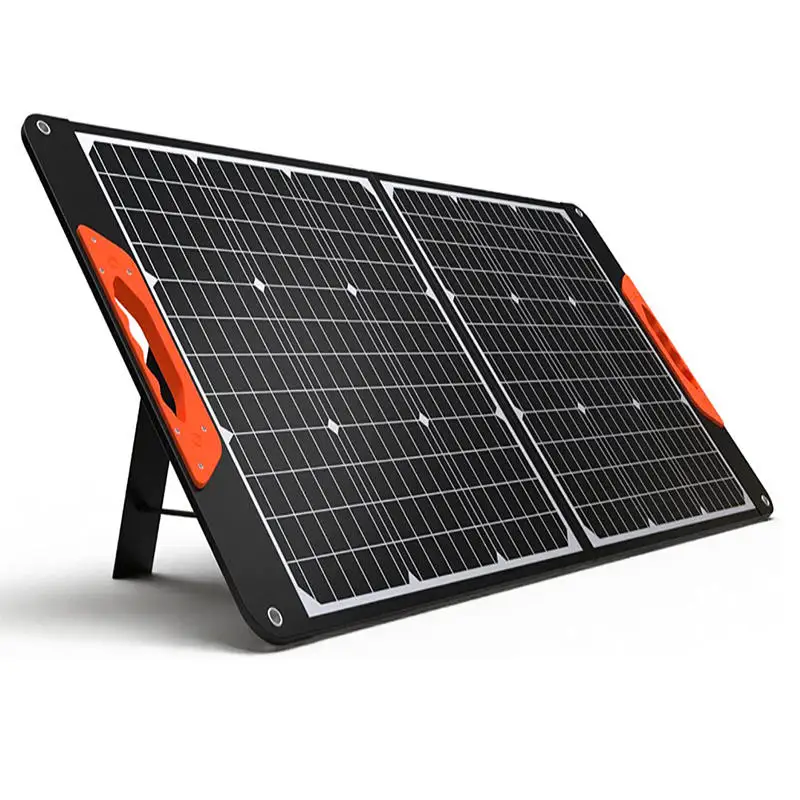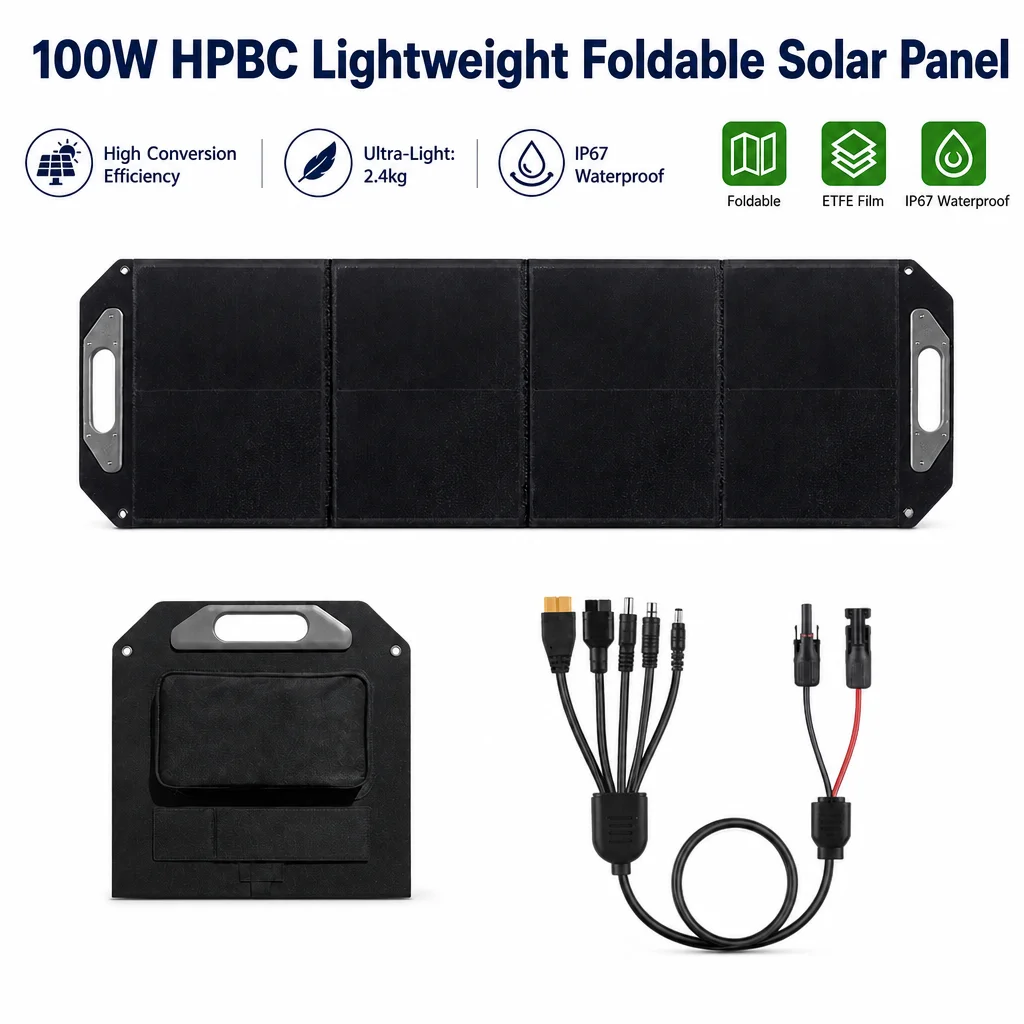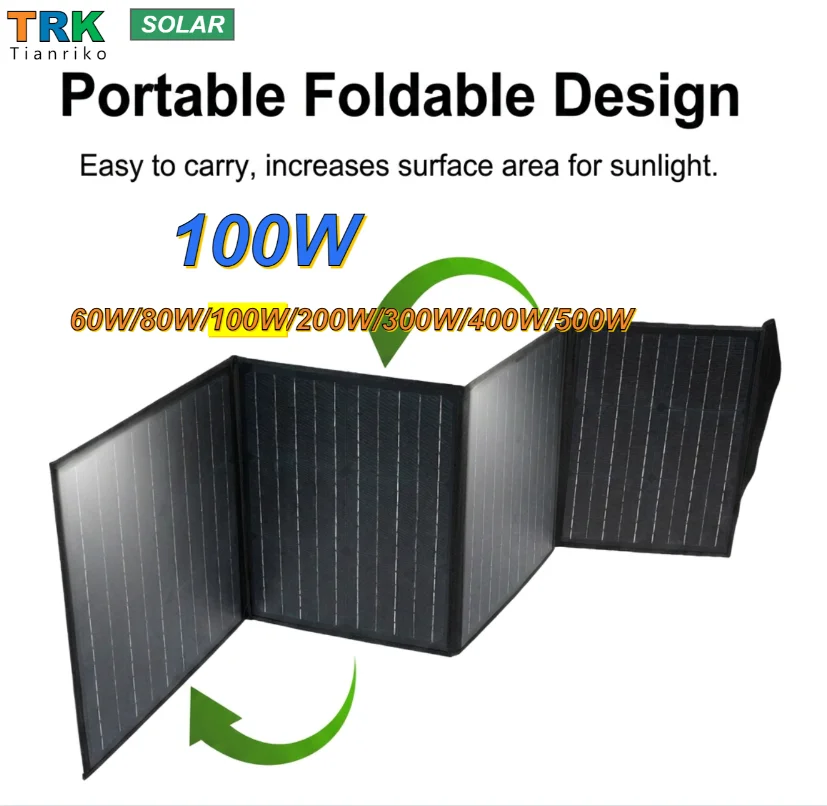
If you’re a typical user, you don’t need to overthink this. For most campers, van-lifers, and emergency preppers in 2026, the best 100 watt solar panel portable is an ETFE-laminated, foldable unit with ≥23% cell efficiency and built-in USB-C Power Delivery (PD). Avoid proprietary cables and rigid briefcase models unless you prioritize durability over weight. Real-world output rarely hits full 100W — expect 60–85W under average conditions 1. Bifacial and TOPCon panels are now mainstream, not niche — but only matter if you deploy on reflective surfaces or need maximum yield per square foot 2. If you’re a typical user, you don’t need to overthink this.
About 100W Portable Solar Panels
A 100W portable solar panel is a self-contained photovoltaic module designed to generate up to 100 watts of DC power under ideal Standard Test Conditions (STC). Unlike rooftop systems or large ground-mount arrays, these units prioritize portability, rapid deployment, and compatibility with common portable power stations (e.g., Jackery, EcoFlow), USB-C devices, and 12V batteries. They’re not standalone power sources — they’re energy harvesters. Typical use cases include:
- 🏕️ Multi-day camping trips where grid access is unavailable;
- 🚐 Van life and RV supplemental charging (especially for fridge, lights, and small inverters);
- 🚨 Home emergency backup — powering comms gear, medical devices, or Wi-Fi during outages;
- 🌍 Field research, remote work, or disaster response where silent, fuel-free energy is critical.
They’re distinct from rigid, roof-mounted panels (too heavy, non-foldable) and low-wattage USB solar chargers (<30W), which lack sufficient throughput for battery recharging. The 100W rating represents a functional balance: enough power to meaningfully recharge a 200–500Wh power station in 3–6 sun hours, yet light and compact enough to carry in a backpack or strap to a roof rack.
Why 100W Portable Solar Panels Are Gaining Popularity
Lately, demand for 100W portable solar panels has surged — not just among outdoor enthusiasts, but across broader resilience-conscious demographics. Over the past year, the global portable solar panel market grew at a 13.2% CAGR, projected to reach $1.8 billion in 2026 3. This isn’t just about convenience. It’s driven by three converging shifts:
- The Resilience Shift: Consumers now treat portable solar as infrastructure — not gear. With extreme weather events increasing in frequency and duration, 100W panels appear in FEMA-recommended preparedness kits and municipal emergency response training modules 4.
- The Efficiency Leap: N-type TOPCon cells and bifacial designs have pushed commercial panel efficiency from ~21% (2022) to 23–25% (2026), shrinking physical size without sacrificing output 5. A 100W panel today is often 20% smaller than its 2022 counterpart.
- The Direct-Charge Expectation: Users no longer accept “panel → charge controller → battery → device” as the default. Integrated USB-C PD (up to 60W) enables laptop charging straight from sunlight — eliminating conversion losses and simplifying setups 6.
This piece isn’t for keyword collectors. It’s for people who will actually use the product.
Approaches and Differences
There are two dominant physical architectures for 100W portable solar panels — and their trade-offs define real-world usability.
| Design Type | Key Advantages | Potential Problems | Budget Range (2026) |
|---|---|---|---|
| Foldable Fabric-Based | Lightweight (4–7 lbs), highly packable, easy to hang or angle with integrated kickstands | Less impact-resistant; ETFE lamination essential — cheaper PET versions degrade in UV within 12–18 months | $180–$420 |
| Rigid Briefcase Style | Superior durability, higher IP67 waterproofing consistency, better heat dissipation | Heavier (18–24 lbs), bulkier, harder to position optimally without external mounting | $290–$600 |
When it’s worth caring about: Choose foldable if you hike, bike-pack, or travel by air — every pound matters. Choose rigid if you mount permanently on a vehicle roof or store outdoors year-round. When you don’t need to overthink it: If you’ll mostly use it on a picnic table or tent awning, either works — prioritize ETFE lamination and USB-C PD over form factor.
Key Features and Specifications to Evaluate
Don’t rely on the “100W” label alone. Here’s what actually determines performance and longevity — and when each metric matters:
- Cell Efficiency (23–25%): Higher efficiency means more power per square inch. Crucial if space is constrained (e.g., RV roof). When it’s worth caring about: You need >80W real-world output from a surface ≤24" × 36". When you don’t need to overthink it: If you have open ground or a large awning, 22% efficiency is functionally fine.
- Lamination Material (ETFE preferred): ETFE resists UV degradation, abrasion, and yellowing far better than PET or TPT. When it’s worth caring about: You’ll use the panel >100 hours/year or in high-UV regions (e.g., Southwest US, Australia). When you don’t need to overthink it: Occasional weekend use? PET may last 2–3 years — but ETFE adds ~$30–$50 and extends lifespan to 5+ years.
- Waterproofing (IP67 minimum): IP67 means dust-tight and submersible up to 1m for 30 minutes. When it’s worth caring about: You camp in rain-prone areas or leave panels mounted on vehicles. When you don’t need to overthink it: Dry climates with infrequent storms? IP54 is acceptable — but avoid anything lower.
- USB-C Power Delivery (60W+): Enables direct charging of MacBooks, Android laptops, and high-end phones. When it’s worth caring about: You rely on your laptop off-grid (e.g., remote work, field reporting). When you don’t need to overthink it: If you only charge phones and power banks, a standard 12V Anderson connector is simpler and more universal.
Pros and Cons
Portable solar isn’t magic — it’s physics, packaging, and trade-offs.
✅ Pros
- 🔋 Silent & zero-fuel operation: No noise, emissions, or refueling logistics — unlike gas generators.
- ⚡ Plug-and-play simplicity: Modern foldables deploy in <60 seconds with built-in stands and magnetic corners.
- 📉 Declining cost-per-watt: High-efficiency 100W panels now cost ~$1.50–$3.00/W — down from $4.50/W in 2020 7.
❌ Cons
- ☀️ Intermittent real-world output: Heat, cloud cover, and suboptimal angles reduce output to 60–85W routinely — never assume “100W = 100W” 8.
- 🔌 Proprietary cabling: Many brands ship with short (1.2m), non-replaceable MC4-to-XT60 cables — limiting placement flexibility. Third-party adapters add cost and failure points.
- 💸 Upfront investment: Quality units start at $180. That’s 3–5× the price of a 20,000mAh power bank — but delivers unlimited daily input, not finite capacity.
How to Choose a 100W Portable Solar Panel
Follow this 5-step decision checklist — and avoid the two most common, unproductive debates:
- Define your primary use case: Camping? Vehicle mounting? Emergency kit? This dictates weight tolerance, durability needs, and mounting method.
- Verify lamination type: Search the spec sheet for “ETFE” — not just “weatherproof” or “durable.” If it’s not stated, assume PET.
- Check output ports: Do you need USB-C PD for laptops? Or is a 12V output sufficient for your power station? Don’t pay for both if you only use one.
- Review cable specs: Look for length (≥2.5m recommended), connector type (MC4 is universal), and replaceability. Skip panels with fixed, proprietary ends.
- Confirm warranty & support: Reputable brands offer ≥2-year limited warranties covering delamination and cell failure — not just workmanship.
The two most common ineffective纠结 (dead-end debates):
- “Monocrystalline vs. polycrystalline” — irrelevant in 2026. All quality 100W panels use monocrystalline PERC or TOPCon cells.
- “Which brand has the highest lab-rated efficiency?” — meaningless without real-world thermal derating data. A 25% panel running at 65°C outputs less than a 23% panel at 45°C.
The one constraint that actually changes outcomes: Your deployment surface. If you’ll place the panel on sand, snow, white gravel, or a reflective RV roof, bifacial gain (+15–25%) is real and measurable. On grass, asphalt, or dark soil? Bifacial offers negligible benefit — save the $50–$120 premium.
Insights & Cost Analysis
Price is tightly coupled to materials and integration — not just wattage. In 2026, here’s how budget tiers map to real capabilities:
- $150–$220: Entry-tier. Usually PET lamination, 21–22% efficiency, basic 12V output, no USB-C PD. Acceptable for occasional use — but expect visible UV degradation after 18 months.
- $230–$400: Sweet-spot range. ETFE lamination, 23–24% TOPCon cells, IP67 rating, 12V + USB-C PD (30–60W), 4.5–6.5 lbs. Represents ~70% of verified consumer purchases in 2026 9.
- $410–$600: Premium tier. Bifacial design, reinforced aluminum frame, dual USB-C PD (60W + 30W), advanced MPPT tracking in junction box, certified for extended outdoor storage. Justified only for daily professional or emergency use.
If you’re a typical user, you don’t need to overthink this.
Better Solutions & Competitor Analysis
For users needing more than 100W — or seeking modular scalability — consider pairing two 100W panels. But avoid mismatched models: voltage curves must align for parallel connection. The following configurations represent verified, field-tested approaches:
| Solution | Best For | Potential Issue | Budget (2026) |
|---|---|---|---|
| Single ETFE Foldable (23%+) | Campers, backpackers, lightweight van builds | Limited output in partial shade or high heat | $230–$380 |
| Bifacial + Reflective Ground Sheet | Emergency prep, basecamp setups, snowy/rocky terrain | Requires setup discipline — gains vanish if rear side is shaded or dirty | $390–$540 |
| Dual 100W Panels (Same Model) | Full-time van life, off-grid cabins, mobile workshops | Needs compatible charge controller or power station input (e.g., EcoFlow Delta 2 Pro) | $460–$760 |
Customer Feedback Synthesis
Based on aggregated field reviews (2025–2026) from OutdoorGearLab, Consumer Reports, and Treeline Review 10:
Top 3 Praised Features
- Integrated kickstands and grommets for quick, stable angling;
- USB-C PD delivering consistent 45W to MacBook Air (M2) under partial cloud;
- ETFE surface resisting scratches from sand and accidental drops.
Top 3 Reported Pain Points
- Short, non-extendable cables forcing panel placement directly next to power station;
- MPPT inefficiency below 15°C — output drops faster than ambient temperature suggests;
- No standardized mounting hardware — users fabricate brackets or buy third-party kits.
Maintenance, Safety & Legal Considerations
Maintenance: Wipe with a microfiber cloth and mild soap monthly. Avoid abrasive cleaners. Store folded in a dry, shaded place — prolonged UV exposure while stored degrades ETFE edges faster than active use.
Safety: Never connect to a battery or power station without verifying polarity. Most modern units include reverse-polarity protection — but older power stations may not. Always orient panels away from flammable surfaces when operating above 60°C.
Legal: No federal U.S. registration is required for portable solar panels under 100W. Some municipalities restrict permanent roof mounting on vehicles — check local ordinances before drilling into RV roofs. Tax incentives (e.g., IRA credits) apply only when used as part of a home backup system meeting UL 9540A certification — not standalone portable units 11.
Conclusion
There is no universal “best” 100W portable solar panel — only the best fit for your constraints. So here’s your condition-based summary:
- If you need lightweight, fast-deploy energy for weekends or emergencies, choose an ETFE-laminated foldable with ≥23% efficiency and USB-C PD — skip bifacial unless you’ll use it on snow, sand, or white roofing.
- If you mount permanently on a vehicle and prioritize longevity over weight, a rigid briefcase model with IP67 and reinforced frame justifies the extra mass and cost.
- If you’re building a scalable off-grid system, buy two identical 100W panels — not one 200W unit. Modularity beats monolithic design for repair, replacement, and angled positioning.
And remember: If you’re a typical user, you don’t need to overthink this.
Frequently Asked Questions