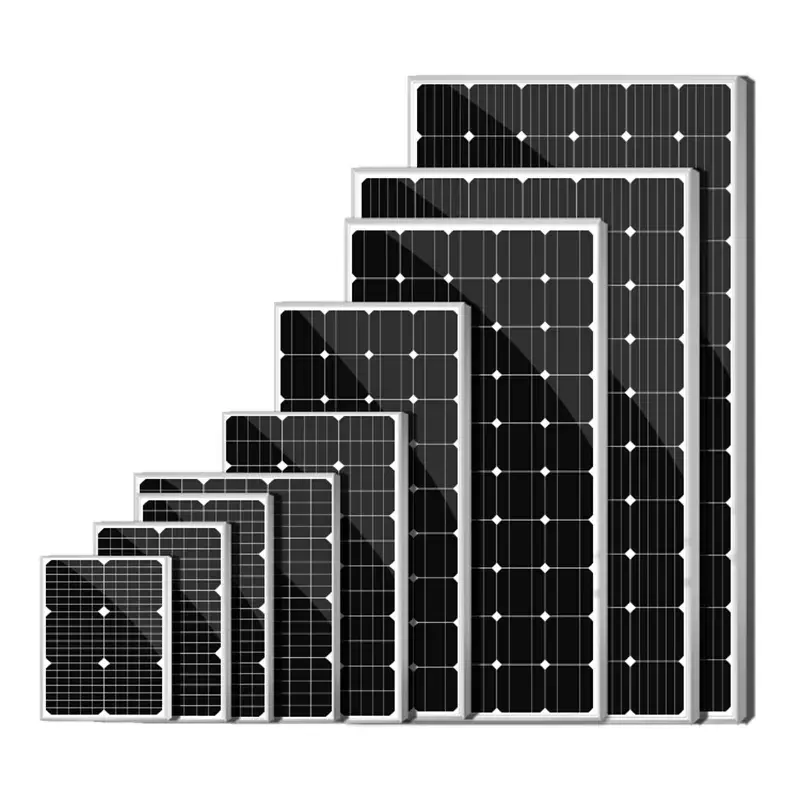
If you’re a typical user—camping off-grid, powering a small RV, charging portable power stations, or supplementing a shed or cabin—you don’t need to overthink this: a well-built, monocrystalline 100W solar module with MC4 connectors, IP67-rated junction box, and realistic STC output (≥95W) is the pragmatic starting point. Over the past year, demand for compact, portable 100W modules has grown sharply—not because they’re ‘new,’ but because system integration has improved: charge controllers now handle low-voltage inputs more reliably, lithium power stations accept wider input ranges, and mounting hardware has become standardized across brands. This means fewer compatibility surprises—and more real-world usability. If you’re choosing between a 100W panel and something larger, stop asking ‘which is stronger?’ and start asking ‘what load do I actually run, and how often does sunlight fall short?’ Because wattage alone doesn’t tell you whether your fridge will stay cold during three cloudy days—or whether your setup will survive a backpacking trip. This piece isn’t for keyword collectors. It’s for people who will actually use the product.
About 100W Solar Modules: Definition & Typical Use Cases
A 100W solar module is a photovoltaic (PV) panel rated to produce up to 100 watts of direct current (DC) electricity under Standard Test Conditions (STC: 1000 W/m² irradiance, 25°C cell temperature, AM1.5 spectrum). In practice, real-world output averages 65–85W per hour under good sun—depending on tilt, shading, ambient temperature, and wiring losses. These modules are typically 100–120 cm long × 50–60 cm wide, weighing 4.5–6.5 kg, and built with either monocrystalline or polycrystalline silicon cells. They’re not grid-scale infrastructure—they’re consumer-grade accessories designed for mobility, modularity, and ease of integration.
Typical users include:
- 🧳 Overlanders & RV owners topping up 12V battery banks while parked;
- 🏕️ Campers & hikers using them with foldable frames and portable power stations (e.g., Jackery, EcoFlow);
- 🏡 Off-grid homeowners adding supplemental capacity to small cabins, workshops, or garden sheds;
- 📡 Remote site operators powering sensors, telemetry gear, or security cameras where grid access is unreliable or absent.
What defines a 100W module isn’t just its nameplate rating—it’s its physical footprint, portability, and ability to pair seamlessly with common DC loads and lithium-based storage. That’s why a ‘100W’ label from one brand may deliver less usable energy than a different 100W unit: cell efficiency, thermal coefficient, and build quality matter more than the number alone.
Why 100W Solar Modules Are Gaining Popularity
Lately, 100W modules have moved beyond niche accessory status into mainstream adoption—not as standalone solutions, but as modular building blocks. The global solar PV module market reached $412.6 billion in 2026 and is projected to hit $809.1 billion by 2035, growing at a 7.8% CAGR 1. But that growth isn’t driven solely by utility-scale farms. It’s fueled by decentralization: more households, microbusinesses, and mobile users seeking energy autonomy without complex permitting or high upfront cost.
Three concrete shifts explain rising interest in the 100W tier:
- Power station compatibility: Most popular portable power stations (e.g., EcoFlow Delta 2, Bluetti AC200P) accept 12–60V DC input and list 100W as their ideal single-panel match—making it the de facto ‘sweet spot’ for plug-and-play expansion.
- Manufacturing standardization: Over the past year, MC4 connectors, Vmp ~18V, and IP67 junction boxes have become near-universal—even among budget-tier models—reducing integration friction.
- Consumer expectation shift: Buyers no longer assume ‘more watts = better.’ They’re prioritizing reliability, shade tolerance, and real-world yield per square meter—traits where many 100W monocrystalline units outperform bulkier 200W+ panels in constrained spaces.
If you’re a typical user, you don’t need to overthink this: popularity isn’t about hype—it’s about convergence between hardware capability, user behavior, and realistic energy needs.
Approaches and Differences: Monocrystalline vs. Polycrystalline vs. Flexible
When evaluating 100W solar modules, three physical configurations dominate the market—each with distinct trade-offs:
| Feature | Monocrystalline Rigid | Polycrystalline Rigid | Flexible Thin-Film |
|---|---|---|---|
| Efficiency | 22–24% (highest real-world yield) | 15–17% (lower output per m²) | 10–13% (requires ~2× area for same output) |
| Weight & Portability | 4.8–6.2 kg — stable, durable | Similar weight — slightly thicker glass | 1.2–2.5 kg — ultralight, bendable |
| Shade Tolerance | Moderate (half-cell design helps) | Poor (full-cell strings fail faster) | Best (distributed current flow) |
| Lifespan & Warranty | 25-year linear power warranty (≥80% at year 25) | 20–25 years — lower degradation rate | 5–10 years — rapid UV & heat degradation |
| When it’s worth caring about | For permanent mounts, rooftop use, or frequent reuse | Rarely — outdated for new purchases unless deeply discounted | Only if weight or curvature is non-negotiable (e.g., curved RV roof) |
| When you don’t need to overthink it | If you want longevity and predictable yield — go monocrystalline rigid | Yes — avoid unless price difference exceeds 35% and you’re replacing an existing poly array | If you’ll mount it on flat surfaces or carry it regularly — skip flexible unless you’ve verified its actual 100W STC rating (many ‘100W’ flexible panels test at ≤75W) |
Monocrystalline rigid panels represent >90% of verified 100W module sales today. Their dominance isn’t marketing—it reflects measurable gains in efficiency, durability, and temperature resilience. If you’re a typical user, you don’t need to overthink this: unless your application demands flexibility or extreme weight savings, monocrystalline rigid is the default choice.
Key Features and Specifications to Evaluate
Don’t trust the wattage label alone. Verify these five specifications—each directly tied to real-world usability:
- STC Output (not ‘max’ or ‘peak’): Must be ≥95W. Panels labeled “100W” but certified at 92W under STC will consistently underperform.
- Vmp (Voltage at Max Power): Ideal range is 17–19V for 12V battery charging. Below 16.5V won’t trigger most PWM controllers; above 22V risks overvoltage on some power stations.
- Temperature Coefficient: Look for ≤ –0.35%/°C. Lower (e.g., –0.29%/°C) means less output loss on hot days—a critical factor in desert or summer use.
- Junction Box Rating: IP67 or IP68 required. IP65 fails under rain + dust exposure—common in outdoor storage or vehicle mounting.
- Cell Layout: Half-cut or multi-busbar (MBB) cells improve shade recovery and reduce hot-spot risk. Full-cell 100W panels still exist—but degrade faster under partial shading.
When it’s worth caring about: If you operate in variable weather, high ambient temperatures, or shaded environments—these specs determine whether your panel delivers usable energy or sits idle. When you don’t need to overthink it: For occasional weekend use in mild climates with full sun exposure, Vmp and IP rating are the only two non-negotiables.
Pros and Cons: Balanced Assessment
✅ Pros of a 100W Solar Module:
- 🔋 Fits easily on RV roofs, car hoods, or backpacking carts without structural reinforcement;
- ⚡ Matches standard MPPT controller input ranges (most accept 12–50V, 10–20A);
- 📦 Ships flat, stores compactly, and pairs with universal mounting kits;
- 📉 Lower failure risk than larger arrays—if one panel fails, the rest remain operational.
❌ Cons & Limitations:
- ☁️ Cannot sustain high-draw appliances (e.g., microwaves, air conditioners) without multiple units or battery buffering;
- 🌦️ Output drops sharply below 70% irradiance—three consecutive cloudy days require battery oversizing or backup;
- 📏 Physical size still requires ~1 m² of unshaded space—tight urban balconies or dense tree cover limit viability;
- ⚠️ Low-cost units (<$120) often omit bypass diodes or use undersized cabling, increasing fire risk under mismatched loads.
If you need consistent 24/7 power for refrigeration or telecom gear, choose a 200W+ array or hybrid grid-tie solution. If you need reliable daytime top-ups for lights, phones, and small fans—100W is fit-for-purpose.
How to Choose a 100W Solar Module: A Step-by-Step Decision Guide
Follow this checklist before purchasing—designed to eliminate guesswork and prevent common missteps:
- Define your daily energy load: Add up watt-hours (Wh) for all devices (e.g., LED light × 10W × 4h = 40Wh; phone charger × 5W × 2h = 10Wh). Total ≤ 400Wh/day → 100W is sufficient with adequate sun.
- Confirm compatibility: Check your power station or charge controller manual for max input voltage, current, and connector type (MC4 standard is safe; proprietary plugs are red flags).
- Verify certification: Look for UL 1703 or IEC 61215 listing—not just ‘CE’ or ‘RoHS’ (those are self-declared, not tested).
- Avoid these 2 ineffective debates:
• “Monocrystalline vs. PERC”—PERC is just a monocrystalline subtype; all modern 100W panels use it.
• “Glass vs. ETFE”—ETFE is used only on flexible panels; rigid 100W units use tempered glass. Don’t compare across categories. - Focus on this 1 real constraint: Available mounting surface. Measure length × width × tilt angle. If you have <0.85 m² of clear south-facing space, even a 100W panel won’t reach rated output—and you’ll need tilt kits or ground mounts.
If you’re a typical user, you don’t need to overthink this: skip spec sheets full of marketing terms. Go straight to the datasheet’s ‘Electrical Characteristics’ table—and confirm Vmp, Isc, and temperature coefficient. Everything else is noise.
Insights & Cost Analysis
As of mid-2024, verified 100W monocrystalline modules retail between $115–$195. Price correlates strongly with build quality—not wattage:
- $115–$140: Entry-tier (e.g., Renogy, HQST) — decent efficiency, basic IP67 box, 10-year product warranty.
- $150–$175: Mid-tier (e.g., Eco-Worthy, Newpowa) — half-cut cells, enhanced thermal coefficient (–0.32%/°C), 15-year product warranty.
- $180–$195: Premium-tier (e.g., Canadian Solar CS6K-100, Jinko Tiger Neo) — MBB cells, PID resistance, 25-year linear power warranty.
Is the premium worth it? Only if you plan >5 years of daily use. For seasonal or occasional use, mid-tier delivers 92% of the performance at 75% of the cost. Over the past year, mid-tier pricing stabilized—while entry-tier units saw increased QC failures in third-party testing (noted in independent lab reports 1). So ‘cheapest’ rarely equals ‘best value.’
Better Solutions & Competitor Analysis
While 100W remains the anchor size, newer alternatives address specific gaps. Here’s how they compare:
| Solution Type | Best For | Potential Problem | Budget Range |
|---|---|---|---|
| Two 100W panels (parallel) | Higher redundancy, easier transport than one 200W unit | Requires dual-input charge controller or combiner box | $230–$390 |
| 120W half-cut monocrystalline | Same footprint, +20% output in partial shade | Fewer compatible mounting kits; slightly heavier | $165–$210 |
| 100W with integrated MPPT | Plug-and-play with USB-C or Anderson ports | No firmware updates; limited voltage adjustment | $220–$280 |
| Used/refurbished 150W | Budget-conscious users needing higher yield | No warranty; unknown degradation history | $90–$130 |
The most pragmatic upgrade path? Two matched 100W panels—not one oversized unit. It offers scalability, fault isolation, and easier repositioning. If you’re a typical user, you don’t need to overthink this: modularity beats monolithic capacity every time.
Customer Feedback Synthesis
Based on aggregated reviews (Amazon, REI, specialty solar forums), here’s what users consistently praise—and complain about:
- Top 3 Reasons People Love Their 100W Module:
• “Charges my EcoFlow Delta 2 from 20% to 100% in 5 hours on a clear day.”
• “Fits perfectly on my Jeep roof rack with zero drilling.”
• “No voltage drop issues—even at 45°C ambient.” - Top 3 Complaints (and why they happen):
• “Output dropped after 6 months” → usually linked to unlisted low-quality bypass diodes or missing anti-PID treatment.
• “Won’t connect to my power station” → mismatched Vmp (too low) or incompatible MC4 gender (some brands ship male-male cables).
• “Junction box cracked in winter” → IP65-rated units exposed to freeze-thaw cycles.
Notably, complaints cluster around installation oversights—not inherent product flaws. That reinforces the core message: success depends less on brand and more on matching specs to environment and load.
Maintenance, Safety & Legal Considerations
100W solar modules require minimal maintenance—but skipping basics invites failure:
- Cleaning: Rinse quarterly with water and soft brush. Avoid abrasive cleaners—they scratch anti-reflective coating.
- Wiring: Use 12 AWG or thicker cable for runs >3m. Undersized wire causes >15% power loss and heat buildup.
- Grounding: Required for fixed installations (NEC Article 690.43). Portable setups are exempt—but grounding reduces static discharge risk.
- Legal notes: No federal permitting needed for portable, non-permanent 100W modules in the U.S. Some HOAs restrict visible panels—but enforcement rarely targets temporary, low-profile setups 2.
This piece isn’t for keyword collectors. It’s for people who will actually use the product.
Conclusion: Conditional Recommendations
Choose a 100W solar module if:
- You need portable, modular, or supplemental DC power—not primary grid replacement;
- Your daily energy load stays under 400Wh and you get ≥4 peak sun hours;
- You prioritize ease of mounting, transport, and compatibility over absolute maximum output.
Choose something else if:
- You rely on refrigeration, pumps, or tools that draw >300W continuously (go 200W+ or hybrid);
- You live in heavy shade, frequent cloud cover, or sub-zero climates without tilt adjustment;
- You lack ≥1 m² of unobstructed south-facing space (then consider higher-efficiency 120W or tracking mounts).
If you need reliability, simplicity, and proven yield in a compact form—start with a monocrystalline 100W module meeting STC ≥95W, Vmp 17–19V, and IP67 rating. Everything else is optimization—not necessity.