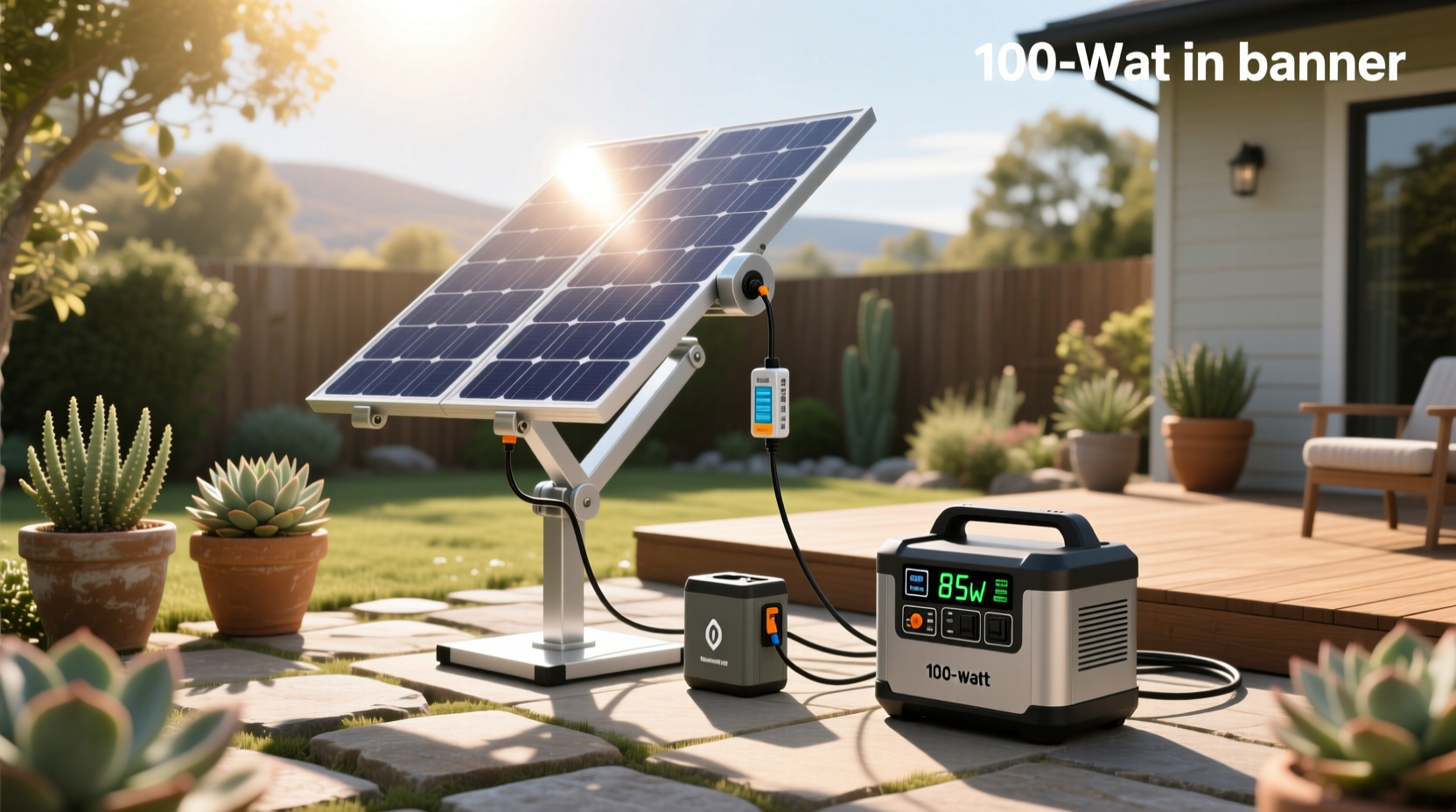
If you’re a typical user—a camper, RVer, or homeowner seeking portable grid resilience—you don’t need to overthink this. Over the past year, 100-watt solar panel kits have shifted decisively toward N-type bifacial cells and ETFE-laminated foldables, delivering >22% efficiency at under 0.9 kg1. For most users, a premium ETFE foldable kit ($170–$200) outperforms budget rigid panels ($70–$90) in real-world yield per square foot and long-term reliability—especially when used off-grid, on uneven terrain, or in reflective environments like snow or sand. Skip monocrystalline rigid kits unless you’re mounting permanently on a shed roof; avoid flexible PVC-laminated models if daily folding is required—they degrade faster. This piece isn’t for keyword collectors. It’s for people who will actually use the product.
About 100-Watt Solar Panel Kits: Definition & Typical Use Cases
A 100-watt solar panel kit is a self-contained, portable photovoltaic system designed to generate up to ~100 watts of DC power under standard test conditions (STC). Unlike rooftop arrays, these kits integrate a panel (or multiple panels), charge controller (often built-in or external), cables, and sometimes a carry case or mounting hardware. They are not standalone power sources but energy harvesters—designed to recharge 12V batteries (e.g., LiFePO₄ or AGM), power stations (like Jackery or EcoFlow units), or small DC loads directly.
Typical users include:
- 🏕️ Campers & backpackers: Charging power banks, headlamps, GPS, and satellite messengers during multi-day trips.
- 🚐 RVers & van-lifers: Topping off house batteries between hookups or extending boondocking time by 2–5 days/week.
- 🏠 Homeowners preparing for outages: Pairing with a portable power station for refrigerator, lights, or comms during short-duration blackouts.
- 🛰️ Field professionals & aid workers: Powering radios, medical sensors, or data loggers in remote deployments2.
Crucially, a 100W kit does not power high-wattage AC appliances (microwaves, air conditioners, kettles) without significant battery and inverter infrastructure. Its value lies in consistent, low-draw replenishment—not peak output.
Why 100-Watt Solar Panel Kits Are Gaining Popularity
Lately, demand for 100W solar kits has surged—not because they’re new, but because their role has evolved. The global portable solar panel market is projected to reach $1.8 billion by 2026, growing at a 13.2% CAGR3. Two interlocking trends explain this:
- Grid resilience as baseline expectation: With U.S. average outage duration up 64% since 20134, consumers no longer treat backup power as “nice-to-have.” A 100W kit + 1000Wh power station delivers reliable 3–5 day autonomy for critical devices—without permitting or roof modification.
- Portability redefined: Foldable kits now weigh <0.9 kg and fold to ~30 × 30 × 4 cm—fitting easily into a duffel or cargo area. That’s a 35% weight reduction versus 2022 equivalents, enabled by ETFE lamination and thinner N-type wafers1. If you’re a typical user, you don’t need to overthink this: lighter means more likely to be deployed, which directly increases annual energy yield.
This isn’t about “going off-grid forever.” It’s about eliminating one point of failure—your wall outlet—so your phone, light, or water pump stays functional when the grid doesn’t.
Approaches and Differences: Rigid vs. Flexible vs. Foldable
Three physical architectures dominate the 100W kit space. Each solves different problems—and introduces distinct trade-offs.
| Design Type | Key Advantages | Potential Drawbacks | Budget Range (2026) |
|---|---|---|---|
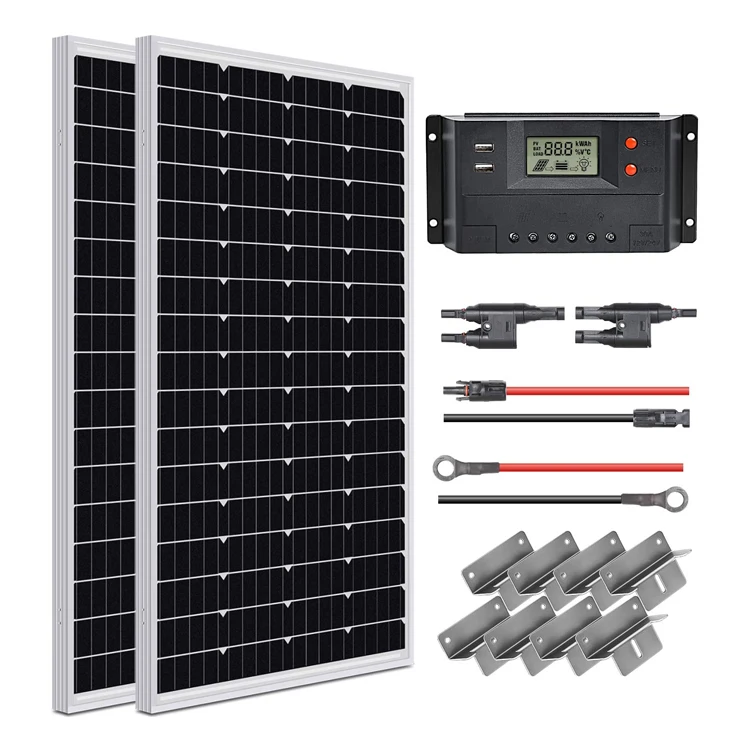
| Rigid Monocrystalline | Best heat dissipation; highest long-term UV resistance; lowest $/watt | Bulky (≥3.5 kg); requires fixed mounting; poor for irregular surfaces | $70–$90 |
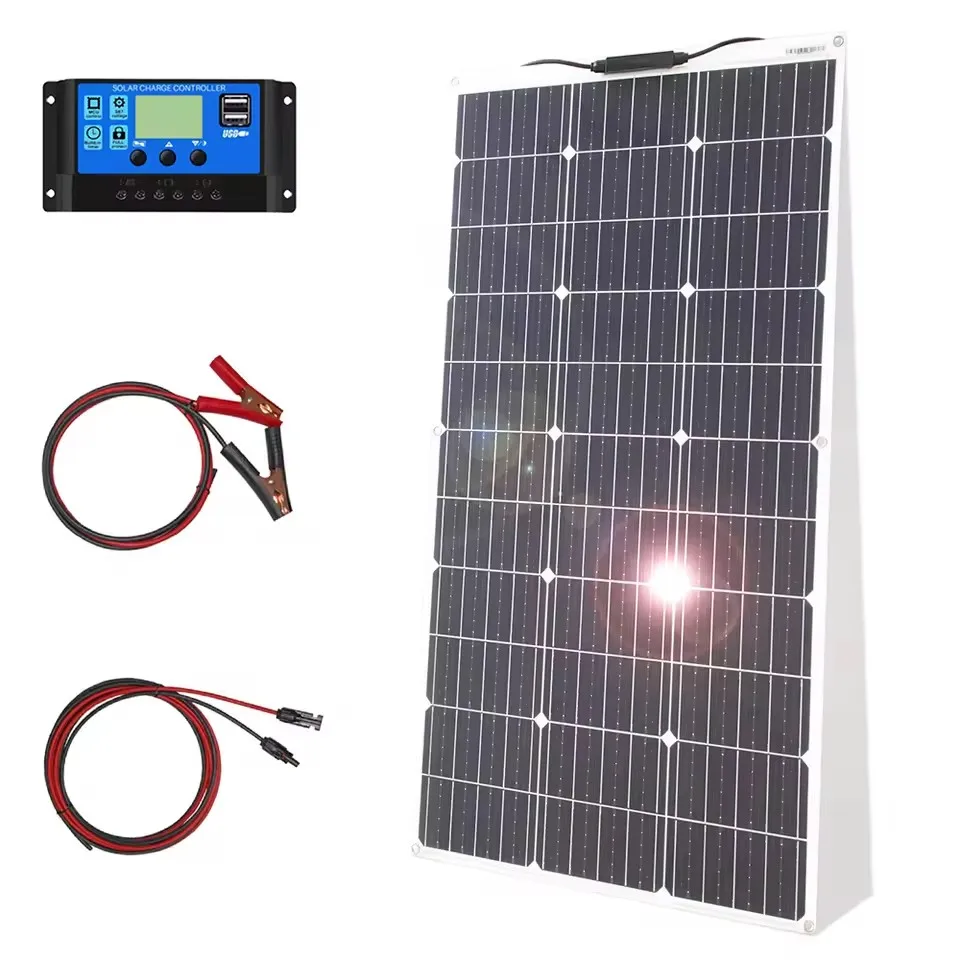
| Flexible (PVC/Fiberglass) | Conforms to curved roofs (RVs, boats); lightweight (~1.8 kg); low wind profile | PVC degrades under UV exposure; fiberglass adds stiffness; lower efficiency (<20%) | $130–$160 |
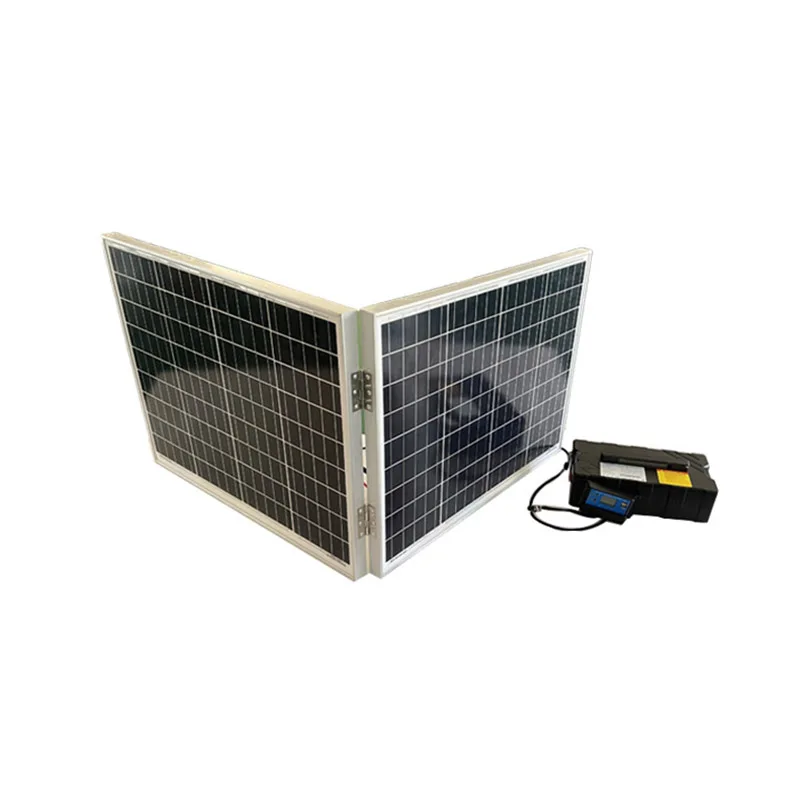
| Foldable (ETFE/N-type) | Bifacial gain (+5–15% in reflective settings); ultra-light (<0.9 kg); rapid deployment; ruggedized fabric shell | Highest upfront cost; hinge wear over 500+ folds; requires careful storage to avoid creasing | $170–$200+ |
When it’s worth caring about: If you’ll deploy the kit ≥3x/month on varied terrain—or need it to survive dust, rain, or sand exposure—foldable ETFE is objectively superior. Its bifacial design captures ambient light from below (e.g., off a white RV roof or snowfield), boosting real-world output beyond STC ratings5.
When you don’t need to overthink it: If you mount once on a south-facing garage roof and leave it year-round, rigid is simpler, cheaper, and more durable over 10+ years. If you’re a typical user, you don’t need to overthink this.
Key Features and Specifications to Evaluate
Don’t default to wattage alone. A 100W rating is measured under lab conditions (25°C, 1000W/m² irradiance). Real-world performance depends on four measurable specs:
- Cell Technology: Prioritize N-type monocrystalline (TOPCon or PERC). They offer higher temperature coefficients (−0.30%/°C vs. −0.40%/°C for P-type), meaning less output loss on hot days6. Bifacial capability adds value only if mounted above reflective surfaces.
- Efficiency: Look for ≥22%. Panels rated at 21% or lower often use older P-type cells or thicker glass—adding weight without yield gain.
- Connector Standard: MC4 is universal and weatherproof. XT60 is common on power stations but requires an adapter for most charge controllers. Avoid proprietary plugs.
- Warranty & Certifications: Minimum 5-year product warranty; 10–15 year linear power output guarantee (e.g., “≥92% at year 10”). IP65 rating confirms dust/water resistance for outdoor use.
When it’s worth caring about: Efficiency and cell type directly impact how much energy you harvest per hour of sun—and how much space you need on your RV roof or backpack. In shaded or partial-sun conditions, N-type cells maintain voltage better than P-type.
When you don’t need to overthink it: “All-black” aesthetics matter only if mounting visibly on a home balcony. Black frames reduce reflection but raise operating temperature slightly—no meaningful yield penalty for 100W kits.
Pros and Cons: Who Is This Right For?
A 100W solar panel kit excels where mobility, speed of setup, and moderate daily energy needs converge.
✅ Best suited for:
- Users needing ≤500Wh/day (e.g., charging a 20,000mAh power bank twice, running LED lights + fan overnight).
- Those prioritizing ease of transport over absolute lowest cost.
- Applications where mounting permanence isn’t possible (rentals, shared spaces, temporary shelters).
❌ Not ideal for:
- Powering AC refrigerators, microwaves, or heaters—even with large batteries.
- Regions averaging <3 peak sun hours/day without supplemental generation (e.g., Pacific Northwest winters).
- Users unwilling to orient panels toward the sun 1–2x daily (output drops ~30% at 30° tilt error).
How to Choose a 100-Watt Solar Panel Kit: A Step-by-Step Decision Framework
Follow this checklist—not in order of preference, but in order of consequence:
- Define your primary deployment environment: Camping (ground/folding) → prioritize ETFE foldables. RV roof (curved) → consider flexible fiberglass. Shed roof (fixed) → rigid is sufficient.
- Verify compatibility with your battery or power station: Check input voltage range (most 100W kits output 18–22V MPPT) and connector type (MC4 standard is safest).
- Calculate realistic daily yield: Multiply panel rating (100W) × local peak sun hours × 0.75 (system losses). In Phoenix: 100W × 6.5 × 0.75 ≈ 488Wh/day. In Seattle: 100W × 3.2 × 0.75 ≈ 240Wh/day.
- Avoid these three common oversights:
- Ignoring tilt angle: Even 15° off-optimal reduces yield 10–15%.
- Using undersized cables: 10AWG minimum for runs >3m to prevent >3% voltage drop.
- Skipping a charge controller: Never connect directly to a lithium battery—voltage spikes will damage it.
Insights & Cost Analysis
Pricing reflects material innovation—not marketing. Here’s what $100 buys you today versus $200:
- $70–$90 (Budget): Rigid P-type monocrystalline, 19–20% efficiency, tempered glass, 5-year warranty. Adequate for seasonal use—but heavier, less efficient in heat, and lacks modern connectors.
- $130–$160 (Mid-tier): Flexible fiberglass, 20–21% efficiency, basic PWM controller included. Better for RVs but still vulnerable to microcracks from repeated flexing.
- $170–$200+ (Premium): Foldable N-type bifacial, ETFE frontsheet, integrated kickstand, MC4/XT60 dual output, 10-year warranty. Delivers ~25% more annual kWh per kg than budget kits1.
Manufacturing costs have stabilized, but the premium for lightweighting and ruggedization remains justified for mobile users7. If you’ll use the kit ≥20 days/year, the ROI on the premium model appears within 18 months via extended lifespan and higher yield.
Better Solutions & Competitor Analysis
For most users, a single 100W kit is the optimal starting point. But context matters:
| Solution | Best For | Potential Issue | Budget (2026) |
|---|---|---|---|
| Single 100W ETFE Foldable | Most campers, RVers, and backup users | Output limited on cloudy days; requires daily adjustment | $170–$200 |
| Dual 100W Kits (200W total) | Full-time van life; winter camping; high-draw setups | Weight doubles; storage bulk increases 3×; diminishing returns after 150W in most scenarios | $320–$380 |
| 100W + 20Ah LiFePO₄ Portable Battery | Ultralight backpacking; emergency kits | Capacity too small for multi-day power; limited cycle life if deeply discharged | $220–$260 |
Customer Feedback Synthesis
Based on aggregated reviews across Outdoor Gear Lab, DIY Solar Forum, and Amazon (Q1 2026), top recurring themes:
- Top 3 praises: “Folds smaller than my sleeping pad,” “Charged my EcoFlow Delta 2 from 20% to 100% in 4.5 hours (Phoenix, May),” “Survived 3 months on a saltwater boat deck with zero delamination.”
- Top 3 complaints: “Hinge loosened after 12 months of weekly use,” “No built-in USB-C output—had to buy adapter,” “Spec sheet claims 24% efficiency; real-world tests show 22.3% average.”
The gap between lab-rated and field-measured efficiency is normal—but consistently >2% suggests either aggressive marketing or suboptimal cell binning.
Maintenance, Safety & Legal Considerations
Maintenance: Wipe surface monthly with microfiber + water; avoid abrasive cleaners. Store folded kits flat or rolled—not bent sharply at hinges. Inspect connectors annually for corrosion.
Safety: Never cover active panels—heat buildup can exceed 70°C and damage laminates. Always disconnect before cleaning. Use gloves when handling MC4 connectors under load.
Legal: No federal permitting required for portable, non-permanent solar kits in the U.S. Some HOAs restrict visible installation—but ground-deployed or vehicle-mounted systems fall outside most covenants. Always verify local fire codes if integrating with permanent battery banks.
Conclusion: Conditional Recommendations
There is no universal “best” 100-watt solar panel kit—only the best fit for your constraints:
- If you need portability, frequent deployment, and reliability in variable conditions, choose an ETFE-laminated, N-type bifacial foldable kit. It delivers measurable gains where it matters most: per gram, per square inch, and per deployment cycle.
- If you need lowest cost for infrequent, fixed-location use, a rigid monocrystalline kit meets the requirement—just confirm it includes a compatible charge controller.
- If you’re mounting on a curved RV roof and won’t move it, flexible fiberglass is a pragmatic middle ground—provided you accept slightly lower long-term yield.
Over the past year, the technology shift has made “good enough” kits obsolete for mobile users. Efficiency, weight, and durability are no longer trade-offs—they’re bundled. If you’re a typical user, you don’t need to overthink this.
Frequently Asked Questions
Can a 100W solar panel kit charge a car battery?
Yes—but only if paired with a charge controller that supports 12V lead-acid profiles. Direct connection risks overcharging and gassing. Most modern 100W kits include PWM or MPPT controllers compatible with AGM or flooded batteries.
How many amps does a 100W solar panel produce?
At 18V (typical MPPT operating voltage), it produces ~5.5A in full sun. Actual current varies with light intensity, temperature, and panel angle—expect 3–5A average over a 5-hour solar window.
Do I need a battery with a 100W solar panel kit?
Not strictly—but highly recommended. Without storage, you only use power while the sun shines. A 100Wh–500Wh portable power station (e.g., Jackery 300, EcoFlow River 2) lets you capture and use energy on demand.
Are bifacial 100W kits worth the extra cost?
Only if mounted above reflective surfaces (white roofs, sand, snow). On grass or asphalt, gain is negligible (<2%). For RVs or snowy campsites, yes—the extra 5–12% yield justifies the premium.


