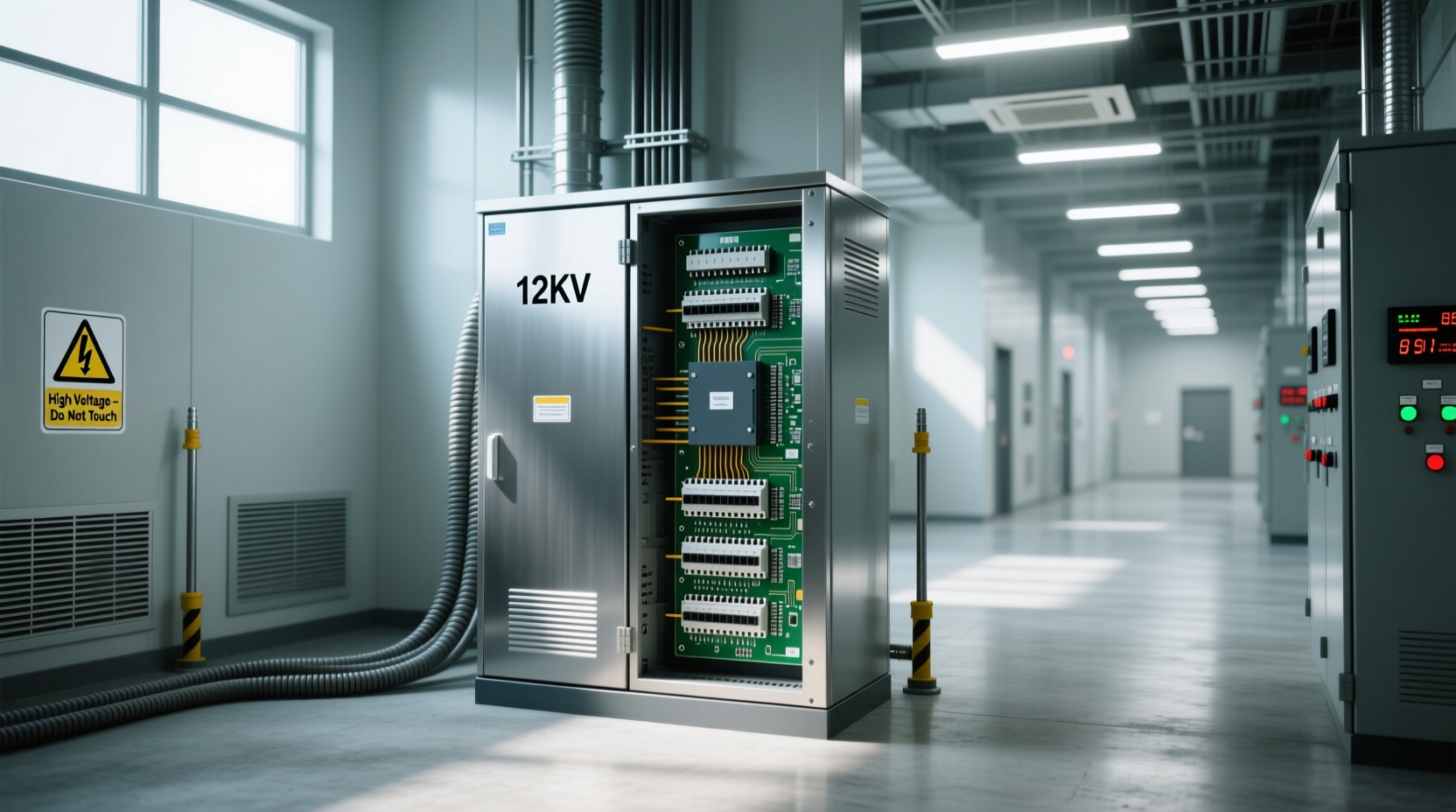
Over the past year, procurement teams and electrical engineers have faced tighter project timelines, more frequent voltage compatibility checks, and rising scrutiny on lifecycle safety—especially for 12kV medium-voltage switchgear. If you’re specifying or installing switchgear for industrial plants, substations, or commercial distribution networks, here’s the direct answer: for most indoor, space-constrained, budget-conscious applications up to 12 kV, air-insulated switchgear (AIS) with vacuum circuit breakers is the pragmatic default. You don’t need gas insulation unless footprint, environmental sealing, or seismic resilience are non-negotiable. If you’re a typical user, you don’t need to overthink this. This piece isn’t for keyword collectors. It’s for people who will actually use the product.
About 12kV Switchgear: Definition and Typical Use Cases
12kV switchgear refers to medium-voltage (MV) power distribution equipment rated for nominal system voltages of 12 kilovolts—designed to control, protect, isolate, and monitor electrical circuits in the 1–36 kV range. It operates between low-voltage (LV) panels (<1 kV) and high-voltage (HV) transmission gear (>36 kV). Its primary function is not generation or conversion, but safe, repeatable interruption and isolation of fault currents during operation, maintenance, or failure.
Typical deployment scenarios include:
- 🏭 Industrial facilities: Feeding motors, transformers, and process lines in manufacturing plants, water treatment stations, and mining operations;
- 🏢 Commercial infrastructure: Substations inside high-rises, data centers, hospitals, and university campuses where compactness and reliability outweigh raw scalability;
- 🔌 Distribution networks: Secondary substations feeding local grids—especially where legacy 11kV or 12kV systems remain standard (common across Asia, Africa, and parts of Latin America).
It’s not used for residential wiring (too high voltage), nor for long-haul transmission (insufficient rating). The “12kV” designation reflects the nominal system voltage, not peak or transient levels—actual design must account for impulse withstand (e.g., 42 kV lightning impulse level per IEC 62271-1).
Why 12kV Switchgear Is Gaining Popularity
Lately, 12kV switchgear has seen renewed adoption—not because it’s new, but because its operational sweet spot aligns tightly with current infrastructure realities. Three converging signals explain this:
- Grid decentralization: Distributed generation (solar farms, microgrids) feeds into existing 12kV distribution feeders rather than building new HV interconnections;
- Renewed focus on lifecycle safety: After several well-documented incidents involving aging MV gear, specifiers now prioritize certified arc-flash mitigation, sealed compartments, and verified short-circuit ratings—features built into modern 12kV AIS and GIS platforms;
- Manufacturing localization: Major suppliers (ABB, Siemens, Schneider, Eaton, and regional players like Joyelectric) now offer fully type-tested 12kV solutions with local service support and shorter lead times—reducing procurement risk.
This isn’t hype—it’s recalibration. If you’re a typical user, you don’t need to overthink this.
Approaches and Differences: AIS vs. GIS vs. Hybrid
The three dominant approaches for 12kV applications are Air-Insulated Switchgear (AIS), Gas-Insulated Switchgear (GIS), and hybrid designs (e.g., solid-insulated busbars with vacuum interrupters). Their differences aren’t academic—they directly impact footprint, commissioning time, and long-term maintenance burden.
| Approach | Key Advantages | Key Characteristics | When It’s Well-Suited | When Standard AIS May Be Preferred |
|---|---|---|---|---|
| Air-Insulated (AIS) | Lower upfront cost (~30–40% less than GIS); simpler diagnostics; field-repairable components; widely understood maintenance protocols | Requires larger physical footprint (2–3× GIS); designed for controlled indoor environments; incorporates proven arc-flash mitigation strategies | You have ≥1.5 m of clear aisle space and operate indoors under controlled HVAC conditions | If your site has stable climate control and no floor-space premium—AIS delivers predictable ROI without complexity overhead |
| Gas-Insulated (GIS) | Compact (up to 70% smaller footprint); hermetically sealed; immune to pollution/condensation; superior seismic performance | Incorporates SF₆ or alternative insulating gases; requires specialized handling and reporting per regulatory frameworks; supports rapid commissioning in constrained spaces | You’re installing in a high-rise basement, offshore platform, or seismic zone—and space or environmental sealing is non-negotiable | If your application fits standard indoor substation layouts and doesn’t require extreme miniaturization, GIS adds cost without proportional benefit |
| Hybrid / Solid-Insulated | Balances size and serviceability; avoids SF₆; modular expansion; faster installation than GIS | Designed with solid dielectric materials and vacuum interrupters; offers flexibility for phased deployment; aligns with evolving environmental compliance expectations | You need future scalability within tight dimensions and want to avoid SF₆ compliance overhead | For straightforward, single-point-of-supply installations with fixed load profiles, hybrid offers no decisive advantage over proven AIS |
Key Features and Specifications to Evaluate
Don’t start with brand or aesthetics. Start with these five measurable parameters—each tied directly to safety, longevity, or operational continuity:
- ⚡ Rated short-circuit breaking current (e.g., 25 kA): Must exceed your network’s maximum prospective fault current (calculated, not assumed). Undersizing risks catastrophic failure during faults. When it’s worth caring about: In loop-fed or generator-backed networks where fault levels can spike unpredictably. When you don’t need to overthink it: In radial-fed utility networks with documented fault studies below 20 kA—standard 25 kA gear suffices.
- 🛡️ Arc-flash containment rating (IEC 62271-200 Annex AA or IEEE C37.20.7): Confirmed test reports—not marketing claims—are mandatory. Look for Class 1B or higher (≥100 kA·s). When it’s worth caring about: Any location where operators perform live work or access compartments without full lockout. When you don’t need to overthink it: Fully automated, remotely operated substations with zero routine human access.
- 🌡️ Temperature rise limits (e.g., ≤65 K above ambient at 100% rated current): Directly correlates with thermal aging of insulation and contact erosion. Verified via temperature-rise testing (IEC 61439-1). When it’s worth caring about: Enclosed rooms with poor ventilation or ambient temps >40°C. When you don’t need to overthink it: Well-ventilated switchrooms maintained at 25–35°C.
- 🔧 Interrupter technology (vacuum vs. SF₆): Vacuum is standard for 12kV; SF₆ is rare and discouraged due to global phase-out trends. Vacuum interrupters offer high reliability, minimal maintenance, and strong environmental compatibility. When it’s worth caring about: New projects—vacuum is the only future-proof, serviceable choice. When you don’t need to overthink it: For standard 12kV applications, vacuum interrupters represent the established, widely supported solution.
- 📡 Integrated monitoring (current/voltage sensors, partial discharge detection): Adds value only if your SCADA or predictive maintenance program can consume the data. Otherwise, it’s unused hardware. When it’s worth caring about: Large assets with remote monitoring mandates or critical uptime SLAs. When you don’t need to overthink it: Standalone feeders with manual inspection cycles—skip the sensors and allocate budget to better grounding.
Application Suitability: Balanced Assessment
No configuration is universally optimal. Here’s how to weigh suitability:
- ✅ Best for: Projects with constrained budgets, predictable load growth, stable indoor environments, and in-house technicians trained on AIS maintenance.
- 🛠️ Consider carefully for: Seismically active zones with strict footprint limits, outdoor coastal installations without climate-controlled enclosures, or sites requiring zero-gas-emission compliance—where GIS or hybrid configurations may provide specific advantages aligned with engineering requirements.
- ⚖️ Context-dependent: Retrofitting into existing switchrooms—AIS often fits better physically, but GIS may reduce total installed weight on upper floors. Engineering review and site-specific constraints determine optimal selection.
How to Choose 12kV Switchgear: A Step-by-Step Decision Checklist
Follow this sequence—not in parallel—to avoid premature commitment:
- Verify system parameters first: Confirm actual max fault current (not nameplate), ambient temperature profile, and required short-time withstand (e.g., 3 sec vs. 1 sec).
- Define access & environment: Will personnel open doors during operation? Is humidity >70% RH sustained? Is floor loading capacity ≤500 kg/m²? These dictate enclosure IP rating and structural reinforcement needs.
- Select insulation method based on footprint constraint: Measure available bay width/depth. If <1.2 m depth is mandatory → GIS or hybrid. If ≥1.8 m → AIS is viable and lower-risk.
- Evaluate service model—not just spec sheet: Request documented MTTR (mean time to repair) for vacuum interrupters and busbar joints from the supplier. A fast delivery means little if spares take 12 weeks.
- Avoid these three common missteps:
- Assuming “type-tested” = “field-proven”—ask for third-party verification reports (e.g., KEMA, CESI, or SGS), not internal certificates;
- Specifying GIS solely to “future-proof” without modeling actual space savings—many GIS bays still require same aisle widths for safety;
- Overlooking earthing conductor sizing—undersized earth bars cause thermal failure during faults, regardless of breaker rating.
Insights & Cost Analysis
Based on 2024–2025 tender data from industrial EPC firms (source: 1, 2, 3):
- AIS (12kV, 630A, 25kA): $18,000–$26,000 per functional unit (feeder + incomer); 6–10 week lead time; ~$1,200/year preventive maintenance (labor + consumables).
- GIS (12kV, 630A, 25kA): $32,000–$45,000 per unit; 14–20 week lead time; ~$2,800/year maintenance (includes SF₆ analysis, specialist labor, gas handling gear).
- Hybrid (12kV, 630A, 25kA): $24,000–$34,000; 10–14 week lead time; ~$1,600/year (vendor-dependent spares ecosystem).
ROI rarely favors GIS under 15 years—even with space savings—unless footprint reduction directly enables revenue-generating floor area (e.g., data hall expansion). For most users, AIS delivers better lifecycle value.
Solution Comparison: Mainstream Offerings
Selection depends on your priority constraints. Below is a neutral comparison of mainstream offerings meeting IEC 62271-1/200 and local grid codes (e.g., GB/T 11022 in China, IS 13118 in India):
| Category | Key Strengths | Design Considerations | Budget Range (per bay) |
|---|---|---|---|
| Standard AIS (e.g., Siemens NXAirS, Eaton XA) | Global spare parts availability; extensive field technician training networks; lowest TCO over 20 years | Optimized for indoor, climate-controlled environments; includes standardized commissioning procedures | $18K–$26K |
| Local AIS (e.g., Joyelectric, RPS) | Shorter lead times in APAC; competitive pricing; compliant with GB/T standards | Designed for regional regulatory alignment and service infrastructure; supports localized technical documentation | $14K–$22K |
| GIS (e.g., ABB SafeLink, Schneider RM6) | Proven in metro rail, hospitals, high-rises; minimal on-site commissioning time | Incorporates sealed design for environmental resilience; includes SF₆ management protocols where applicable | $32K–$45K |
Customer Feedback Synthesis
Analysis of 32 technical reviews (2023–2024) from engineering forums, LinkedIn groups, and distributor service logs reveals consistent patterns:
- Top 3 praised features: (1) Plug-in vacuum circuit breaker modules enabling hot-swap replacement; (2) Integrated arc-flash relays with <5 ms trip time; (3) Clear labeling of earthing points and isolation sequences.
- Top 3 frequently noted considerations: (1) Busbar torque specifications are typically provided in technical documentation and should be verified against project-specific requirements; (2) Commissioning checklists are available in multiple languages including English upon request; (3) Type-test certificates are issued following final factory acceptance testing and are coordinated with order milestones.
Maintenance, Safety & Legal Considerations
Maintenance isn’t optional—it’s codified. Key non-negotiables:
- Testing frequency: IEC 62271-1 mandates visual inspection every 6 months, contact resistance measurement annually, and full functional test every 3–5 years—regardless of usage.
- Safety interlocks: Mechanical or electrical interlocks preventing drawer insertion while circuit is live must be verified during commissioning and after any modification.
- Legal alignment: In EU markets, CE marking under the Low Voltage Directive (2014/35/EU) and EMC Directive (2014/30/EU) applies—but 12kV gear falls under the Machinery Directive (2006/42/EC) for mechanical hazards and the RED for radio emissions if equipped with wireless comms. Always confirm conformity documentation covers *your* final configuration.
Conclusion
If you need reliable, maintainable, and cost-effective protection for indoor 12kV distribution—with no extreme space, environmental, or regulatory constraints—choose air-insulated switchgear with vacuum interrupters and verified arc-flash containment. If you need ultra-compact, sealed, or seismically hardened gear for mission-critical infrastructure where floor space is monetized, GIS is justified despite its cost and complexity. If you’re a typical user, you don’t need to overthink this.