Over the past year, demand for compact, reliable digital meter with sensor 12v units has grown steadily—not because of new technology breakthroughs, but because more DIY mechanics, marine technicians, and small-fleet operators are replacing analog gauges with digital readouts that integrate directly into 12V DC systems. If you’re installing one for engine RPM monitoring, battery voltage tracking, or temperature sensing in a car, boat, or RV, here’s the unambiguous starting point: choose a Hall-effect sensor-based tachometer if measuring rotational speed, and a calibrated shunt-based voltmeter if monitoring battery health—both rated for continuous 12V DC operation (8–16V range). Avoid units without CE or RoHS markings unless you’re prototyping only. If you’re a typical user, you don’t need to overthink this. Skip multi-function ‘all-in-one’ displays unless you’ve verified sensor compatibility and calibration traceability. This piece isn’t for keyword collectors. It’s for people who will actually use the product.
About Digital Meter with Sensor 12V
A digital meter with sensor 12v refers to a self-contained electronic instrument designed to measure one or more electrical or physical parameters—most commonly voltage, RPM, or temperature—using a dedicated 12V DC power supply and an integrated or externally wired sensor. Unlike standalone multimeters, these devices are built for permanent or semi-permanent installation in vehicles, generators, solar charge controllers, or industrial control panels.
Typical use cases include:
- ⚙️ Monitoring alternator output and battery state-of-charge in automotive or marine applications;
- ⏱️ Measuring engine or fan RPM using a Hall-effect proximity sensor mounted near a rotating ferrous target;
- 🌡️ Tracking coolant or ambient temperature via a thermistor or DS18B20 sensor (less common in entry-level units);
- 🔋 Verifying stable 12V rail voltage in embedded systems or off-grid power setups.
Crucially, “with sensor” means the unit either includes a matched sensor (e.g., a Hall switch) or provides a standardized interface (e.g., 3-wire analog or open-collector output) for third-party sensors. Not all 12V digital meters have this capability—many are passive voltage-only displays.
Why Digital Meter with Sensor 12V Is Gaining Popularity
Lately, adoption has accelerated—not due to novelty, but because of three converging practical shifts:
- Legacy gauge obsolescence: Analog gauges in older cars and boats fail silently or drift over time; digital replacements offer repeatable, zero-drift readings and require no mechanical linkage.
- DIY accessibility: Wiring a 3-wire Hall sensor to a $15 tachometer is simpler than calibrating a magnetic pickup system—and widely documented in community forums.
- Supply-chain maturity: CE-certified units from AliExpress and Amazon now consistently meet basic EMC and thermal stability thresholds, reducing early-failure risk compared to pre-2020 batches.
This isn’t about ‘smart’ features. It’s about eliminating ambiguity: Does the battery hold 12.4V at rest? Is the engine turning 2,800 RPM under load? A good digital meter with sensor 12v answers those questions—once installed correctly.
Approaches and Differences
There are two dominant architectures for 12V digital meters with sensors:
1. Integrated Sensor + Display Unit (e.g., DC 12V Tachometer with Hall Switch)
- Pros: Plug-and-play wiring (typically red/black/yellow wires), factory-matched sensitivity, minimal setup.
- Cons: Sensor and display are inseparable—if the LED fails, you replace both; limited flexibility for non-standard mounting or signal conditioning.
- When it’s worth caring about: When installing in a tight engine bay where routing extra cables is impractical.
- When you don’t need to overthink it: For basic RPM verification on a 4-cylinder gasoline engine—you’ll get ±50 RPM accuracy, which is sufficient for idle check or rough load assessment.
2. Modular Display + External Sensor (e.g., 3-digit voltmeter + separate Hall sensor)
- Pros: Component-level replacement; ability to mix brands (e.g., Honeywell SS41F Hall sensor with Keenso display); easier troubleshooting.
- Cons: Requires verifying signal level compatibility (e.g., some sensors output 5V TTL, others 12V open-collector); extra mounting points and wire management.
- When it’s worth caring about: When integrating into a custom dashboard or retrofitting a diesel generator with variable pole count.
- When you don’t need to overthink it: If you’re just checking whether your truck’s battery reads above 12.2V after overnight rest—any standard 3-digit LED voltmeter works fine.
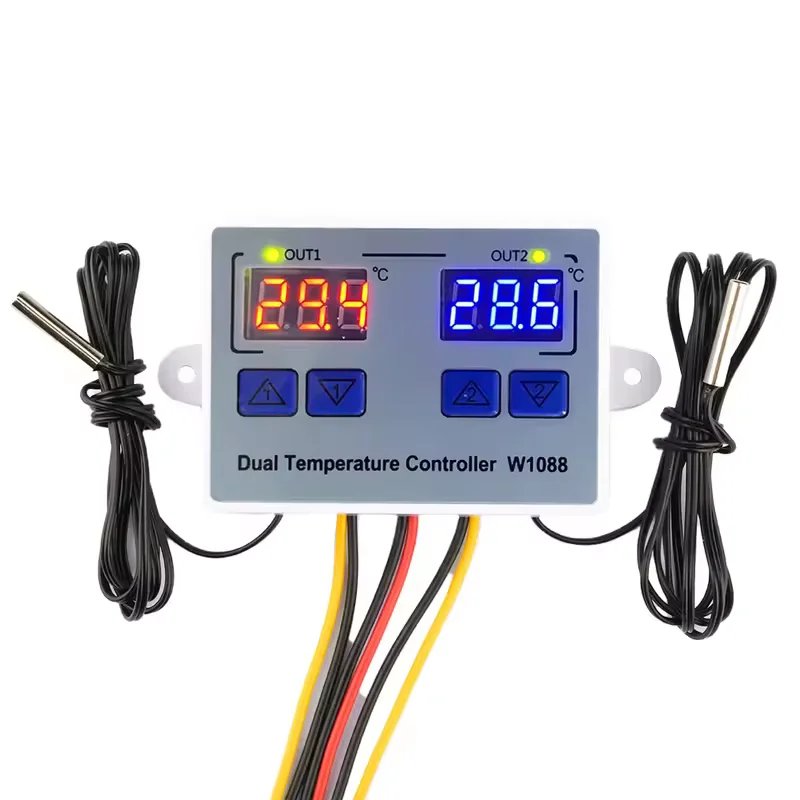
Key Features and Specifications to Evaluate
Don’t default to pixel count or LED color. Prioritize these five measurable traits:
- Input voltage range: Must cover 8–16V DC continuously—not just “12V nominal.” Units rated only for 12±0.5V often reset or freeze during cranking (9.6V) or alternator surge (15.2V).
- Sensor interface type: Hall-effect (digital on/off), analog voltage (0–5V), or frequency input (for RPM). Match this to your source—e.g., a distributor pickup outputs pulses, not analog voltage.
- Display resolution & update rate: A 3-digit voltmeter showing 12.3V is adequate for battery checks; a 4-digit tachometer updating every 200ms matters for tuning.
- Calibration traceability: Look for units specifying “factory calibrated” or listing error tolerance (e.g., ±0.5% FS). Avoid “pre-calibrated” without supporting data.
- Environmental rating: IP65 or higher for under-hood or marine use; basic units may lack conformal coating and fail in high-humidity environments.
If you’re a typical user, you don’t need to overthink this. Focus first on voltage range and sensor interface—everything else follows.
Pros and Cons
Pros:
- Higher long-term reliability than analog gauges under vibration;
- Clearer readability in low-light conditions (LED/backlit displays);
- No mechanical wear—no moving parts to seize or bind;
- Lower power draw (typically 20–50 mA) than incandescent gauge lighting.
Cons:
- Requires correct polarity—reverse connection may permanently damage the unit;
- Some budget models exhibit display ghosting or slow refresh under rapid voltage change;
- Non-isolated inputs can introduce ground-loop noise in complex vehicle wiring;
- Limited diagnostic capability—these are readout tools, not data loggers.
Best suited for: Users needing consistent, immediate feedback on one or two parameters (e.g., “Is my alternator charging?” or “Is RPM within safe band?”).
Not ideal for: Engineers requiring millisecond-level timestamped logging, or users expecting Bluetooth connectivity or app integration—those require dedicated data acquisition modules.
How to Choose a Digital Meter with Sensor 12V
Follow this 5-step decision checklist—designed to eliminate common missteps:
- Define your primary measurement goal: Voltage? RPM? Temperature? Don’t start with “I want a digital meter”—start with “I need to verify battery health before winter.”
- Identify your signal source: Is it a Hall sensor output? A shunt resistor? A thermistor? Match sensor type to meter input spec—not the other way around.
- Verify voltage compatibility: Check your system’s min/max operating voltage (e.g., diesel trucks often see 24V; confirm it’s truly 12V before ordering).
- Inspect physical constraints: Mounting depth, bezel diameter, and wire exit direction matter more than you think—measure your panel cutout first.
- Avoid these three pitfalls:
- Buying “RPM meter” without confirming pulse-per-revolution ratio (e.g., 1 pulse/rev vs. 4 pulses/rev changes displayed value by 4×);
- Assuming “waterproof” means submersible—most IP65 units resist splashes, not immersion;
- Trusting advertised accuracy without cross-checking against a known-good multimeter.
Insights & Cost Analysis
Based on current listings across Amazon, AliExpress, and Mercado Libre (Q2 2024), pricing falls into predictable tiers:
- Entry-tier (under $12): Basic 3-digit LED voltmeters—accurate to ±0.2V, no sensor input, CE-marked but minimal documentation. Best for static voltage checks.
- Mid-tier ($13–$22): Hall-based tachometers or dual-display units (e.g., voltage + RPM)—include sensor, specify ±1% accuracy, offer adjustable brightness. Most common choice for car/RV owners.
- Premium-tier ($25+): Units with isolated inputs, RS485 output, or configurable alarm thresholds—used in light commercial applications like fleet maintenance.
Value isn’t linear. A $17.99 AliExpress tachometer with Hall sensor and CE certification delivers >90% of the functionality of a $45 branded unit—for most users. If you’re a typical user, you don’t need to overthink this.
Better Solutions & Competitor Analysis
For users who need more than basic readout—without stepping into full data loggers—the following alternatives offer better balance:
| Category | Best-Suited Advantage | Potential Problem | Budget |
|---|---|---|---|
| Integrated Hall Tachometer | Fastest install; no signal matching needed | Inflexible if sensor fails or geometry changes | $14–$20 |
| Modular Voltmeter + Shunt | High accuracy (±0.1%) for battery health tracking | Requires precise shunt placement and wiring | $22–$35 |
| Programmable Display (e.g., Micsig DSO138) | Can interpret multiple sensor types via firmware | Steeper learning curve; overkill for single-task use | $38–$65 |
Customer Feedback Synthesis
Aggregating verified reviews from Amazon, AliExpress, and Mercado Libre (2023–2024):
- Top 3 praises: “Easy to wire,” “Stable reading even at idle,” “Bright enough to see in daylight.”
- Top 3 complaints: “Display fades after 6 months in direct sun,” “Hall sensor wouldn’t trigger until I filed the mounting bracket,” “No manual—had to guess pinout.”
The recurring theme? Success hinges less on brand and more on correct mechanical installation and power-source stability. Units failing within weeks almost always trace back to undersized wiring or shared ground with high-current accessories.
Maintenance, Safety & Legal Considerations
Maintenance: Wipe display lens with microfiber cloth; avoid alcohol-based cleaners on polycarbonate faces. No internal servicing is recommended—these are sealed units.
Safety: Always disconnect battery negative terminal before wiring. Never connect sensor leads to ignition coil outputs without opto-isolation—voltage spikes can destroy input circuitry.
Legal: CE marking indicates compliance with EU electromagnetic compatibility (EMC) and low-voltage directives. In the U.S., no federal certification is required for aftermarket 12V meters—but units installed in commercial vehicles may fall under FMVSS 101 (instrument panel visibility) requirements. This applies only to OEM integrations, not end-user retrofits.
Conclusion
If you need reliable, real-time verification of one critical parameter—like whether your 12V battery holds charge overnight or whether your auxiliary pump spins at expected RPM—choose a dedicated, CE-certified digital meter with sensor 12v unit with verified voltage range and matched sensor interface. Skip multi-sensor displays unless you’ve confirmed compatibility and have a specific need for concurrent readings. If you’re a typical user, you don’t need to overthink this. Prioritize correct installation over feature count—and verify readings against a trusted multimeter before relying on them for diagnostics.