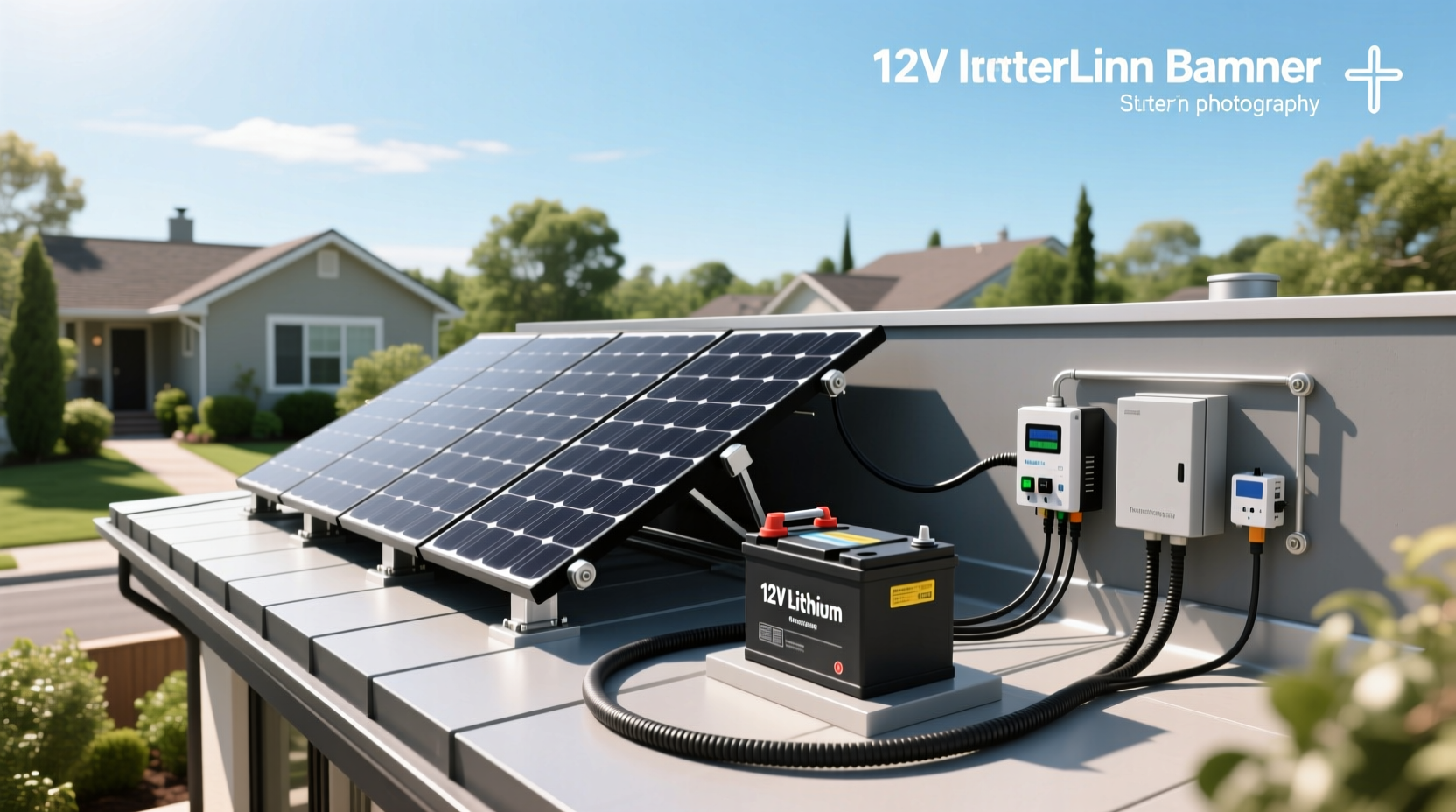
If you’re setting up off-grid power for an RV, boat, cabin, or emergency kit in 2026, start here: choose a 100W–200W monocrystalline solar panel paired with a 100Ah LiFePO4 battery. Over the past year, monocrystalline panel efficiency has climbed to 21.5%1, and LiFePO4 batteries now deliver 10+ year lifespans—making them the only rational choice over lead-acid for any user planning >2 years of use2. Skip foldable panels unless you camp weekly—and skip PWM charge controllers entirely. If you’re a typical user, you don’t need to overthink this.
About 12V Battery Solar Panels
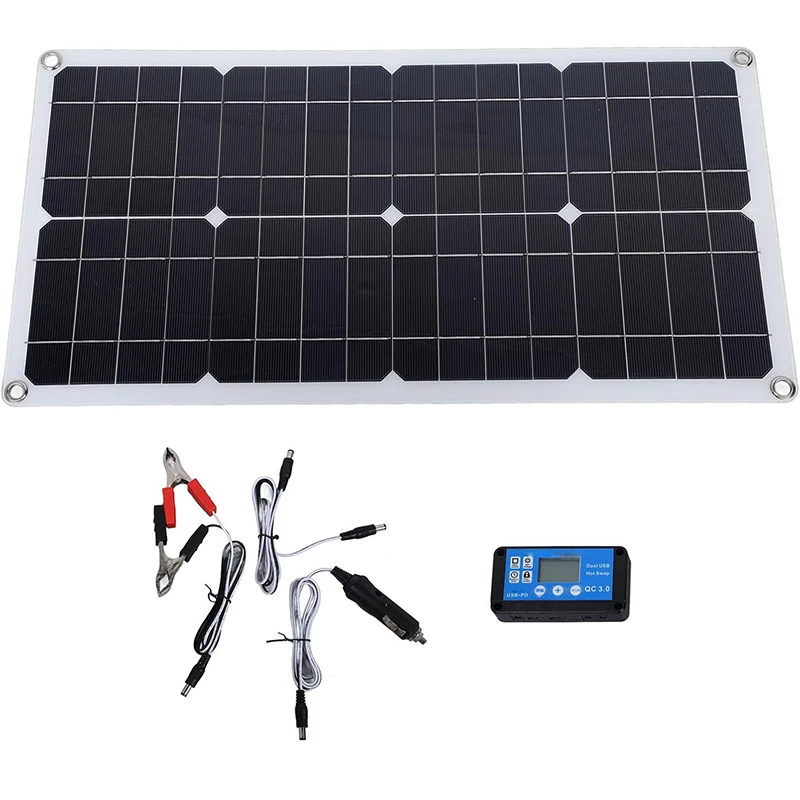
A 12V battery solar panel system is a self-contained, low-voltage DC power solution that combines a photovoltaic panel (typically rated at 12V nominal output), a charge controller, a 12V battery, and often basic wiring or mounting hardware. It’s not a grid-tied system—it’s designed for autonomy. The ‘12V’ designation refers to the battery’s nominal voltage, not the panel’s open-circuit voltage (which usually runs 17–22V to ensure reliable charging under load and temperature variation).
Typical use cases include:
- 🚐 RV & van life: powering lights, fans, small refrigerators, and USB devices while boondocking;
- ⛵ Marine applications: maintaining trolling motor batteries or running navigation electronics on sailboats or pontoons;
- 🏕️ Camping & overlanding: lightweight, portable energy for phones, headlamps, and portable fridges;
- 🏠 Remote cabins & sheds: basic lighting, security cameras, or water pump backup without grid access;
- 🚨 Emergency preparedness: powering radios, medical devices, or comms gear during outages.
This isn’t about replacing household AC loads. It’s about resilience where AC isn’t available—or affordable.
Why 12V Battery Solar Panels Are Gaining Popularity
Lately, three converging forces have accelerated adoption: rising residential electricity costs, expanded off-grid lifestyles, and sharper value in lithium storage. The U.S. residential solar battery market is projected to reach $12 billion by 20262, and global solar charger demand is expected to hit $9.03 billion in the same year3. This isn’t just hobbyist growth—it’s infrastructure-level momentum.
What changed? LiFePO4 chemistry matured. Where lead-acid batteries lasted 300–500 cycles and degraded rapidly below 50% depth of discharge, modern LiFePO4 units sustain 3,000+ cycles at 80% DoD—and retain >80% capacity after 10 years4. That shifts the math: even at 2–3× the upfront cost, LiFePO4 wins on $/kWh over time. And monocrystalline panels now deliver consistent output in partial shade and high heat—critical for mobile setups.
If you’re a typical user, you don’t need to overthink this. You’re not optimizing for lab conditions—you’re optimizing for reliability across seasons, temperatures, and usage patterns.
Approaches and Differences
There are three common approaches to building a 12V solar system—and each reflects a different priority: simplicity, portability, or scalability.
| Approach | Pros | Cons | Best For |
|---|---|---|---|
| Plug-and-play kits | Includes panel, controller, cables, and sometimes battery; pre-matched components; minimal wiring errors | Less flexibility; fixed wattage/battery size; often uses lower-tier LiFePO4 or AGM | Beginners, RV owners wanting fast deployment, seasonal users |
| Modular build (DIY) | Full control over panel efficiency, battery BMS quality, controller MPPT algorithm; future expansion-ready | Requires voltage/wiring knowledge; risk of mismatched specs (e.g., panel Voc > controller max input); longer setup time | Tech-savvy users, long-term off-gridders, marine or remote cabin owners |
| Foldable portable systems | Ultra-lightweight; packs into backpacks; ideal for hiking, festivals, short trips | Lower durability; reduced efficiency per sq. ft.; vulnerable to wind damage; limited battery integration | Backpackers, festival-goers, emergency responders, weekend campers |
The most common false dilemma? “Series vs. parallel wiring for multiple panels.” In practice, for 12V battery banks, parallel is almost always safer and more forgiving—unless your panel’s Voc exceeds your charge controller’s input limit (which happens rarely below 3 panels). When it’s worth caring about: if you’re adding >4 panels or operating above 35°C ambient. When you don’t need to overthink it: for a single 100W–200W panel, or two panels under 150W each. If you’re a typical user, you don’t need to overthink this.
Key Features and Specifications to Evaluate
Don’t optimize for one spec in isolation. Prioritize these four—and know when each matters:
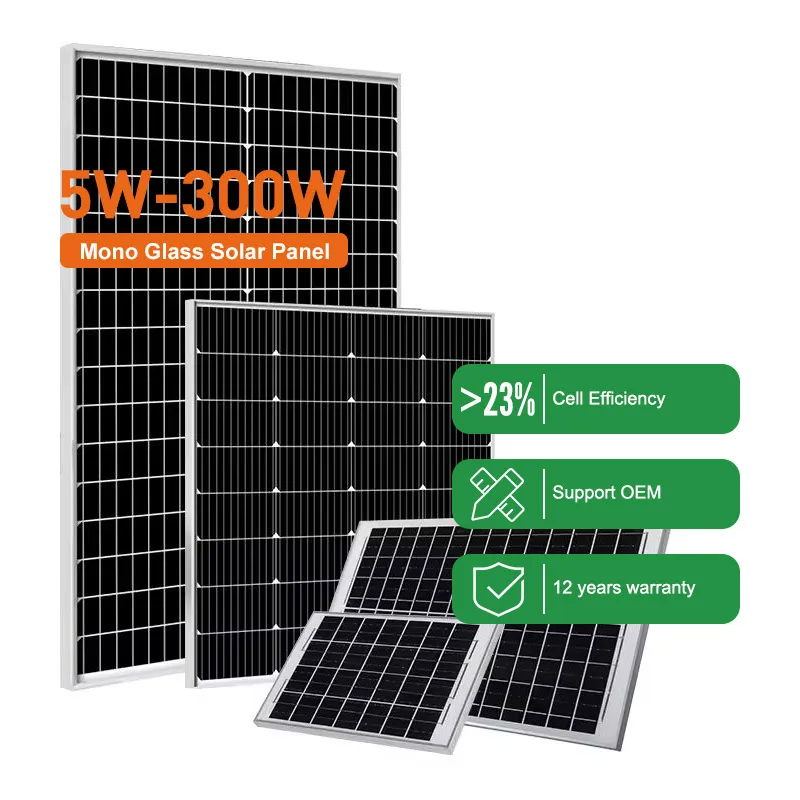
- Panel efficiency (21.5%+): When it’s worth caring about: if roof or deck space is tight (e.g., RV roof, kayak mount). When you don’t need to overthink it: if you have >2 m² of unshaded surface and budget allows 200W instead of 100W.
- Battery chemistry (LiFePO4 only): When it’s worth caring about: any application requiring >500 cycles or daily cycling. When you don’t need to overthink it: if you’re using lead-acid “just to save money”—you’ll replace it 3–4× before a LiFePO4 wears out.
- Charge controller type (MPPT required): When it’s worth caring about: every time. MPPT delivers 15–30% more harvest than PWM in real-world conditions (cloud, heat, low light). When you don’t need to overthink it: there is no scenario where PWM is better for a 12V solar panel + battery system in 2026.
- IP rating (IP65 minimum): When it’s worth caring about: marine, desert, or monsoon-prone environments. When you don’t need to overthink it: IP65 covers rain, dust, and splashing—sufficient for 95% of land-based use.
Pros and Cons
Advantages of modern 12V solar systems:
- ✅ No grid dependency—ideal for remote work, disaster prep, or travel;
- ✅ Lower lifetime cost than generator fuel + maintenance (especially with LiFePO4);
- ✅ Silent, zero-emission operation;
- ✅ Modular upgrades: add panels or batteries without rewiring core infrastructure.
Limitations to acknowledge:
- ❌ Cannot power high-wattage AC appliances (microwaves, air conditioners, kettles) without a large inverter and oversized battery bank—this moves beyond “12V system” into 24V/48V territory;
- ❌ Output drops significantly under heavy cloud cover or snow cover—plan for 30–50% winter derating;
- ❌ LiFePO4 batteries require a compatible BMS and low-temp cutoff (<0°C charging disabled)—not plug-and-play with old chargers.
This piece isn’t for keyword collectors. It’s for people who will actually use the product.
How to Choose a 12V Battery Solar Panel System
Follow this 5-step decision checklist—designed to eliminate guesswork:
- Calculate your daily Wh needs: List all devices, wattage, and hours used. Example: LED light (10W × 4h = 40Wh), phone charger (5W × 2h = 10Wh), fridge (60W × 8h = 480Wh) → ~530Wh/day. Round up to 600Wh.
- Size the battery first: For 600Wh/day, a 100Ah @ 12V = 1,200Wh usable capacity (at 50% DoD for lead-acid; 80% for LiFePO4 = 960Wh). So 100Ah LiFePO4 fits. Avoid undersizing—battery capacity dictates system resilience more than panel size.
- Select panel wattage based on location & season: Use PVWatts (NREL) or rule-of-thumb: 100W generates ~350–450Wh/day in summer (U.S. Sunbelt), ~200Wh in winter. For 600Wh winter need: ≥300W panel array.
- Choose MPPT controller rated ≥1.25× panel Voc and ≥1.3× max current: e.g., 200W panel @ 18V = 11.1A → pick 20A MPPT min. Verify low-temp Voc spec (panels gain voltage when cold).
- Avoid these three pitfalls: (1) Using a PWM controller with LiFePO4 (no voltage regulation precision); (2) Buying “12V” panels with Voc < 17V (won’t charge reliably); (3) Pairing high-efficiency panels with low-grade BMS batteries (wastes performance).
Insights & Cost Analysis
Based on mid-2026 B2B and retail pricing (Alibaba, REI, specialized solar retailers):
- 100W monocrystalline panel (rigid, PERC): $85–$120
- 200W monocrystalline panel (half-cell, bifacial): $150–$210
- 100Ah LiFePO4 battery (with BMS, Bluetooth monitoring): $420–$620
- 30A MPPT charge controller (Bluetooth, configurable): $95–$145
- Complete 200W + 100Ah kit (pre-wired, tested): $780–$1,050
The biggest ROI lever isn’t panel price—it’s battery longevity. A $500 LiFePO4 battery amortizes to ~$0.08/kWh over 10 years. A $180 AGM battery amortizes to ~$0.22/kWh—even before replacement labor.
Better Solutions & Competitor Analysis
For most users, the “better solution” isn’t a specific brand—it’s a specification stack: monocrystalline PERC + LiFePO4 + MPPT + IP65 enclosure. Below is how common configurations compare on real-world utility:
| Configuration | Fit for Purpose | Potential Issue | 2026 Value Rating |
|---|---|---|---|
| 100W mono + 100Ah LiFePO4 + 20A MPPT | Ideal for RVs, small cabins, moderate camping | May require supplemental charging in prolonged gray weather | ★★★★☆ |
| 200W bifacial mono + 200Ah LiFePO4 + 40A MPPT | Robust for full-time off-grid, boats, remote offices | Higher upfront cost; requires secure mounting surface | ★★★★★ |
| 50W flexible panel + 50Ah AGM + PWM | Only for emergency trickle-charge or very light loads | Underperforms in heat; AGM degrades fast with daily cycling | ★☆☆☆☆ |
Customer Feedback Synthesis
Aggregated from Reddit (r/solarenergy, r/vandwellers), DIY Solar Forum, and Amazon reviews (Q1 2026):
- Top 3 praised features: (1) Bluetooth-enabled MPPT controllers (real-time monitoring), (2) Drop-in LiFePO4 replacements for existing AGM bays, (3) Pre-terminated MC4 connectors reducing field wiring errors.
- Top 3 complaints: (1) Poor English manuals with incorrect wiring diagrams, (2) BMS low-temp cutoff triggering at 5°C instead of stated 0°C, (3) Foldable panel hinge failure after ~12 months of frequent use.
Maintenance, Safety & Legal Considerations
Maintenance: Wipe panels quarterly; check terminal torque annually; verify BMS firmware updates (if supported); inspect cable insulation for UV cracking.
Safety: Always disconnect battery before working on wiring. Use appropriately sized fuses (within 7” of battery positive terminal). Never mix battery chemistries or ages in parallel. LiFePO4 batteries require thermal management—avoid installing inside sealed compartments without ventilation.
Legal: Most 12V solar systems fall outside electrical code jurisdiction (NEC Article 690 applies to >50V systems). However, marine (ABYC E-11) and RV (NFPA 1192) standards require proper grounding, fuse placement, and wire gauge compliance. TUV/CE certification is strongly advised for controllers and batteries5.
Conclusion
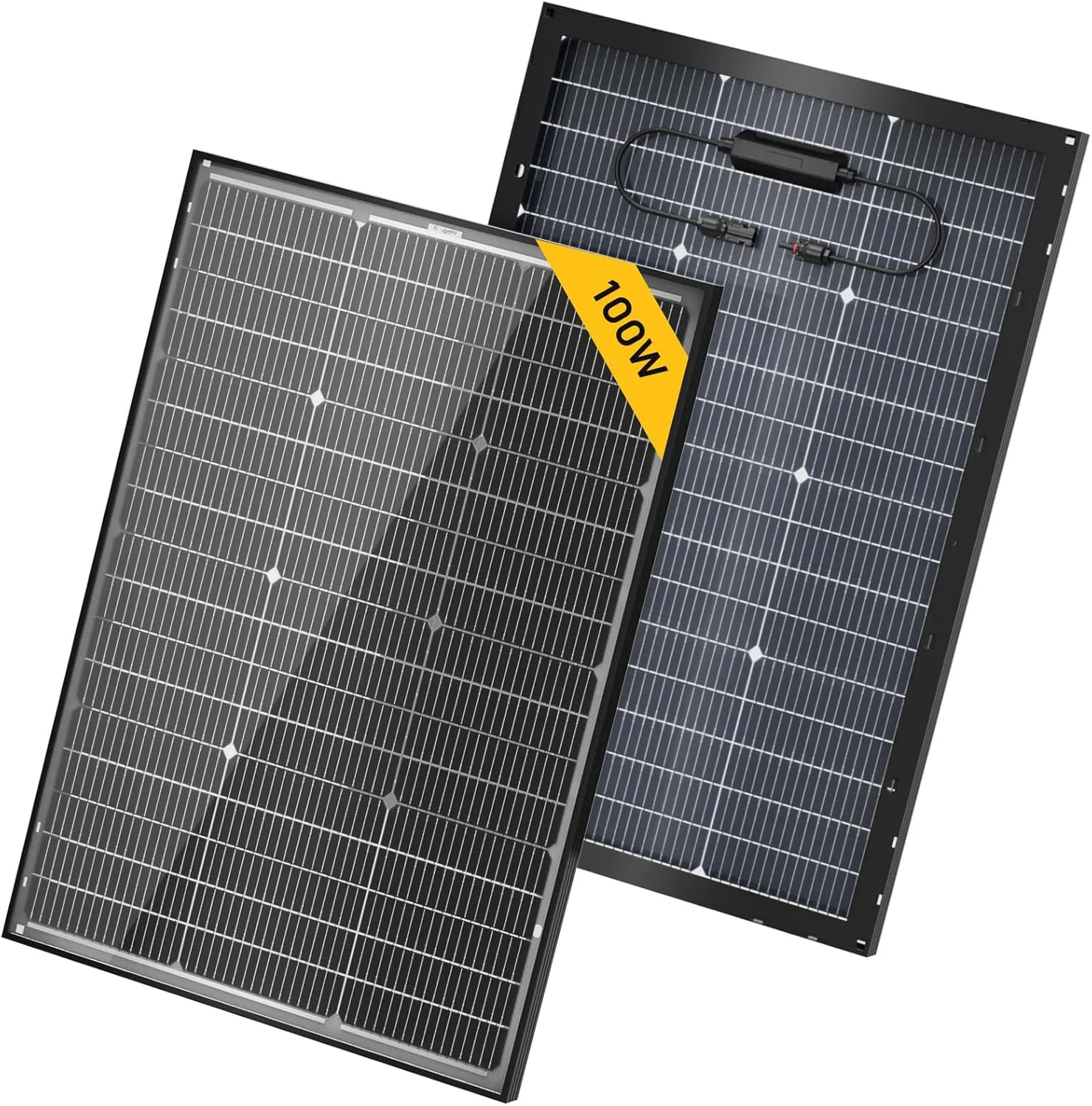
If you need reliable, low-maintenance power for an RV, boat, or remote site for 5+ years, choose a 200W monocrystalline panel + 100Ah LiFePO4 battery + 30A MPPT controller. If you’re a weekend camper with light loads, a 100W rigid panel + 50–100Ah LiFePO4 is sufficient—and far more durable than foldable alternatives. If you’re upgrading from lead-acid, replace the battery and controller together: pairing new LiFePO4 with an old PWM unit wastes 30% of potential harvest.
This piece isn’t for keyword collectors. It’s for people who will actually use the product.


