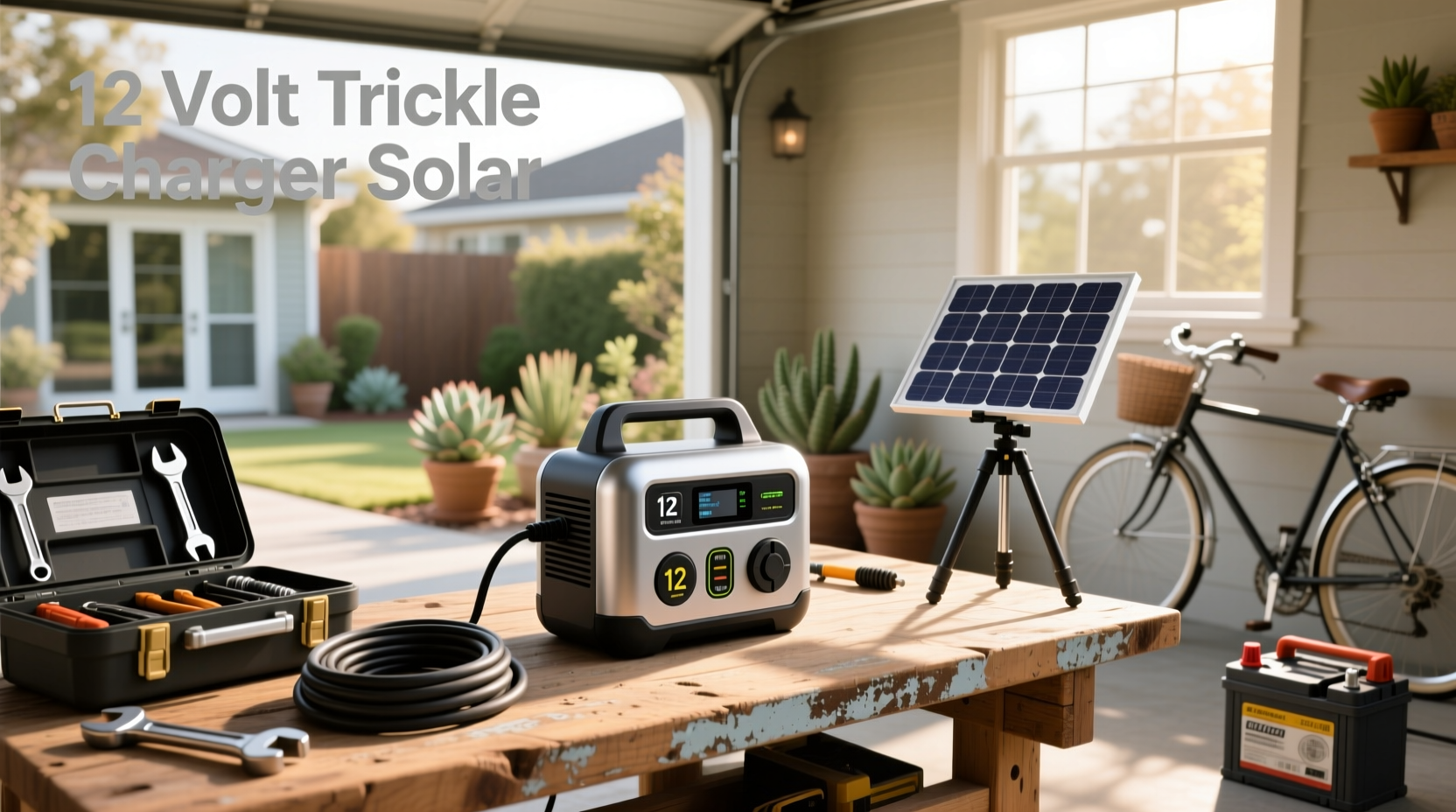
If you’re maintaining a car, RV, boat, or classic vehicle that sits idle for weeks — especially during winter or long trips — a 12V solar trickle charger is no longer optional. Over the past year, demand has surged as consumers prioritize off-grid resilience and battery longevity over grid-dependent solutions1. For most users, the optimal choice is a 10W–20W mono-crystalline unit with an IP67 rating and built-in MPPT controller, paired with alligator clips, O-ring terminals, and a 12V DC plug. Skip amorphous panels, avoid PWM-only controllers, and never assume a solar panel can revive a dead battery — it maintains, not jump-starts. If you’re a typical user, you don’t need to overthink this.
About 12V Solar Trickle Chargers
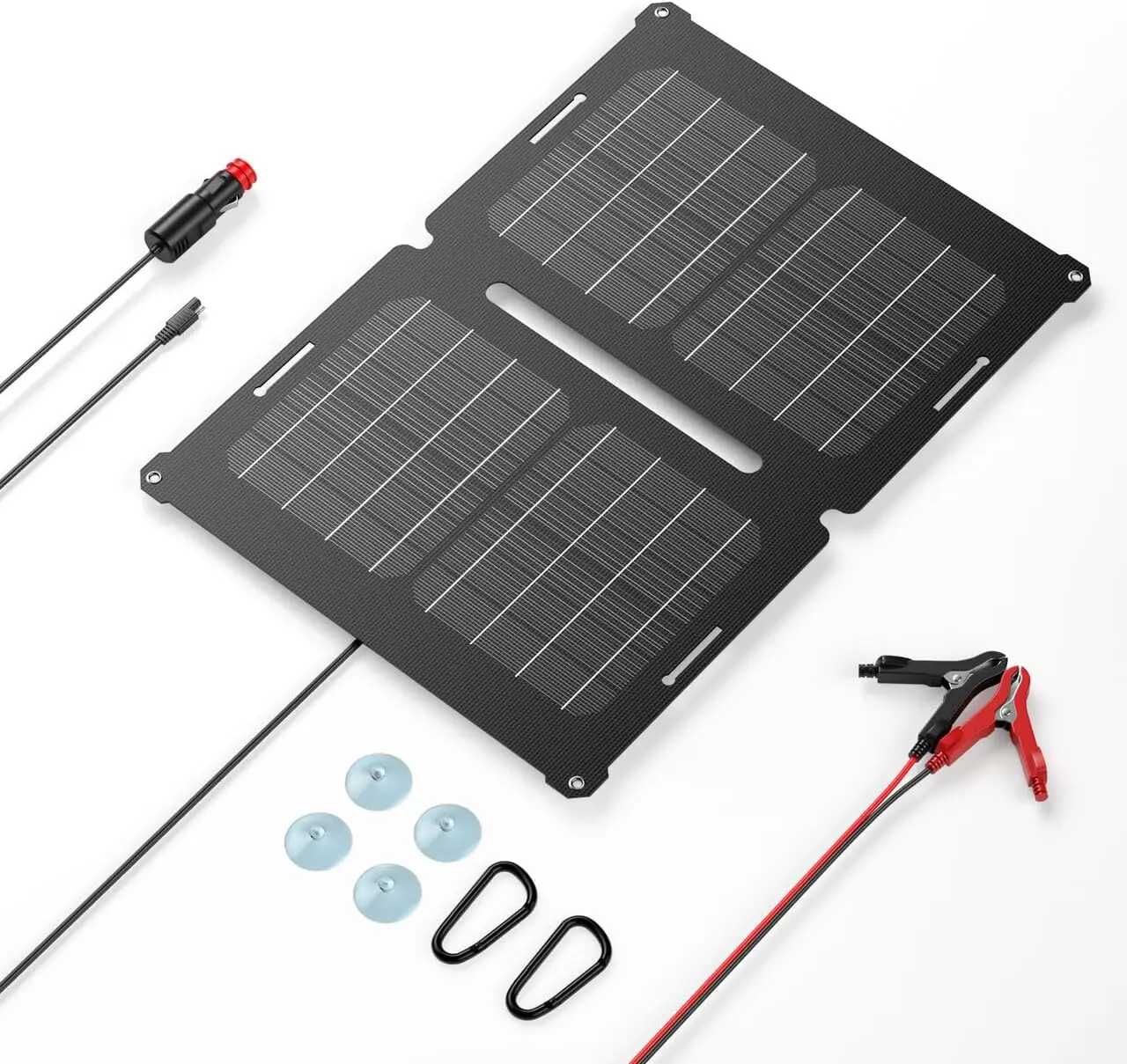
A 12V solar trickle charger is a low-wattage photovoltaic system designed to deliver a continuous, regulated current (typically 0.5–2A) to a 12V lead-acid or AGM battery — counteracting natural self-discharge and parasitic drain from modern vehicle electronics. Unlike full-featured solar power stations or high-amperage chargers, it’s not meant for rapid recharging or powering loads. Its purpose is passive, long-term maintenance: keeping a battery at ~12.6–12.8V without overcharging, sulfation, or voltage drop.
Typical use cases include:
- Storing a second car, motorcycle, or ATV for >2 weeks
- Maintaining RV or marine batteries during seasonal storage
- Supporting security systems or telematics units on parked fleet vehicles
- Backing up emergency preparedness kits for blackout scenarios
Why 12V Solar Trickle Chargers Are Gaining Popularity
Lately, three converging shifts have accelerated adoption. First, vehicle electronics have grown more power-hungry — infotainment systems, keyless entry modules, and telematics draw 20–50mA even when “off.” That adds up to ~1.5Ah per week, enough to flatten a healthy 60Ah battery in under two months2. Second, extreme weather events and rolling blackouts have elevated demand for passive, grid-independent readiness — a solar maintainer requires zero setup beyond placement and connection. Third, panel efficiency gains and cost reductions have made mono-crystalline units accessible: conversion rates now exceed 24%, and prices for reliable 15W units have stabilized between $18–$283.
This isn’t about “going green” as a lifestyle statement. It’s about preventing a $200 battery replacement, avoiding a tow truck call, or ensuring your emergency generator starts when needed. The emotional value isn’t optimism — it’s quiet confidence.
Approaches and Differences
There are three common technical approaches — and only one delivers consistent reliability across variable conditions.
| Approach | How It Works | Pros | Cons |
|---|---|---|---|
| MPPT Controller + Mono-Crystalline Panel | Uses microprocessor logic to dynamically adjust input voltage/current to harvest maximum available solar energy — even in partial shade or low-light conditions. | Up to 30% more efficient than PWM in suboptimal light; prevents overvoltage; extends battery life | Slightly higher cost; requires proper heat dissipation in enclosed spaces |
| PWM Controller + Polycrystalline Panel | Simple switch-mode regulator that pulses power to match battery voltage — no optimization for panel output variability. | Lower price point; proven reliability in full sun | Wastes ~20–30% of available solar energy in clouds/shade; less stable voltage regulation; higher risk of undercharging in winter |
| Amorphous Panel (No Controller) | Thin-film silicon layer directly bonded to flexible substrate; often bundled with basic diode-only regulation. | Lightweight; performs slightly better in diffuse light than poly; low profile | Efficiency rarely exceeds 8–10%; degrades faster outdoors; no reverse-current protection unless explicitly added |
When it’s worth caring about: MPPT vs. PWM matters most if your vehicle parks in shaded areas (e.g., under trees or carports), experiences frequent cloud cover, or sits through winter months with low sun angles.
When you don’t need to overthink it: If your car lives in full southern sun year-round and you only need summer maintenance, a well-built PWM unit may suffice — but MPPT is now standard in the $20+ range. If you’re a typical user, you don’t need to overthink this.
Key Features and Specifications to Evaluate
Not all specs carry equal weight. Focus on these four — ranked by real-world impact:
- Panel Type & Efficiency: Mono-crystalline dominates for good reason: 23–25% lab efficiency translates to usable output in real conditions. Polycrystalline (15–18%) and amorphous (<10%) require larger surface area for equivalent output — and degrade faster outdoors4.
- IP Rating: IP67 means dust-tight and submersible up to 1m for 30 minutes — critical for rain, snow, and roadside vibration. IP65 resists water jets but not immersion. Avoid units rated below IP65.
- Blocking Diode Integration: A non-negotiable feature. Without it, the panel acts as a resistor at night, slowly draining the battery. Look for “reverse discharge protection” explicitly stated — not just “diode included.”
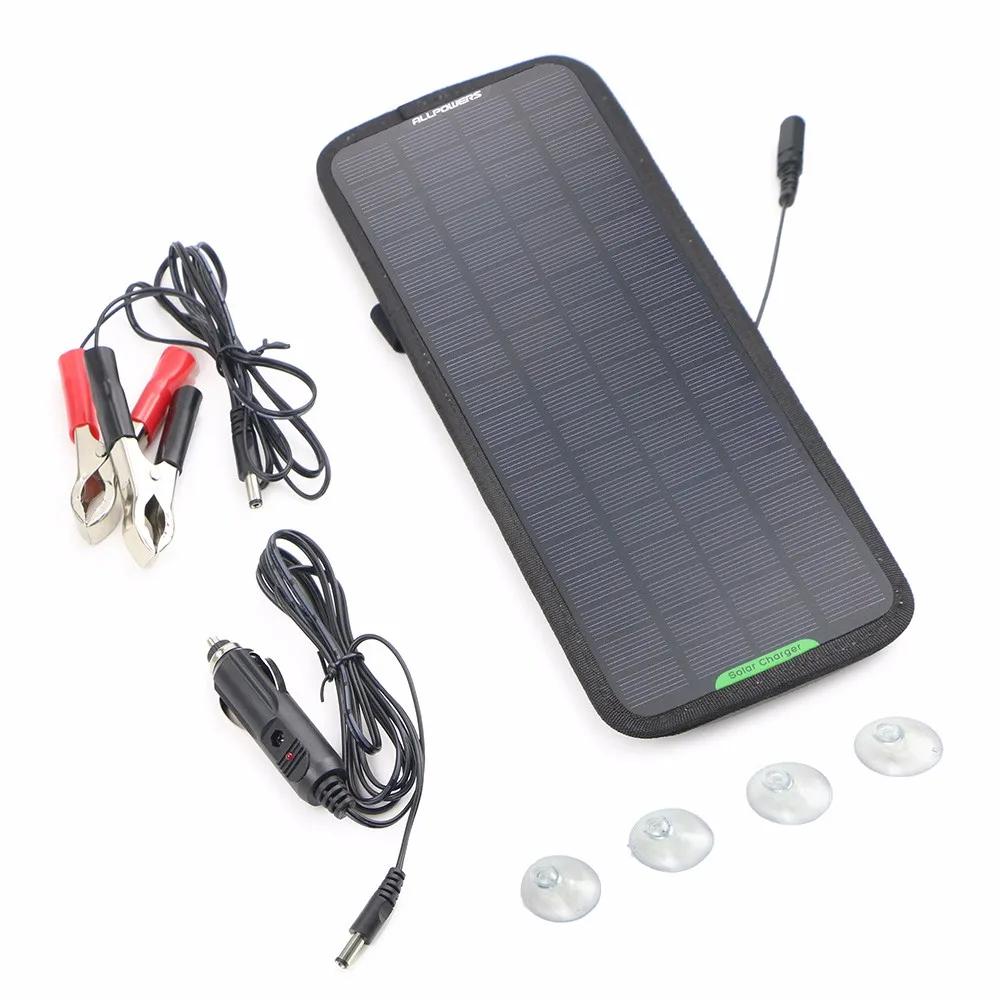
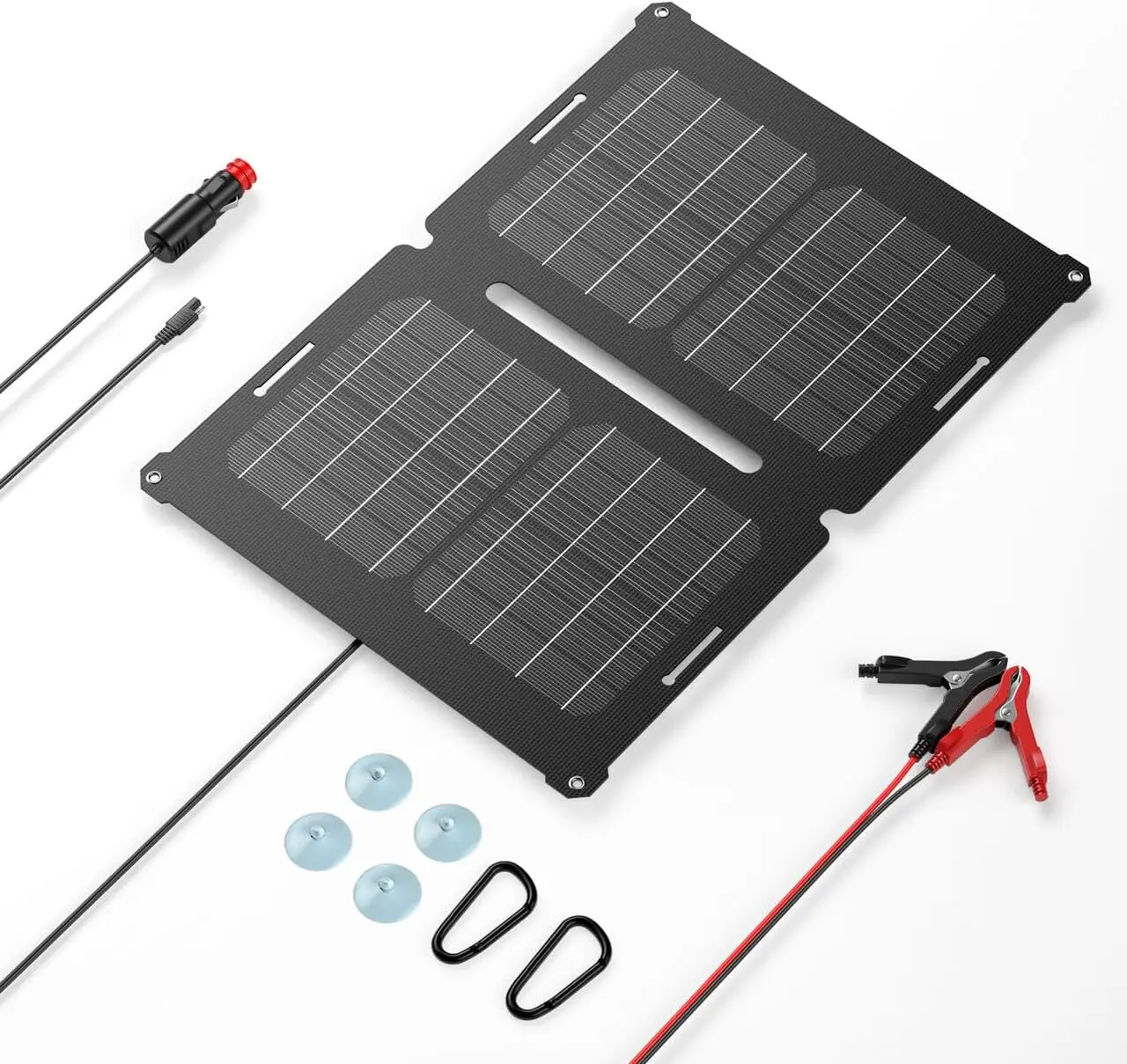
- Connection Flexibility: Triple-kit compatibility (alligator clips + O-ring terminals + 12V cigarette plug) eliminates installation friction. Cigarette ports often cut power when ignition is off — making clips or O-rings essential for true maintenance.
Pros and Cons
Pros:
- ✅ Zero operating cost after purchase
- ✅ Prevents sulfation and capacity loss during storage
- ✅ Silent, emission-free, and scalable (add panels if needed)
- ✅ No risk of overcharging when spec-compliant
Cons:
- ⚠️ Output drops sharply in heavy cloud cover or shade — not a substitute for AC charging if battery is deeply depleted
- ⚠️ Mounting requires secure, sun-facing placement — roof racks or dash mounts work best; hood mounting risks theft or wind damage
- ⚠️ Not compatible with lithium iron phosphate (LiFePO₄) batteries unless explicitly rated — most 12V solar maintainers target lead-acid chemistry
This piece isn’t for keyword collectors. It’s for people who will actually use the product.
How to Choose a 12V Solar Trickle Charger
Follow this five-step checklist before purchasing:
- Confirm battery type and capacity: Most 12V automotive batteries are 45–70Ah. For these, 10W–20W is ideal. Below 10W risks insufficient current in winter; above 20W adds complexity without benefit for maintenance-only use.
- Verify panel specs: Check manufacturer datasheets — not marketing copy — for cell type (mono), efficiency (%), and temperature coefficient (should be ≤ –0.4%/°C).
- Inspect enclosure and connectors: Look for UV-stabilized housing, stainless steel terminals, and silicone-jacketed cables — not PVC that cracks in cold.
- Check certifications: CE and RoHS are baseline. UL listing is rare but preferred for North American safety compliance. ISO 9001 signals manufacturing consistency — not product performance, but a useful proxy.
- Avoid these red flags: “Works in any light” claims (physically impossible), missing IP rating, no mention of blocking diodes, or warranty under 12 months.
Insights & Cost Analysis
Bulk pricing data shows clear tiers:
- $7–$12: Basic 5–10W polycrystalline units — often lack MPPT, IP67, or certified diodes. High return rate due to inconsistent output and night-time drain.
- $15–$25: 10–20W mono-crystalline units with MPPT, IP67, triple connections, and 2-year warranty — the sweet spot for reliability and value.
- $28–$35: Premium 20W+ units with smart diagnostics (LED status codes), adjustable charge profiles, or integrated USB outputs — useful only for multi-battery setups or commercial fleets.
Over the past year, the $18–$22 segment gained the highest consumer satisfaction scores — not because it’s “best,” but because it balances proven tech, durability, and realistic expectations5.
Better Solutions & Competitor Analysis
| Solution Type | Best For | Potential Issue | Budget Range |
|---|---|---|---|
| 15W MPPT Mono + IP67 | Most cars, SUVs, RVs, boats — balanced performance and simplicity | Requires occasional cleaning in dusty environments | $18–$24 |
| 20W Dual-Panel Kit | Large RV house batteries or dual-bank marine systems | Needs two mounting points; higher wind load | $28–$33 |
| 10W Flexible ETFE Panel | Curved surfaces (RV roofs, camper shells) where rigidity is impractical | Lower efficiency (~18%), shorter lifespan outdoors | $22–$27 |
Customer Feedback Synthesis
Based on aggregated reviews across retail and enthusiast forums (Overland Bound, Reddit r/fordranger, GridFreeNZ), top-rated units share three traits: clear “maintenance-only” labeling, physical robustness of clips and cables, and intuitive LED indicators (green = charging, red = fault). Frequent complaints cluster around:
- Units failing within 6 months — almost always tied to uncertified components or missing blocking diodes
- Confusion over cigarette-plug functionality — many users expect it to work while engine is off (it rarely does)
- Underestimating required sun exposure — 3–4 hours of direct light daily is minimum for effective maintenance
Maintenance, Safety & Legal Considerations
No special permits or legal registration are required for 12V solar trickle chargers in any major market. However, two safety practices are non-negotiable:
- Always disconnect the negative terminal first when attaching/removing clips — prevents short-circuit sparks near battery gassing zones.
- Never cover the panel while active — heat buildup damages cells and voids warranties. Use a breathable mesh cover only during transport or storage.
For maintenance: wipe the glass monthly with isopropyl alcohol and a microfiber cloth; inspect cables for cracking annually; test open-circuit voltage with a multimeter every 6 months (should read ≥18V in full sun).
Conclusion
If you need reliable, set-and-forget battery maintenance for a vehicle parked 2+ weeks — choose a 10W–20W mono-crystalline solar trickle charger with MPPT, IP67 rating, and triple connection options. If your parking spot is shaded or you live north of 40° latitude, lean toward 20W and verify the MPPT’s low-light cutoff (ideally ≤15V). If you only park in full sun for summer weekends, a 15W unit meets 95% of needs. If you’re a typical user, you don’t need to overthink this.


