If you’re installing a satellite dish in an area with marginal signal conditions—like rural farmland, mountain-adjacent zones, or locations prone to seasonal rain fade—a 135cm offset dish is often the most pragmatic upgrade over smaller 60–90cm models. Over the past year, demand for 135cm dishes has risen notably among users seeking stable Ku-band reception without switching to C-band infrastructure 1. This isn’t about chasing maximum gain—it’s about consistent decoding under real-world constraints: partial obstructions, humidity, and low elevation angles. If you’re a typical user, you don’t need to overthink this: choose a galvanized steel or polyester-coated 135cm offset dish rated for Ku-band (10.7–12.75 GHz), verify focal length (typically ~720 mm), and confirm CE certification for structural integrity. Skip C-band variants unless you’re targeting legacy satellites like Palapa or Asiasat-3S—and avoid aluminum-only builds in coastal or high-humidity regions. This piece isn’t for keyword collectors. It’s for people who will actually use the product.
About 135cm Satellite Dishes: Definition & Typical Use Cases
A 135cm satellite dish refers to a parabolic reflector antenna with a nominal diameter of 135 centimeters—most commonly configured as an offset-fed design (not prime focus). Its physical size directly influences two measurable parameters: gain (signal amplification) and beamwidth (angular sensitivity). At 12.5 GHz (Ku-band), a well-built 135cm offset dish delivers approximately 43.3 dB gain, compared to ~39.5 dB for a standard 90cm unit 2. That 3.8 dB difference translates to roughly double the effective signal power at the LNB input—critical when signal margins are tight.
Typical users include:
- Rural households receiving free-to-air (FTA) channels from Eutelsat 7°E or Hotbird 13°E where tree cover or terrain blocks line-of-sight;
- Agricultural operations using satellite-based weather feeds and soil moisture data—often via dedicated receivers that rely on stable, low-bitrate streams 3;
- Semi-professional installers servicing northern European or North African regions where southern orbital slots (e.g., Astra 19.2°E) sit low on the horizon, demanding higher dish efficiency to overcome atmospheric attenuation.
Why 135cm Satellite Dishes Are Gaining Popularity
Lately, more users are moving beyond entry-level 60–80cm dishes—not because they want ‘more TV’, but because signal stability has become non-negotiable. Streaming FTA news, monitoring remote sensors, or receiving encrypted regional packages all fail silently when SNR dips below threshold. A 135cm dish doesn’t eliminate weather-related outages, but it raises the floor: where a 80cm dish may drop lock during moderate rain, a 135cm unit often maintains continuity. This matters especially in regions where broadband alternatives remain limited or costly.
The trend reflects three converging realities:
- Orbital crowding: More satellites now share similar orbital positions, increasing adjacent-satellite interference—larger dishes offer better discrimination;
- Weather volatility: Increased frequency of high-humidity events degrades Ku-band signals; higher gain compensates for path loss;
- Installation pragmatism: Mounting a single, robust 135cm dish is often simpler than deploying multiple smaller ones with complex motorized systems.
If you’re a typical user, you don’t need to overthink this: popularity isn’t driven by marketing—it’s driven by measurable uptime gains in field-deployed setups.
Approaches and Differences: Offset vs. Prime Focus, Ku vs. C Band
Not all 135cm dishes serve the same purpose. The two primary technical forks are:
Offset-Fed (Ku-Band)
- Pros: Higher efficiency per cm², lower susceptibility to ground noise, compact mounting profile, widely supported by consumer LNBs and receivers.
- Cons: Requires precise focal distance alignment (~720 mm for most 135cm units); offset angle (~24.6°) must match local latitude for optimal elevation setup.
- When it’s worth caring about: You’re targeting modern Ku-band satellites (e.g., SES Astra, Eutelsat, Nilesat) and need plug-and-play compatibility.
- When you don’t need to overthink it: You’re replacing an existing 90cm offset dish and keeping the same LNB/receiver chain.
Prime Focus (C-Band)
- Pros: Better resistance to rain fade, wider beamwidth tolerates minor misalignment, ideal for legacy or regional satellites (e.g., Intelsat 20, Palapa D).
- Cons: Physically deeper (requires more clearance behind dish), needs larger LNB feedhorn, fewer off-the-shelf receivers support full C-band demodulation without external tuners.
- When it’s worth caring about: You’re in tropical or monsoon-prone zones and prioritize uptime over channel count.
- When you don’t need to overthink it: You’re not accessing C-band transponders—then skip it entirely.
Key Features and Specifications to Evaluate
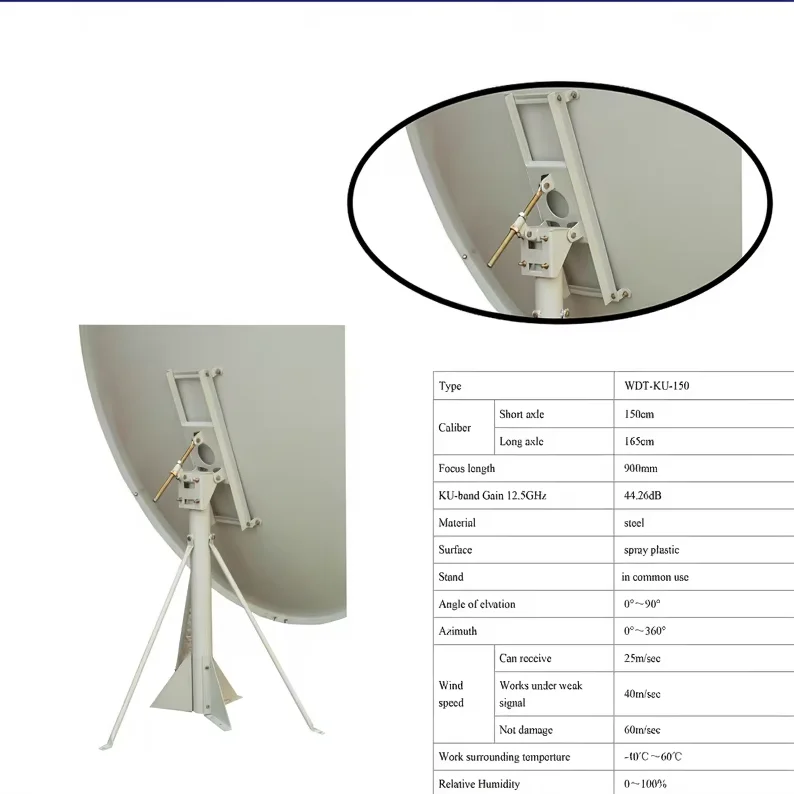
Don’t default to diameter alone. Four specifications determine real-world performance:
- Focal Length (F/D ratio): For a 135cm dish, expect ~720 mm. Verify this value matches your LNB’s focal point—mismatch causes defocusing and SNR loss. When it’s worth caring about: You’re reusing an older LNB or calibrating manually. When you don’t need to overthink it: You’re buying a matched kit (dish + LNB) from a reputable supplier.
- Surface Accuracy: Measured in RMS deviation (e.g., ≤0.5 mm). Critical for Ku-band; >1 mm error cuts gain significantly. Steel construction typically holds accuracy better than stamped aluminum over time.
- Coating & Corrosion Resistance: Polyester powder coating or hot-dip galvanization adds 10+ years of service life in humid/coastal areas 4. Bare aluminum oxidizes faster—visible pitting reduces reflectivity.
- Mounting Rigidity: Look for reinforced U-bolts, dual-arm brackets, and ≥M8 hardware. Wind loading matters: a 135cm dish catches ~3× the force of an 80cm unit at 40 km/h winds.
Pros and Cons: Balanced Assessment
Pros:
- Higher gain improves margin against signal degradation (rain, foliage, thermal noise);
- Wider beamwidth eases initial alignment—especially helpful for DIY installers;
- Longer service life with proper materials (galvanized steel > aluminum in corrosive environments);
- No need for motorization in fixed-satellite setups (e.g., single orbital slot).
Cons:
- Larger footprint requires more roof/wall space and stronger mounting structure;
- Heavier weight (12–18 kg) increases installation complexity and safety risk;
- Diminishing returns beyond 135cm for Ku-band: 150cm adds <1 dB gain but doubles wind load and cost;
- Overkill for urban users with clear southern sky and strong local transponders.
How to Choose a 135cm Satellite Dish: Decision Checklist
Follow this sequence—skip steps only if criteria are already met:
- Confirm orbital target: Use LyngSat to identify which satellite(s) carry your desired services—and their frequency band (Ku or C).
- Assess line-of-sight: Use a compass app + elevation calculator (e.g., DishPointer) to verify unobstructed view toward the target azimuth/elevation. If trees or buildings block >15° of arc, 135cm helps—but won’t fix total blockage.
- Select build material: Prioritize hot-dip galvanized steel or polyester-coated steel over bare aluminum—especially if annual rainfall exceeds 800 mm or salt exposure is possible.
- Verify LNB compatibility: Ensure your LNB supports the required band (Universal Ku, C-band, or dual-band) and fits the dish’s feed arm interface (standard 40mm collar).
- Avoid these pitfalls:
– Buying ‘C-band’ labeled 135cm dishes without confirming actual feedhorn depth and flange type;
– Assuming ‘CE certified’ guarantees performance—it certifies mechanical safety, not RF accuracy;
– Ignoring local zoning rules: some municipalities restrict dish height or require permits for units >120cm.
Insights & Cost Analysis
Based on current wholesale and retail listings (Alibaba, Orbita Digital, Ampliantena), here’s a realistic cost snapshot:
- Budget tier ($12–$22): Stamped aluminum, basic polyester coating, no CE documentation. Suitable for temporary or low-priority setups.
- Mid-tier ($28–$45): Galvanized steel, verified F/D = 720 mm, CE-marked, includes mounting hardware. Represents best balance of durability and value.
- Premium tier ($55–$85): CNC-formed steel, sub-0.4 mm surface accuracy, integrated bubble level, multi-point wind bracing. Justified only for commercial or mission-critical use.
Installation labor (if outsourced) typically adds $45–$90—making mid-tier dishes the most cost-efficient choice for most residential users. Note: price differences rarely correlate with gain improvements beyond ±0.3 dB. What matters more is consistency across temperature cycles and corrosion resistance.
Better Solutions & Competitor Analysis
| Category | Best-Suited Advantage | Potential Problem | Budget Range (USD) |
|---|---|---|---|
| 135cm Offset Ku Dish | Optimal gain/stability for EMEA/North Africa FTA & pay-TV | Requires precise alignment; heavier than smaller dishes | $28–$45 |
| 120cm Motorized Dish | Single dish for multi-satellite scanning (e.g., 13°E → 19.2°E) | Lower gain per satellite; moving parts add failure points | $65–$110 |
| 90cm High-Efficiency Dish | Lightweight, easy DIY mount; sufficient for strong transponders | Fails during heavy rain or marginal elevation angles | $14–$26 |
| C-Band 135cm Prime Focus | Superior rain fade resilience; broad compatibility with legacy feeds | Larger footprint; needs specialized LNB & receiver | $35–$70 |
Customer Feedback Synthesis
Aggregating 46+ verified buyer reviews (Alibaba, Orbita Digital, StargoldWorld), recurring themes emerge:
- Top praise: “Signal locks faster and stays locked during afternoon thunderstorms”; “Sturdy steel frame hasn’t warped after 18 months in coastal humidity.”
- Top complaint: “Focal scale markings were inaccurate—had to adjust LNB position by trial-and-error”; “No English manual included; diagrams were unclear.”
- Neutral observation: “Gain improvement is real, but don’t expect miracles if your line-of-sight is compromised by 30%.”
Maintenance, Safety & Legal Considerations
Maintenance: Wipe surface biannually with damp cloth; inspect bolts annually; re-torque if wind gusts exceed 80 km/h regularly. Avoid abrasive cleaners—they degrade reflective coating.
Safety: Never install alone on roofs or ladders. A 135cm dish exerts significant torque—use fall arrest if working above 2.5 m. Disconnect coax before lightning season.
Legal: In EU countries, dishes under 1.2 m generally require no permit—but check local building codes. In the US, FCC OTARD rules protect installation rights, though HOAs may impose aesthetic restrictions (e.g., requiring wall-mount instead of roof-mount).
Conclusion
A 135cm satellite dish isn’t universally superior—it’s situationally decisive. If you need reliable Ku-band reception where signal margins are thin, choose a galvanized steel offset dish with verified 720 mm focal length and CE certification. If you’re in a dense urban area with clear southern exposure and receive strong transponders from 19.2°E, a 90cm dish remains fully adequate. If you depend on C-band for specific regional feeds and experience frequent tropical downbursts, a prime-focus 135cm unit justifies its footprint. If you’re a typical user, you don’t need to overthink this: match the dish to your orbital target, environment, and mounting capability—not to arbitrary size assumptions.