If you’re outfitting an RV, mounting under a kitchen cabinet, or building a low-power mobile setup, skip the 24-inch models and go straight to a 15-inch TV with 12V DC input, Full HD (1080p) resolution, and IPS panel — especially if viewing angles matter in tight spaces. Over the past year, demand for sub-16-inch TVs has sharpened around real-world constraints: limited 12V battery capacity, cramped mounting zones, and the need for reliable smart functionality without overheating or draining power. This isn’t about shrinking screen size for novelty—it’s about matching hardware to physics. If you’re a typical user, you don’t need to overthink this: prioritize 12V compatibility first, then verify Android TV or Google TV support, and accept that built-in speakers will rarely suffice. This piece isn’t for keyword collectors. It’s for people who will actually use the product.
About 15-Inch TVs: Definition & Typical Use Cases
A 15-inch TV refers to a display with a diagonal screen measurement of approximately 15 to 15.6 inches—most commonly marketed as “portable,” “kitchen,” “RV,” or “flip-down” units. Unlike mainstream living-room TVs, these are engineered for constrained environments where power, space, and mounting flexibility outweigh raw resolution or peak brightness.
Typical users include:
- Van lifers and RV owners: Needing stable 12V DC operation, vibration resistance, and low standby draw (<2W).
- Kitchen renovators: Installing under-cabinet units that rotate or fold, often requiring ultra-thin profiles (<35 mm depth) and wide-angle visibility.
- Mobile educators or field technicians: Using battery-powered displays for demos, training, or remote diagnostics where AC outlets aren’t guaranteed.
These aren’t replacements for primary entertainment screens. They’re task-specific tools—like a ruggedized tablet with broadcast tuner and HDMI input. If you’re a typical user, you don’t need to overthink this: treat it as infrastructure, not lifestyle gear.
Why 15-Inch TVs Are Gaining Popularity
Lately, adoption has accelerated—not because screen tech improved dramatically, but because usage patterns shifted. The rise of full-time RV living (up 68% since 2020 1) and micro-kitchen renovations have exposed gaps in conventional TV design. Manufacturers responded with purpose-built hardware: integrated 12V regulators, passive-cooled chips, and lightweight aluminum chassis. Simultaneously, Google TV’s lightweight interface runs reliably on ARM-based SoCs—even at 1GB RAM—making smart features viable without thermal throttling 2. OLED panels remain rare at this size due to cost and yield issues, but newer IPS variants now deliver >178° viewing angles and 400 nits peak brightness—enough for shaded interiors 3. When it’s worth caring about: power source compatibility. When you don’t need to overthink it: whether it’s labeled “OLED” — it almost certainly isn’t, and IPS performs just as well in practice.
Approaches and Differences
Three main form factors dominate the 15-inch segment—each solving distinct problems:
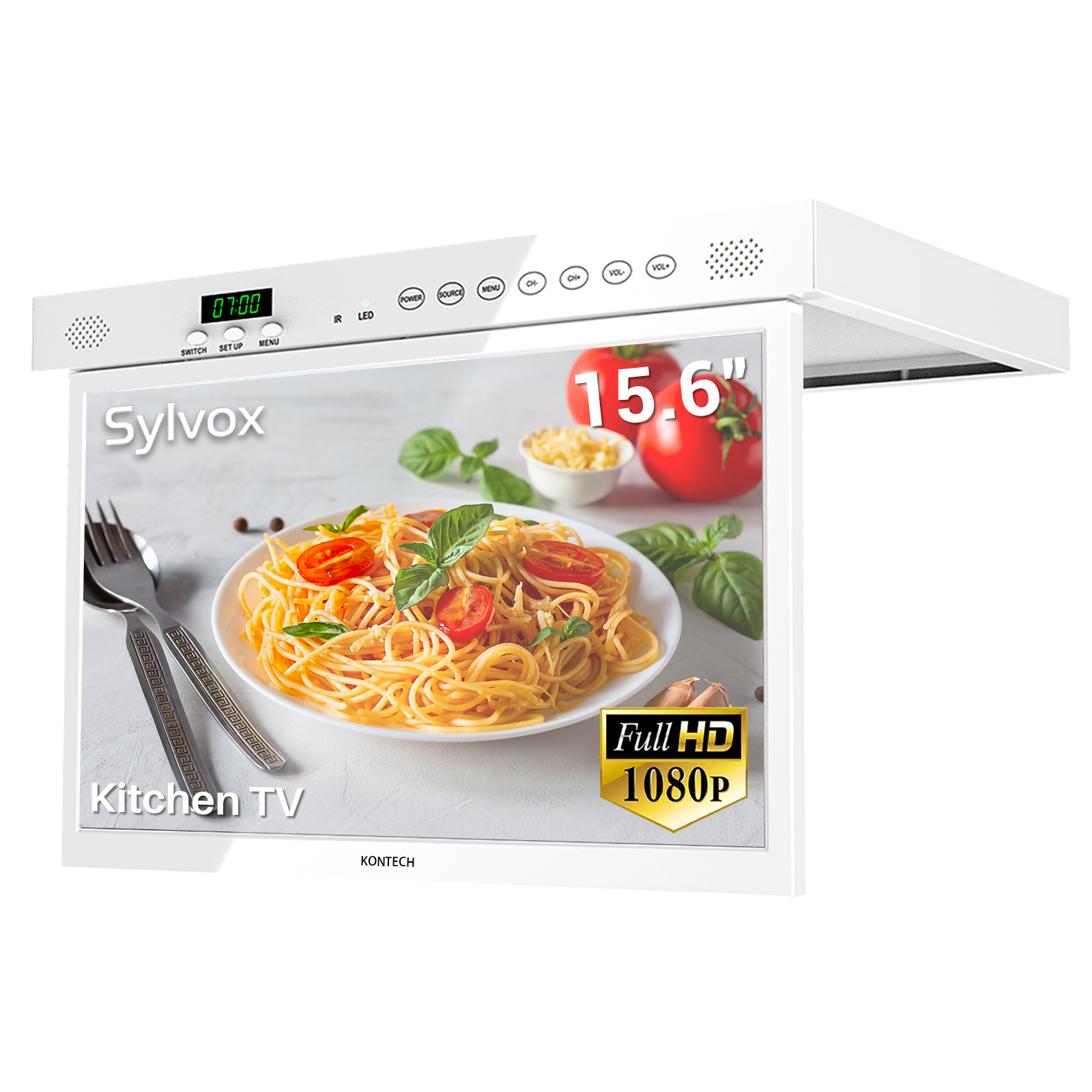
- Flip-down / under-cabinet models (e.g., SYLVOX 15.6") — Mount flush, rotate downward, often include IR remotes and analog tuners. Pros: Space-saving, fixed orientation, stable mounting. Cons: Limited portability, no battery, often lacks modern app stores.
- Battery-integrated portable TVs — Built-in Li-ion (typically 10,000–15,000 mAh), USB-C PD input, and foldable stands. Pros: True off-grid use, HDMI-in for cameras or game consoles. Cons: Heavier (1.8–2.3 kg), shorter runtime (~3–4 hrs at 50% brightness), software updates less frequent.
- 12V-dedicated RV TVs — No AC adapter; only hardwired 12V input (often with reverse-polarity protection). Pros: Lowest standby drain (<0.5W), ruggedized casing, fanless design. Cons: No battery backup, fewer smart features, often limited to YouTube/Netflix via sideloaded APKs.
When it’s worth caring about: Which power architecture matches your vehicle’s fuse panel or converter output. When you don’t need to overthink it: Whether the unit includes a physical antenna port—if you rely on streaming, OTA broadcast is secondary.
Key Features and Specifications to Evaluate
Don’t optimize for specs. Optimize for failure points. Here’s what matters—and why:
- Power Input: Must accept 10–32V DC (not just “12V compatible”). Real-world voltage in running vehicles fluctuates between 13.6–14.7V. Units with narrow 11–13V tolerance risk shutdown during alternator surges. When it’s worth caring about: If your RV uses a lithium house battery bank (which can hit 14.6V on charge). When you don’t need to overthink it: Whether it says “12V” on the box—verify the spec sheet.
- Panel Type: IPS is non-negotiable for shared viewing in kitchens or dinettes. VA panels offer deeper blacks but suffer severe color shift at 30° off-axis—unusable when mounted above eye level. When it’s worth caring about: If multiple people view simultaneously from different angles. When you don’t need to overthink it: Contrast ratio claims—IPS panels at this size rarely exceed 1,200:1, and higher numbers are marketing noise.
- Resolution: 1080p is the sweet spot. 720p looks soft at arm’s length; 4K is pointless on a 15-inch screen (pixel density >290 PPI offers no perceptible gain, and decodes poorly on low-end SoCs). When it’s worth caring about: If you’ll feed 1080p security camera feeds via HDMI. When you don’t need to overthink it: “HDR support”—no 15-inch TV meets even basic HDR10 luminance requirements (≥1,000 nits).
- Smart Platform: Android TV 11+ or Google TV (not “Android-based” forks) ensures Play Store access, voice search, and multi-user profiles. Avoid proprietary OSes lacking firmware update paths. When it’s worth caring about: If you depend on specific apps like Tidal or Plex. When you don’t need to overthink it: “Voice remote included”—most remotes lack mic calibration for small rooms, and far-field mics don’t exist here.
Pros and Cons
Pros:
- Low power draw (typically 8–12W active, <1W standby)—compatible with solar + lithium systems.
- Narrow bezels and thin profiles (<30 mm) suit under-cabinet or wall-arm mounts.
- Lightweight (1.2–2.3 kg) enables repositioning without structural reinforcement.
- Full HD resolution remains sharp at viewing distances under 1.2 meters.
Cons:
- Built-in speakers are universally weak—average output is ≤2W RMS with heavy bass roll-off. External Bluetooth speakers or soundbars are near-mandatory 2.
- Limited app ecosystem: No Apple TV+, Disney+, or Max pre-installed; some require APK sideloading.
- Few models support HDMI ARC or eARC—optical audio out is the most common workaround.
- No VESA mount standardization: Many use proprietary brackets, limiting third-party arm compatibility.
How to Choose a 15-Inch TV: A Step-by-Step Decision Guide
- Start with your power source: If you’re hardwiring into an RV or van, confirm voltage range (10–32V DC) and polarity protection. Skip any unit requiring an AC adapter.
- Define mounting intent: Under-cabinet? Wall-arm? Tabletop? Flip-down units need ≥15 cm clearance above; portable units need ≥3 cm vent space on all sides.
- Verify smart OS authenticity: Go to the manufacturer’s support page and check firmware update history. No updates in 12 months = likely abandoned platform.
- Test audio assumptions: Assume built-in speakers won’t suffice. Budget $40–$80 for a compact Bluetooth speaker (e.g., JBL Flip 6 or Anker Soundcore Motion+) with optical or 3.5mm aux input.
- Avoid these traps: “Dual-band Wi-Fi” claims (rarely implemented meaningfully at this tier); “4K upscaling” (uses basic bilinear interpolation); “Google Assistant built-in” (requires cloud round-trip—useless offline).
If you’re a typical user, you don’t need to overthink this: Your top two criteria are power input range and panel viewing angle—not processor speed or app count.
Insights & Cost Analysis
Price bands are tightly clustered:
- $85–$125: Entry-level 15.6" IPS units (e.g., SYLVOX, RUIZU) — 1080p, Android 9, 12V DC, no battery. Best for fixed-mount kitchen or RV use.
- $130–$185: Mid-tier with battery (10,000–12,000 mAh), Google TV, dual-band Wi-Fi, HDMI 2.0. Trade-off: heavier, shorter software support.
- $190–$260: Premium builds—aluminum chassis, certified 12V input (SAE J1113-12), HDMI ARC, optical out. Rare; mostly OEM-sourced for fleet installations.
Value peaks between $110–$145. Beyond that, you pay for materials and certification—not meaningful performance gains.
| Category | Best For / Key Advantage | Potential Problem | Budget Range (USD) |
|---|---|---|---|
| Flip-down Kitchen TV | Under-cabinet mounting, consistent sightline, plug-and-play | No portability; limited smart features; no battery | $85–$125 |
| Battery-Integrated Portable | Off-grid use, flexible placement, HDMI-in for external sources | Shorter lifespan (battery degrades after ~300 cycles); bulkier | $130–$185 |
| 12V-Dedicated RV Model | Direct fuse-box wiring, ultra-low standby, fanless cooling | Fewer apps; no consumer-facing support; limited retail availability | $190–$260 |
Customer Feedback Synthesis
Based on aggregated reviews across Target, Walmart, Amazon, and iRV2 forums 41:
- Top 3 praises: “Stays cool during 6-hour drives,” “Mounting kit actually fits standard cabinets,” “12V works straight from my Victron battery monitor.”
- Top 3 complaints: “Speakers distort above 60% volume,” “Remote sensor fails if mounted >2m away,” “No way to disable auto-brightness—screen dims in shaded campgrounds.”
Maintenance, Safety & Legal Considerations
No special certifications are required for 15-inch TVs in North America or EU—but two practical constraints apply:
- Heat dissipation: Never enclose in sealed cabinetry. Allow ≥2 cm airflow on all sides. Units exceeding 12W draw may require passive vents.
- Vibration resistance: In moving vehicles, use rubber grommets and lock-washers on mounting screws. Avoid glass-only stands.
- EMI compliance: All FCC-certified units list ID codes (e.g., 2ABCB-MODELXYZ) on the back label. Verify before purchase—non-compliant units may interfere with GPS or radio reception.
Conclusion
If you need a TV that runs reliably off your RV’s 12V system without draining batteries, choose a model with verified 10–32V DC input, IPS panel, and Google TV/Android 11+. If you’re mounting under a kitchen cabinet and want zero cable clutter, prioritize flip-down designs with integrated IR blasters and 90° rotation. If you need true off-grid flexibility and don’t mind swapping batteries, go mid-tier portable with ≥12,000 mAh capacity. If you’re a typical user, you don’t need to overthink this: stop comparing processors and start checking voltage tolerances.


