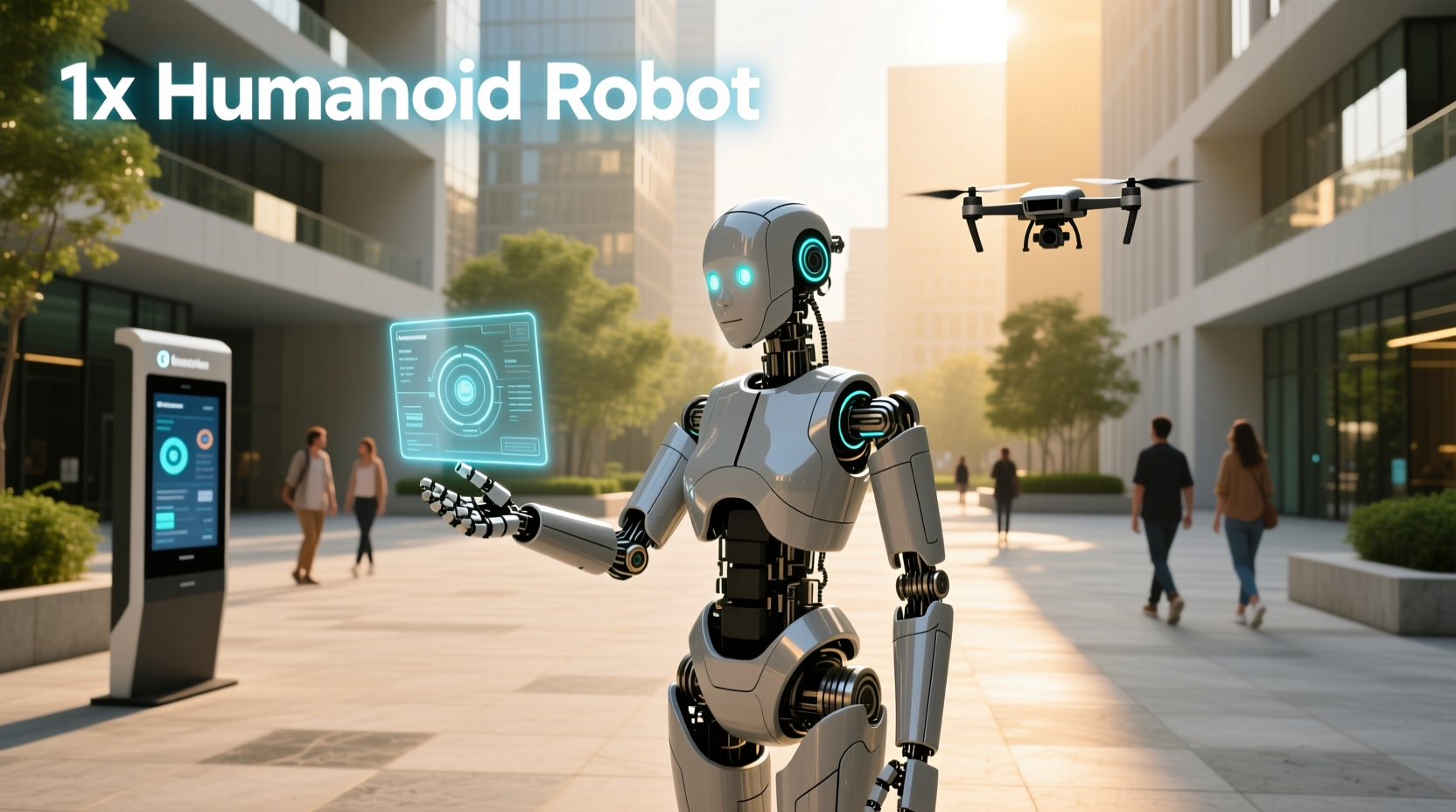
About 1X Humanoid Robots: Definition and Typical Use Cases
1X builds general-purpose humanoid robots designed for physical task execution in human environments — not just mimicry, but functional utility. Their current lineup consists of two distinct platforms: NEO, a bipedal home robot engineered for residential spaces, and EVE, a wheeled humanoid optimized for speed and stability in controlled industrial settings.
NEO stands at 5’6” (168 cm), weighs 66 lbs (30 kg), and carries up to 18 lbs per arm. Its tendon-driven actuation system prioritizes quiet operation and impact absorption — critical when sharing floors with children or pets 4. It navigates stairs, opens doors, and handles household objects using vision-language models (VLMs) trained on real-world domestic data. Its ‘Expert Mode’ teleoperation layer means remote pilots help train it in your actual home — accelerating autonomous capability without requiring full pre-programming.
EVE, by contrast, is lower-profile (4’2”), wheeled, and built for efficiency over adaptability. It operates at up to 3.5 mph on smooth surfaces, uses LiDAR + stereo vision for mapping, and performs repeatable workflows like inventory scanning, shelf monitoring, and perimeter patrol. Its Revo1 motor architecture and learning models were foundational to NEO’s development — but EVE itself lacks stair-climbing, dexterous manipulation, or soft-body compliance 5.
Why Choosing the Right Humanoid Robot Is Gaining Popularity in 2026
Humanoid adoption isn’t rising because they look human — it’s rising because they solve urgent, measurable problems. Three drivers dominate 2026: labor scarcity, embodied AI readiness, and cost-accessibility via Robot-as-a-Service (RaaS).
Across the EU, 63% of SMEs report persistent talent gaps in physical operations roles 6. In Japan and the U.S., aging populations are shrinking the pool of available care and maintenance workers — making assistive robotics less speculative and more operational. Simultaneously, vision-language models have matured enough to interpret natural language commands (“Put the laundry basket in the bedroom”) without rigid scripting — enabling true zero-shot task instruction 7. Finally, RaaS models — like 1X’s $499/month subscription — decouple upfront capital expenditure from value delivery, letting users test utility before committing to hardware ownership.
If you’re a typical user, you don’t need to overthink this: popularity isn’t about novelty — it’s about narrowing the gap between what humans *must do* and what robots can now *reliably do*.
Approaches and Differences: NEO vs. EVE
The core distinction isn’t “which is better,” but “which matches your environment and workflow.” Below is how their architectures translate into real-world behavior:
- NEO (Bipedal, Soft-Body Home Robot): Prioritizes environmental flexibility. Uses compliant actuators, 3D-printed outer shell, and emotive ear rings for status feedback. Requires no infrastructure retrofitting — works on carpet, hardwood, tile, and stairs. Best for homes, assisted living facilities, and mixed-use office lobbies.
- EVE (Wheeled, Industrial Predecessor): Prioritizes throughput and uptime. No climbing ability, but achieves >99.2% task completion rate in flat, GPS-denied indoor warehouses 8. Integrates with existing WMS and RTLS systems. Requires minimal floor prep — but cannot handle thresholds, ramps, or uneven surfaces.
When it’s worth caring about: mobility type. If your space includes stairs, door sills, or varied flooring, bipedal is non-negotiable. When you don’t need to overthink it: brand pedigree. Both share the same underlying AI stack — differences lie in mechanical design, not intelligence tier.
Key Features and Specifications to Evaluate
Don’t default to specs sheets. Focus instead on features that correlate directly with outcome reliability:
- Payload & Dexterity: NEO’s 18-lb/arm capacity covers 92% of common household lifting tasks (laundry baskets, grocery bags, small appliances). EVE’s payload is higher (25 lbs), but its gripper lacks fine manipulation — it’s built for pallet tagging, not folding towels.
- Safety Certification: NEO carries IP67-rated hands and a soft-body rating compliant with ISO/TS 15066 for collaborative robots. EVE meets ISO 13849 PLd for industrial machinery — appropriate for segregated workspaces, not shared living areas.
- Autonomy Model: NEO uses hybrid autonomy — VLM-guided planning + human-in-the-loop refinement. EVE runs deterministic path-following with scheduled retraining. Neither is fully unsupervised — but NEO’s model adapts faster to novel layouts.
If you’re a typical user, you don’t need to overthink this: raw torque numbers or CPU clock speeds rarely predict real-world performance. What matters is whether the robot fails gracefully — and whether its safety profile matches your risk tolerance.
Pros and Cons: Balanced Assessment
✅ NEO fits when: You need stair traversal, operate in unstructured or multi-level homes, prioritize safety around children/pets, or want progressive autonomy via home-specific training.
❌ NEO doesn’t fit when: Your budget is under $25,000 upfront (or $499/month RaaS), you require >12-hour continuous runtime, or your environment has no Wi-Fi coverage — NEO relies on cloud-assisted inference.
✅ EVE fits when: You manage a warehouse, secure campus, or distribution center with consistent flooring, need rapid ROI on repetitive mobile tasks, and already run enterprise fleet management software.
❌ EVE doesn’t fit when: You need object recognition beyond barcodes/QR codes, require manipulation of irregularly shaped items, or expect integration with consumer smart-home ecosystems (Matter, HomeKit).
How to Choose a Humanoid Robot in 2026: A Step-by-Step Decision Framework
Follow this checklist — and avoid these three common pitfalls:
- Map your physical environment first — measure stair pitch, door clearance, floor transitions, and Wi-Fi signal strength in key zones. If stairs exist, eliminate wheeled options immediately.
- Define your top 3 recurring tasks — e.g., “retrieve medication from upstairs cabinet,” “patrol ground-floor perimeter nightly,” “sort recyclables by material type.” Match each to documented capabilities — not marketing claims.
- Verify service model alignment — RaaS includes OTA updates, remote diagnostics, and hardware refresh cycles. Upfront purchase requires in-house maintenance capability and spare-part access.
- Avoid over-indexing on ‘human-like’ appearance — facial expressiveness adds cost and complexity without improving task success rates. Prioritize functional ergonomics (reach envelope, grip force, field-of-view).
- Avoid assuming cross-platform software compatibility — NEO’s Expert Mode tools won’t run on EVE firmware, and vice versa. There is no unified 1X OS — only shared learning models.
This piece isn’t for keyword collectors. It’s for people who will actually use the product.
Insights & Cost Analysis
NEO’s RaaS starts at $499/month (3-year minimum), including hardware, software, support, and annual hardware refresh. Upfront purchase is $39,900. EVE’s industrial lease begins at $349/month (with volume discounts above 5 units); outright purchase is $29,500. Both include standard 24/7 remote monitoring and SLA-backed response times (<4 hrs for critical faults).
For context: entry-level bipedal developer kits start at $13,500 (e.g., Unitree H1), while STEM-focused educational platforms begin below $500 — but none offer NEO’s safety certification or EVE’s industrial integration depth 9. If you’re a typical user, you don’t need to overthink this: price alone isn’t the bottleneck — it’s whether your use case justifies the operational overhead of managing a humanoid platform at all.
Better Solutions & Competitor Analysis
No single platform dominates all scenarios. Below is how 1X compares against accessible alternatives serving overlapping needs:
| Platform | Best For | Potential Issue | Budget Range |
|---|---|---|---|
| 1X NEO | Home assistance, multi-level navigation, safety-first deployment | Requires stable broadband; limited battery life (~4 hrs active) | $499/mo (RaaS) or $39,900 (upfront) |
| 1X EVE | Warehouse logistics, perimeter security, flat-floor automation | No stair capability; minimal dexterity beyond grasping | $349/mo (RaaS) or $29,500 (upfront) |
| Unitree H1 | Developer prototyping, academic research, open-source customization | No certified safety suite; no commercial support SLA | $13,500–$16,000 |
| Figure 02 | Industrial material handling, factory floor collaboration | Limited availability; no consumer-facing sales channel | Not publicly priced (enterprise quote only) |
Customer Feedback Synthesis
Early adopters (via beta programs and pilot deployments) consistently praise NEO’s intuitive voice interface and responsive emergency stop behavior. Common friction points include setup time for home mapping (avg. 3.2 hours) and occasional latency in complex lighting conditions (e.g., dusk near windows). EVE users highlight reliability in temperature-controlled environments but note reduced accuracy in humid or dusty air — a known limitation of its stereo-vision stack.
Maintenance, Safety & Legal Considerations
Both NEO and EVE require quarterly calibration and biannual firmware validation — included in RaaS. NEO’s soft-body design complies with ISO/TS 15066 for power-and-force limiting, making it suitable for unmonitored cohabitation. EVE follows ISO 13849 for industrial machinery — meaning it must be deployed behind safety fencing or with area-scanning sensors unless used in low-risk patrol mode.
Legally, neither platform qualifies as a medical device or personal mobility aid — so FDA or CE MDR pathways don’t apply. However, import tariffs for humanoid robots shipped from China to the U.S. currently range from 2.5% to 5.3%, depending on classification under HTS code 8543.70 10. This affects landed cost but not functionality.
Conclusion
If you need reliable, safe, stair-capable assistance in a home or mixed-use building — choose 1X NEO. If you need high-speed, repeatable task execution in a flat, controlled industrial environment — choose 1X EVE. If you’re a typical user, you don’t need to overthink this: the decision hinges on floor plan, not feature lists. Neither robot replaces human judgment — but both extend human reach where physical labor is scarce, dangerous, or unsustainable.


