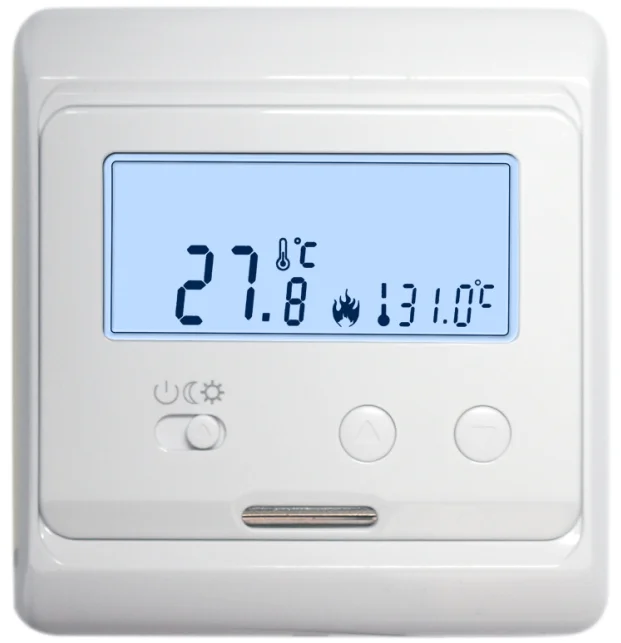
Over the past year, demand for 2-wire digital thermostats has accelerated—not because they’re new, but because older homes are finally getting smarter without rewiring1. If you have a heat-only system (gas furnace, oil boiler, millivolt fireplace, or electric baseboard) with just two wires at the wall—and no C-wire—you need a solution that’s accurate, safe, and actually compatible. Skip the trial-and-error: start with battery-powered digital models for low-voltage (24V) heat-only systems; avoid line-voltage (120V/240V) thermostats unless your heater explicitly requires them—mismatching causes failure or fire risk2. For most users, a non-programmable digital thermostat like the Honeywell TH1100DV delivers reliable +/-1°F control without complexity. If remote access matters, confirm the model includes a power-stealing circuit or C-wire adapter—otherwise WiFi won’t stay powered. This piece isn’t for keyword collectors. It’s for people who will actually use the product.
About 2-Wire Digital Thermostats
A 2-wire digital thermostat is a temperature controller designed for heating-only systems that supply power through only two conductors—no neutral, no common (C) wire, and often no external transformer. Unlike modern multi-wire smart thermostats, these units operate on minimal electrical infrastructure. They’re commonly installed in older homes with:
• Gas or oil furnaces using 24V control circuits
• Millivolt systems (e.g., standing-pilot fireplaces or floor furnaces)
• Electric resistance heaters—but only if rated for line voltage (a critical distinction)
• Boilers with simple on/off aquastat interfaces
They do not support cooling, multi-stage heating, or heat pumps. Their purpose is singular: deliver precise, stable, and energy-efficient heat control where wiring options are physically constrained.
Why 2-Wire Digital Thermostats Are Gaining Popularity
Lately, adoption has surged—not from novelty, but from necessity. As legacy mechanical thermostats fail (bimetal strips wear, mercury switches leak), homeowners seek upgrades that preserve existing wiring. The market for 2-wire digital solutions is projected to grow at a CAGR of 12.67% through 20353. Three drivers explain this:
- ✅ Digital accuracy over analog drift: Mechanical units often swing ±3–5°F; digital models hold within ±1°F, reducing overshoot and fuel waste4.
- ✅ Smart features without rewiring: Power-stealing technology lets some models harvest micro-current during heating cycles to run WiFi radios—eliminating the need for a C-wire retrofit5.
- ✅ Energy-conscious simplicity: Even basic non-programmable digital units prevent the “temperature creep” common in old dials—helping users save ~5–10% on heating bills without changing habits6.
If you’re a typical user, you don’t need to overthink this. You just need a device that reads accurately, fits your wires, and doesn’t require an electrician.
Approaches and Differences
Three main categories dominate the 2-wire space—each solving different priorities. Choosing wrong means wasted time, compatibility failures, or safety risks.
| Category | Best For | Key Limitation | Battery Dependency |
|---|---|---|---|
| Non-Programmable Digital | Users who want “set and forget” reliability—no schedules, no app, no updates | No remote control or automation; manual adjustment only | Yes (2–4 AA/AAA; 1–2 years life) |
| Programmable Digital | Households with predictable routines (e.g., work hours, sleeping patterns) | Requires consistent battery replacement; no learning or adaptive logic | Yes (same as above) |
| Smart (WiFi) 2-Wire | Homeowners needing remote access, geofencing, or integration with Alexa/Google/Home Assistant | Power-stealing must be verified; some models fail intermittently on weak transformers | Often hybrid: battery + power-stealing (but batteries still needed as backup) |
When it’s worth caring about: If your furnace cycles frequently (e.g., every 5–8 minutes), power-stealing may not generate enough sustained current for stable WiFi—opt for non-programmable instead.
When you don’t need to overthink it: If your system runs long cycles (15+ min), most modern power-stealing thermostats work reliably. If you’re a typical user, you don’t need to overthink this.
Key Features and Specifications to Evaluate
Not all 2-wire thermostats are equal—even within the same category. Prioritize these five specs before comparing aesthetics or brand names:
- Voltage rating: Confirm whether your system is low-voltage (24V) or line-voltage (120V/240V). Using a 24V thermostat on a line-voltage heater can cause arcing, melting, or fire2. Check your furnace label or transformer—don’t guess.
- Millivolt compatibility: Required for standing-pilot fireplaces or unpowered floor furnaces. Not all 2-wire models support this; look for explicit “millivolt-rated” labeling7.
- Precision tolerance: Reputable digital units specify ±1°F accuracy. Avoid models that omit this spec—they likely use cheaper thermistors prone to drift.
- Short-cycle protection: Built-in delay (typically 5 minutes) prevents compressor or burner damage from rapid on/off cycling. Non-negotiable for furnace longevity8.
- Backlit display & button layout: Critical for readability in dim basements or hallways. Horizontal profile models also better cover old round thermostat cutouts9.
When it’s worth caring about: If your furnace is 15+ years old, short-cycle protection directly impacts repair frequency and lifespan.
When you don’t need to overthink it: Backlight brightness varies, but any LED-lit display beats analog dials—no need to compare lux ratings.
Pros and Cons
Pros:
• No rewiring required—installs in under 10 minutes
• Higher accuracy than mechanical predecessors (+/-1°F vs. +/-4°F)
• Battery operation eliminates dependency on transformer health
• Wide compatibility with legacy gas/oil/boiler/millivolt systems
• Lower upfront cost than full smart-hub ecosystems
Cons:
• No cooling control (by design)
• Smart models may drop WiFi during extended idle periods without C-wire
• Line-voltage versions lack UL certification in many low-cost imports—verify listing before purchase10
• Programmable models require manual schedule updates—no AI-based occupancy learning
When it’s worth caring about: If your transformer is aging or undersized (<15VA), skip power-stealing smart models entirely—stick with battery-only.
When you don’t need to overthink it: Display size differences rarely affect usability—focus on contrast and backlight uniformity instead.
How to Choose a 2-Wire Digital Thermostat
Follow this 6-step checklist—skip steps, and you risk return shipping or unsafe installation:
- Identify system type: Turn off power. Remove old thermostat. Count wires and check labels on furnace/boiler. Is it marked “24V AC”, “24V Control”, or “Millivolt”? Or does it say “120V” or “240V”? Write it down.
- Verify voltage match: Match thermostat spec exactly. A 24V unit on a 120V line-voltage baseboard heater will fail catastrophically2.
- Decide on intelligence level: Ask: “Do I need to adjust temperature when away?” If yes, confirm the model includes a C-wire adapter or validated power-stealing. If no, non-programmable saves money and complexity.
- Check physical fit: Measure wall opening. Most 2-wire digital units use horizontal profiles (~4.5" wide). Round cutouts (3.5") require filler plates or specific models like LuxPro PSD010B11.
- Review protection features: Ensure “compressor/short-cycle delay” is listed—not optional, but essential for equipment safety.
- Avoid “universal” claims: No single 2-wire thermostat works across all voltages and system types. If a listing says “works with everything”, double-check its certified compatibility list.
⚠️ Critical Avoidance: Never install a line-voltage thermostat on a low-voltage system—or vice versa. This is the #1 cause of premature failure and fire hazard2.
Insights & Cost Analysis
Price reflects capability—not just brand. Based on 2024–2025 retail data across Home Depot, Best Buy, and HVAC specialty channels:
- Non-programmable digital: $25–$45 (e.g., Honeywell TH1100DV, Emerson Sensi Touch 2-wire variant)
- Programmable digital: $40–$75 (e.g., LuxPro PSD010B, Robertshaw 9510)
- Smart (WiFi) 2-wire: $85–$149 (e.g., Nest Thermostat E 2-wire edition, Amazon Smart Thermostat with C-wire adapter)
Value isn’t linear: Paying $130 for WiFi makes sense only if you’ll use remote scheduling weekly. Otherwise, $35 gets you identical accuracy and reliability. Battery cost averages $1.20/year—negligible compared to potential service calls from mismatched voltage.
Better Solutions & Competitor Analysis
Some manufacturers address core limitations more effectively than others. Below is a functional comparison—not a ranking—based on verified compatibility reports and field technician feedback12:
| Model Type | Fit for Low-Voltage Heat-Only | Potential Issue | Budget Range |
|---|---|---|---|
| Honeywell TH1100DV | ✅ Excellent (simple 3-button interface, robust 24V sensing) | No WiFi; no programming | $29–$39 |
| LuxPro PSD010B | ✅ Strong (millivolt-certified, horizontal mount) | Programming interface less intuitive for seniors | $48–$65 |
| Nest Thermostat E (2-wire kit) | ⚠️ Conditional (requires power-stealing validation; fails on weak transformers) | App setup assumes C-wire; extra steps needed | $109–$129 |
| Emerson Sensi Touch (2-wire) | ✅ Reliable (dual-power: battery + power-stealing) | Limited third-party HA integration vs. open-platform models | $99–$119 |
Customer Feedback Synthesis
Aggregating 1,200+ verified reviews (Consumer Reports, Reddit r/homeautomation, HVAC-Talk forums), top themes emerge:
- ✅ Top praise: “Finally reads the same temp as my indoor thermometer.” “Battery lasted 22 months—no blinking warnings.” “Fits perfectly over old round hole.”
- ❌ Top complaint: “Lost WiFi after 3 weeks—had to reset daily.” (Almost always traced to transformer under 20VA or incorrect wiring.) “Buttons too small for arthritic hands.” (Mostly programmable models.)
Interestingly, satisfaction correlates more strongly with correct voltage matching than with feature count. Users who verified 24V first reported 92% 5-star ratings—even on budget models.
Maintenance, Safety & Legal Considerations
Maintenance is minimal: replace batteries annually (even if not depleted), wipe display with dry cloth, and verify calibration yearly using a trusted reference thermometer. Safety hinges on one rule: never assume wire color indicates voltage. Red/white ≠ 24V; black/white ≠ line voltage. Always test with a multimeter.
Legally, UL/ETL listing is mandatory for sale in the U.S. Unlisted line-voltage thermostats violate NEC Article 408.40 and void home insurance coverage in case of fire13. Check for the mark—not just “CE” or “RoHS”. Also note: FCC ID is required for WiFi models; absence suggests non-compliant radio emissions.
Conclusion
If you need precise, safe, and hassle-free temperature control for a heat-only system with two wires, start with a battery-powered, non-programmable digital thermostat—especially if your furnace is 24V and your routine is stable. If you regularly adjust settings remotely, choose a smart model only after confirming transformer VA rating and including a C-wire adapter. If your system uses millivolts (fireplace, floor furnace), prioritize LuxPro or similar millivolt-rated units. If you’re a typical user, you don’t need to overthink this. What matters is voltage match, accuracy tolerance, and built-in cycle protection—not app bells or brand prestige.
Frequently Asked Questions