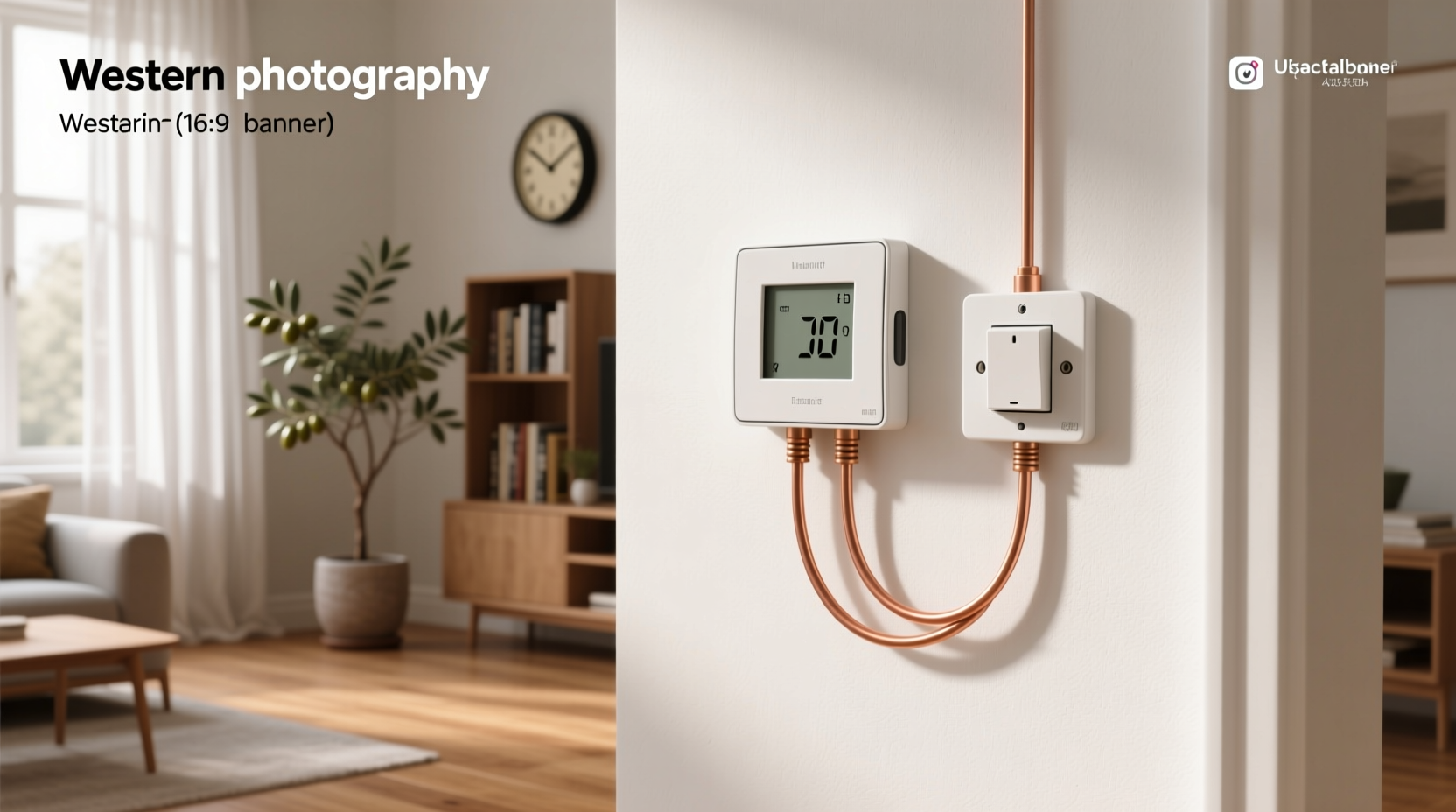
If you’re installing or replacing a thermostat in an older home with only two low-voltage wires (typically R and W), skip the smart thermostat marketing hype. Over the past year, demand for thermostats with 2 wires has risen sharply—not because they’re ‘cutting-edge,’ but because millions of homes still rely on simple heat-only systems without a common (C) wire, fan control, or cooling stage. The right choice isn’t about features—it’s about compatibility, reliability, and avoiding costly rewiring. For most users, a dedicated 2-wire heating-only thermostat (like Beca’s GB-series or equivalent non-smart models) delivers stable performance without firmware headaches or battery dependency. If you’re a typical user, you don’t need to overthink this.
About Thermostats with 2 Wires
A thermostat with 2 wires refers to a device designed for basic heating-only HVAC systems that use only two low-voltage (24V AC) conductors: one for power (R or Rh) and one for the heating call (W). These systems are common in older homes with electric baseboard heaters, hydronic radiant floor heating, or single-stage gas/oil furnaces lacking cooling, fan control, or auxiliary stages. Unlike modern multi-wire setups (which support cooling, fan speed, humidification, or smart sensors), 2-wire thermostats operate in a closed-loop mode—no continuous power source, no onboard Wi-Fi radio, and no ability to control anything beyond heat activation.
Typical use cases include:
- Electric floor heating mats controlled by a wall-mounted thermostat ⚡
- Hydronic boiler systems with zone valves (e.g., underfloor water heating) 💧
- Simple forced-air furnaces without air conditioning or variable-speed blowers 🔥
- Retrofit projects where running new cable is structurally impractical or prohibitively expensive 🛠️
Why Thermostats with 2 Wires Are Gaining Popularity
Lately, interest in thermostats with 2 wires hasn’t surged due to innovation—but because of realism. As energy costs rise and climate volatility increases across North America and Europe, homeowners and contractors are prioritizing functional upgrades over aesthetic ones. Retrofitting aging heating infrastructure is faster and more cost-effective when it avoids drywall demolition or conduit rerouting. At the same time, commercial integrators report growing demand from property managers maintaining legacy apartment blocks—where 2-wire compatibility isn’t a limitation, but a requirement 1.
This trend reflects a broader shift: buyers now favor solutions that match system constraints—not force systems to match solutions. Smart home adoption hasn’t slowed, but its growth is increasingly segmented: premium ecosystems (Matter-enabled, BACnet-integrated) serve new construction and commercial retrofits, while pragmatic, low-complexity controls dominate repair-and-replace cycles in existing housing stock 2.
Approaches and Differences
There are three main categories of thermostats marketed for 2-wire use—each with distinct trade-offs:
1. Mechanical (Bimetallic) Thermostats
Pros: Zero power required, immune to firmware bugs, decades-long lifespan, fully compatible with any 2-wire heating circuit.
Cons: ±2°F accuracy, no scheduling, no remote access, manual adjustment only.
When it’s worth caring about: If your priority is fail-safe operation during power outages or extreme cold—and you accept manual setpoint changes.
When you don’t need to overthink it: For rental units, vacation homes, or secondary heating zones where automation adds no measurable value.
2. Digital Non-Smart Thermostats
Pros: Programmable schedules, tighter temperature tolerance (±1°F), backlit display, battery-powered (no C-wire needed), often supports floor sensor inputs.
Cons: Requires periodic battery replacement (every 1–2 years); no app control or cloud logging.
When it’s worth caring about: When you want daily/weekly scheduling without introducing network dependencies.
When you don’t need to overthink it: If your heating cycle is predictable and you rarely adjust settings mid-week.
3. Smart Thermostats with 2-Wire Adaptation
Pros: Remote access, energy usage reports, geofencing, integration with voice assistants or Matter hubs.
Cons: Relies on power harvesting (capacitor charging) or optional external power adapters; may drop offline during extended heating calls; not all models support true 2-wire operation—some require workarounds like “power stealing” that risk relay wear or inconsistent behavior 1.
When it’s worth caring about: Only if you already have a robust local Wi-Fi mesh, monitor usage data closely, and accept occasional sync delays.
When you don’t need to overthink it: If your goal is reliable heat—not analytics. If you’re a typical user, you don’t need to overthink this.
Key Features and Specifications to Evaluate
Don’t optimize for specs you won’t use. Focus instead on four functional dimensions:
- Voltage compatibility: Confirm 24V AC (not 120V/230V line voltage)—most 2-wire residential heating systems run low-voltage. Line-voltage thermostats (e.g., for electric baseboards) are a separate category 1.
- Load rating: Match the thermostat’s maximum current (e.g., 5A, 10A, 16A) to your heating device’s draw. Exceeding rating risks contact welding or premature failure.
- Sensor type: Built-in air sensor only? Or does it accept an external floor probe? For radiant floors, surface temperature feedback prevents overheating—critical for wood or tile finishes.
- Protocol support: Does it offer Modbus or BACnet? Irrelevant for homes—but essential if integrating into a building management system (BMS) for multifamily or light commercial use 1.
Pros and Cons: Balanced Assessment
✅ Pros of sticking with 2-wire thermostats:
— No rewiring labor or drywall repair
— Lower failure rate than power-harvesting smart units in marginal electrical environments
— Faster installation (often under 15 minutes)
— Predictable behavior: no OTA updates, no account lockouts, no cloud downtime
❌ Cons to acknowledge:
— No cooling control (obviously)
— No fan-only mode or dehumidification staging
— Limited diagnostics: no error codes, no voltage monitoring
— Cannot support advanced zoning logic without external relays or controllers
This piece isn’t for keyword collectors. It’s for people who will actually use the product.
How to Choose a Thermostat with 2 Wires: A Step-by-Step Decision Guide
- Confirm your system type: Turn off power, remove old thermostat, and verify only two wires connect to terminals labeled R/Rh and W. If you see Y, G, C, or O/B—your system isn’t truly 2-wire.
- Determine load requirements: Check heater nameplate for voltage and amperage. Match to thermostat rating (e.g., 16A for high-output electric radiators).
- Decide whether scheduling matters: If yes, choose digital non-smart. If no, mechanical is sufficient and more durable.
- Avoid these pitfalls:
— Installing a Wi-Fi thermostat without verifying capacitor charge time (some require >30 min of idle time between heating cycles)
— Using a line-voltage thermostat on a low-voltage system (or vice versa)
— Assuming “2-wire compatible” means “plug-and-play”—always check manufacturer wiring diagrams
Insights & Cost Analysis
Price ranges reflect typical landed costs (2024–2025) for standard units:
- Mechanical bimetallic: $12–$28
— Best value for simplicity and longevity - Digital non-smart (programmable): $35–$75
— Mid-range ROI: scheduling saves ~5–8% on heating bills in moderate climates - Smart thermostats with 2-wire mode: $99–$220
— Premium justified only with documented energy tracking needs or BMS integration
Installation labor is nearly identical across types—so total cost difference comes down to hardware and long-term maintenance (battery vs. no battery, firmware updates vs. none).
Better Solutions & Competitor Analysis
| Category | Best For | Potential Issue | Budget Range (USD) |
|---|---|---|---|
| Mechanical (e.g., Honeywell T87) | Fail-safe heat in rentals or cabins | Limited accuracy; no programming$12–$28 | |
| Digital Non-Smart (e.g., Beca GB-2000) | Homeowners wanting schedule + reliability | Battery replacement every 18 months$45–$75 | |
| Smart w/ Power Stealing (e.g., Nest E w/ 2-wire kit) | Users already in Google Home ecosystem | Unreliable in short-cycle heating systems$129–$189 | |
| Dedicated 2-Wire Smart (e.g., RadioThermostat CT30) | Remote monitoring for vacation properties | Requires stable 2.4 GHz Wi-Fi; no Matter support$149–$220 |
Customer Feedback Synthesis
Based on aggregated installer and homeowner reviews (2023–2025), top recurring themes:
- Highly praised: “No setup hassles,” “worked immediately after mounting,” “never lost calibration over 5 winters.”
- Frequent complaints: “Battery died mid-winter and heating stopped,” “Wi-Fi dropped during furnace runtime,” “floor sensor readings drifted after 2 years.”
The strongest satisfaction correlates not with feature count—but with correct initial matching of load rating and sensor type.
Maintenance, Safety & Legal Considerations
Maintenance is minimal: dust the sensor opening annually; replace batteries per schedule; inspect terminal screws for corrosion every 2–3 years. Safety-wise, always de-energize the HVAC transformer before handling wires—24V is low-risk, but accidental shorts can damage control boards.
Legally, no certification mandates apply specifically to 2-wire thermostats—but regional standards matter. In North America, UL 60730-1 compliance is expected for safety-critical controls 3. In EU markets, CE marking and RoHS compliance are baseline requirements 1. Always verify markings before procurement—especially for commercial or multi-unit installations.
Conclusion
If you need reliable, maintenance-light heat control in a legacy 2-wire system, choose a digital non-smart thermostat with programmable scheduling and floor-sensor support. If you prioritize absolute simplicity and zero electronics, go mechanical. If you require remote access *and* have verified stable Wi-Fi and long heating cycles, a dedicated 2-wire smart model may justify its cost—but treat it as a monitored tool, not a set-and-forget appliance. This piece isn’t for keyword collectors. It’s for people who will actually use the product.


