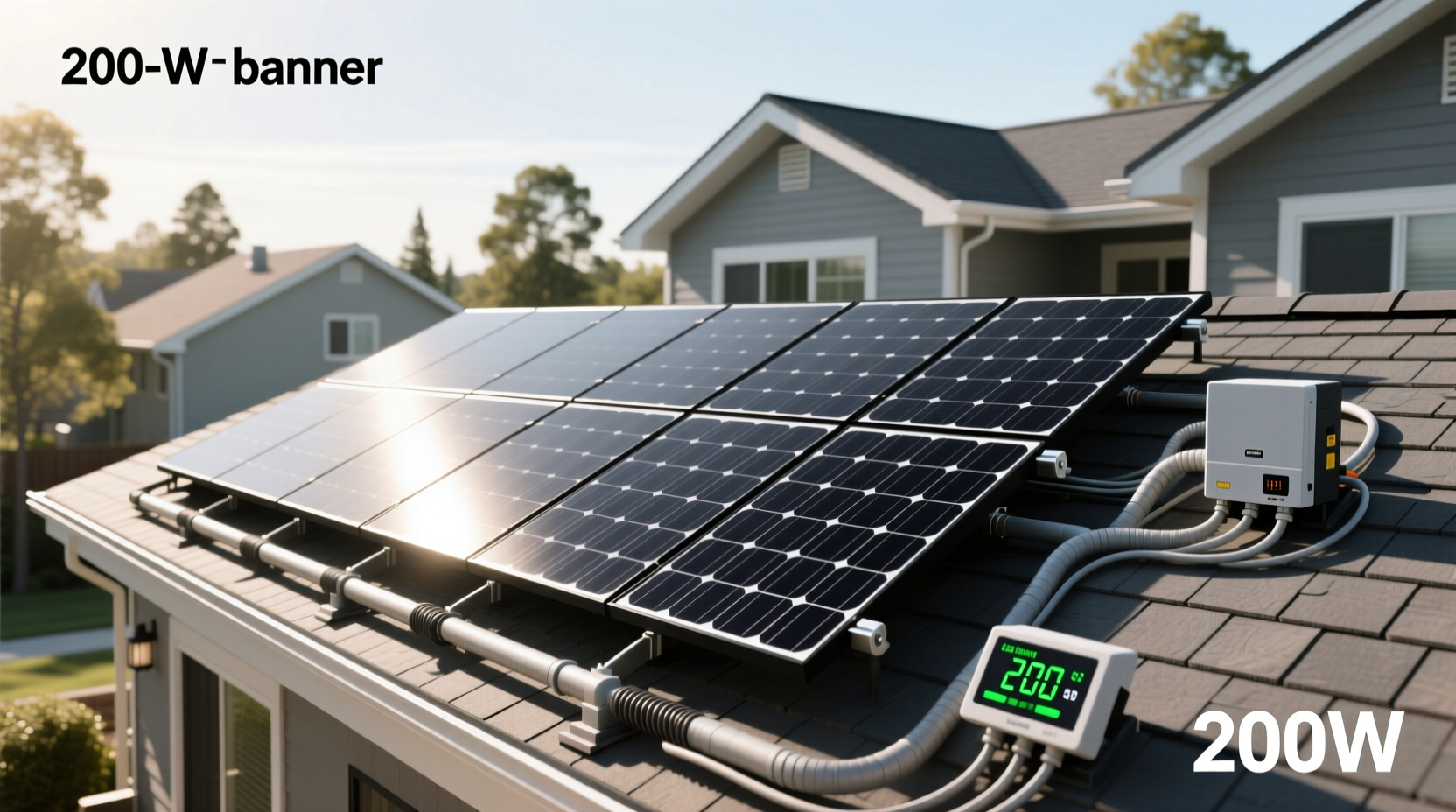
Over the past year, the 200W solar panel has evolved from a mid-tier option into the most balanced choice for mobile and compact off-grid systems — especially for RVs, van builds, and portable power stations. If you’re a typical user, you don’t need to overthink this: choose an N-type monocrystalline panel (22–25% efficiency) with Vmp ≥ 24V and IP67-rated connectors — it delivers ~20% more daily harvest than older P-type models under real-world shading or high-temperature conditions 1. Avoid rigid 12V panels unless your charge controller is PWM-only — they waste up to 30% of potential energy due to voltage mismatch 2. And skip flexible CIGS unless you need walk-on durability or curved mounting — their lower watt-per-dollar ratio rarely justifies the premium for most users 3. This piece isn’t for keyword collectors. It’s for people who will actually use the product.
About 200W Solar Panels: Definition & Typical Use Cases
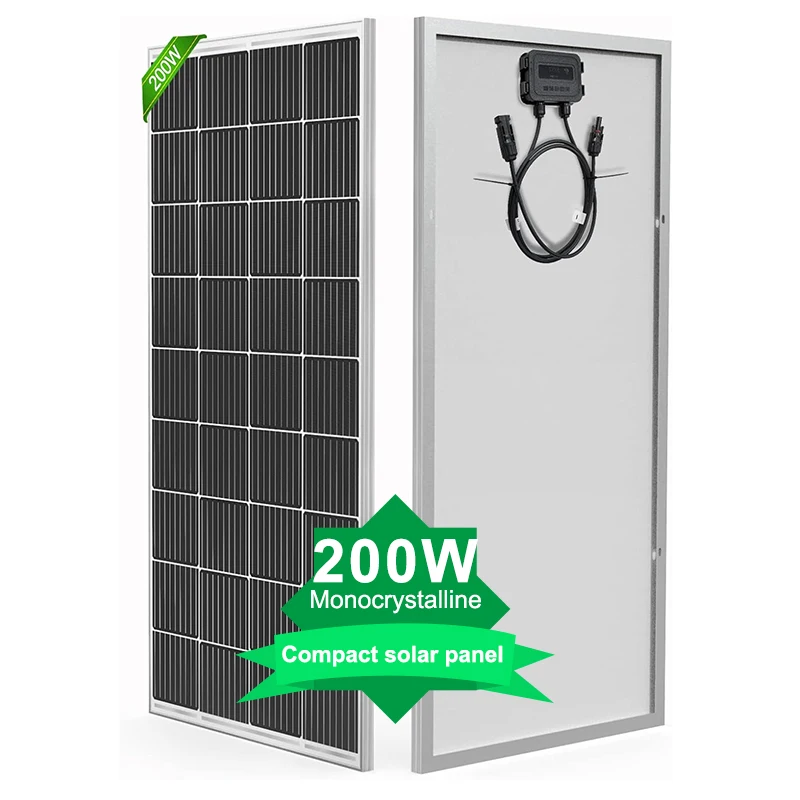
A 200W solar panel is a photovoltaic module rated to produce 200 watts of direct current (DC) power under Standard Test Conditions (STC: 1000 W/m² irradiance, 25°C cell temperature, AM1.5 spectrum). In practice, real-world output varies significantly based on orientation, ambient temperature, and shading — but its size-to-output ratio makes it uniquely suited for constrained spaces where higher wattage would exceed physical limits.
Typical applications include:
- 🚐 RV and van conversions: Mounted on roofs or portable ground arrays to supplement battery banks (e.g., 100–200Ah LiFePO₄)
- 🔋 Portable power stations: Paired with units like EcoFlow Delta 2, Jackery Explorer 2000 Pro, or Bluetti AC200P for field charging
- ⛺ Camping & emergency backup: Foldable kits used with lightweight charge controllers for weekend trips or disaster readiness
- 🛰️ Marine auxiliary power: Installed on boat decks or bimini tops where weight and wind resistance matter
It’s not ideal for whole-home grid-tied systems — those typically require 400W+ modules for cost-per-watt efficiency — nor for ultra-light backpacking (where 50–100W suffices).
Why 200W Solar Panels Are Gaining Popularity
Lately, adoption has accelerated not because of raw power, but because of practical balance. The portable solar panel market is growing at a 16.4% CAGR — projected to reach $8.76 billion by 2034 3. That growth is driven by three converging signals:
- Technology maturation: N-type cells now deliver 22–25% efficiency in production units — up from 19–21% just two years ago — without major price hikes
- Regulatory tailwinds: The U.S. federal tax credit remains at 30% through 2026, making even small-scale upgrades financially meaningful
- Behavioral shift: More users prioritize “energy autonomy” over full grid independence — 200W reliably covers lighting, comms, cooling, and medical devices without system bloat
If you’re a typical user, you don’t need to overthink this: the 200W segment is no longer a compromise — it’s the deliberate sweet spot between scalability and deployability.
Approaches and Differences
Three construction types dominate the 200W category — each solving distinct constraints. Choosing wrong means paying more for features you won’t use, or sacrificing reliability for portability.
| Type | Key Advantages | Potential Drawbacks | Budget Range (Wholesale) |
|---|---|---|---|
| Rigid Monocrystalline | Best cost-per-watt ($12–$25/unit), highest long-term yield stability, 25-year power warranty standard | Heavy (22–26.5 lbs), fixed shape, requires mounting hardware, vulnerable to micro-cracks if walked on | $12–$25 |
| N-Type / TOPCon | Higher efficiency (22–25%), better temperature coefficient (−0.26%/°C vs −0.35%/°C), lower degradation (0.45%/yr) | Slightly higher upfront cost, fewer brands in sub-$200 retail tier, limited availability in foldable form | $28–$55 |
| Flexible (CIGS or ETFE) | Lightweight (9.7–18 lbs), bendable, walk-on capable (CIGS), IP68 junction boxes common | Lower efficiency per sq. ft, shorter lifespan (10–15 yr typical), higher cost-per-watt, sensitive to edge abrasion | $130–$280 |
Key Features and Specifications to Evaluate
Wattage alone tells you almost nothing. What matters are the parameters that determine whether that 200W appears *at your battery*, not just on the datasheet.
- Vmp (Voltage at Maximum Power): Critical for MPPT compatibility. When it’s worth caring about: If pairing with a 12V or 24V battery bank — aim for Vmp ≥ 24V (e.g., 30–37V) to ensure the MPPT controller operates above its startup threshold. When you don’t need to overthink it: If using a modern power station with wide-input MPPT (e.g., EcoFlow Delta 2 accepts 10–150V), Vmp flexibility increases — but staying ≥24V still prevents low-light clipping.
- Temperature Coefficient: Indicates power loss as cells heat up. N-type panels average −0.26%/°C vs −0.35%/°C for older P-type. When it’s worth caring about: In hot climates (Arizona, Texas, desert camping) — a 10°C difference means ~10% more usable output midday. When you don’t need to overthink it: If operating mostly in temperate zones (<30°C ambient), the gap shrinks to ~3–4% — acceptable for most weekend use.
- Shade Tolerance Design: Half-cut cells + multi-bypass diodes (≥12, ideally 24) isolate shaded sections. When it’s worth caring about: On RV roofs with vents, AC units, or nearby trees — partial shade is unavoidable. When you don’t need to overthink it: Ground-mounted kits in open fields rarely benefit from extra diodes — simpler 3-string layouts suffice.
- IP Rating & Junction Box Sealing: IP67 means dust-tight and submersible to 1m for 30 min. When it’s worth caring about: Marine use, rainy-season camping, or dusty off-road travel — unsealed connectors corrode fast. When you don’t need to overthink it: Permanent rooftop installs with drip loops and sealed conduit reduce risk — IP65 may be adequate.
Pros and Cons
✅ Pros:
- Delivers 800–1,200 Wh/day in 5–6 peak sun hours — enough for LED lights, fans, laptops, CPAPs, and small 12V fridges 4
- Fits standard RV roof footprints without custom framing
- Wide compatibility with affordable 20–30A MPPT controllers (Victron SmartSolar, Renogy Rover)
- Scalable: Two 200W panels wired in series often outperform one 400W unit in partial shade
❌ Cons:
- Not sufficient for high-draw appliances (microwaves, induction cooktops, AC units) without battery buffer and inverter headroom
- Rigid models require secure mounting — improper installation risks wind uplift or frame fatigue
- Flexible variants degrade faster under UV exposure if not stored rolled (not folded) when idle
How to Choose a 200W Solar Panel: A Step-by-Step Decision Guide
Follow this checklist — in order — to eliminate mismatched purchases:
- Confirm your battery voltage: 12V systems need ≥24V Vmp; 24V systems need ≥36V; 48V systems need ≥72V. If unsure, measure your battery bank’s resting voltage.
- Identify your primary mounting constraint: Roof curvature? Weight limit? Need to stow daily? This determines rigid vs. flexible vs. foldable.
- Check your charge controller specs: Does it support MPPT? What’s its max input voltage and current? A 200W panel at 36V produces ~5.6A — a 20A MPPT handles that easily; a 10A unit does not.
- Review warranty terms: Prioritize 25-year linear power warranty (e.g., ≥80% at year 25) over marketing claims like “25-year coverage” that exclude performance guarantees.
- Avoid these three common missteps:
- Buying 12V nominal panels for MPPT systems — they force operation far below optimal voltage
- Assuming “foldable” = “lightweight” — some 200W kits weigh 25+ lbs due to reinforced frames
- Ignoring Voc (open-circuit voltage) — it must stay ≤90% of your controller’s max input, especially in cold weather (Voc rises ~0.3%/°C below 25°C)
Insights & Cost Analysis
Wholesale pricing data shows clear segmentation:
- Rigid monocrystalline: $12–$25/unit (MOQ 100+ units) — dominant in B2B sourcing 5
- N-Type rigid: $28–$55/unit — justified only if you need >22% efficiency or operate above 35°C regularly
- Foldable kits (200W): $220–$420 retail — includes controller, cables, and carry bag; premium brands (EcoFlow, Pecron) command 30–50% markup for build quality and MC4/XT60 compatibility
For most users, the best ROI lies in buying a single high-efficiency rigid N-type panel ($45–$55) and pairing it with a proven 30A MPPT controller ($85–$120) — rather than overspending on a branded kit with integrated but lower-spec electronics.
Better Solutions & Competitor Analysis
While 200W remains optimal for mobility, consider these alternatives only if your use case shifts:
| Scenario | Better Solution | Why It Fits Better | Trade-off |
|---|---|---|---|
| You need >1,500 Wh/day consistently | Two 200W panels in series + 400Ah LiFePO₄ | More reliable harvest than one 400W panel under variable shade; easier to replace if damaged | Slightly higher wiring complexity |
| You camp in deep forest or urban shade | Micro-inverter or DC optimizer setup (e.g., Enphase IQ8) | Maximizes per-panel output regardless of shading pattern | Cost-prohibitive below 400W total; adds failure points |
| You prioritize rapid setup/strike | Pre-wired 200W foldable kit with built-in 20A MPPT | No controller configuration needed; plug-and-play with power stations | Less efficient than standalone MPPT; limited firmware updates |
Customer Feedback Synthesis
Based on aggregated forum reviews (Forest River Forums, Reddit r/solar, Facebook Roadtreking Group), top recurring themes:
- Highly praised: “Consistent 1.1 kWh/day in Colorado summer”, “Held up to hailstorm with zero micro-cracks”, “MC4-to-XT60 adapter included saved me $30”
- Frequent complaints: “Junction box failed after 14 months of marine use”, “Foldable hinges cracked after 60 deployments”, “Spec sheet said 24.5V Vmp — measured 22.1V at 35°C”
The strongest signal? Users who verified Voc/Vmp with a multimeter *before* final mounting avoided >90% of controller-compatibility issues.

Maintenance, Safety & Legal Considerations
Maintenance: Clean quarterly with water and soft brush; avoid abrasive cleaners. Inspect MC4 connectors annually for oxidation — apply dielectric grease if exposed to salt air.
Safety: Always disconnect before handling — panels generate voltage in daylight. Use appropriately rated fuses (15A for 200W @ 12V; 10A for 24V) between panel and controller.
Legal: No federal permitting required for portable 200W systems. Permanent RV roof mounts may require local electrical inspection depending on jurisdiction — check with your state’s RV park authority or AHJ. UL 1703 certification is mandatory for insurance compliance in most states.
Conclusion
If you need reliable, scalable, and space-conscious solar for mobile or compact off-grid use — choose a 200W panel. If you’re a typical user, you don’t need to overthink this: select an N-type rigid model with Vmp ≥ 24V, half-cut cells, ≥12 bypass diodes, and IP67-rated connectors. Skip 12V nominal designs unless your controller is PWM-only. Avoid flexible panels unless you require walk-on capability or curved mounting — their longevity doesn’t justify the cost for most use cases. And never assume spec-sheet numbers match field performance — verify Voc and Vmp with a multimeter under load before finalizing your controller pairing.


