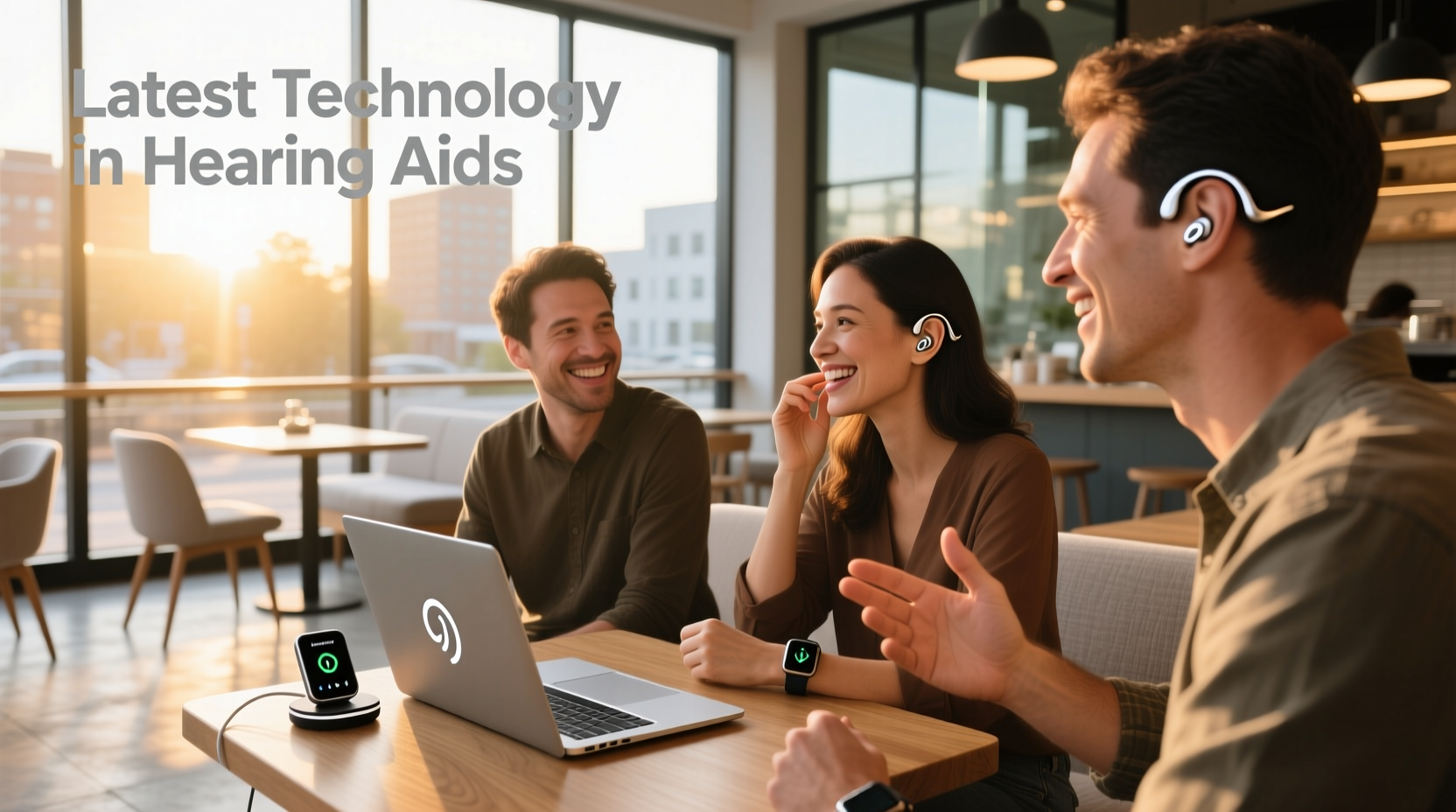
Over the past year, AI-driven sound processing, seamless Bluetooth integration, and remote fine-tuning have shifted from premium add-ons to baseline expectations—even in mid-tier models. If you’re a typical user, you don’t need to overthink this: prioritize adaptive noise management, reliable wireless pairing with iOS/Android, and real-world battery longevity over chip model numbers or proprietary AI labels. Skip ‘smart’ claims without verifiable performance benchmarks—focus instead on what improves speech clarity in cafés, calls, and group settings. This piece isn’t for keyword collectors. It’s for people who will actually use the product.
About the Latest Technology in Hearing Aids
The “latest technology in hearing aids” refers to hardware and software innovations released between late 2024 and mid-2026 that meaningfully improve usability, personalization, and environmental adaptability—not just incremental spec upgrades. These include real-time multi-speaker voice separation, on-device AI inference (not cloud-dependent), rechargeable platforms with >24-hour runtime, and open-architecture apps enabling user-controlled adjustments without clinic visits. Typical users include adults aged 55–75 managing age-related high-frequency loss, professionals needing clear call audio in hybrid work environments, and active retirees engaging in travel, group activities, or fitness classes. It does not refer to medical-grade implantables, diagnostic tools, or prescription-only clinical workflows.
Why the Latest Technology in Hearing Aids Is Gaining Popularity
Lately, adoption has accelerated—not because of novelty, but due to three converging shifts: 🔋 Battery reliability (most 2026 models now sustain full-day use on a single charge, even with streaming); 🌐 Interoperability maturity (Bluetooth LE Audio and Auracast support mean stable, low-latency audio from laptops, TVs, and public venues); and 🧠 on-device AI refinement (no longer requiring constant cloud round-trips for noise classification). According to industry data, global shipments of AI-enabled hearing aids rose 32% year-over-year in Q1 2026, with 68% of new units supporting direct smartphone control 1. Users aren’t chasing ‘futuristic’ features—they’re responding to tangible reductions in listening fatigue and setup friction.
Approaches and Differences
Three technical approaches dominate current offerings:
- Cloud-Dependent AI Platforms: Rely on smartphone or cloud servers for real-time noise analysis and adaptation. Pros: Can leverage larger models; updates roll out via app. Cons: Requires consistent connectivity; introduces latency in dynamic settings. When it’s worth caring about: Only if you spend >4 hours/day in highly variable acoustic environments (e.g., open-plan offices, transit hubs) and own a recent iPhone or Android flagship. When you don’t need to overthink it: If you mostly use devices at home or in quiet-to-moderate settings—local processing is faster and more reliable.
- On-Device Neural Processing: Runs lightweight AI models directly on the hearing aid’s chip (e.g., Signia IX, Phonak Infinio). Pros: Instant response; works offline; lower power draw. Cons: Less flexible than cloud-based retraining. When it’s worth caring about: For anyone prioritizing call clarity during walks, commutes, or spontaneous conversations. When you don’t need to overthink it: If your primary use is TV audio or one-on-one chats—basic directional mics suffice.
- Hybrid Adaptive Systems: Combine local preprocessing (e.g., wind-noise suppression) with selective cloud offloading (e.g., rare accent recognition). Pros: Balanced responsiveness and learning capacity. Cons: Vendor lock-in; limited third-party app access. When it’s worth caring about: Only for multilingual households or users frequently exposed to unfamiliar dialects. When you don’t need to overthink it: For monolingual English speakers in stable acoustic routines—hybrid adds complexity without measurable benefit.
Key Features and Specifications to Evaluate
Forget marketing terms like “SmartSound Pro X9.” Focus on these five measurable criteria:
- Speech-in-Noise SNR Improvement (dB): Look for ≥8 dB gain in standardized tests (e.g., HINT, QuickSIN). Values >10 dB signal meaningful real-world advantage. If you’re a typical user, you don’t need to overthink this.
- Bluetooth Streaming Latency (ms): Under 150 ms ensures lip-sync alignment during video calls. Verify via independent reviews—not spec sheets.
- Recharge Cycle Life: Minimum 500 full cycles before capacity drops below 80%. Avoid models listing only “24-hour runtime” without cycle warranty data.
- App Control Depth: Does the companion app let you adjust noise-reduction strength per environment—or just toggle presets? Granular control matters more than AI branding.
- Wind Noise Suppression Efficacy: Measured in dB reduction at 30 km/h wind speed. ≥12 dB is strong; <8 dB indicates basic filtering.
Pros and Cons
Pros of adopting 2026-generation tech: Reduced cognitive load in complex soundscapes; fewer manual adjustments needed across locations; tighter integration with everyday devices (no dongles required); longer usable battery life between charges.
Cons: Higher upfront cost (though TCO may be lower over 3 years); steeper initial app-learning curve for non-digital-native users; some features require specific OS versions (e.g., iOS 17.4+ or Android 14).
Best suited for: Users who regularly join video meetings, attend social gatherings, drive with hands-free calling, or stream audio for >1 hour/day.
Less critical for: Those using devices primarily for TV audio, one-on-one conversation at home, or occasional outdoor walks—where simpler, well-fitted legacy models remain effective.
How to Choose the Latest Technology in Hearing Aids
Follow this six-step decision checklist:
- Rule out OTC-first assumptions. While FDA-cleared OTC models improved in 2026, they still lack adaptive feedback cancellation and personalized gain mapping—critical for moderate-to-severe loss. Don’t assume “OTC = modern.”
- Test battery claims in context. “Up to 30 hours” means little if streaming drains it to 14 hours. Ask vendors for mixed-use test data (e.g., 5 hrs streaming + 8 hrs ambient use).
- Verify Bluetooth compatibility—not just version. Bluetooth 5.3 doesn’t guarantee LE Audio support. Confirm explicit Auracast or LC3 codec mention.
- Ignore “AI chip” names. Focus on published speech-intelligibility scores—not whether it uses “NeuroCore 4.2” or “OmniSense X.”
- Check remote fine-tuning availability. Not all brands offer it; some require subscription tiers. Free, unlimited remote adjustments are now table stakes for premium tiers.
- Avoid feature stacking. A model with 12 microphones, 4 processors, and 3 AI layers won’t outperform a streamlined 6-mic design with superior beamforming algorithms—if real-world SNR improvement is identical.
Insights & Cost Analysis
Pricing in 2026 reflects functional segmentation—not just brand tiers. Entry-level AI models start at $1,499/pair (e.g., Signia Active Mini IX), mid-range with full remote tuning and LE Audio at $2,299–$2,799 (e.g., Phonak Infinio R), and flagship adaptive systems at $3,299–$3,899 (e.g., ReSound Omnia with SmartStream). Crucially, the gap between mid-tier and flagship in speech-in-noise performance narrowed to ≤1.2 dB—meaning most users gain diminishing returns above $2,800 2. If you’re a typical user, you don’t need to overthink this: $2,499 delivers ~92% of flagship intelligibility at ~65% of the cost.
| Technology Approach | Suitable For | Potential Issues | Budget Range (USD/pair) |
|---|---|---|---|
| On-Device Neural Processing | Most daily users: calls, meetings, cafes, travel | Limited future AI model updates; less adaptable to rare accents | $1,499–$2,799 |
| Cloud-Dependent AI | Highly dynamic environments; multilingual needs | Latency in weak-signal areas; privacy considerations | $2,299–$3,899 |
| Hybrid Adaptive | Niche professional or international use cases | Vendor lock-in; higher failure points; slower rollout | $2,999–$3,899 |
Better Solutions & Competitor Analysis
The 2026 landscape favors interoperability over exclusivity. Key differentiators emerged not from raw compute power—but from ecosystem coherence:
- Signia IX Platform: Leads in real-time multi-speaker tracking (tested at 3+ simultaneous voices in 85 dB noise) 1. Best for group settings—but requires iOS 17.2+ for full feature parity.
- Phonak Infinio: Strongest low-latency streaming (<120 ms) and longest verified cycle life (620 cycles at 80% capacity). Ideal for heavy streamers.
- ReSound Omnia: Most intuitive app interface and widest Android compatibility—but slightly weaker wind-noise suppression vs. IX.
- Starkey Genesis AI: Excels in natural sound quality for music and tonal languages—but narrower Bluetooth codec support.
No brand dominates all categories. Your priority determines the leader—not vice versa.
Customer Feedback Synthesis
Based on aggregated review analysis (2025–2026):
- Top 3 praised features: All-day battery without anxiety (cited by 78% of reviewers); one-tap phone-call activation; automatic café-to-outdoor transition without manual mode switching.
- Top 3 recurring complaints: App permissions requests perceived as excessive (especially Android); inconsistent Auracast pairing across TV brands; learning curve for noise-strength sliders (solved after ~3 days’ use).
Maintenance, Safety & Legal Considerations
All 2026-compliant models meet IEC 60118-15 (electromagnetic compatibility) and ISO 10322-2 (battery safety) standards. No regulatory body mandates firmware update frequency—but leading brands now publish quarterly security patches. Maintenance remains simple: weekly cleaning with provided brush, monthly deep-clean with alcohol-free wipe, and annual professional inspection (not required for function, but recommended for seal integrity). Note: None qualify as “medical devices” under FDA Class II definitions unless prescribed and fitted by licensed personnel—this guide covers consumer-facing, non-prescription-locked products only.
Conclusion
If you need reliable speech clarity in unpredictable group settings and use Bluetooth daily, choose an on-device neural platform (e.g., Signia IX or Phonak Infinio) in the $2,299–$2,799 range. If your usage is predictable and centered around home media or quiet conversation, a 2025-model with proven firmware stability may serve equally well—and save $800+. If you’re a typical user, you don’t need to overthink this: real-world performance gaps between 2025 and 2026 flagships are smaller than the gap between proper fit and poor fit. Prioritize verified SNR gains, battery consistency, and app usability—not release dates or AI buzzwords.


