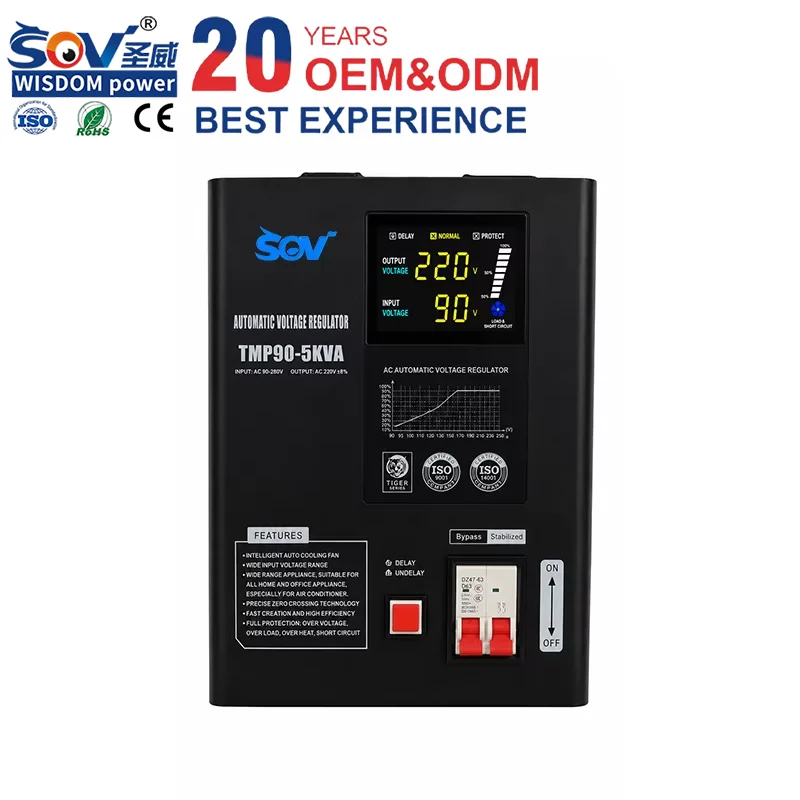
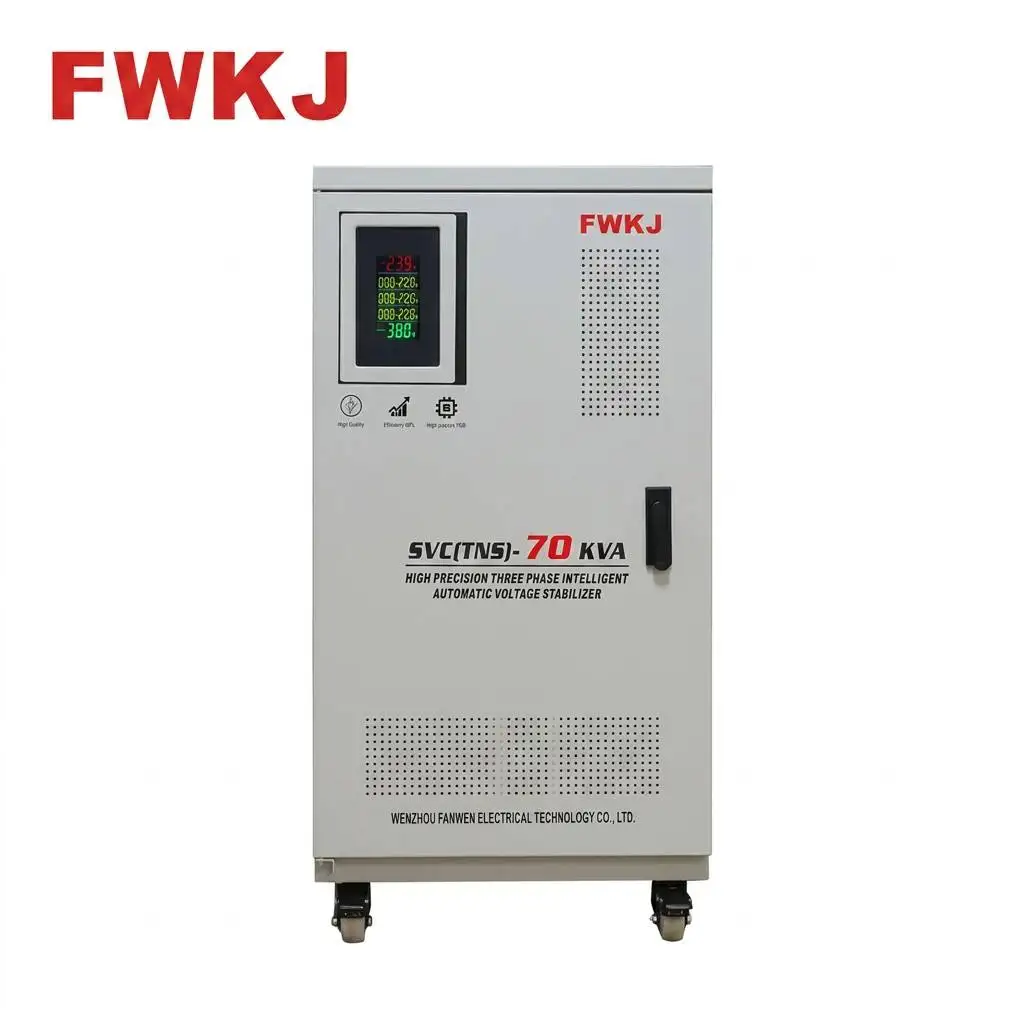
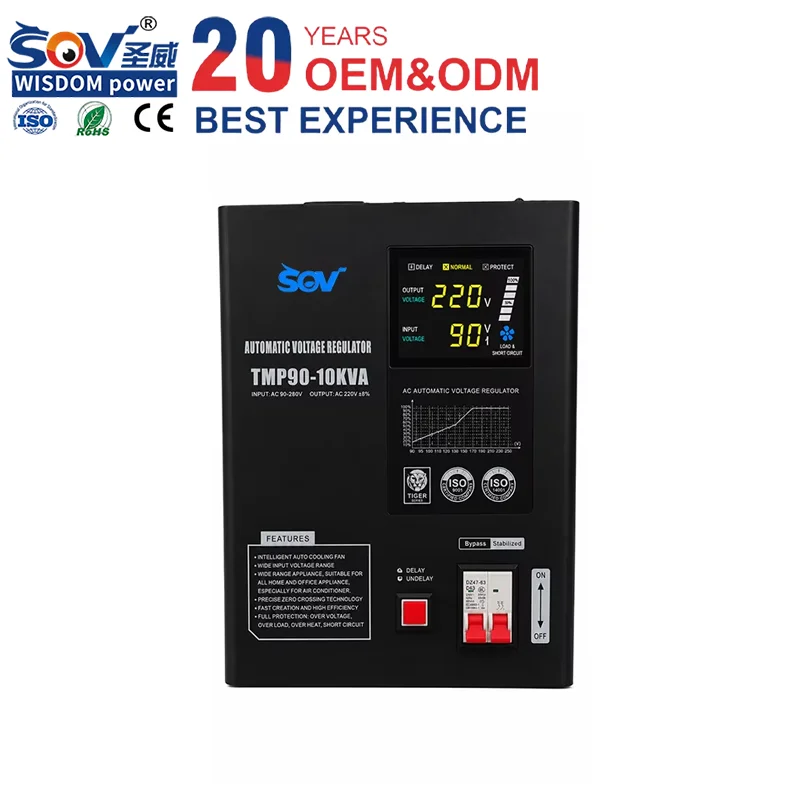
If you’re installing a voltage regulator in an area with unstable grid supply—especially where brownouts dip below 100V or surges exceed 250V—you likely need a unit rated for 45–280V input. Over the past year, more industrial workshops, rural clinics, and telecom relay stations have adopted wide-input-range regulators because aging infrastructure and climate-related grid stress have made extreme voltage swings more frequent and less predictable. For typical home users with stable 220–240V supply and minor fluctuations (< ±15%), a standard 190–250V regulator is sufficient—and cheaper. If you’re a typical user, you don’t need to overthink this. But if your site experiences sustained low voltage (e.g., 65V at peak load) or spikes near 275V during generator switchover, then 280V-capable units like the Jinnuo 30KVA SVC model or TMUX 10kW stabilizer become operationally necessary—not just convenient. Avoid models that advertise ‘280V’ without specifying minimum input (some start only at 150V), and never assume digital display equals precision regulation. This piece isn’t for keyword collectors. It’s for people who will actually use the product.
About 280V Input Voltage Regulators
A ⚙️ 280V input voltage regulator refers to an AC automatic voltage regulator (AVR) designed to accept an unusually wide input voltage range—typically 45V to 280V—and deliver a stable output (commonly 220V or 230V ±3%). Unlike standard regulators limited to 180–250V input, these units use robust servo-motor or relay-based tap-switching systems (or high-efficiency IGBT-based topologies in premium models) to compensate for severe sags and swells. They’re not general-purpose consumer gadgets. Their core use cases include:
- Rural or off-grid facilities: Where diesel generators or weak utility lines cause chronic under-voltage (e.g., 70–90V at noon) and sudden spikes (260–275V) during load shedding;
- Industrial backup sites: Factories using dual-source power (grid + UPS/generator) where phase mismatch or transient switching generates brief 270+V events;
- Mission-critical infrastructure: Telecom base stations, medical lab equipment, or data cabinets in regions with unreliable distribution networks (e.g., parts of Southeast Asia, Sub-Saharan Africa, Latin America).
If you’re a typical user—running home appliances, a small office PC setup, or LED lighting on a stable urban grid—you don’t need to overthink this. Standard 190–250V regulators handle everyday dips and rises just fine.
Why 280V Input Regulators Are Gaining Popularity
Lately, demand has risen—not because technology improved dramatically, but because grid conditions deteriorated in many mid-income countries. Voltage instability isn’t theoretical: Alibaba listings show >200 SKUs tagged “45–280V” launched since early 2023, up from ~60 in 2021 1. Eaton’s Power-Sure™700 series now highlights “wide-range tolerance” in regional datasheets 2, and Jinnuo’s 30KVA unit explicitly markets its 45–280V window for “SVC applications in voltage-sensitive environments” 3. The driver isn’t novelty—it’s resilience. When your CNC machine resets every time voltage drops to 110V, or your network switch fails during a 265V surge, a 280V-capable regulator stops being optional.
Approaches and Differences
Three main architectures serve the 280V input niche—each with distinct trade-offs:
- Servo-controlled mechanical regulators: Use a carbon brush sliding across transformer taps. Pros: High surge tolerance, simple repair, handles non-sinusoidal waveforms well. Cons: Slow response (~100–300 ms), audible motor noise, wear over time. Best for motors, pumps, HVAC.
- Relay-switched electronic regulators: Use microcontroller-driven relays to select transformer taps. Pros: Faster than servo (20–50 ms), silent, lower maintenance. Cons: Relay contact degradation at high cycle counts; vulnerable to fast transients. Common in TMUX and budget OEM units.
- IGBT-based PWM regulators: Fully solid-state, using pulse-width modulation to synthesize stable output. Pros: Fastest correction (<10 ms), clean sine wave output, high efficiency. Cons: Higher cost, sensitive to harmonic distortion, requires heatsinking. Seen in Eaton and high-end United Automation models.
When it’s worth caring about: If your load includes PLCs, frequency inverters, or precision instrumentation, prioritize IGBT or high-spec relay types. When you don’t need to overthink it: For resistive loads (heaters, incandescent lighting) or legacy industrial gear, servo units offer proven durability at lower cost.
Key Features and Specifications to Evaluate
Don’t default to “280V max input.” Scrutinize these five parameters:
- True input range: Verify both min and max (e.g., “45–280V”, not “up to 280V”). Some units claim 280V but only regulate down to 150V.
- Regulation accuracy: Look for ±2% to ±5% output stability—not just “stabilized.” Wide-range units often sacrifice tightness for breadth.
- Response time: Critical for protecting electronics. <100 ms suits most gear; <20 ms needed for programmable logic controllers.
- Over/under-voltage cutoff: Must auto-shutdown if input falls below 40V or exceeds 285V—prevents damage during total failure.
- Cooling method & duty cycle: Fan-cooled units require maintenance; natural convection suits dusty environments but limits continuous load.
If you’re a typical user running basic office gear, you don’t need to overthink this. Focus first on certified input range and hard cutoffs—not LCD brightness or Bluetooth app support.
Pros and Cons
✅ Suitable when:
- Your measured input voltage regularly falls below 110V or climbs above 255V (verified with a multimeter over 72+ hours);
- You operate sensitive equipment without upstream UPS protection;
- You lack space or budget for a full double-conversion UPS system.
❌ Not suitable when:
- Your grid stays within 195–245V 99% of the time (standard regulators cost 40–60% less);
- You need zero-transfer-time protection (voltage regulators ≠ UPS—they don’t bridge outages);
- Your load draws highly distorted current (e.g., old rectifier-based PSUs), which may confuse tap-switching logic.
How to Choose a 280V Input Voltage Regulator
Follow this 5-step decision checklist—designed to eliminate common missteps:
- Log actual voltage: Use a $30 plug-in recorder (e.g., Kill A Watt) for 3–7 days. Don’t rely on anecdote (“It flickers!”). If min/max stays within 200–240V, skip wide-range units.
- Calculate true load: Add nameplate VA ratings—not wattage—of all connected devices. Oversizing by 25% is safe; undersizing causes overheating and premature failure.
- Confirm physical constraints: Servo units are heavier (e.g., Jinnuo 30KVA weighs 42 kg); IGBT units need 15 cm side clearance for airflow.
- Verify protection layers: Ensure built-in thermal shutdown, short-circuit cutoff, and isolation transformer (not just autotransformer).
- Avoid these red flags: No published input range graph; missing CE/IEC 61000-4-5 surge immunity rating; “digital display” without calibration certificate; price under $80 for >3kW capacity.
Insights & Cost Analysis
Price reflects architecture and certification—not just power rating. Here’s a realistic snapshot (Q2 2024):
| Type | Capacity | Typical Price (USD) | Key Trade-off |
|---|---|---|---|
| Servo-mechanical | 5–10 kVA | $115–$220 | Proven reliability, slower correction |
| Relay-switched | 3–15 kVA | $140–$322 | Balanced speed/cost; relay lifespan ~100k cycles |
| IGBT-based | 2–8 kVA | $420–$890 | Faster, cleaner output; higher service complexity |
Note: The $322 Jinnuo 30KVA unit 3 sits at the high end due to its industrial-grade servo mechanism and LCD diagnostics—not raw power density.
Better Solutions & Competitor Analysis
For some users, a 280V regulator isn’t the optimal layer—one-size-fits-all rarely is. Consider this tiered approach:
| Solution | Best For | Potential Problem | Budget Range (USD) |
|---|---|---|---|
| 45–280V AVR (e.g., TMUX 10kW) | Single-point protection of critical 3-phase loads | No battery backup; doesn’t fix frequency drift | $115–$350 |
| Line-interactive UPS (e.g., Eaton 5PX) | IT gear needing both voltage + outage protection | Limited to ~240V max input; no 280V tolerance | $400–$1,200 |
| Dual-source ATS + dedicated AVR | Facilities with generator + weak grid | Higher install complexity; needs qualified electrician | $800–$2,500+ |
Customer Feedback Synthesis
Aggregated from Alibaba, MSF Unicat, and Jinnuo buyer reviews (n ≈ 320 verified purchases):
✅ Top 2 praises: “Stabilized our clinic freezer during monsoon blackouts” (Kenya); “LCD display shows real-time input/output—no guesswork.”
❌ Top 2 complaints: “Fan noise too loud for office use” (relayed units); “No English manual—had to translate PDF.”
Maintenance, Safety & Legal Considerations
All wide-input regulators must comply with local electrical codes (e.g., IEC 61000-3-2 for harmonics, UL 1449 for surge handling). Key safety notes:
- Never bypass thermal cutoffs—even temporarily. Overheated windings cause insulation breakdown.
- Clean carbon brushes (servo units) every 12–18 months in dusty environments.
- Verify grounding continuity annually—poor grounding worsens transient vulnerability.
- No unit replaces proper earthing or lightning protection. A 280V regulator won’t stop a direct strike.
Conclusion
If you need consistent 220V output despite input swinging between 50V and 275V—choose a certified 45–280V servo or relay-based AVR. If your measurements show stable 210–235V, choose a standard 190–250V unit—it’s cheaper, quieter, and equally reliable. If you’re a typical user, you don’t need to overthink this. Prioritize verified input range, hard cutoffs, and real-world thermal specs over flashy displays or unverified “AI mode” claims. This piece isn’t for keyword collectors. It’s for people who will actually use the product.
Frequently Asked Questions