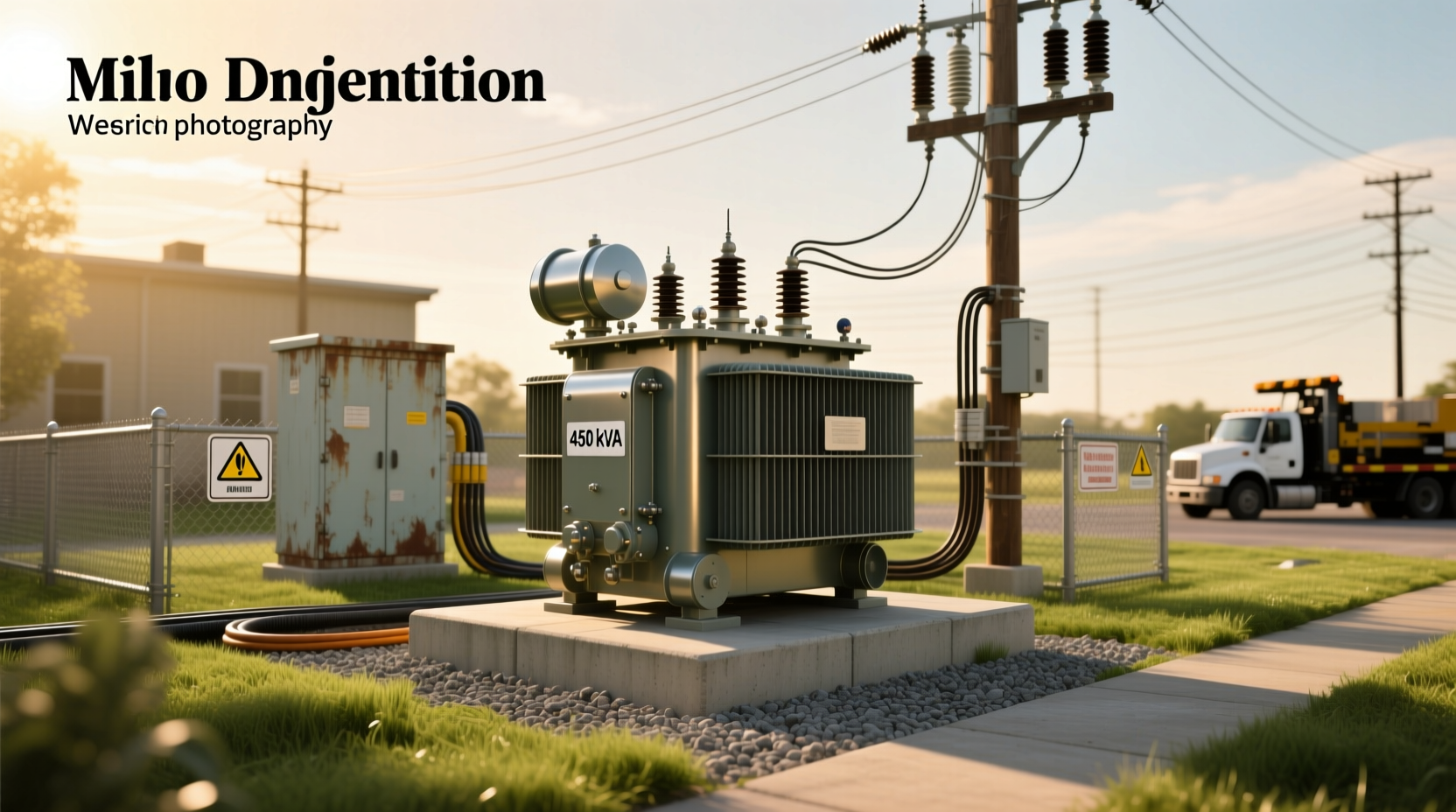
If you’re specifying or procuring a 450 kVA transformer for industrial, commercial, or utility-grade power distribution—start here. Over the past year, procurement patterns have shifted: more buyers are prioritizing cold-resistance capability (especially in northern climates), compact footprint (for retrofit sites), and dry-type units where oil containment is impractical. The most common mistake? Assuming all 450 kVA units are functionally interchangeable. They’re not. Voltage configuration (e.g., 12.47kV Δ / 480Y/277V vs. 33kV / 11kV), cooling method (oil-immersed vs. dry-type), and duty cycle (continuous vs. intermittent) define suitability—not just the kVA rating. If you’re a typical user, you don’t need to overthink this: match primary/secondary voltages to your grid and load, verify ambient temperature range, and confirm physical constraints before comparing price. This piece isn’t for keyword collectors. It’s for people who will actually use the product.
About 450 kVA Transformers: Definition & Typical Use Cases
A 450 kVA transformer is a medium-voltage power conversion device rated to handle up to 450 kilovolt-amperes of apparent power. It does not generate electricity—it steps voltage up or down while conserving power (minus small losses). Unlike consumer electronics, it’s infrastructure-grade hardware: built for decades of service, subject to strict regional standards (IEC 60076, IEEE C57.12.00), and deployed where reliability outweighs portability.
Typical applications include:
- 🏭 Industrial facilities: Feeding HVAC, motor control centers, or production lines requiring stable 480V or 208Y/120V three-phase power from a 12.47kV or 33kV utility feed.
- 🏢 Commercial campuses: Powering multi-tenant office buildings or data halls with distributed loads and backup generator integration.
- ⚡ Utility distribution: Serving as a pad-mounted or pole-mounted unit feeding neighborhoods or substations—often configured at 11kV/0.4kV or 33kV/11kV.
- ❄️ Cold-climate deployments: Units with cold-resistance features (e.g., special insulation, low-pour-point oil, or encapsulated windings) are increasingly specified in Canada, Scandinavia, and mountainous regions.
What defines “450 kVA” is its thermal capacity—not peak surge tolerance. It’s sized to sustain 450 kVA under continuous load at rated ambient temperature (typically 40°C). Exceeding that derates performance or shortens life.
Why 450 kVA Transformers Are Gaining Popularity
Lately, demand for 450 kVA units has risen—not because they’re new, but because they hit a functional sweet spot. Smaller units (<315 kVA) often lack headroom for future expansion or harmonic-rich loads (e.g., VFDs, LED lighting). Larger units (>630 kVA) increase capital cost, footprint, and complexity without proportional benefit for mid-scale projects. Recent shifts reinforce this:
- Renewables integration: Solar farms and battery storage systems often require dedicated 450 kVA step-up transformers to interface with medium-voltage grids.
- Generator synchronization: Many 450 kVA diesel generators (e.g., Cummins C450D5, CAT DE450GC) pair with matching transformers for seamless island-mode operation.
- Regulatory tightening: Energy efficiency mandates (e.g., DOE 2016, EU Ecodesign) now favor low-loss core designs—common in newer 450 kVA models but rare in legacy stock.
If you’re a typical user, you don’t need to overthink this: popularity reflects real-world fit—not marketing hype.
Approaches and Differences: Oil-Immersed vs. Dry-Type vs. Pad-Mount
The three dominant configurations differ fundamentally—not just in price, but in safety, maintenance, and deployment logic.
| Configuration | Key Advantages | Potential Drawbacks | Budget Range (USD) |
|---|---|---|---|
| Oil-Immersed | Higher efficiency, superior heat dissipation, longer lifespan (30–40+ years), lower noise | Requires secondary containment, fire-rated vaults in indoor settings, periodic oil testing | $7,400–$59,5001 |
| Dry-Type (Air-Cooled) | No flammable fluid, indoor-safe, minimal maintenance, faster installation | Lower overload capacity, larger physical size per kVA, higher initial loss (up to 15% more than oil) | $1,700–$63,2002 |
| Pad-Mount (Oil-Filled, Enclosed) | Weatherproof, tamper-resistant, ready-to-install outdoors, ideal for utility or campus edge | Heavy (3,000–5,000 kg), requires concrete pad, limited voltage flexibility | $43,500–$109,0003 |
When it’s worth caring about: Indoor installations, fire codes (e.g., NFPA 70, NEC Article 450), or sites lacking spill containment. Dry-type eliminates oil risk entirely.
When you don’t need to overthink it: Outdoor utility substations with existing containment—oil-immersed remains the efficiency and longevity standard.
Key Features and Specifications to Evaluate
Don’t default to kVA alone. Four technical parameters determine whether a 450 kVA unit delivers what your site needs:
- Voltage configuration: Match primary (e.g., 12.47kV Δ, 33kV, 600V) and secondary (e.g., 480Y/277V, 208Y/120V, 11kV/0.4kV) exactly to your source and load panels. Mismatches require additional switchgear—or failure.
- Cooling class (e.g., ONAN, AN, FA): ONAN (oil-natural/air-natural) is standard for oil units; AN (air-natural) is typical for dry-type. Forced-air (FA) adds fans for 15–25% extra capacity—but increases noise and failure points.
- Impedance (%Z): Typically 4–6% for distribution units. Lower %Z improves voltage regulation but increases fault current—critical for breaker coordination.
- Efficiency & Losses: Look for “low-loss” or “high-efficiency” labels meeting DOE Level 2 or IEC 60076-20. A 0.5% efficiency gain saves ~$1,200/year at full load (assuming $0.10/kWh).
If you’re a typical user, you don’t need to overthink this: prioritize voltage match and cooling method first—efficiency and impedance are fine-tuned later.
Pros and Cons: Who Should (and Shouldn’t) Use a 450 kVA Unit?
✅ Suitable for:
- Facilities drawing 350–420 kW continuous load (accounting for power factor)
- Sites needing redundancy (e.g., two 450 kVA units instead of one 900 kVA)
- Projects with space constraints favoring compact oil-filled or hermetically sealed dry-type units
❌ Not suitable for:
- Residential use (even large estates)—450 kVA vastly exceeds typical demand; 50–100 kVA suffices)
- Highly variable, short-duration loads (e.g., welding shops)—better served by smaller, dynamically rated units
- Budget-limited retrofits without engineering review—undersized or mismatched units cause overheating, nuisance tripping, or premature failure
How to Choose a 450 kVA Transformer: A Step-by-Step Decision Checklist
Follow this sequence—deviating risks costly rework:
- Confirm load profile: Calculate total connected load (kW), diversity factor, and expected power factor. Derive required kVA: kVA = kW ÷ (PF × efficiency). Add 15–20% headroom for growth or harmonics.
- Verify voltage system: Measure incoming utility voltage (phase-to-phase and phase-to-neutral). Do not assume—utility feeds vary even within the same city.
- Assess physical environment: Indoor/outdoor? Ambient temp range? Seismic zone? Hazardous area classification? These dictate cooling, enclosure (IP rating), and mounting.
- Select cooling & construction: Oil-immersed for outdoor/utility; dry-type for indoor/commercial; pad-mount only if ground-level outdoor placement is confirmed.
- Review compliance: Ensure UL 1561 (US), BS EN 60076 (EU), or AS 2067 (AU) certification—and confirm local AHJ accepts it.
Avoid these common errors:
- Using “450 kVA” as a proxy for “enough power”—without verifying actual load curves.
- Choosing dry-type solely for perceived safety—ignoring its larger footprint and lower overload tolerance.
- Specifying cold-resistance features without confirming minimum ambient temp (e.g., -40°C vs. -25°C)—over-specing adds 12–18% cost.
Insights & Cost Analysis
Price varies widely—not by brand, but by specification. Here’s what moves the needle:
- Voltage ratio: Standard ratios (e.g., 12.47kV/480V) cost 20–30% less than custom taps or multi-winding configurations.
- Cooling method: Dry-type units start lower ($1,700) but scale sharply with premium features (e.g., vacuum-pressure impregnation + Class H insulation).
- Certifications: UL listing adds ~8–12% vs. CE-only; CSA adds ~15% for Canadian sites.
- Lead time: Off-the-shelf oil-immersed units ship in 4–8 weeks; custom dry-type or cold-resistance models take 12–20 weeks.
For most industrial users, the $9,000–$14,000 range covers reliable, standard-spec 450 kVA oil-immersed units (e.g., 11kV/0.4kV, ONAN, DOE-compliant). Pad-mount or high-spec dry-type units exceed $43,000—justified only when code or space demands it.
Better Solutions & Competitor Analysis
“Better” depends on your constraint—not raw specs. Below is a reality-tested comparison of implementation paths:
| Solution Type | Best For | Potential Problem | Budget (USD) |
|---|---|---|---|
| Standard Oil-Immersed (ONAN) | Outdoor substations, utility interconnection, long-term ROI focus | Not permitted indoors without vault; requires oil handling protocols | $7,400–$14,100 |
| Hermetically Sealed Dry-Type | Indoor data centers, hospitals, retrofit projects with no oil containment | Larger footprint; higher no-load losses impact light-load efficiency | $632–$63,200 |
| Cold-Resistant Oil-Immersed | Sub-zero climates (e.g., Alberta, Minnesota), unheated outdoor enclosures | Overkill above -20°C ambient; adds 10–15% cost vs. standard oil | $59,500 (typical quoted) |
Customer Feedback Synthesis
Based on aggregated vendor reviews (Larson Electronics, Made-in-China suppliers, Target Power Generators), top themes emerge:
- ✅ Frequent praise: “Reliable cold-start performance,” “precise voltage regulation under 80% load,” “straightforward UL documentation.”
- ⚠️ Common complaints: “Lead times exceeded quoted 12 weeks by 5+ weeks,” “no-load losses higher than datasheet claims,” “mounting brackets incompatible with existing pad.”
Note: Complaints cluster around logistics and integration—not core performance. That signals robust underlying design, but fragmented supply chain execution.
Maintenance, Safety & Legal Considerations
All 450 kVA transformers require proactive oversight:
- Maintenance: Oil units need annual DGA (dissolved gas analysis) and moisture testing; dry-type units need infrared scans every 2 years and coil resistance checks every 5 years.
- Safety: Lockout/tagout (LOTO) must cover both primary and secondary sides. Clearance distances per IEEE C2 (NESC) are non-negotiable—especially for pad-mount units near pedestrian zones.
- Legal: In the US, NEC Article 450 governs installation—including ventilation, guarding, and overcurrent protection. Local AHJs may require additional permits for oil containment or seismic anchoring.
Conclusion: Conditional Recommendations
If you need maximum efficiency and longevity for outdoor utility or industrial use, choose a standard oil-immersed 450 kVA transformer with ONAN cooling and DOE-compliant core losses.
If you need indoor-safe, fast-deployment power with zero fluid risk, select a hermetically sealed dry-type unit—but verify footprint and harmonic tolerance.
If you operate in sustained sub-zero environments without heated enclosures, invest in cold-resistance features—but only if ambient temps fall below -25°C regularly.
If you’re a typical user, you don’t need to overthink this: match voltage, confirm location, then optimize for lifecycle cost—not first price.