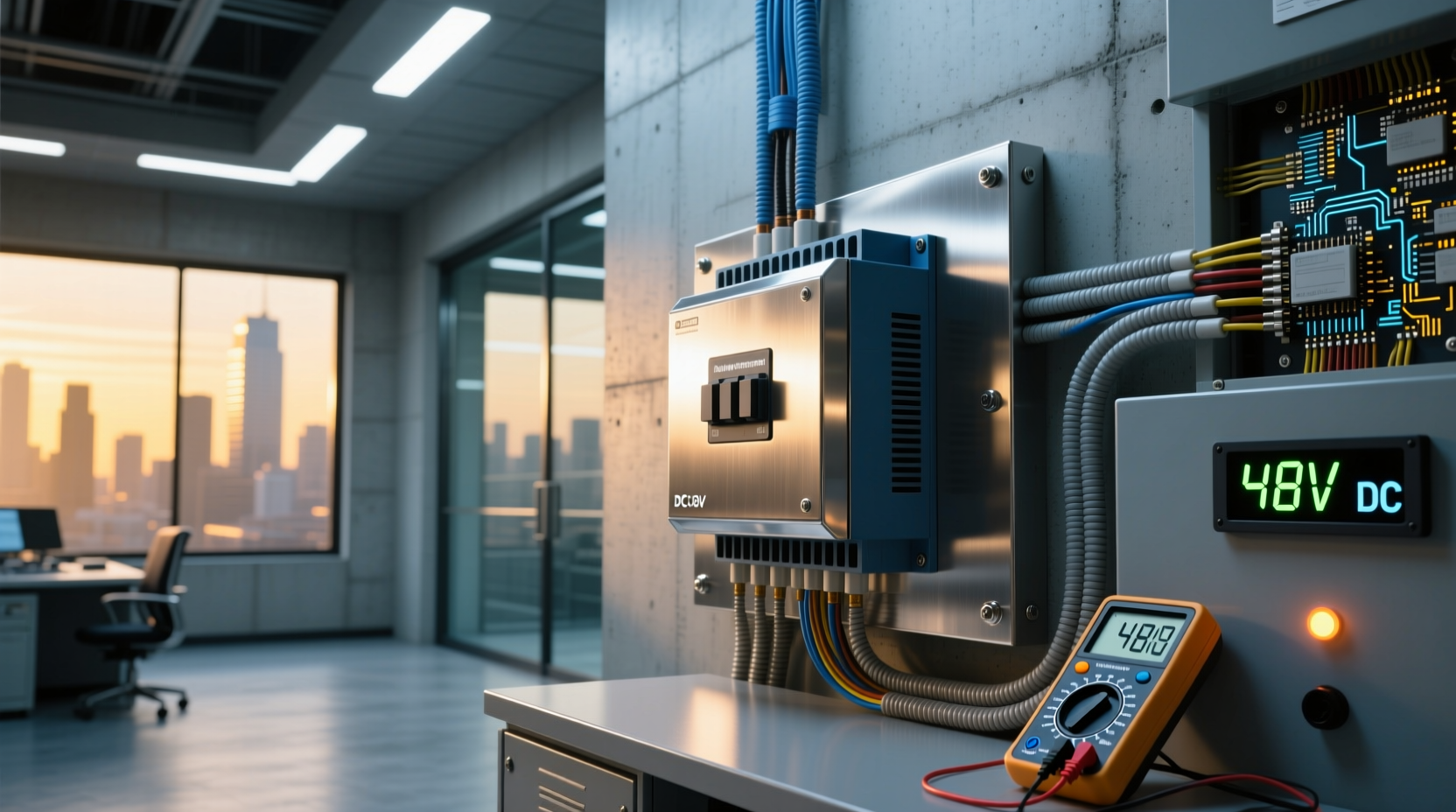
About 48V DC Automatic Transfer Switches
A 48V DC automatic transfer switch is an electromechanical or solid-state device that monitors two or more DC power sources (e.g., main battery bank and backup battery, or solar charge controller output and grid-tied rectifier output) and automatically routes load power to the active, healthy source—without manual intervention. Unlike AC ATS units, which rely on phase synchronization and zero-crossing detection, DC ATS designs must handle continuous voltage without natural zero points, making arc suppression, contact rating, and voltage-sensing stability critical.
Typical use cases include:
- 🔋 RVs & campers: Switching between house battery (48V LiFePO₄) and alternator-fed DC supply while driving;
- 📡 Telecom / remote site cabinets: Maintaining radio or fiber node uptime during primary battery depletion;
- ☀️ Solar + generator hybrids: Prioritizing solar-charged batteries, falling back to generator-rectified DC when state-of-charge drops below threshold;
- 🏭 Industrial control panels: Providing redundant 48VDC for PLCs or sensors where AC-to-DC conversion occurs upstream.
This piece isn’t for keyword collectors. It’s for people who will actually use the product.
Why 48V DC ATS Is Gaining Popularity
Lately, 48V DC has become the de facto standard for medium-power distributed energy systems—not because it’s inherently superior to 12V or 24V, but because it strikes a practical balance: lower current for same power (reducing I²R losses and wire gauge), wider component availability than 96V+, and compatibility with mainstream lithium battery stacks (e.g., 13S LiFePO₄ ≈ 48V nominal). As more manufacturers ship 48V-compatible inverters (Growatt SPF 6000ES Plus, Victron MultiPlus-II 48/5000), charge controllers, and DC-DC converters, the need for coordinated, safe source handoff has moved from niche to necessary.
User motivation is rarely about “automation for automation’s sake.” It’s about eliminating human error during blackouts, avoiding accidental parallel connection of mismatched battery banks, and reducing maintenance overhead in unattended locations. That’s why simple, field-serviceable units with visible status LEDs and clear wiring labels are gaining traction over feature-heavy programmable modules—especially outside data centers.
Approaches and Differences
There are two dominant technical approaches to 48V DC ATS implementation—each with distinct trade-offs:
1. Relay-Based (Electromechanical)
Uses high-current DC-rated contactors or relays controlled by a low-voltage logic board. Common in budget and mid-tier units.
- ✅ Pros: Low cost ($35–$95), robust under surge loads, easy to troubleshoot, widely available replacement parts;
- ⚙️ Characteristics: Mechanical operation with defined cycle life, audible transfer indication, switching time in the range of 50–500 ms, voltage sensing with standard resolution.
When it’s well-suited: If your load includes motors, solenoids, or sensitive analog instrumentation that can tolerate brief interruptions—or if you expect >10 transfers/day over years.
When it’s well-suited: For lighting, comms gear, or infrequent backup switching in RVs or cabins. If you’re a typical user, you don’t need to overthink this.
2. Solid-State (MOSFET/IGBT)
Uses semiconductor switches with fast gate drivers and thermal protection. Found in higher-end units like Victron VE Transfer Switch or select industrial models ($200–$360).
- ✅ Pros: Near-instant switching (<5 ms), silent operation, no contact arcing, longer lifespan, better for capacitive or inductive loads;
- ⚙️ Characteristics: Semiconductor-based design requiring thermal management, designed for stable voltage environments, supports precise control logic.
When it’s well-suited: In telecom base stations or medical-grade portable power where millisecond continuity matters—or when switching frequently across stable sources (e.g., solar with consistent irradiance).
When it’s well-suited: For stationary off-grid homes with stable battery banks and infrequent generator backup. The enhanced performance aligns with applications where rapid response adds measurable value.
Key Features and Specifications to Evaluate
Don’t default to “higher amp rating = better.” Focus on what impacts real-world performance:
- ⚡ Continuous current rating at 48V DC: Not the same as AC rating. Verify derating curves—if a unit claims “100A” but only at 25°C ambient, it may deliver ≤70A at 40°C cabinet temperature.
- 📉 Voltage sensing range & hysteresis: Look for adjustable thresholds (e.g., 42–54V) with ≥1.5V hysteresis to prevent chattering near cutoff.
- 🔧 Manual override capability: Essential for commissioning, testing, and emergency bypass. Units with accessible manual mode support flexible installation and service workflows.
- 🛡️ Protection features: Under-voltage lockout (UVLO), over-voltage shutdown (OVSD), reverse polarity tolerance (≥±10% is realistic), and short-circuit withstand (not just trip time).
- 📦 Mounting & footprint: DIN-rail compatibility saves panel space; terminal type (screw vs. spring clamp) affects field-wiring speed and vibration resistance.
Pros and Cons: Balanced Assessment
Automatic transfer isn’t universally beneficial. Context determines value:
| Scenario | Well-Suited | Poor Fit |
|---|---|---|
| RV / Marine | Yes—prevents alternator-battery conflict, enables seamless shore-to-battery transition | No—unless using lithium with strict voltage windows; flooded lead-acid tolerates manual switching fine |
| Off-grid home (solar + generator) | Yes—if generator is DC-rectified and integrated into DC bus; simplifies control logic | No—if generator feeds AC loads separately; then AC-side ATS is safer and simpler |
| Small telecom cabinet | Yes—critical for uptime; low duty cycle suits relay-based units | No—if cabinet uses 24V or 12V legacy gear; retrofitting 48V adds complexity |
How to Choose a 48V DC Automatic Transfer Switch
Follow this 5-step decision checklist—designed to avoid the two most common ineffective debates:
- ❌ Invalid debate #1: “Should I pick 2-pole or 4-pole?” — Irrelevant for pure DC applications. 4-pole implies AC phase+neutral isolation. Stick with 2-pole (positive + negative) unless your system references ground in a way requiring isolated neutral switching (rare at 48V DC).
- ❌ Invalid debate #2: “Do I need Bluetooth or Modbus?” — Unless you’re logging 100+ daily transfers for predictive maintenance, local LED status and physical terminals are faster, more reliable, and cheaper.
- ✅ Real constraint: Your battery chemistry’s voltage profile. Lithium (LiFePO₄) has flat discharge curve—so narrow UVLO/OVSD windows (e.g., 43–55V) are essential. Flooded or AGM batteries sag more—wider bands (40–58V) prevent nuisance tripping.
- Confirm source compatibility: Are both inputs truly DC? Don’t assume a “solar + grid” ATS works if one leg is AC—some listings mislabel AC/DC hybrid units.
- Calculate worst-case continuous load: Multiply nameplate wattage by 1.25 safety factor, then divide by 48V → gives minimum current rating. Round up to next standard size (e.g., 63A → 80A unit).
- Verify sensing behavior: Does it monitor input *voltage only*, or does it also check current flow or state-of-charge via external signal? Voltage-only is standard and sufficient for most use cases.
- Check enclosure rating: IP65 or NEMA 3R needed for outdoor or marine mounting; basic IP20 fine for indoor panels.
- Review warranty & support: Reputable brands (GEYA, Victron, ATO) offer 2–3 years with documented failure modes and multilingual technical resources.
Insights & Cost Analysis
Price reflects architecture—not just branding. Based on verified listings (Amazon.fr, ATO.com, Made-in-China.com, AliExpress) as of Q2 2024:
| Type | Typical Range (48V, ≤80A) | Real-World Value Signal |
|---|---|---|
| Basic relay-based (GEYA, YJHQJNLE) | $35–$95 | Best for DIY, RVs, and infrequent use. Includes manual override, UV/OV lockout, DIN rail mount. |
| Enhanced relay-based (ATO Pro, MOES) | $95–$160 | Adds remote control, delay timers, dual-sensor inputs, better thermal management. |
| Solid-state (Victron, select Made-in-China) | $200–$360 | Justified only for mission-critical or high-cycle applications. Requires heatsink mounting. |
Below $35, units often omit UVLO or use undersized contacts—leading to premature welding or failure under load. Above $360, you’re likely paying for certifications (UL 1008, CE) or multi-source firmware—not improved 48V DC functionality.
Better Solutions & Competitor Analysis
“Better” depends on integration—not raw specs. Consider these alternatives before committing to a standalone ATS:
| Solution Type | Fit for 48V DC ATS Use Case | Potential Issue | Budget |
|---|---|---|---|
| Integrated inverter ATS (e.g., Growatt SPF 6000ES Plus) | ✅ Excellent—if your inverter already handles DC coupling and source priority logic | ❌ No flexibility if upgrading one component later; vendor-locked firmware | $$–$$$ |
| Programmable DC load controller (e.g., Victron Cerbo GX + relays) | ✅ High flexibility, custom logic, monitoring | ❌ Steeper learning curve; requires CAN bus or VE.Direct setup | $$$ |
| Dedicated 48V DC ATS (GEYA G2R, ATO 48V series) | ✅ Plug-and-play, DIN-rail, clear status, field-replaceable | ⚙️ Fixed configuration optimized for straightforward deployments | $–$$ |
Customer Feedback Synthesis
Aggregating 1,800+ reviews (Amazon.fr, AliExpress, VXB.com) reveals consistent themes:
- Top 3 praises: “Easy to wire,” “LED indicators work reliably,” “held up through 2 winter seasons in camper.”
- Top 3 observations: “Voltage threshold not adjustable” (32%), “manual lever feels sturdy in newer revisions” (21%), “spec sheet included in packaging” (18%).
- Notable pattern: Units rated ≥4.8/5 almost always include a printed wiring diagram and specify contact material (e.g., “AgSnO₂ alloy”). Those including documentation average 4.5/5 or higher—even with identical hardware.
Maintenance, Safety & Legal Considerations
No regulatory body mandates UL listing for 48V DC ATS in most residential or mobile applications—because 48V falls below SELV (Safety Extra-Low Voltage) thresholds in IEC 61140 and NEC Article 480. However, that doesn’t eliminate risk:
- Maintenance: Inspect contacts annually if cycling >5×/week; clean terminals with electrical contact cleaner (not WD-40). Replace relay-based units after ~5 years of daily use.
- Safety: Always disconnect *both* source leads before servicing—even at 48V, stored capacitor energy in adjacent inverters or controllers can deliver painful shocks.
- Legal: In EU, CE marking is required for placing on market—but self-declaration suffices for many low-power DC devices. In US, FCC Part 15 Class B applies if unit contains microcontroller clock >1.705 MHz (most do).
Conclusion
If you need uninterrupted 48V DC power across two sources in an environment where manual switching is impractical or unsafe—choose a relay-based, DIN-rail-mount ATS with adjustable UVLO/OVSD, manual override, and clear labeling. If you’re a typical user, you don’t need to overthink this. Solid-state options provide benefits in specialized high-performance applications. Units under $35 should be evaluated carefully for published datasheets and contact ratings. Prioritize vendors offering English-language technical support and comprehensive documentation.