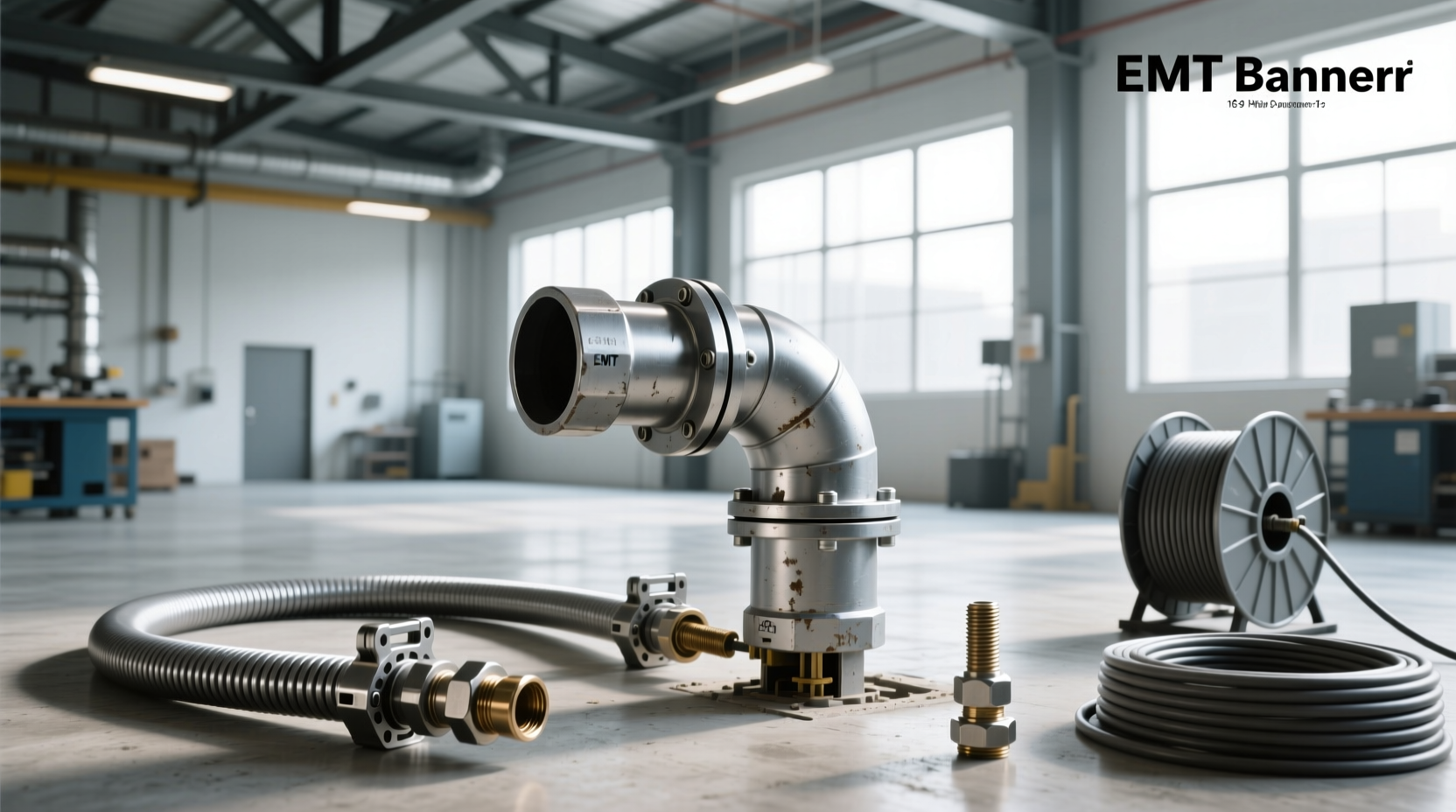
Over the past year, demand for pre-fabricated EMT conduit elbows has risen sharply—not because of new technology, but because more electricians and DIY builders are prioritizing speed, code compliance, and pullability over field-bending. If you’re installing EMT in commercial retrofits or residential service panels, choose a standard-radius 90° galvanized steel elbow (½"–1") with E-Z Pull interior coating—it’s the most reliable balance of wire-pulling ease, mechanical protection, and NEC 358.26 compliance. Avoid non-UL-listed die-cast elbows for permanent runs, and skip custom bends unless your job requires precise angles under 11¼°. If you’re a typical user, you don’t need to overthink this.
About EMT Conduit Elbows
An EMT conduit elbow is a factory-made, rigid fitting used to change the direction of electrical metallic tubing (EMT) at fixed angles—most commonly 90° or 45°, though specialty options like 11¼° and 22½° exist. Unlike flexible conduit fittings or PVC elbows, EMT elbows are designed for thin-walled, unthreaded steel tubing and rely on compression-type connectors (e.g., set-screw or push-in) rather than threads. They serve two primary functions: directional routing (to navigate corners, walls, or obstructions) and wire pulling access (especially “pulling elbows,” which feature larger internal radii and smooth interiors to reduce friction during cable installation).
Typical use cases include: commercial office ceiling grids, industrial machine control panels, residential service entrances, and data center raceway transitions. You’ll find them connecting EMT to junction boxes, panelboards, or other conduit segments—never as standalone structural supports. Importantly, EMT elbows do not replace conduit bodies (like ‘L’ or ‘T’ boxes); they’re purely directional, not access points.
Why EMT Conduit Elbows Are Gaining Popularity
Lately, EMT elbows have moved beyond contractor-only inventory into hardware stores and online B2C channels—not because they’ve gotten smarter, but because field bending has become less viable. Tight labor margins, rising insurance scrutiny on improper bends, and stricter enforcement of NEC 358.26 (which limits bend radius and prohibits kinking) have made prefabricated elbows a cost-avoidance tool. A single poorly executed field bend can cause wire abrasion, failed inspections, or rework delays. Meanwhile, UL-listed elbows guarantee consistent radius geometry and material integrity. This shift isn’t about preference—it’s about risk reduction and schedule certainty. If you’re a typical user, you don’t need to overthink this.
Approaches and Differences
There are three main ways to achieve a directional change in EMT: field bending, prefabricated elbows, and conduit bodies with offset fittings. Each serves different constraints—and misalignment between method and job scope causes the most common installation failures.
- 🔧Field-Bent EMT: Using a hand or hydraulic bender to create custom angles on-site.
Pros: Maximum flexibility for odd angles (e.g., 37°), minimal part count.
Cons: High skill dependency; risk of ovalization or wall thinning; violates NEC 358.26 if radius falls below 6× conduit diameter; no interior smoothing.
When it’s worth caring about: When retrofitting historic buildings with irregular framing.
When you don’t need to overthink it: For standard 90° turns in new construction—prefab elbows save time and pass inspection first try. - 📦Prefabricated Elbows (Standard & Pulling): Die-cast or stamped steel elbows, typically galvanized, available in ½"–4" trade sizes.
Pros: Consistent radius (usually 6× OD), UL-listed, E-Z Pull coatings reduce pull force by ~25%, faster install.
Cons: Fixed angles only; bulkier than field bends; higher per-unit cost.
When it’s worth caring about: Any run exceeding 36 ft or containing THHN/THWN-2 cables >6 AWG.
When you don’t need to overthink it: For short, straight-wall residential lighting circuits—standard elbows are sufficient. - 🧩Conduit Bodies + Offset Fittings: Using an ‘L’ or ‘T’ box with angled entries.
Pros: Provides physical access for splicing or pulling; allows multi-directional branching.
Cons: Requires additional box fill calculations (NEC 314.16); more mounting points; higher profile.
When it’s worth caring about: When you’ll need future wire access or plan to add circuits later.
When you don’t need to overthink it: For simple point-to-point conduit runs—elbows eliminate unnecessary complexity.
Key Features and Specifications to Evaluate
Not all EMT elbows perform equally—even within the same angle and size. Focus on four measurable attributes:
- Material & Coating: Galvanized steel is standard. Look for hot-dip or electro-galvanized finishes with ≥0.7 mil zinc thickness (ASTM A123). E-Z Pull or similar interior polymer coatings reduce wire drag—critical for long pulls or bundled cables.
- Bend Radius: Must meet NEC 358.26: minimum 6× conduit outside diameter (e.g., 3" radius for ½" EMT). Verify stamped radius on packaging—not just “standard” labeling.
- UL Listing & Compliance: UL 797 certification confirms mechanical strength and grounding continuity. Non-UL elbows may pass visual inspection but fail torque testing or ground-path validation.
- Connector Compatibility: Ensure matching set-screw or compression connectors (e.g., ½" elbow requires ½" EMT connector). Mismatched threads or grip surfaces cause loosening over time.
This piece isn’t for keyword collectors. It’s for people who will actually use the product.
Pros and Cons
✅ Best for: Commercial retrofits, multi-story residential wiring, jobs requiring NEC-compliant documentation, teams with mixed experience levels.
❌ Not ideal for: Temporary low-voltage runs (e.g., landscape lighting), ultra-tight spaces where elbow depth exceeds clearance, or applications requiring frequent disassembly.
How to Choose an EMT Conduit Elbow: A Step-by-Step Decision Guide
Follow this checklist before ordering—or walking into Lowe’s or Home Depot:
- Confirm conduit size: Match elbow trade size exactly to EMT (½", ¾", 1", etc.). Never assume metric equivalents.
- Select angle: 90° for right-angle turns; 45° for gradual offsets; avoid 11¼° unless specified in engineering drawings.
- Verify UL 797 listing: Check packaging or spec sheet—no exceptions. Unlisted elbows lack third-party validation of pull strength and grounding integrity.
- Check interior finish: For runs >25 ft or with >3 conductors, prioritize E-Z Pull or equivalent coated interiors.
- Avoid these pitfalls:
- Using die-cast elbows rated only for IMC/Rigid conduit—they often lack EMT-specific compression grooves.
- Stacking multiple elbows in one conduit segment (violates NEC 362.26’s 360° total bend limit).
- Installing elbows without supporting the conduit within 3 ft upstream/downstream (per NEC 358.30).
Insights & Cost Analysis
Price varies significantly by size, brand, and feature set—but not linearly. Based on current retail pricing (Q2 2024):
- ½" 90° standard elbow: $3.20–$5.90 (Eaton, Atkore, Commercial Electric)
- ¾" 90° E-Z Pull elbow: $7.40–$11.20
- 1" 90° UL 797 elbow: $12.94–$18.50 1
- 11¼° specialty elbow: $162.80 (NorthEast Electrical) 2
The premium for E-Z Pull or UL 797 compliance is justified when wire-pulling labor exceeds $45/hour—and it usually does. For small jobs (<5 elbows), standard UL-listed units deliver best value. For large-scale deployments, the time saved on first-pass pulls offsets cost differences within 2–3 days.
Better Solutions & Competitor Analysis
| Category | Suitable Advantage | Potential Problem | Budget Range (per unit) |
|---|---|---|---|
| Standard UL 797 Elbow (Atkore, Eaton) | Proven durability; wide distributor availability; full NEC alignment | No interior coating; slightly higher pull force vs. E-Z Pull | $3.20–$18.50 |
| E-Z Pull Coated Elbow (Sigma ProConnex, Eaton) | ~25% lower pull force; smoother cable transition; fewer snag points | Limited size availability (mostly ¾"–1"); longer lead times | $7.40–$22.00 |
| Non-UL Die-Cast Elbow (some Amazon listings) | Lowest upfront cost; lightweight | Fails torque tests; inconsistent radius; grounding path unverified | $1.99–$4.50 |
Customer Feedback Synthesis
Based on aggregated reviews from Home Depot, Lowe’s, and Amazon (2023–2024), users consistently praise:
- Reliability in pull tests: “Pulled 12/2 THHN through 4x 90° elbows—zero snags.”
- Fit-and-finish consistency: “No wobble when tightened—connectors seat fully every time.”
- UL verification confidence: “Passed city inspection on first visit—no rework.”
Top complaints involve:
- Mislabeling (e.g., “1" elbow” actually fitting 1¼" conduit)
- Packaging damage leading to dented interiors
- Lack of multilingual instructions for international crews
Maintenance, Safety & Legal Considerations
EMT elbows require no routine maintenance—but safety depends on correct installation. Key considerations:
- Grounding continuity: Per NEC 250.64(E), EMT systems must maintain an effective ground-fault path. Elbows must be securely fastened and bonded—loose fittings break the path.
- Bend limits: NEC 362.26 restricts total bends between pull points to 360°. Three 90° elbows = max allowed. Exceeding this requires a conduit body or access point.
- Support spacing: NEC 358.30 mandates support within 3 ft of each elbow—and every 10 ft along straight runs.
- Environmental exposure: Galvanized elbows resist corrosion indoors or in dry commercial spaces. For damp locations (e.g., parking garages), specify GRC (galvanized rigid conduit) elbows instead.
Conclusion
If you need code-compliant, repeatable, low-friction directional changes in EMT—choose a UL 797-listed, galvanized steel elbow in your exact conduit size, with E-Z Pull coating if pulling >25 ft or >3 conductors. If you need custom angles or field adaptability, invest time in proper bender calibration and verify radius with a bend gauge. If you’re a typical user, you don’t need to overthink this. Skip non-UL options, ignore marketing claims about “heavy-duty” without test data, and treat elbow selection as a reliability checkpoint—not a commodity choice.