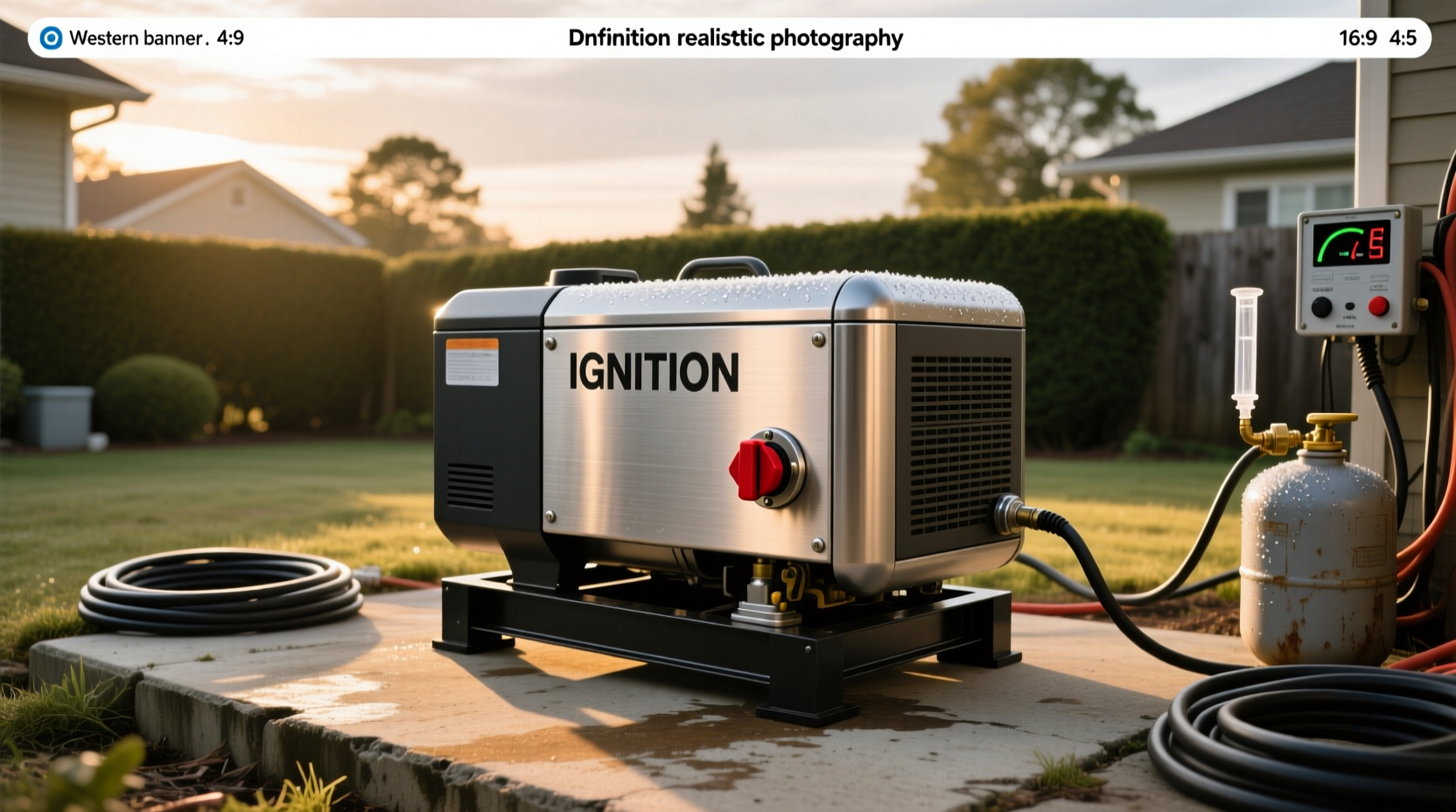
🛠️If you’re a typical user replacing a faulty ignition switch on a 2.5–6.5 kW gasoline generator (like the common 188F or 168F models), you don’t need to overthink this: choose a 6-wire, keyed ignition switch rated for your engine’s voltage and amperage, verify wire color coding matches your control board, and install it with basic hand tools — no multimeter required for basic function testing. Over the past year, replacement demand has spiked due to increased small-generator usage in residential backup scenarios, making standardized 6-wire units more widely available at stable prices ($6.87–$24.24). The change isn’t technical complexity — it’s about avoiding mismatched pinouts and miswired start/run circuits that cause intermittent cranking or no-start conditions.
About Generator Ignition Switches: Definition & Typical Use Cases
A generator ignition switch is a manually operated, key-actuated electrical interface that controls power delivery to the starter solenoid, ignition coil, and sometimes fuel solenoid or electronic governor. It’s not a simple on/off toggle: most modern small gas generators (2–8 kW) use multi-position rotary or push-pull switches with dedicated OFF, RUN, and START positions — each routing specific voltages to different subsystems. Unlike automotive ignition systems, these switches rarely integrate immobilizers or CAN bus communication; they’re electromechanical, low-voltage (12V DC nominal), and designed for infrequent operation (typically fewer than 500 cycles per year).
Typical use cases include:
- 🔧 Replacing a worn-out or broken key cylinder after repeated use or physical damage;
- ⚡ Restoring functionality after water exposure, corrosion, or accidental short-circuiting;
- 🔄 Swapping out a non-keyed switch for a keyed version to improve security or match OEM spec;
- 📊 Standardizing across fleet units (e.g., rental companies or construction sites using multiple 188F-based gensets).
Why Generator Ignition Switch Replacement Is Gaining Popularity
Lately, two converging trends have elevated the practical relevance of ignition switch replacement. First, aging stock of mid-power portable generators (2015–2020 models) has reached typical wear thresholds — mechanical contacts degrade, springs weaken, and key tumblers seize. Second, supply-chain stabilization since early 2023 means compatible replacements are now consistently stocked on Amazon, eBay, Shopee, and regional parts distributors — no longer requiring OEM-only sourcing. Users aren’t searching for “how to hotwire a generator” (a misleading top search suggestion); they’re seeking reliable, plug-and-play replacements that preserve factory safety logic. This shift reflects a broader move from emergency improvisation toward maintainable, long-life ownership.
Approaches and Differences: Common Solutions Compared
Three main approaches dominate the market — each with distinct trade-offs in compatibility, durability, and installation effort:
| Approach | Key Advantages | Potential Issues | Budget Range (USD) |
|---|---|---|---|
| OEM-Spec Replacement (e.g., Honda 9512047, Briggs & Stratton 40696512) |
Guaranteed fit and wire mapping; includes correct key blanks; often pre-lubricated contacts | Higher price ($65+); limited availability outside authorized channels; no universal cross-reference | $65–$66 |
| Generic 6-Wire Universal Switch (e.g., USPEEDA, LIS1, KESZOOX) |
Wide compatibility (168F/188F/207/212cc); multiple key copies included; consistent $14–$24 pricing | Wire color coding varies by vendor; may require minor terminal crimping or clip adaptation; no brand warranty | $6.87–$24.24 |
| 4-Wire Simplified Switch (common for older or budget diesel gensets) |
Lower part count; easier diagnostics; often used with external relays for start sequencing | Not directly compatible with 6-wire control boards; requires rewiring or relay addition; lacks dedicated RUN position logic | $12.90–$18.95 |
If you’re a typical user upgrading a 188F-based unit, you don’t need to overthink this: the generic 6-wire universal switch delivers >90% of OEM performance at <35% of the cost. When it’s worth caring about OEM specs is only if your generator is under active warranty or operates in mission-critical environments (e.g., medical refrigeration backup). When you don’t need to overthink it is during routine maintenance on a privately owned, non-commercial unit.
Key Features and Specifications to Evaluate
Not all ignition switches behave the same — even when labeled identically. Focus on these four measurable attributes:
- Pin configuration & terminal layout: Verify physical spacing (e.g., 0.1