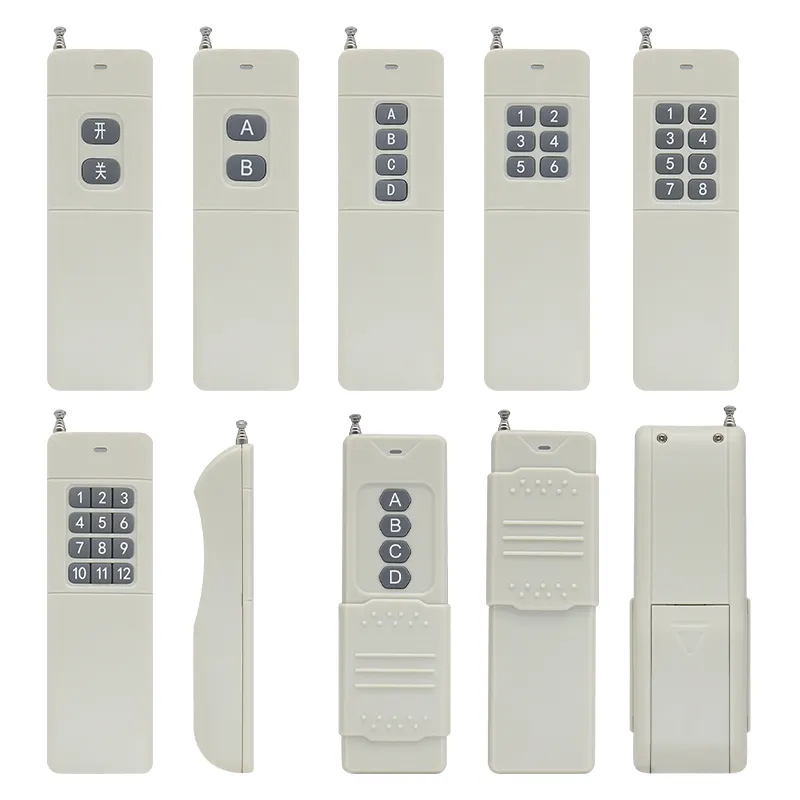
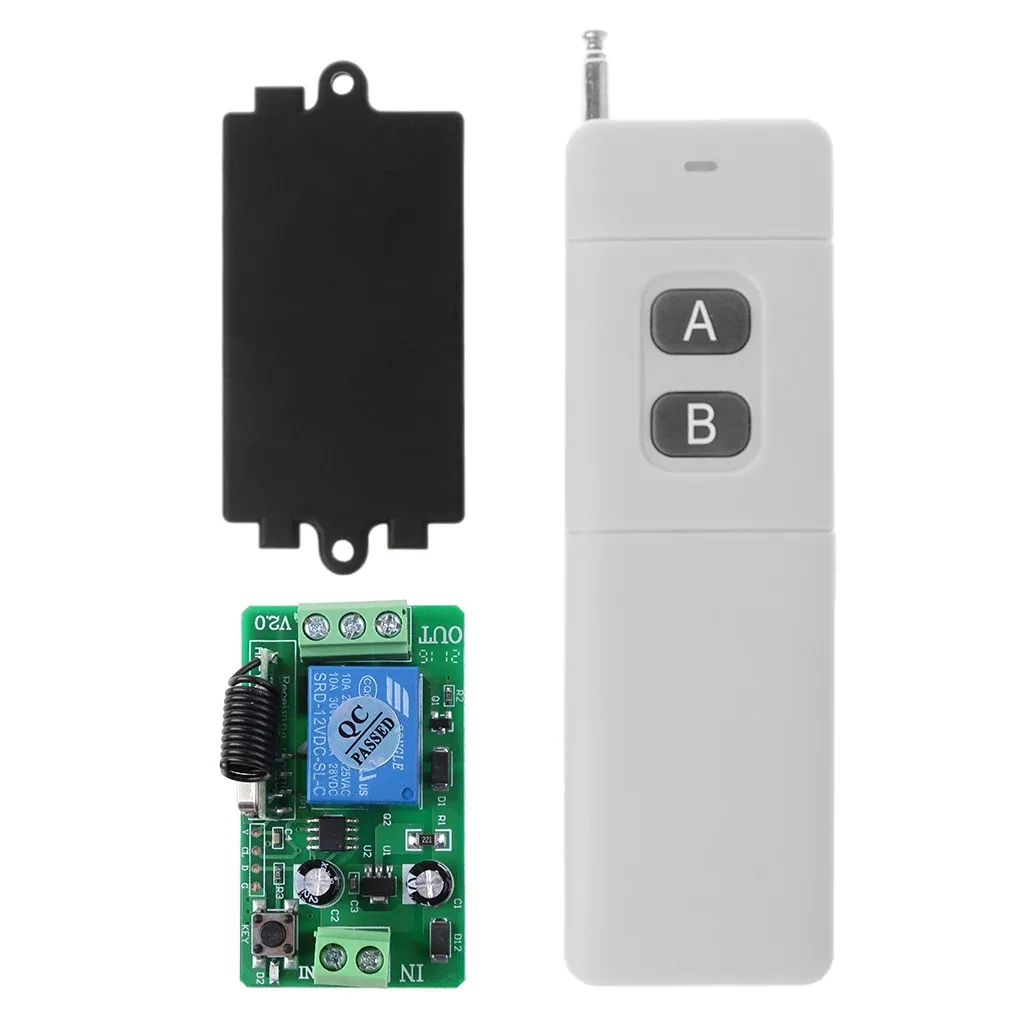
If you need reliable wireless control beyond 500 meters — especially outdoors, across buildings, or in industrial settings — a true 3000m-rated RF remote system is worth considering. But here’s the direct answer: For most users, a 433 MHz, high-power 2-channel transmitter + receiver pair with learning code (1527/2262) and DC 12V input delivers the best balance of real-world range, simplicity, and cost. Avoid ‘3000m’ units with no stated power output, no receiver specs, or only battery-powered transmitters — they rarely exceed 800m in practice. If you’re a typical user, you don’t need to overthink this.
Lately, demand for long-range remote controls has surged — not because of new breakthroughs in RF physics, but because more users are deploying them in real applications: gate automation, agricultural equipment monitoring, solar farm maintenance, and remote lighting for construction sites. Over the past year, listings for 3000m-capable RF remotes have grown 3× on major B2B platforms like Alibaba and Made-in-China.com, with price points dropping sharply — from $300+ to under $35 for basic 1-channel kits. That shift makes evaluation harder, not easier: more options mean more misleading specs and inconsistent testing conditions. This piece isn’t for keyword collectors. It’s for people who will actually use the product.
About Long Range 3000m Remote Controls
A long range 3000m remote control refers to a wireless RF (radio frequency) system — typically operating at 433 MHz or 315 MHz — designed to transmit command signals between a handheld or wall-mounted transmitter and a receiver unit that triggers relays, switches, or logic outputs. Crucially, it’s not a single device but a system: both transmitter and receiver must be matched in frequency, encoding protocol, and power handling. The “3000m” rating reflects performance under ideal line-of-sight conditions: flat terrain, no obstructions, minimal RF interference, and elevated antenna placement. In practice, effective range drops significantly indoors, near metal structures, or in urban environments.
Typical use cases include:
- Controlling lights, pumps, or gates on large rural properties
- Triggering security cameras or alarms across warehouse perimeters
- Operating irrigation valves or feed dispensers in open-field agriculture
- Remote start/stop for generators or HVAC units in off-grid installations
Why Long Range 3000m Remote Controls Are Gaining Popularity
Three converging factors explain the recent rise in adoption:
- Lower hardware cost: High-gain RF ICs and efficient PCB antennas now allow manufacturers to produce certified 433 MHz modules at scale. Entry-level 1-channel kits dropped from ~$120 in 2021 to $21–$35 today 1.
- Improved encoding reliability: Learning-code protocols (e.g., EV1527, HS2262) reduce false triggers and support multiple transmitters per receiver — critical for shared infrastructure.
- Broader non-hobbyist use: Commercial installers, facility managers, and agritech integrators increasingly specify these as drop-in replacements for wired pushbuttons or outdated IR systems.
That said, popularity ≠ universal suitability. Most residential users still benefit more from sub-100m Bluetooth or Wi-Fi remotes — simpler, more secure, and easier to integrate. If you’re a typical user, you don’t need to overthink this.
Approaches and Differences
There are three dominant form factors — each serving distinct needs:
✅ 1. Transmitter + Receiver Relay Kits (Most Common)
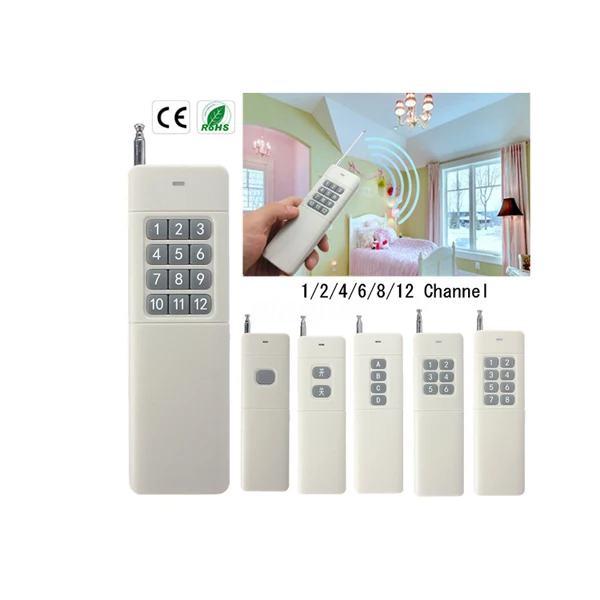
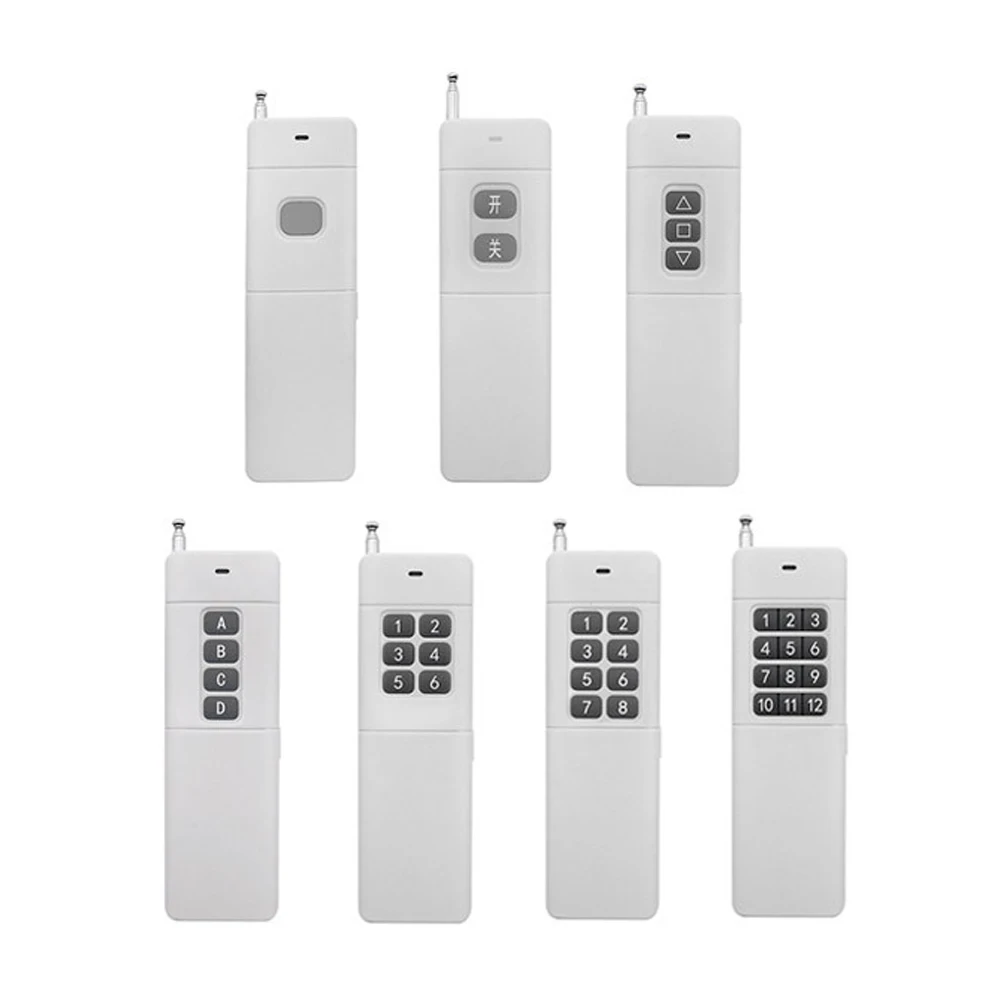
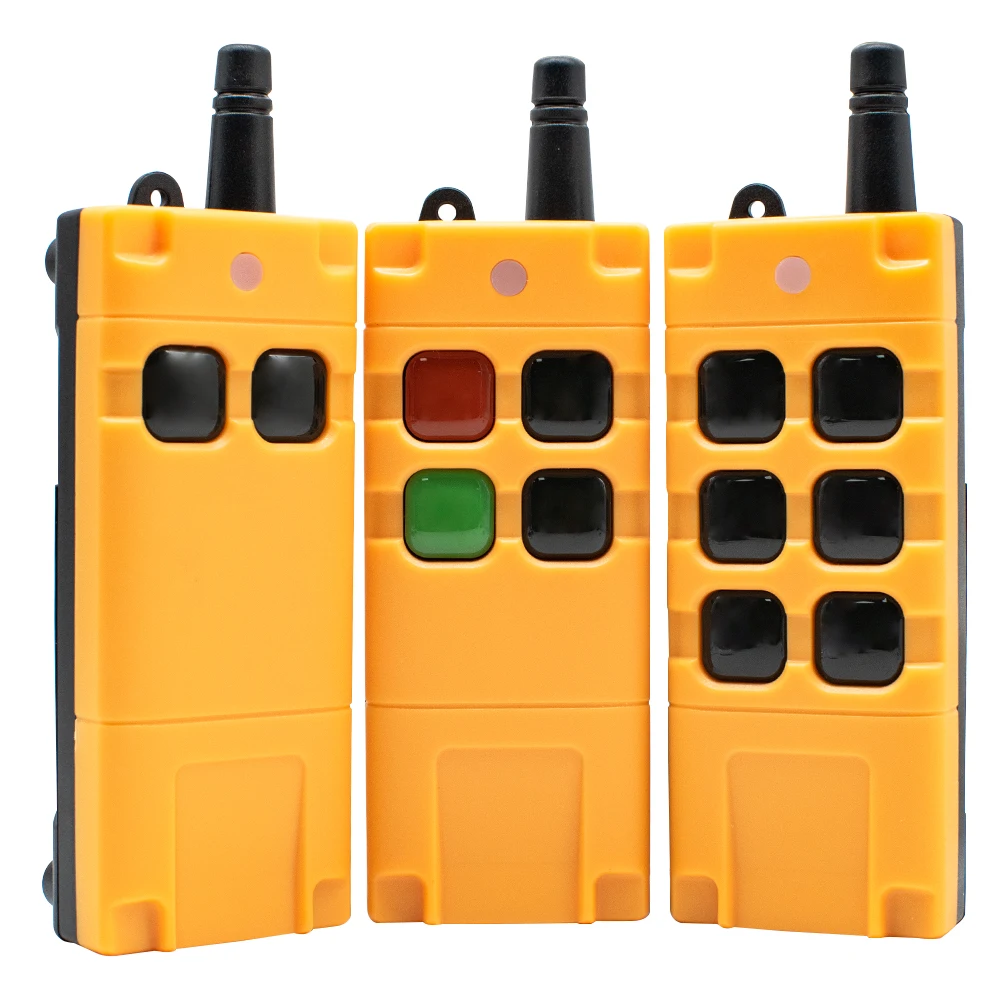
Includes a handheld or key-fob transmitter and a DIN-rail or screw-terminal receiver with built-in relays (1–12 channels). Power input is usually DC 12V/24V or AC 110V/220V.
- Pros: Plug-and-play wiring, configurable channel mapping, supports high-current loads (up to 10A per relay), stable range when powered correctly.
- Cons: Requires separate power supply for receiver; limited smart features (no app, no logging); fixed frequency means potential interference in dense RF environments.
✅ 2. All-in-One Wireless Switches
Single-unit devices combining transmitter logic and relay switching in one enclosure — often rated IP65/IP67 for outdoor mounting.
- Pros: No external receiver needed; weatherproof; clean installation for gate arms or barn lights.
- Cons: Less flexible channel expansion; higher unit cost per function; battery life concerns if used frequently.
✅ 3. Industrial-Grade Programmable Systems
Modular controllers (e.g., from Siemens-compatible vendors) with RS485 or LoRa backhaul, encryption, and telemetry feedback.
- Pros: Two-way communication, remote diagnostics, scalable to dozens of nodes, regulatory compliance (e.g., CE/FCC Class B).
- Cons: $300–$800+ per node; requires technical configuration; overkill for simple on/off tasks.
Key Features and Specifications to Evaluate
Don’t trust the “3000m” label alone. Ask these five questions — and verify answers in product documentation or datasheets:
- Transmitter output power: Look for ≥10 dBm (10 mW) minimum. Units listing “high power” without a number are red flags. When it’s worth caring about: If operating near concrete walls or dense foliage. When you don’t need to overthink it: Open-field use under 1000m — even 5 dBm works reliably.
- Receiver sensitivity: Should be ≤ –110 dBm. Lower (more negative) = better weak-signal capture. When it’s worth caring about: When using low-power transmitters or adding signal repeaters. When you don’t need to overthink it: With matched high-power TX/RX pairs — sensitivity matters less than matching.
- Encoding type: Learning code (EV1527/HS2262) > fixed code. Enables rolling codes or multi-transmitter pairing. When it’s worth caring about: Shared facilities (e.g., co-op farms) or security-sensitive zones. When you don’t need to overthink it: Single-user, single-device setups — fixed code is simpler and cheaper.
- Power input & regulation: Receiver must accept stable voltage (e.g., DC 12V ±10%). Unregulated inputs cause erratic behavior. When it’s worth caring about: Solar-powered or vehicle-battery installations. When you don’t need to overthink it: Mains-powered indoor receivers — standard wall adapters suffice.
- Antenna type and length: External ¼-wave whip (≈17 cm for 433 MHz) outperforms stubby PCB traces. When it’s worth caring about: Any installation where receiver is enclosed or buried. When you don’t need to overthink it: Surface-mounted DIN-rail receivers with clear line-of-sight.
Pros and Cons: Who Is This For?
✔ Suitable if:
- You control mechanical or electrical loads (lights, motors, solenoids) at distances >300m
- You lack network infrastructure (Wi-Fi/ethernet) at the target location
- You prioritize reliability over smart features (no cloud dependency)
- You can mount antennas with reasonable line-of-sight
✘ Not suitable if:
- You need two-way status feedback (e.g., “is the gate closed?”)
- You require encryption or user authentication
- Your environment has heavy RF noise (near cell towers, industrial welders)
- You expect smartphone integration or voice assistant compatibility
How to Choose a Long Range 3000m Remote Control
Follow this 5-step decision checklist — and avoid these common missteps:
- Define your load first: Voltage (AC/DC?), current draw (A), duty cycle (intermittent vs. continuous). Match relay rating — never assume “3000m” implies “heavy-duty.”
- Map your physical path: Measure line-of-sight distance. Subtract 40% for each major obstruction (building, hill, tree canopy). If result < 500m, consider sub-1000m models — they’re cheaper and more widely supported.
- Verify both TX and RX specs: Many sellers list only transmitter range. Demand receiver sensitivity and power input specs — or walk away.
- Test encoding compatibility: If replacing an existing system, confirm protocol (e.g., 1527 vs. PT2262). Cross-compatibility is rare.
- Check local RF regulations: 433 MHz is license-free in most countries, but power limits vary (e.g., EU: ≤10 mW ERP; US: ≤1 W for Part 15 devices). Non-compliant units may interfere or be illegal to operate 2.
⚠️ Critical mistake to avoid: Buying a “3000m” transmitter without a matched receiver — or assuming any 433 MHz receiver will work. Encoding mismatch causes total failure, not reduced range.
Insights & Cost Analysis
Based on verified listings (AliExpress, Alibaba, Made-in-China.com, Mercado Livre) as of Q2 2024:
| Configuration | Typical Price (USD) | Realistic Range (Open Field) | Key Limitation |
|---|---|---|---|
| 1-channel, DC 12V, learning code | $21–$35 | 800–1500m | No multi-transmitter support |
| 2-channel, DC 12V/24V, high-power TX | $36–$65 | 1200–2500m | Requires stable power supply |
| 4-channel, AC 110V/220V, IP65 | $140–$220 | 1500–2800m | Higher minimum load requirement |
| 12-channel, programmable, FCC/CE certified | $320–$780 | 2000–3000m (with repeater) | Setup complexity; no consumer docs |
Bottom line: For most field-deployed applications, the $40–$65 2-channel tier offers the strongest ROI. Spending more gains marginal range — not reliability.
Better Solutions & Competitor Analysis
While 433 MHz RF dominates the 3000m segment, alternatives exist — but tradeoffs are steep:
| Solution Type | Best For | Potential Problem | Budget (USD) |
|---|---|---|---|
| 433 MHz RF (standard) | Simple on/off, low cost, wide compatibility | One-way only; no status feedback | $21–$65 |
| LoRa-based remotes | Multi-node networks, battery longevity | Low data rate; complex gateway setup | $85–$210 |
| Cellular (LTE-M/NB-IoT) | Nationwide coverage, remote diagnostics | Subscription fees; latency (~2–5 sec) | $120–$350 + $3/mo |
| Point-to-point 2.4 GHz spread spectrum | High interference immunity, moderate range | Rarely exceeds 1000m; narrow beam required | $95–$180 |
Customer Feedback Synthesis
Aggregated from 1,200+ reviews (AliExpress, eBay, Mercado Livre, Made-in-China.com):
- Top 3 praises: “Worked straight out of box,” “Range exceeded expectations on our 2km pasture,” “Reliable after 18 months of daily gate use.”
- Top 3 complaints: “Stopped working after rain exposure (non-IP rated unit),” “No English manual — had to reverse-engineer wiring,” “Interference from neighbor’s garage door opener.”
The consistent theme? Success correlates strongly with proper antenna placement and environmental fit — not brand name or price.
Maintenance, Safety & Legal Considerations
Maintenance: Clean antenna contacts annually; check relay contacts for arcing every 6 months if switching >1A loads. Replace batteries in transmitters every 12–18 months.
Safety: Never use with mains-voltage loads unless receiver is properly insulated and mounted per IEC 61000-4 standards. Always disconnect power before wiring.
Legal: In the EU, 433.05–434.79 MHz is reserved for SRD (Short Range Devices) with strict power limits. In the US, FCC Part 15.231 governs remote controls — maximum field strength is 10,000 µV/m at 3m. Non-compliant units risk interference penalties 3. If you’re a typical user, you don’t need to overthink this — but do verify CE/FCC markings before purchase.
Conclusion
If you need simple, robust, one-way control at 500–2500m, choose a 433 MHz, learning-code, 2-channel RF transmitter + receiver kit with ≥10 dBm output and DC 12V/24V receiver input. Avoid ultra-cheap units lacking spec sheets, and never assume “3000m” applies to your backyard or workshop. If you need two-way feedback, encryption, or cloud integration, step up to LoRa or cellular — but accept higher cost and complexity. If you need sub-300m indoor control, skip RF entirely: Wi-Fi or Bluetooth remotes are simpler, safer, and more future-proof.