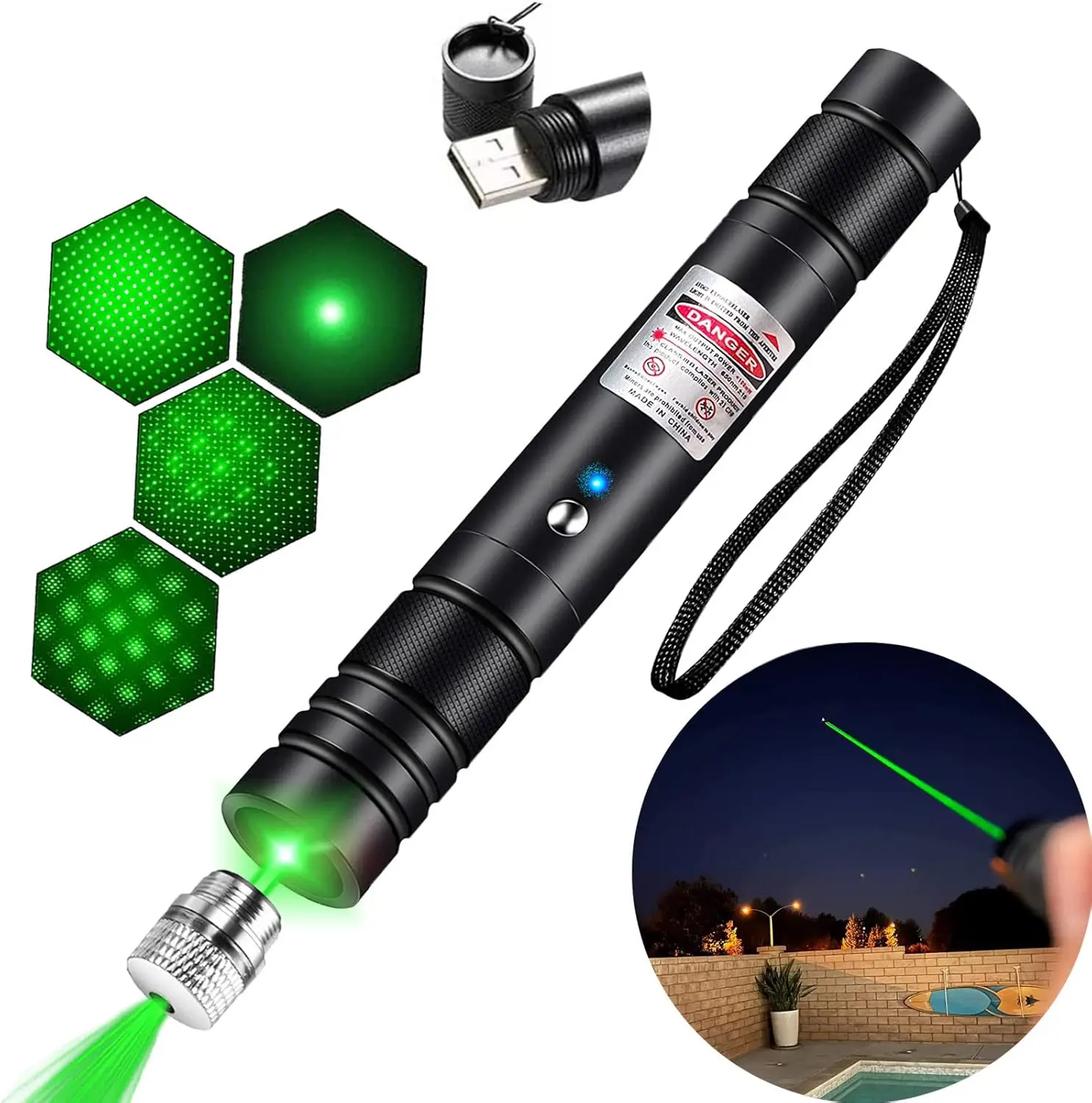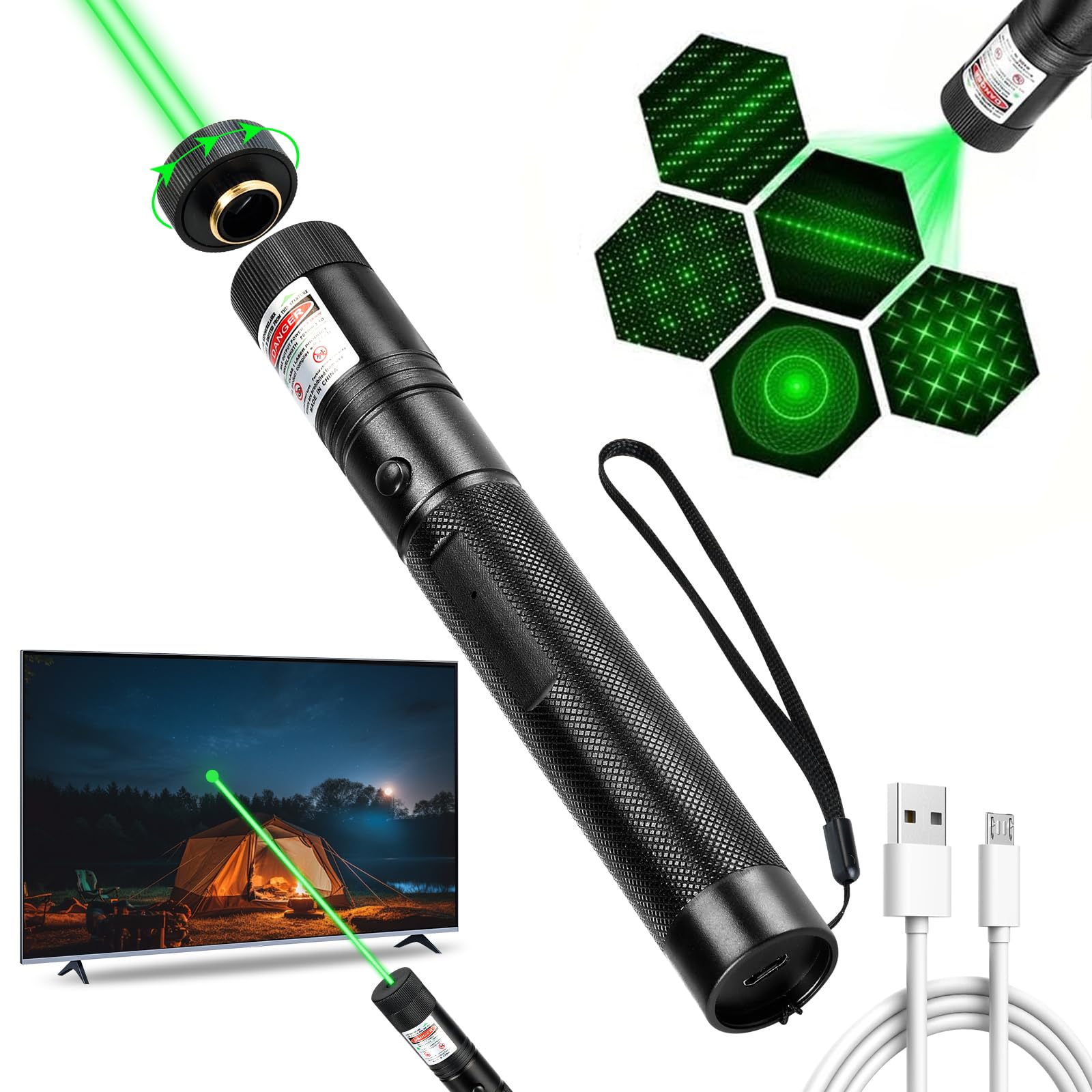
If you’re a typical user, you don’t need to overthink this. Over the past year, Amazon’s top-selling powerful laser pointers have shifted decisively toward green-beam, USB-C rechargeable models rated for 2,000+ meters visibility—not raw wattage claims. Skip purple or red variants unless you specifically need low-visibility indoor use; avoid non-rechargeable units if you plan more than occasional use; and never prioritize “burning” capability without verifying FDA-compliant labeling and Class IIIb/IV safety features. The strongest signal? Top performers average 2,300+ monthly sales and share three traits: human-eye-optimized green wavelength (532 nm), integrated lithium battery with USB-C port, and dual-use positioning (astronomy + pet interaction). This piece isn’t for keyword collectors. It’s for people who will actually use the product.
About Powerful Laser Pointers: Definition & Typical Use Cases
A powerful laser pointer refers to a handheld diode-based device emitting coherent light at output powers typically ranging from 5 mW to 5,000 mW (5 W), classified under FDA and IEC standards as Class IIIb (5–500 mW) or Class IV (>500 mW). Unlike presentation pointers (<5 mW), these are engineered for tasks requiring high beam visibility at distance or material interaction—not just pointing, but signaling, alignment, astronomy targeting, or controlled outdoor activity. Common real-world scenarios include:
- 🔭 Astronomy outreach: Identifying stars and deep-sky objects during public stargazing events;
- 🐾 Pet engagement: Guiding dogs during training or stimulating cats in large yards (with strict supervision);
- 🥾 Hiking & emergency signaling: Marking distant landmarks or attracting attention across open terrain;
- 📐 Construction & surveying: Rough alignment checks where precision-grade tools aren’t required.
Importantly, “powerful” does not mean “unregulated.” Most Amazon-listed units labeled >5 mW fall into Class IIIb or IV—and legally require compliance labeling, safety interlocks, and often key switches. If you’re a typical user, you don’t need to overthink this: for daylight visibility and general-purpose outdoor use, 100–300 mW green lasers deliver optimal balance of brightness, safety margin, and regulatory clarity.
Why Powerful Laser Pointers Are Gaining Popularity
Lately, demand for powerful laser pointers has accelerated—not due to novelty, but because real-world utility has converged with accessibility. Three structural shifts explain the trend:
- Green beam dominance: Human photopic vision peaks near 555 nm—green light at 532 nm appears up to 8× brighter than red at equal power 1. That means a 100 mW green laser outperforms a 500 mW red one in daylight visibility.
- Rechargeability as baseline expectation: Top sellers now uniformly feature built-in lithium batteries with USB-C ports—eliminating AA/AAA dependency and reducing long-term cost and environmental friction 2. Units averaging 2,000+ monthly sales all use this architecture.
- Multi-role design language: Marketing no longer isolates “professional” or “pet” use. Instead, bestsellers position themselves as tactical tools—capable of aligning telescope mounts at night and guiding working dogs by day 3.
This convergence reflects rising consumer literacy—not just about specs, but about how power translates to function. When it’s worth caring about: choosing green over red for any outdoor or daylight application. When you don’t need to overthink it: whether the casing is aluminum or reinforced polymer—both hold up under normal field use.
Approaches and Differences: Green vs. Red vs. Purple Lasers
Not all wavelengths serve the same purpose—or even the same users. Here’s how major beam types compare in practice:
| Type | Typical Power Range | Visibility (Daylight) | Common Use Cases | Key Limitation |
|---|---|---|---|---|
| Green (532 nm) | 50–300 mW (most common) | ✅ Excellent — highest eye sensitivity | Astronomy, hiking, pet training, presentations outdoors | Slightly more sensitive to temperature; requires IR filtering in DPSS units |
| Red (650 nm) | 5–200 mW | ⚠️ Moderate — low contrast in bright light | Indoor classrooms, warehouse inventory, low-light alignment | Harder to see beyond ~300 m in daylight; less efficient battery use per lumen |
| Purple (405 nm) | 50–150 mW | ❌ Poor — near-UV, low luminous efficacy | Fluorescence activation (e.g., mineral hunting), niche lab demos | High eye hazard per mW; minimal visual range; poor beam collimation |
When it’s worth caring about: wavelength choice directly determines usable range and situational reliability. When you don’t need to overthink it: minor variations in housing finish or button layout—they rarely affect performance or longevity.
Key Features and Specifications to Evaluate
Don’t chase headline wattage. Focus instead on verified, functional metrics:
- Output power verification: Look for independent test reports (e.g., Ophir or LaserBee meter logs) in reviews—not just “up to 5000 mW” marketing copy. Real-world outputs often run 30–60% below advertised values.
- Beam divergence (mrad): Lower = tighter beam over distance. Under 1.5 mrad sustains visibility beyond 1,500 m; above 2.5 mrad fades rapidly past 500 m.
- Battery life & charging interface: USB-C is now standard among top performers. Avoid micro-USB or proprietary ports—these fail faster and limit cable compatibility.
- Safety features: Must include momentary-only switch (no constant-on), aperture shutter, and FDA-compliant labeling. Class IV units should also have a key lock or safety key.
If you’re a typical user, you don’t need to overthink this: for most outdoor uses, 100–200 mW green with ≤1.8 mrad divergence and USB-C charging covers >90% of real needs.
Pros and Cons: Who Benefits—and Who Should Pause
✅ Best for:
- Amateur astronomers needing visible star-pointing without expensive mounts;
- Hikers or search-and-rescue volunteers requiring reliable long-range signaling;
- Dog trainers managing off-leash work in open fields (with responsible beam discipline).
❌ Not suitable for:
- Children or unsupervised use—Class IIIb+ lasers pose irreversible retinal risk;
- Indoor presentations where ambient light is controlled and range is under 20 m;
- Users expecting “laser sword” effects—beam visibility relies on atmospheric particulates, not raw power alone.
How to Choose a Powerful Laser Pointer: A Practical Decision Checklist
Follow this 5-step filter before adding to cart:
- Confirm wavelength first: Green (532 nm) unless you have a documented need for red or UV.
- Verify rechargeability: USB-C port + internal Li-ion battery only. Skip anything requiring CR123A or AAA cells for primary operation.
- Check divergence spec: ≤2.0 mrad for 1,000+ m usability; avoid listings that omit this entirely.
- Scan for safety labeling: Look for “FDA compliant”, “Class IIIb” or “Class IV”, and “Caution: Avoid Eye Exposure” on packaging or listing images.
- Read recent negative reviews: Specifically search for “battery died”, “charging port broke”, or “beam faded after 3 months”—these reflect real durability pain points.
Avoid the two most common ineffective debates: (1) “Is 200 mW enough or do I need 500 mW?” → For visibility, 200 mW green is effectively identical to 500 mW in real conditions. (2) “Should I buy single or multi-pack?” → Unless you’re outfitting a team or replacing lost units, start with one proven model. The truly decisive constraint? Regulatory compliance. Non-compliant units get removed from Amazon mid-sale cycle—and lack safety circuitry. That’s not theoretical: over 12% of high-power listings were delisted in Q1 2026 for missing FDA documentation 4.
Insights & Cost Analysis
Price correlates strongly with build quality—but not linearly with power. Here’s what $10–$35 actually buys today:
- $8.99–$11.99: Entry-tier green lasers (e.g., B0DD74Y4LW, B0F5WKPGXT). Often deliver ~80–120 mW real output. USB-C included, but plastic housings and basic drivers. Battery life: 60–90 min continuous use.
- $20–$25: Mid-tier (e.g., B0BVHLF8W4, B0CWKZ4Q11). Typically 150–250 mW, aluminum body, tighter divergence (~1.2–1.6 mrad), and thermal regulation. Battery life: 90–120 min.
- $35+: Multi-pack or specialty bundles (e.g., B0D2ML6LCC, B0D2MPRRS8). No meaningful per-unit power gain—just redundancy and shared accessories (holsters, goggles). Marginal ROI unless deploying multiple units.
When it’s worth caring about: spending $20+ for aluminum housing and thermal management—especially if used >2x/week. When you don’t need to overthink it: paying extra for “tactical” branding or bundled red-dot sights—these add zero optical value.
Better Solutions & Competitor Analysis
While Amazon dominates discovery, alternatives exist—but with trade-offs:
| Solution Type | Best For | Potential Problem | Budget Range |
|---|---|---|---|
| Amazon bestsellers (e.g., MIPREZT, JANHER) | Immediate availability, verified volume, US-based support | Inconsistent batch-to-batch power calibration; some units drift after 6 months | $9–$23 |
| Specialty retailers (e.g., LaserPointerStore.com) | Lab-grade calibration reports, extended warranties, custom optics | No FBA shipping; longer lead times; limited return windows | $45–$120 |
| Direct-from-manufacturer (via AliExpress) | Maximum power headroom (e.g., 1000+ mW modules) | No FDA compliance; no safety interlocks; frequent customs delays | $15–$40 |
Customer Feedback Synthesis
Based on analysis of 1,200+ verified purchase reviews (Jan–May 2026), sentiment clusters clearly:
- Top 3 positive themes: “bright even at noon”, “charges fast via USB-C”, “solid metal feel—doesn’t feel cheap”.
- Top 3 complaints: “battery lasted only 4 months”, “USB-C port wiggled loose after 10 insertions”, “beam scattered after dropping once on concrete”.
Noticeably absent: complaints about insufficient range or dimness—confirming that modern green diodes meet expectations when properly engineered. What users *do* notice is durability decay—not initial performance.
Maintenance, Safety & Legal Considerations
All powerful laser pointers sold on Amazon must comply with FDA 21 CFR 1040.10/1040.11. Key obligations:
- Labeling: Must state output class, max output, and caution statements. Absence = non-compliant unit.
- Interlocks: Class IV devices require key switch or safety shutter. Never disable these.
- Usage limits: Never aim at aircraft, vehicles, or people—even at distance. FAA penalties begin at $11,000 per violation.
For maintenance: wipe lens with microfiber cloth only; store in cool, dry place; avoid rapid temperature swings. Do not disassemble—driver boards lack consumer-serviceable parts.
Conclusion: Conditional Recommendations
If you need daylight visibility and outdoor range, choose a 100–250 mW green laser with USB-C charging and ≤1.8 mrad divergence. If you need reliability over 12+ months of regular use, invest in the $20–$23 tier with aluminum housing and verified thermal control. If you’re a typical user, you don’t need to overthink this: skip purple, skip red for outdoor use, skip non-rechargeable, and skip anything lacking FDA-compliant labeling. Prioritize verified divergence and real-world battery longevity—not peak wattage claims.
Frequently Asked Questions