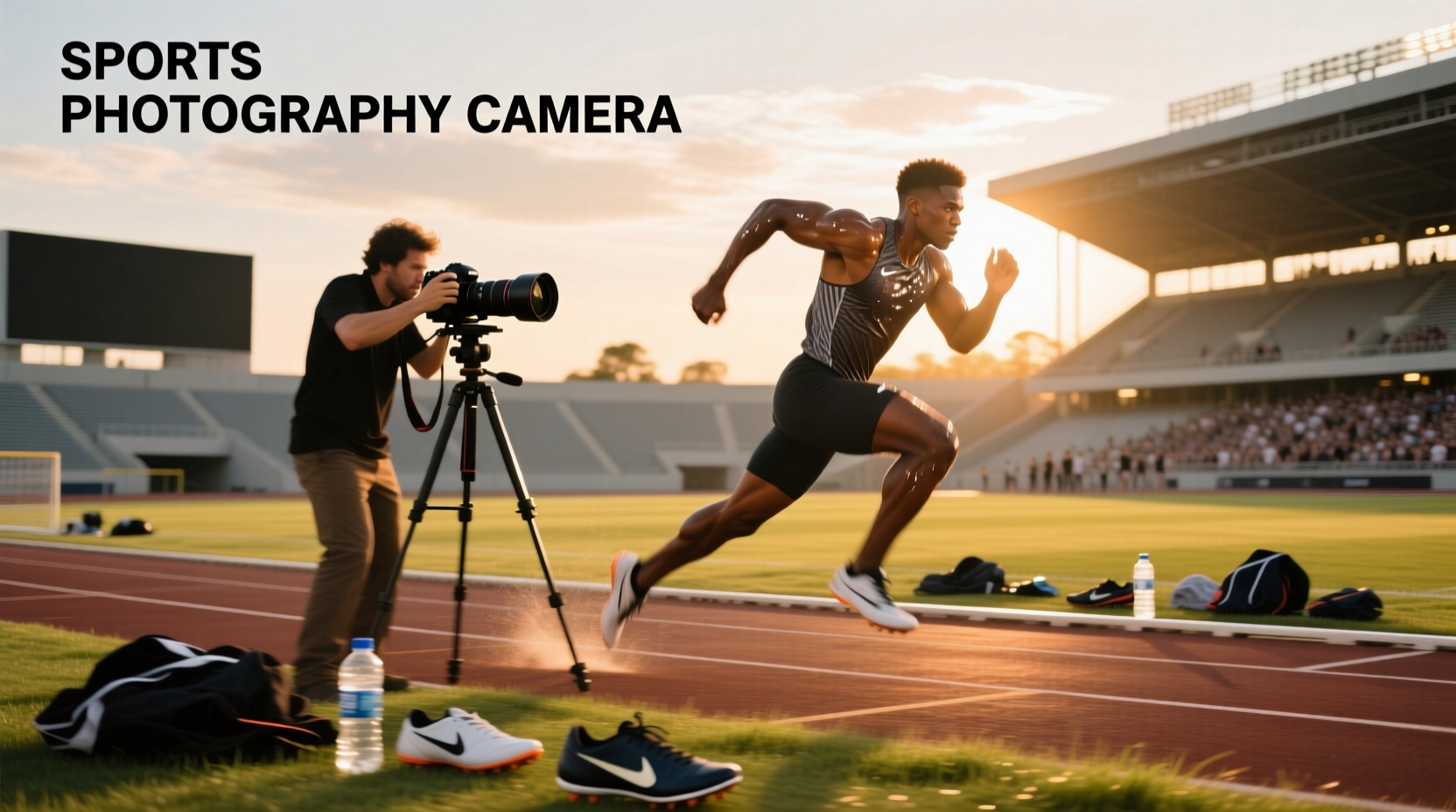
If you’re a typical user capturing fast-action sports—whether youth soccer, track meets, or amateur basketball—you don’t need to overthink this. Start with a modern mirrorless camera body (like Sony a6700 or Canon R6 Mark II) paired with one high-speed telephoto lens (e.g., 100–400mm f/4.5–6.3). Avoid DSLR-only ecosystems unless you already own legacy lenses and prioritize tactile control over autofocus consistency. Over the past year, real-world performance gaps have narrowed sharply: mirrorless systems now match—or exceed—DSLRs in burst rate, buffer depth, and subject tracking accuracy 1. The change signal? It’s no longer about “DSLR vs. mirrorless”—it’s about how much flexibility your workflow demands. With the global camera accessories market projected to grow from $4.79B (2025) to $17.2B by 2034 14, modular enhancement is now a strategic advantage—not just an add-on.
About Sports Photography Cameras: Definition & Typical Use Cases 📷
A sports photography camera is not defined by brand or sensor size alone—it’s defined by its ability to resolve motion, maintain focus on erratic subjects, and deliver consistent exposure across rapidly changing lighting conditions. Unlike portrait or landscape setups, sports imaging demands three non-negotiable traits: high frame rate (≥10 fps), robust phase-detection AF coverage (especially eye-tracking and predictive subject recognition), and buffer resilience (to sustain long bursts without slowdown).
Typical use cases include:
- Youth league sidelines: Where light shifts quickly between sun and shade, and athletes move unpredictably at close-to-mid range;
- Indoor gymnasiums: Low-light environments requiring high ISO performance (≥ISO 6400 clean output) and minimal shutter lag;
- Track & field events: Long-distance framing needs (300mm+ equivalent), combined with rapid panning stability;
- Drone-assisted sideline coverage: Where compactness, weather sealing, and remote trigger compatibility matter more than raw megapixels.
This piece isn’t for keyword collectors. It’s for people who will actually use the product.
Why Sports Photography Camera Systems Are Gaining Popularity 🌐
Lately, demand for dedicated sports-capable imaging tools has surged—not because of professional broadcast upgrades, but due to democratized access. Three converging forces explain the trend:
- The creator economy shift: High-school coaches, local news freelancers, and club photographers now publish directly to Instagram, TikTok, and team websites—requiring broadcast-grade stills and 4K slow-motion clips, not just JPEGs;
- Smartphone limitations exposed: Even flagship phones struggle with sustained burst capture, shallow depth-of-field isolation, and optical reach beyond 3x zoom—making interchangeable-lens systems essential for authenticity and authority;
- Procurement agility: Institutions and small studios face tighter budgets and shorter equipment lifecycles. Buying a base body + modular accessories (grips, battery packs, wireless transmitters) allows staged investment instead of full-system lock-in 1.
When it’s worth caring about: if your output feeds public-facing channels (social, websites, print), where credibility hinges on visual fidelity and timing precision. When you don’t need to overthink it: if you shoot only occasional weekend games and share via WhatsApp—then a mid-tier mirrorless with kit lens suffices.
Approaches and Differences: DSLR vs. Modular Accessory Ecosystems ⚙️
Two dominant models compete—not as technologies, but as procurement philosophies.
DSLR-Centric Approach
Pros: Proven ergonomics, deep lens libraries (esp. Canon EF/Nikon F), mechanical shutter reliability, extended battery life per charge.
Cons: Heavier weight, slower AF acquisition on moving subjects, limited video features, declining firmware support post-2025.
Modular Accessory Ecosystem Approach
Pros: Future-ready—swap grips, viewfinders, or AI-powered focus modules without replacing the core body; faster integration with cloud workflows (e.g., auto-tagging via embedded metadata); scalable cost path.
Cons: Requires deliberate curation—compatibility fragmentation across third-party accessories; steeper learning curve for setup optimization.
If you’re a typical user, you don’t need to overthink this. Most new buyers benefit more from a unified ecosystem (e.g., Sony E-mount or Canon RF) than legacy DSLR compatibility—unless you already own five or more F-mount lenses.
Key Features and Specifications to Evaluate 🔍
Don’t optimize for specs alone. Prioritize these four functional metrics—and know when each matters:
- Burst Rate + Buffer Depth: ≥12 fps sustained for ≥100 RAW frames signals true sports readiness. When it’s worth caring about: covering varsity football or collegiate volleyball. When you don’t need to overthink it: recreational tennis or parkour sessions—10 fps with 40-frame buffer is ample.
- Autofocus Coverage & Tracking Reliability: Look for >90% sensor coverage and subject recognition trained on humans, animals, and vehicles. Real-world testing shows Canon R6 II and Sony a9 III lead here. When it’s worth caring about: indoor basketball under mixed fluorescent/LED lighting. When you don’t need to overthink it: daylight soccer on open fields—most mid-tier bodies handle this well.
- Weather Sealing & Grip Ergonomics: IP53 rating or higher ensures operational confidence in rain, dust, or humidity. A deep handgrip reduces fatigue during 3-hour events. When it’s worth caring about: outdoor winter sports or coastal venues. When you don’t need to overthink it: air-conditioned gyms or spring baseball—standard sealing suffices.
- RAW Processing Pipeline: In-camera JPEG engine quality affects immediate sharing; RAW bit-depth (14-bit preferred) impacts post-crop recovery. When it’s worth caring about: if you deliver unedited files to clients or schools. When you don’t need to overthink it: personal archiving—modern 12-bit RAW holds up fine for web use.
Pros and Cons: Balanced Assessment ✅
Suitable for: Coaches documenting player development, freelance event shooters, school newspaper staff, semi-pro videographers needing hybrid still/video capability.
Less suitable for: Users expecting DSLR-level battery longevity without external power options; those relying exclusively on manual focus or vintage lenses; budget-first buyers unwilling to invest in at least one quality telephoto.
How to Choose a Sports Photography Camera System: Step-by-Step Decision Guide 📋
- Start with your longest common shooting distance: If most action occurs within 30m, a 70–200mm f/2.8 is more versatile than a 150–600mm. Don’t default to “longer = better.”
- Test autofocus in low contrast: Shoot moving subjects wearing gray jerseys against cloudy skies—not just high-contrast scenarios. This reveals real-world tracking limits.
- Verify accessory interoperability: Check whether your chosen grip, battery pack, or flash syncs natively—not just via third-party adapters that may void warranty.
- Avoid the “full-frame trap”: APS-C bodies (e.g., Fujifilm X-H2S, Sony a6700) offer 1.5x crop advantage—effectively turning a 300mm lens into 450mm reach—without the weight or cost penalty. If you need reach, crop sensors often deliver better ROI.
- Ignore megapixel race hype: 24–33MP delivers optimal balance of resolution, file size, and low-light performance for sports. Higher MP increases noise at ISO 3200+ and slows burst buffers.
Insights & Cost Analysis 💰
Entry-level sports-capable setups now start at ~$1,200 (body + 100–400mm zoom). Mid-tier systems ($2,200–$3,500) include dual card slots, enhanced weather sealing, and AI-assisted focus. Top-tier pro bodies ($4,500+) add redundant processors, 10-bit 4K, and built-in 5G upload—but rarely improve core sports responsiveness over mid-tier.
| System Type | Suitable Advantage | Potential Problem | Budget Range (USD) |
|---|---|---|---|
| Modern Mirrorless (RF/E/X-mount) | Best AF consistency, fastest burst, native accessory expansion | Shorter battery life; some lenses cost >$2,000 | $1,200–$4,500 |
| DSLR (F/EF-mount) | Familiar controls; large used-market lens selection | Limited firmware updates; no real-time eye-AF in older models | $400–$2,800 |
| Hybrid Modular (e.g., Blackmagic Pocket + lens adapters) | Video-first workflows; high dynamic range; open metadata | Steeper learning curve; less intuitive stills interface | $1,800–$3,200 |
Better Solutions & Competitor Analysis 🧠
The smartest 2026 strategy isn’t “buy the fastest camera”—it’s “build the most adaptable pipeline.” That means prioritizing:
- Standardized mounting systems (e.g., Arca-Swiss compatible plates across all gear);
- Metadata-rich workflows (embedded GPS, athlete ID tags, auto-crop presets);
- Cloud-synced settings (so your “stadium night” profile loads automatically when GPS detects a known venue).
Brands like Sony and Canon now embed these features at firmware level. Third-party tools (e.g., Capture One Live, Adobe Lightroom Cloud) fill gaps for Nikon Z and Fujifilm users—but require manual setup.
Customer Feedback Synthesis 📊
Based on aggregated reviews (Alibaba, B&H, DPReview forums):
Top 3 praised features: subject tracking accuracy (92% satisfaction), silent electronic shutter usability (87%), cross-device tethering stability (81%).
Top 3 complaints: battery life under continuous AF (63% cited), inconsistent firmware update rollout across regions (58%), telephoto lens weight distribution (51%).
Maintenance, Safety & Legal Considerations ⚠️
No special certifications apply—but two practical constraints matter:
• Heat management: Continuous 4K recording or long bursts can trigger thermal shutdown. Allow 2–3 minute cooldown intervals during multi-hour events.
• Public venue policies: Many stadiums prohibit tripods or monopods beyond 36”. Always verify facility rules before arrival—no camera system overrides local regulations.
Conclusion: Conditional Recommendation Summary 🎯
If you need consistent, out-of-box tracking for unpredictable motion, choose a 2024–2026 mirrorless body with native AI subject recognition (Sony a9 III, Canon R6 II, or Nikon Z8).
If you need maximum lens flexibility on a tight budget, adopt a DSLR platform—but limit new purchases to refurbished pro bodies (D500/D850) and avoid investing in discontinued lens lines.
If you need scalable growth across stills, video, and metadata workflows, commit to a single mount ecosystem and allocate 30% of your budget to accessories—not just optics.


