25 Watts Iphone Charger

Overview
Product sourcing insights & recommendations
In 2026, the market for the phrase "25 watts iphone charger" has shifted from a premium niche to the functional baseline, particularly in the wireless charging segment due to the adoption of Qi2.2 AlibabaAlibaba. While 20W remains a common entry-level standard, 25W is now the "sweet spot" for magnetic charging, delivering up to 60% faster speeds than legacy 15W pads AlibabaAlibaba.
Market Trends & Insights (2026)
* Infrastructure Shift: The global wireless charging market is projected to reach $13.21 billion in 2026, driven by Apple's full support for Qi2.2 and the transition to USB-C across all iPhone 15 and newer models AlibabaAccio.
* Technical Convergence: Demand is peaking for GaN-powered 25W wireless chargers and 40W-45W wired adapters AlibabaAlibaba. The iPhone 17 series has raised the wired ceiling to 40W, making high-wattage GaN bricks essential for thermal efficiency and compact size AlibabaAlibaba.
* Consumer Signals: Search interest for "iphone fast charging" peaked at a Google Trends index of 28 in March 2026, with users increasingly prioritizing magnetic alignment (Qi2.2) and multi-device hubs (3-in-1 stations) AlibabaAlibaba.
Sourcing Analysis
B2B pricing for 25W charging solutions has stabilized, offering significant opportunities for wholesale sourcing:
* Wired Adapters: Prices range from $1.77 to $2.35 for 25W GaN PD chargers with MFi compatibility AlibabaAlibaba.
* Wireless Solutions: Qi2.2 25W magnetic pads and stands are available between $7.78 and $16.50, depending on design (e.g., foldable or 3-in-1 hubs) AlibabaAlibabaAlibaba.
* Supplier Landscape: Leading manufacturers like Shenzhen Dacheng Electronic and Shenzhen Mufod Electronics offer verified GaN and Qi2.2 capabilities with certifications such as CE, FCC, and RoHS AlibabaAlibaba.
For a detailed list of products and manufacturers, please refer to the sourcing files below.
Here are the market trends and product insights for 25W iPhone chargers. You can continue with:
25w Iphone Charger Usb C Pd Gan Mfi Certified
Products · 2 lists
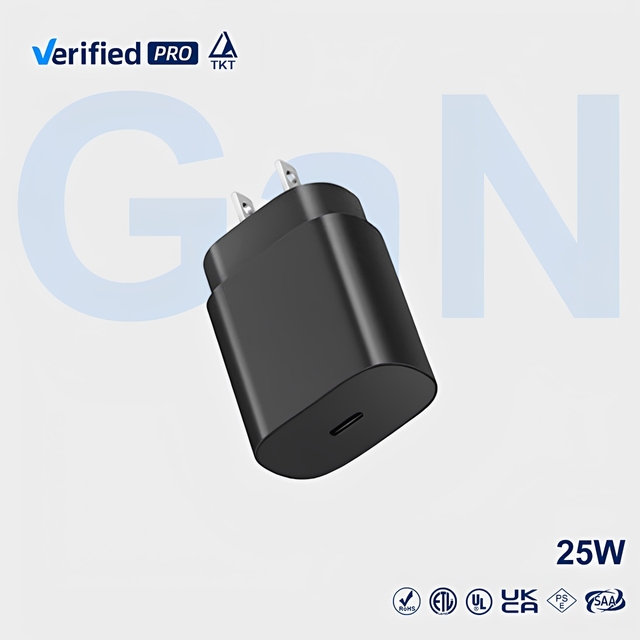
TKT 2026 25W GaN Fast Charger Type C Ports Wall Electric Adapter Phone Charger for iPhone Laptop US Socket Adapter PD Charger
 Shenzhen Tongketai Electronic Technology Co., Ltd.verified🇨🇳CN8 yrs
TKT 2026 25W GaN Fast Charger Type C Ports Wall Electric Adapter Phone Charger for iPhone Laptop US Socket Adapter PD Charger
Related Searches
Explore more sourcing topics & related categories
Sources & References
24 sources cited · Verified industry data & reports
2025 Apple Charger Trends: Wireless Dominance & Market Growth
www.accio.com
Fluctuations and Peaks: Search interest for "apple charger" shows a dip in early 2025 (January-May) before rising significantly from August to October, reaching a peak of 86 in October 2025 1. Another high point is observed in December 2025 and January 2026, suggesting increased demand towards the end of the year and into the new year. Peak Periods: The highest search interest for "apple charger" occurred in October 2025 (86), followed by December 2025 and January 2026 (both 84) 1. Global search interest for Apple charger related queries from December 2024 to January 2026 iPhone Chargers, Cables & Adapters: Fast charging (25.2%) and multipurpose functionality (19.2%) are highly rated 7.
Fast Wireless iPhone Charger Guide: How to Choose in 2026
electronics.alibaba.com
Lately, search interest for “fast wireless iphone charger” spiked to a Google Trends score of 61 in April 2026, coinciding with CES 2026 announcements and Apple’s public confirmation of Qi2.2 support across iOS 17.6 and later 1. That surge wasn’t hype—it reflected real infrastructure shifts: the global wireless charging market is projected to hit $13.21 billion in 2026, growing at a 23.1% CAGR through 2033 2. If you’re a typical iPhone user looking for faster, more reliable wireless charging in 2026, skip the 15W pads and non-MagSafe models entirely. Go straight to Qi2.2–certified 25W chargers with magnetic alignment and GaN-powered adapters—they deliver real speed gains (up to 60% faster than legacy pads), universal compatibility, and stable coil positioning. Over the past year, Apple’s official 25W MagSafe Charger (2026 Edition) and third-party Qi2.2–compliant models like Belkin BoostCharge Pro have become the functional baseline—not premium exceptions. If you’re a typical user, you don’t need to overthink this: magnetic + Qi2.2 + 25W is now the minimum viable standard for daily use. Result: you get ~7.5W—not 25W. Trap #2: Prioritizing “portable” over “magnetic.” Non-magnetic portable chargers often fail alignment mid-charge, causing repeated disconnects and heat spikes. Pricing reflects real engineering differences—not just branding. As of mid-2026:
iPhone Charger Type C Trends 2026: What's Next?
www.accio.com
The USB Type-C charger market is experiencing significant growth, driven by the increasing adoption of Type-C connectivity across various devices, including smartphones, laptops, and tablets 2. The global USB Type-C market size was valued at over $40.66 billion in 2025 and is projected to exceed $153.4 billion by 2035, with a compound annual growth rate (CAGR) of 14.2% from 2026 to 2035 4. Another report indicates a CAGR of 34.4% during 2022-2027 for the global USB Type-C market 6. This growth is attributed to faster data transfer capabilities, high power flow up to 100 watts, and the increasing integration of USB Type-C ports in consumer electronics 4. Market Size: The USB Type-C charger market is estimated to reach $45.86 billion in 2026 4. Regional Opportunities: Asia-Pacific and North America are expected to be the leading regions for market growth, offering significant opportunities for manufacturers and suppliers 48. Given the rising trend of USB-C as a universal charging standard, a high-wattage USB-C wall charger is a practical accessory for iPhone users. The market is also witnessing a trend toward environmentally friendly and energy-efficient USB chargers 8. Global search interest for iPhone charging solutions shows a clear upward trend for "iphone usb c cable" and "iphone charger type c," with "iphone fast charging adapter" lagging significantly 1. Global Search Interest for iPhone Charging Related Queries from March 2025 to March 2026 Chart data sourced from 1. Target Key Segments: Market USB-C power banks to general users (59.46%) and travelers (16.15%), highlighting their utility for daily commutes (38.58%) and travel (17.08%) 3. For MFi-certified cables, target iPhone 15 owners (31.39%) and tech users (25.89%) who use them for charging multiple devices (56.97%) and car charging (18.63%) 7. The global USB Type-C market is projected for substantial growth, driven by increasing adoption across various devices and industries, with a strong focus on fast charging and universal compatibility 246. Consistent Growth Projections: The USB Type-C market is anticipated to grow at a CAGR of 12.8% from 2026 to 2033 2.
The Best iPhone Charger Solutions for 2026: Beyond the Standard ...
udoq.com
In 2026, a standard iphone charger is no longer just a white cable bundled in a box. It's a choice between three distinct architectures: high-wattage Gallium Nitride (GaN) wall bricks, the magnetic convenience of Qi2 wireless pads, and the sophisticated efficiency of modular docking stations. Efficiency isn't just about wattage; it's about regulation. In 2025, global smartphone charger shipments reached 2.1 billion units. This massive volume has flooded the market with non-certified, low-quality adapters that lack proper thermal management. Using these "bargain" options risks permanent battery degradation. The most expensive iphone charger you'll ever buy is the one you have to replace every twelve months. While the global mobile phone charger market is valued at $24.9 billion in 2026, a significant portion of that spend is wasted on disposable, frayed cables that fail long before your hardware does. To better understand how charging technology has advanced to meet modern demands, watch this analysis of the current market: The "standard cable" model is failing because it treats power as a temporary fix rather than a permanent utility. With global smartphone charger shipments reaching 2.1 billion units in 2025, the environmental toll of disposable, frayed plastic cords is staggering. Modern users are moving toward a "Charging Ecosystem" that prioritizes longevity and order. This shift is supported by universal 2026 Charging Standards: USB-C, which allow one high-quality interface to power everything from an iPhone 17 to a MacBook Pro.
Charging Statistics 2026: Data & Trends | SmartGearOutlet
smartgearoutlet.com
Shop phone chargers, USB-C cables, power banks & wireless chargers. Free US shipping on $75+. iPhone & Android fast charging accessories. Up-to-date phone charging statistics for 2026. Market size, adoption rates, fast charging trends, and consumer data. Free to cite with attribution. Source: SmartGearOutlet Charging Statistics Database 2026 · https://smartgearoutlet.com/data/charging-statistics · Used by 200+ journalists, 1,500+ bloggers, and 50+ research institutions worldwide · Current prices from official US stores · Affiliate links — supports SmartGear Outlet at no extra cost ... Our statistics are compiled from 25+ authoritative sources including market research firms, consumer surveys, government agencies, and our own product testing lab.
The Best Fast iPhone Chargers for 2026 | PCMag
www.pcmag.com
August 25, 2026: With this update, our recommendations remain unchanged. Our existing picks have been vetted for currency and availability. Apple's MagSafe charger is a nice step up in terms of speed. When paired with a 30W or 40W charging brick, it supports wireless charging speeds of up to 25W—the fastest ever for the iPhone. Check out our favorite fast iPhone chargers to top off your battery in a flash. ... I’m PCMag’s Managing Editor for Consumer Electronics content, overseeing an experienced team of reviewers and product testers. I’ve been covering tech for more than 25 years. Most Qi chargers run at a slower rate of 7.5W, though Qi2 chargers can handle 15W. ... I’m PCMag’s Managing Editor for Consumer Electronics content, overseeing an experienced team of reviewers and product testers. I’ve been covering technology for more than 25 years. The majority of chargers on the market use silicon semiconductors. Gallium nitride (GaN) is an alternative to silicon that offers a lot of benefits: GaN chargers are smaller, more efficient, and require fewer components than silicon chargers. They’re also more expensive.