3 Bit Dac

Overview
Product sourcing insights & recommendations


The 3-bit Digital-to-Analog Converter (DAC) is a fundamental architecture primarily used today for high-speed signal processing, MEMS actuation, and educational purposes. While consumer electronics have moved toward 24-bit or 32-bit resolutions, the 3-bit design remains a critical component in segmented architectures where speed and monotonicity are prioritized over precision. TiAnalog
1. Core Architecture & Product Insights
* Flash/Thermometer DACs: This is the most common 3-bit application. It uses 7 equal current sources to ensure the output is inherently monotonic (the signal always increases with the digital code), which is vital for high-speed communication and video systems. TiAnalog
* MEMS-Based 3-Bit DACs: A specialized market niche exists for MEMS (Micro-Electromechanical Systems) where a 3-bit DAC translates digital signals into physical mechanical displacements. This is used for terahertz (THz) beam steering and high-position resolution in optical profiling. Mdpi
* Segmented Architectures: Most high-resolution DACs (like those from Analog Devices or Texas Instruments) actually use a 3-bit or 6-bit "fully-decoded" thermometer-coded stage for the most significant bits (MSBs) to minimize glitch energy at critical transitions. TiAnalogAnalog
2. Market Trends & Commercial Availability
The commercial market for *standalone* 3-bit DAC ICs is limited, as they are typically integrated into larger SoCs (System-on-Chips).
* Educational Demand: The primary standalone "products" found in the B2B market are Digital Electronics Trainer Kits, which use 3-bit or 4-bit binary-weighted or R-2R ladder circuits to teach the basics of conversion. Electronics-TutorialsYoutube
* Integration Trend: Simple DAC architectures like "String DACs" are increasingly integrated into digital potentiometers and low-power general-purpose controllers due to their small footprint and cost efficiency in sub-micron CMOS processes. Ti
* Market Drivers: The broader data converter market is projected to grow significantly through 2026, driven by high-speed applications in 5G, aerospace, and defense where low-latency, high-speed conversion (often utilizing small-bit segmented stages) is essential. MordorintelligenceGminsightsTi
3. Representative Products
While 8-bit modules (like the PCF8591) are more common for general development, 3-bit logic is found in specialized training and high-speed core components.
Based on these insights, you can continue with:
High Speed 3 Bit Digital To Analog Converter Module
Products · 3 lists
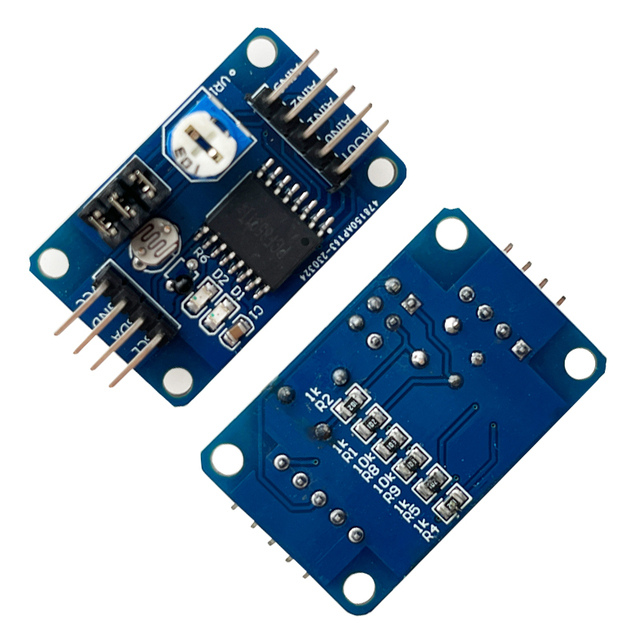
OKY3475 PCF8591 AD/DA Module Analog to Digital Conversion Digital Analog Converter
 Okystar Technology Co., Ltd.verified🇨🇳CN14 yrs
OKY3475 PCF8591 AD/DA Module Analog to Digital Conversion Digital Analog Converter
Related Searches
Explore more sourcing topics & related categories
Sources & References
27 sources cited · Verified industry data & reports
How does a basic digital-to-analog converter (DAC) perform ...
eeworldonline.com
A digital-to-analog converter (DAC) transforms digital binary data into an analog signal using weighted contributions from each bit.
DAC Digital Analog Converters: Types, ICs, and Applications
Ersa Electronics
Explore DAC digital analog converters: principles, types, top ICs from TI, ST, NXP, Renesas, Microchip, onsemi, Melexis, and real applications.

High Speed, Digital-to-Analog Converters Basics (Rev. A)
TI.com
ABSTRACT. The goal of this document is to introduce a wide range of theories and topics that are relevant to high- speed, digital-to-analog converters (DAC) ...

DAC specifications, types, and applications explained
LinkedIn · Shivraj Dharne
Improves matching for small currents. Disadvantages: • Reduced accuracy due to voltage drop across resistor. • More sensitive to temperature.

Binary Weighted Digital to Analogue Converter (DAC)
Basic Electronics Tutorials
Binary weighted digital-to-analogue converters are a type of data converter which converts a digital binary number into an equivalent analogue output signal.

Chapter 3: Data Converter Architectures
Analog Devices
The examples shown have 3-bit first and second stages but for the sake of ... Figure 3.27 shows a 6-bit DAC constructed from two fully- decoded 3-bit DACs.