Electrical Battering Ram

Overview
Product sourcing insights & recommendations
The term "Electrical Battering Ram" is currently used to describe two distinct concepts: a critical cybersecurity vulnerability affecting cloud servers and a modern class of battery-powered tactical breaching tools used by law enforcement.
1. The "Battering RAM" Security Vulnerability
In the tech sector, "Battering RAM" refers to a hardware attack discovered by researchers at KU Leuven and the University of Birmingham Batteringram.
* What it is: A stealthy attack targeting DDR4 memory in cloud environments. It uses a small, $50 custom hardware device (interposer) to manipulate memory signals at runtime Batteringram.
* The Threat: It effectively bypasses the most advanced hardware security features, including Intel SGX and AMD SEV-SNP, which are designed to protect sensitive data even from rogue cloud providers Batteringram.
* Market Impact: Since the vulnerability exploits the physical design of memory modules, it cannot be fixed with a software patch, forcing a long-term industry shift toward memory designs that include "freshness" checks for encryption.
2. Physical Product: Battery-Powered Breaching Tools
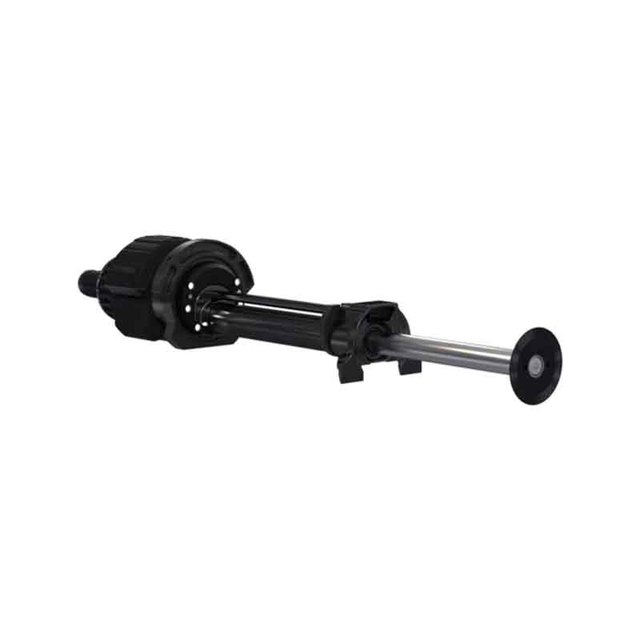
In the physical product market, "electric" or "battery-powered" battering rams have largely evolved into electro-hydraulic breaching systems Ratools.
Product Trends & Features (2025–2026):
* Hydraulic Shift: Traditional heavy steel logs are being replaced by integrated battery-powered hydraulic rams. These tools provide significantly more force (up to 165kN) than manual swinging Alibaba.
* Stealth & Portability: New designs prioritize near-silent operation and weights under 25 lbs to allow for single-operator use in tactical "Black Ops" scenarios Ratools.
* Smart Tech: High-end models for 2026 now feature digital displays for real-time force monitoring and battery health diagnostics.
Mechanical Battering Ram For Law Enforcement
Products · 3 lists

Related Searches
Explore more sourcing topics & related categories
Sources & References
27 sources cited · Verified industry data & reports
Battering RAM
batteringram.eu
The research was conducted by researchers from KU Leuven and the University of Birmingham/Durham University. Jesse De Meulemeester (COSIC, Department of Electrical Engineering, KU Leuven) David Oswald (University of Birmingham/Durham University) Ingrid Verbauwhede (COSIC, Department of Electrical Engineering, KU Leuven) Jo Van Bulck (DistriNet, Department of Computer Science, KU Leuven) Battering RAM can affect all systems using DDR4 memory, but is especially relevant for "confidential computing" workloads running in public cloud environments. Modern computers use memory modules (DRAM) to store everything in use: from photos and passwords to credit card numbers. Public cloud providers increasingly deploy hardware-level memory encryption to protect this sensitive data. However, we previously showed that malicious memory modules, nicknamed “Bad RAM”, can bypass these protections by deliberately supplying false metadata during processor boot. In response, modern cloud systems now validate memory more strictly at startup. With Battering RAM, we show that even the latest defenses on Intel and AMD cloud processors can be bypassed. Later, with just a flip of a switch, our interposer turns malicious and silently redirects protected addresses to attacker-controlled locations, allowing corruption or replay of encrypted memory. Battering RAM fully breaks cutting-edge Intel SGX and AMD SEV-SNP confidential computing processor security technologies designed to protect sensitive workloads from compromised hosts, malicious cloud providers, or rogue employees. Our stealthy interposer bypasses both memory encryption and state-of-the-art boot-time defenses, invisible to the operating system. It enables arbitrary plaintext access to SGX-protected memory, and breaks SEV’s attestation feature on fully patched systems. Ultimately, Battering RAM exposes the limits of today’s scalable memory encryption.
Entry Tools Archives - EDI - USA
execdefense.com
Click View Full Catalog to see All of our Entry Tools products, and more! This item is available to BUY NOW. Click below to add to cart. Bulk Purchaser? Government Agency? International Customer? Please · contact us directly for a bulk quote or international quote! The EDI-USA battering ram series is designed for use by tactical teams to breach doors, walls, windows, and other tactical obstacles. The battering rams are available in three (3) sizes and are manufactured with strong reinforced steel (jet black color) for maximum impact. The small and medium rams can be used by 1 person, and the large ram requires 2 people for use. Each battering ram includes 2 handles and can be stored easily in storerooms or vehicles. A battering ram is an important tool for extraction and operations.
Battering Ram
shop.darley.com
Battering ram - Wikipedia
en.wikipedia.org
Eventually, a breach would appear in the fabric of the wall, enabling armed attackers to force their way through the gap and engage the inhabitants or garrison of the fortified place. The introduction in the later Middle Ages of siege cannons, which harnessed the explosive power of gunpowder to propel weighty stone or iron balls against fortified obstacles, spelled the end of battering rams and other traditional siege weapons. It was much more effective at destroying enemy walls and buildings than an uncapped ram but was heavier to carry. The earliest depiction of a possible battering ram is from the tomb of the 11th Dynasty Egyptian noble Khety, where a pair of soldiers advance towards a fortress under the protection of a mobile roofed structure, carrying a long pole that may represent a simple battering ram. During the Iron Age, in the ancient Middle East and Mediterranean, the battering ram's log was slung from a wheeled frame by ropes or chains so that it could be made more massive and be more easily bashed against its target. Frequently, the ram's point would be reinforced with a metal head or cap while vulnerable parts of the shaft were bound with strengthening metal bands. The frame itself was so light that it could be carried on the shoulders of the men transporting the ram, and the same men could beat the ram against the wall when they reached it. Many battering rams had curved or slanted wooden roofs and side-screens, covered in protective materials, usually fresh wet hides. A battering ram is a siege engine that originated in ancient times and was designed to break open the masonry walls of fortifications or splinter their wooden gates. In its simplest form, a battering ram is just a large, heavy log carried by several people and propelled with force against an ...
Electronic Battering Ram | Marvel Cinematic Universe Wiki | Fandom
marvelcinematicuniverse.fandom.com
The Electronic Battering Ram is a device used by S.H.I.E.L.D. to breach locations and vehicles. It was used to smash the driver's window of Nick Fury's SUV during Hydra's Attack on Nick Fury, and to get inside the Retreat during the Ambush at the Retreat. Unable to kill Nick Fury due to the robust armor on his SUV, a group of Hydra operatives, disguising as D.C.'s Metropolitan Police Department officers and SWAT team members, resorted to using the electronic battering ram to smash the... This formula caused him to wake up with superhuman strength and in an extremely agitated state of mind. Zabo, fueled by his anger towards Coulson, started to rampage within the base. At the hanger, Coulson was finally able to calm him down after he used an electronic battering ram to reinforce the S.H.I.E.L.D. SUV pinning him to a wall. This bought Coulson time to convince Zabo of his wife Jiaying's insanity. When he asked Zabo if he was willing to protect Skye from her mother, Zabo grew angry enough to push away both the SUV and electronic battering ram and free himself.[3] The Marvel Cinematic Universe Wiki has a collection of images and media related to Electronic Battering Ram.
Battering ram — Grokipedia
grokipedia.com
For instance, during the 1993 Waco siege, FBI agents employed vehicle-mounted battering ram variants attached to armored personnel carriers to punch holes in the Branch Davidian compound's walls, facilitating tear gas insertion amid the 51-day standoff. These tools are integrated into standardized tactical training, prioritizing dynamic entry techniques to reduce operational risks.[36][37][33] Safety features include non-conductive coatings on the ram body and heads to prevent sparking or electrical hazards in potentially wired environments, as well as rubber or polyurethane padding on contact surfaces to limit injury to occupants or bystanders from debris. A battering ram is a siege engine consisting of a large, heavy beam—typically made from a tree trunk such as fir or ash, often capped with a metal head shaped like a ram's horns or an animal—to deliver forceful impacts against fortifications, gates, or walls in order to breach them.[1] These devices originated in the ancient Near East during the Neo-Assyrian period around the 9th century BCE, where they evolved from simple wooden poles into more complex wheeled structures used alongside siege ramps to target parapets rather than base-level walls, as evidenced by archaeological findings at sites like Lachish (c. The battering ram operates primarily through the transfer of kinetic energy generated by its mass and velocity, concentrated at the point of impact to overcome the structural integrity of fortifications. This momentum, defined as the product of mass and velocity ($ p = m v $), allows the ram's energy to focus on a small area, such as the weakened center of a gate, exceeding the material's compressive strength. The earliest textual evidence for battering rams appears in administrative records from the ancient city of Ebla in Mesopotamia, dating to approximately 2500 BCE, where the Sumerian term gu₄-si-dili (Akkadian yašubu) is interpreted as referring to a battering ram or similar siege device used in military contexts.[5] These documents, analyzed by scholar Piotr Steinkeller, describe such tools alongside other siege equipment, indicating their role in early organized warfare in the region.[2] Archaeological and textual correlations suggest that these rams were basic wooden implements employed to breach fortifications during conflicts among city-states in the third millennium BCE.