Karaoke Record

Overview
Product sourcing insights & recommendations
The "karaoke record" market is undergoing a significant transformation, evolving from a traditional hardware-based industry into a high-growth, technology-integrated ecosystem valued at approximately $5.9 billion in 2026 MarketStellarmr. While the phrase originally referred to physical records for singing along, it now encompasses the recording and sharing of vocal performances through hybrid digital-analog systems.
Market Dynamics & Emerging Trends
* Technological Shift (AI & Social): Approximately 54% of new karaoke machines now feature AI-based sound processing, including real-time pitch correction and rhythm analysis Businessresearchinsights. The market is shifting towards mobile-first experiences, where users prefer apps like Smule or Pokekara to record and share content directly to social media GlobalgrowthinsightsKidmicrophone.
* Hybrid Workflows: A dominant trend is the convergence of analog vinyl playback with digital recording. Consumers are seeking integrated systems that combine a functional turntable with USB/Bluetooth recording capabilities for casual music creation and podcasting Indexbox.
* Growth Projections: The global karaoke app market is growing at a rapid CAGR of 10.19%, projected to reach $8.29 billion by 2026, driven by younger demographics (aged 18-35) who treat karaoke as a social content creation tool Globalgrowthinsights.
Product Insights & Sourcing Trends
Current B2B offerings reflect these trends with a strong focus on portability and multifunctionality:
* Retro Aesthetics: High demand exists for "Mini Retro Record" style speakers that include microphones, catering to the "nostalgic gift" segment AlibabaAlibaba.
* All-in-One Recording Hubs: Professional-grade karaoke mixers for home use are now standard, featuring USB live interfaces and DSP reverb effects for high-quality vocal recording AlibabaAlibaba.
* Commercial to Home Pivot: While commercial venues (KTV bars) still hold 71% of the market, in-home karaoke systems are seeing steady growth as families favor at-home social gatherings and entertainment hubs MarketDataintelo.
Based on these market trends, you can continue with:
Karaoke Record Player With Microphone And Recording Function
Products · 3 lists
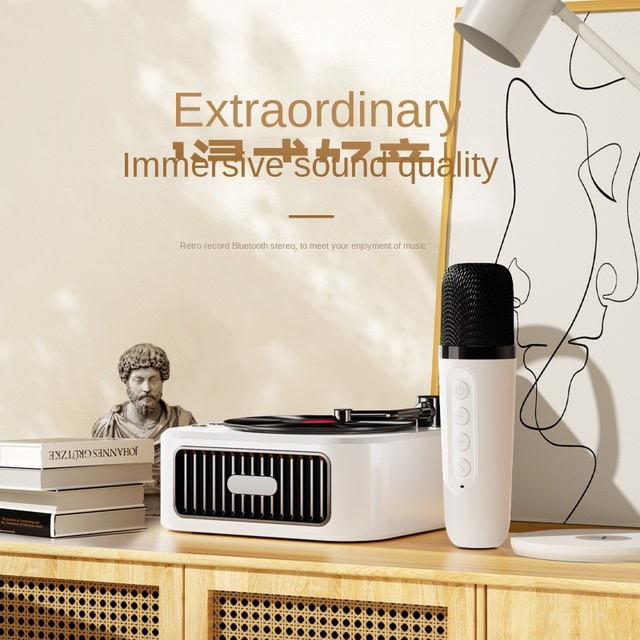
2025 Mini Retro Record for Blue Tooth Speaker Subwoofer Home Portable Wireless Karaoke Audio Gift Karaoke Speaker
 Shenzhen Weizhi Technology Co., Ltd.🇨🇳CN6 yrs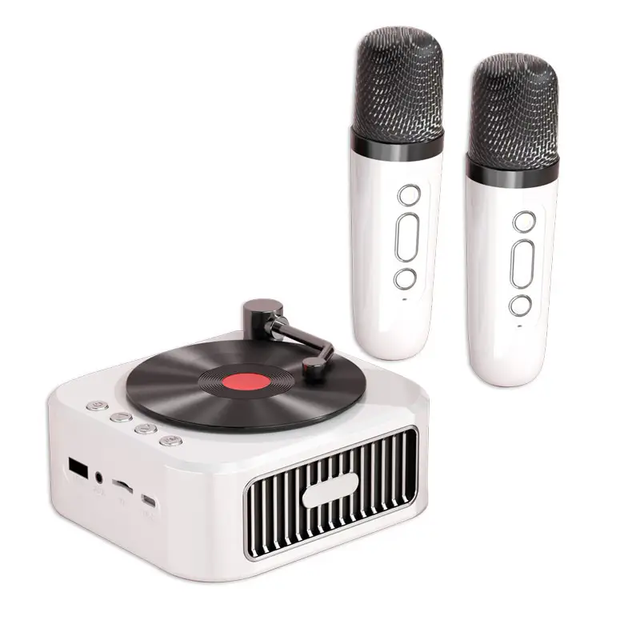
Vintage Family for Karaoke Speaker with Two Microphones Portable Record Player for Mobile Phone and Party Use
 Shenzhen Neosail Technology Co., Ltd.🇨🇳CN10 yrs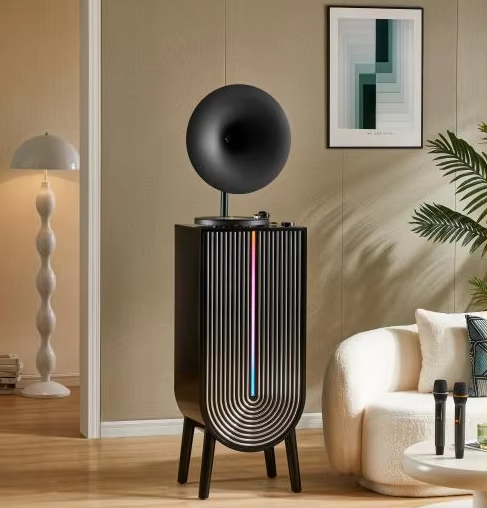
Italian Minimalist Modern Gramophone USB Vinyl Player Wireless Microphone Karaoke Atmosphere Light
Related Searches
Explore more sourcing topics & related categories
Sources & References
24 sources cited · Verified industry data & reports
Karaoke Statistics By Entertainment Technology (2026)
www.news.market.us
The global karaoke market has exhibited a steady growth trajectory, with revenue figures increasing progressively from $5.3 billion in 2022 at a CAGR of 2.60%. In 2023, the market revenue slightly increased to $5.4 billion, followed by $5.6 billion in 2024. The upward trend continued, with revenues reaching $5.7 billion in 2025 and further rising to $5.9 billion by 2026. By the late 1970s, major Japanese corporations began producing karaoke machines, fostering its popularity across the country. The trend reached the Philippines, where Roberto del Rosario patented his version of the karaoke machine in 1983, further advancing the technology. The global karaoke market size, categorized by device type, has shown incremental growth across both portable devices and fixed systems from 2022 to 2032. In 2022, the total market revenue was $5.3 billion, of which portable devices accounted for $3.76 billion and fixed systems contributed $1.54 billion. The market revenue increased to $5.4 billion in 2023, with portable devices generating $3.83 billion and fixed systems $1.57 billion. This upward trend continued in subsequent years, with portable devices gradually increasing their revenue from $3.98 billion in 2024 to $4.83 billion by 2032, while fixed systems saw a rise from $1.62 billion in 2024 to $1.97 billion in 2032. The karaoke user market in Japan experienced significant fluctuations in market size from fiscal year 2015 to 2023, measured in billion Japanese yen. Initially, the market size was at its peak in 2015 with a value of 616.5 billion yen, followed by a gradual decline over the next few years—602.9 billion yen in 2016, 595.3 billion yen in 2017, 585.3 billion yen in 2018, and 576.7 billion yen in 2019, indicating a slow but steady downward trend in the pre-pandemic period.
Karaoke Market Size, Growth | Global Report [2035]
www.businessresearchinsights.com
It grows at a compound annual growth rate (CAGR) of around 3.7% from 2026 to 2035. I need the full data tables, segment breakdown, and competitive landscape for detailed regional analysis and revenue estimates. Download Free Sample · The Karaoke Market Report highlights that over 62% of entertainment venues globally integrated karaoke systems, with more than 48 million karaoke machines installed worldwide. The global karaoke market is valued at approximately USD 0.98 Billion in 2026 and is projected to reach USD 0.645 Billion by 2035. The Karaoke market is expected to reach USD 0.64 billion in 2026. What is projected size of Karaoke Market in 2026?
Karaoke Machines Market Size, Trends, Report By 2035
www.businessresearchinsights.com
Market Size and Growth: Valued at USD 0.58 billion in 2026, projected to touch USD 0.84 billion by 2035 at a CAGR of 4.1%. Key Market Driver: Wireless and Bluetooth‑enabled karaoke units fuel approx. 61% of global demand for karaoke equipment. Major Market Restraint: Counterfeit and low‑quality karaoke products represent nearly 47% of the market supply chain, weakening brand trust. Emerging Trends: About 54% of new machines feature AI‑based sound processing, pitch correction and smart connectivity. The global Karaoke Machines Market is estimated at USD 0.58 billion in 2026 and is projected to grow to USD 0.83 billion by 2035 at a CAGR of 4.1%. The market is projected to reach USD 0.83 Billion by 2035, expanding at a CAGR of 4.1% from 2026 to 2035. I need the full data tables, segment breakdown, and competitive landscape for detailed regional analysis and revenue estimates. Download Free Sample · The global market for karaoke machines has witnessed substantial growth over recent years, driven by the rising popularity of entertainment and leisure activities. The global Karaoke Machines Market is estimated to be valued at USD 0.58 Billion in 2026.
Karaoke App Market Size Trends & Report 2026–2035
www.globalgrowthinsights.com
Market Size: Valued at $7.52Bn in 2025, projected to touch $8.29Bn in 2026 to $19.84Bn by 2035 at a CAGR of 10.19%. Growth Drivers: Over 76% use smartphones, 68% prefer apps over machines, 53% engage socially, and 59% are aged 18–35. Trends: 63% prefer mobile karaoke, 47% create content, 44% join tournaments, and 61% use AI-powered app features. Global Karaoke App Market rises from USD 8.29 Billion in 2026 to USD 19.84 Billion by 2035, fueled by mobile entertainment adoption and a 10.19% CAGR. Over the projected revenue period from 2026 to 2035, the market is expected to expand rapidly and reach USD 19.84 Billion by 2035, registering a CAGR of 10.19%. Market growth is driven by the widespread adoption of smartphones and increasing consumer preference for mobile-first entertainment experiences, with more than 59% of karaoke app downloads originating from smartphone users. The Global Karaoke App Market was valued at USD 7.52 Billion in 2025 and is projected to reach USD 8.29 Billion in 2026, further increasing to USD 9.13 Billion in 2027.
Karaoke Market Industry Analysis and Forecast
www.stellarmr.com
The forecast period of the market is 2026 to 2032. 2. Which region is expected to lead the Karaoke Market during the forecast period? Asia-Pacific is expected to lead the Karaoke Market during the forecast period. 3. What is the profit outlook for companies operating in the Karaoke Market? An analysis of profit trends and projections for companies in the Karaoke Market is included, offering insights into factors driving profitability, cost management strategies, and financial performance metrics. The Karaoke Market size was valued at USD 5.92 Bn. in 2025 and the total Karaoke Market size is expected to grow at a CAGR of 2.50% from 2026 to 2032, reaching nearly USD 7.04 Bn. by 2032. ... The karaoke market is the industry that adopts and commercializes the popular entertainment practice of karaoke, which involves singing along to pre-recorded instrumental tracks of popular songs. Karaoke Market size was valued at USD 5.92 Bn. in 2025 and size is expected to grow at a CAGR of 2.50% from 2025 to 2032. The Karaoke Market size was valued at USD 5.92 Billion in 2025 and the total Karaoke Market size is expected to grow at a CAGR of 2.50% from 2026 to 2032, reaching nearly USD 7.04 Billion by 2032. 5. What segments are covered in the Market report?
Karaoke Applications Market Size, Share, and Industry Trends Forecast ...
markwideresearch.com
The Karaoke Applications Market valued at $3.8 Billion in 2026 is projected to expand to $8.53 Billion by 2035, advancing at a 9.40% CAGR over the analysis window. Mobile-first entertainment adoption among home users is accelerating as AI-powered voice enhancement and cloud streaming architectures mature. What are the main segments of the Karaoke Applications Market?▾ · What sustainability trends affect the Karaoke Applications Market?▾ Smule leverages its proprietary Auto-Tune integration and social network effects to sustain user retention in North American markets. ChangBa dominates China's karaoke ecosystem through in-house production of localized content libraries and tight integration with Tencent's music licensing infrastructure. Karaoke applications are software platforms that render instrumental backing tracks with synchronized lyrics while processing live vocal input through digital signal processing algorithms including pitch correction, reverb, and harmonic enhancement, primarily serving consumer entertainment and amateur music performance markets.