Ntsc Tuner Analog

Overview
Product sourcing insights & recommendations
As of late 2026, the NTSC (National Television System Committee) analog tuner has transitioned from a standard broadcast component to a legacy technology primarily used in retro-gaming, vintage display restoration, and specific low-power transmission niches VideoexpertsgroupMiami. While over-the-air NTSC broadcasting was phased out in major markets like the U.S. (2009) and Canada (2011), a persistent secondary market remains for hybrid devices that bridge digital signals to analog legacy hardware NetceedFuturemarketreport.
Market Trends & Industry Insights (2026)
* The Hybrid Shift: The TV tuner card market is projected to grow from $1.15 billion in 2025 to over $2 billion by 2033 (7.65% CAGR) Futuremarketreport. Hybrid TV Tuner Cards now hold the largest market share (43.7%), as they allow users to toggle between terrestrial digital (ATSC 3.0), digital cable (QAM), and legacy analog NTSC signals Futuremarketreport.
* USB Dominance: Consumer preference has moved away from internal PCI cards toward external USB tuners Futuremarketreport. This is driven by the need for portable TV access on laptops and tablets, as well as the ease of adding digital-to-analog conversion to older screens without opening the chassis Futuremarketreport.
* Regional Demand: North America remains the fastest-growing region (36.8% share), largely due to the rapid adoption of ATSC 3.0 and the continued use of legacy CRT monitors for niche gaming and industrial applications FuturemarketreportAlibaba.
Product Analysis & Technical Specs
Current NTSC-related products focus on "Digital-to-Analog" conversion rather than raw analog reception:
* Tuner Sensitivity: Modern high-performance converters now target sensitivity levels of –85 dBm or better to ensure stable signal reception in rural or high-interference urban areas Alibaba.
* IC Integration: Leading semiconductor manufacturers like Skyworks, NXP, and Silicon Labs are producing 6th-generation silicon tuner ICs that integrate NTSC, PAL, and SECAM support into a single chip alongside 4K-ready digital standards SemiconductorinsightAlibaba.
* Consumer Solutions: Low-cost USB sticks ($8–$15) are popular for users needing to record analog sources (like VCRs) or watch basic cable channels that still provide analog NTSC tiers RedditAlibaba.
Analog Ntsc Tuner Converter Box
Products · 3 lists

RF to AV Converter Intelligent Analog Platform TV Tuner with Audio Input Selection Device
 Shenzhen Fushi Cai Electronic Technology Co., Ltd.🇨🇳CN18 yrs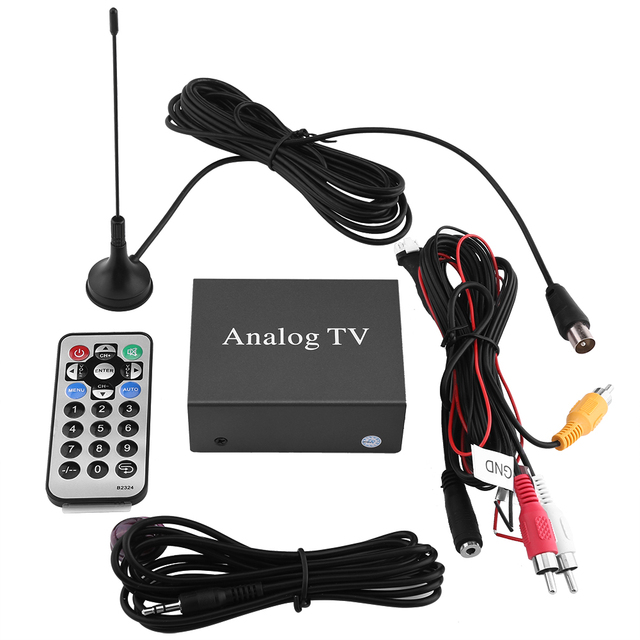
Car Mobile DVD TV Receiver Analog TV Tuner Strong Signal Box with Antenna Remote Controller
Related Searches
Explore more sourcing topics & related categories
Sources & References
28 sources cited · Verified industry data & reports
TV Tuner IC Market Size, Share, and Industry Trends Forecast ...
markwideresearch.com
The TV Tuner IC Market valued at $1.8 Billion in 2026 is projected to expand to $2.5 Billion by 2035, advancing at a 3.70% CAGR over the analysis window. Smart TV manufacturers in South Korea and Taiwan are expanding procurement of integrated tuner solutions. Digital tuner products command the largest volume share as analog switch-offs proceed across multiple geographies, while software-based tuner architectures represent the fastest-evolving category as broadcasters deploy ATSC 3.0 and DVB-T2 standards requiring upgradable demodulation. Silicon Wafer Cost Volatility:Mixed-signal tuner ICs require specialized RF-CMOS processes whose wafer pricing fluctuates with foundry utilization rates at leading-edge nodes. Single-Source RF IP Dependency:High-performance low-noise amplifier designs concentrate among a limited set of analog semiconductor specialists, creating supply vulnerability for tier-two tuner vendors. Software-Defined Radio Convergence:Integration of tuner demodulation with edge AI processing enables dynamic spectrum sensing and interference mitigation for professional broadcast equipment. EU Green Deal Alignment:The F-Gas Regulation and Ecodesign Directive are mandating lower-power receiver architectures, favoring semiconductor vendors with advanced power management IP. RF Analog Design Talent Scarcity:Mixed-signal expertise combining millimeter-wave circuit design with digital signal processing is concentrating among a shrinking pool of experienced engineers.
TV Tuner Card Market (2026 - 2033)
www.futuremarketreport.com
Size, Share, and Growth Analysis By Region - North America (US and Canada), Europe (France, Germany, Italy, and UK), APAC (China, India, and Japan), South America (Brazil), and Rest of World to Forecast (2026 - ) TV Tuner Card Industry Trend & Analysis Report By Application (Personal Use, Commercial Use, Broadcasting, Surveillance) By End User (Residential, Commercial, Government, Entertainment Industry) By Interface (PCI, PCI Express, USB) By Technology (Analog TV Tuner, Digital TV Tuner, Hybrid TV Tuner) By Type (Internal TV Tuner Card, External TV Tuner Card) One prominent trend in the TV tuner card market is the increasing integration of hybrid tuners that support both analog and digital signals as well as multiple broadcasting standards like DVB-T2, ATSC 3.0, and ISDB-T. This multi-format capability appeals to a broader customer base and encompasses emerging markets still transitioning from analog to digital. >>> Understand The Key Trends Shaping This Market:- Download PDF Sample · Key drivers propelling the TV tuner card market include the persistent transition from analog to digital television broadcasting globally. Digital broadcasts offer superior picture and sound quality, compelling consumers to upgrade to tuner cards compatible with these signals. Overall, the TV tuner card market continues to evolve, driven by the need for versatile and high-quality content access across devices. If you’re evaluating in depth, consider Fetal Electronic Cardiodiagram (FECG) Monitors, which connects insights on TV Tuner Card to your current focus. >>> Understand The Key Trends Shaping This Market:- Download PDF Sample
Global TV Tuner IC Market Size, Industry Share, Trends & Forecast ...
www.verifiedmarketreports.com
Global TV Tuner IC Market Size By Application (Consumer Electronics, Broadcasting Systems), By Technology (Analog TV Tuner ICs, Digital TV Tuner ICs), By Frequency Range (VHF Tuner ICs, UHF Tuner ICs), By Component Type (Single Chip Tuner ICs, Multi-chip Tuner ICs), By End-user (Residential Customers, Commercial Customers), By Geographic Scope And Forecast · Author By: Pradip Pawar | Edition : 7th Edition 2026 | Editor : Carter Morris The North American TV Tuner IC market in 2024 was valued at USD 1.2 billion and is poised to grow from USD 1.3 billion in 2025 to USD 2.0 billion by 2033, with a CAGR of approximately 6.2% during 2026-203The region’s market dynamics are heavily influenced by the rapid adoption of 4K and UHD broadcasting standards, alongside the proliferation of smart TV platforms supported by major players like Samsung, LG, and Sony. The U.S. market in 2024 was valued at USD 0.8 billion and is projected to grow from USD 0.9 billion in 2025 to USD 1.4 billion by 2033, at a CAGR of approximately 6.5% during 2026-203The United States’ market is characterized by high consumer adoption of smart TVs, with over 80% of households owning connected television devices as of 202The regulatory push for digital broadcasting, coupled with consumer preference for UHD content, has accelerated the integration of advanced tuner ICs supporting multiple standards, including ATSC 3.0. The market exists primarily because of the persistent need for reliable, efficient, and scalable signal processing solutions in television manufacturing and broadcasting. The transition from analog to digital broadcasting, coupled with the advent of ultra-high-definition (UHD) content, has significantly increased the technical complexity and performance requirements of TV tuner ICs.

Amazon.com: Ntsc Tv Tuner
www.amazon.com
Tuner Technology · Analog · NTSC · Seller · Geniatech · AllAboutAdapters · AVLGEAR · WiredShop Direct See more · Top Brands · Top Brands · Premium Brands · Premium Brands · Your recently viewed items and featured recommendations · › · View or edit your browsing history After viewing product detail pages, look here to find an easy way to navigate back to pages you are interested in.
Analog Box for TV Guide: How to Choose the Right Converter in 2026
electronics.alibaba.com
When evaluating an analog box for TV, focus on four measurable criteria—not marketing claims. Tuner sensitivity (–85 dBm or better): When it’s worth caring about: weak signal areas (rural, urban canyons, attic antennas). Over the past year, the meaning of “analog box for TV” has quietly shifted—not because analog TVs returned, but because digital broadcast standards are changing. If you own a CRT, vintage console setup, or older flat-panel without a built-in ATSC tuner, you still need a converter—but now, choosing one means weighing legacy compatibility against future-proofing. For most users with basic analog inputs (RCA/RF), an ATSC 1.0 converter remains sufficient and cost-effective. If you’re a typical user, you don’t need to overthink this. But if your antenna reception is weak, or you plan to keep your setup beyond 2028, tuner sensitivity (–85 dBm or better) and ATSC 3.0 readiness become material. Officially called a digital-to-analog converter box, it receives over-the-air (OTA) digital broadcast signals (ATSC) and converts them into analog outputs—typically composite video (RCA), RF coaxial, or S-video—that older televisions can display 1. It does not convert analog sources (like VCRs or NES) to digital—it works in the opposite direction. ... 🕹️ Building a retro gaming rig where RF pass-through is needed for authentic console switching; 📦 Extending OTA viewing to secondary rooms with non-smart, non-tuner-equipped displays;
Global Electronic Tuner Market Size, Share, Growth Trends & Global ...
www.verifiedmarketreports.com
Global Electronic Tuner Market Size By Product Type ( Analog Tuners, Digital Tuners), By Technology ( FM Tuners, AM Tuners), By End-users ( Residential Users, Commercial Users), By Connectivity Options (Wired Tuners, Wireless Tuners), By Application (Home Audio Systems, Car Audio Systems), By Geographic Scope And Forecast · Author By: Pradip Pawar | Edition : 7th Edition 2026 | Editor : Abigail Murphy Challenges include budget constraints faced by educational institutions and the need for scalable solutions, but overall, this segment offers steady growth prospects aligned with broader educational technology trends. The Electronic Tuner Market in North America was valued at USD 1.2 billion in 2024 and is projected to grow from USD 1.3 billion in 2025 to USD 2.0 billion by 2033, reflecting a CAGR of approximately 6.8% during 2026-203This region’s market expansion is underpinned by a mature consumer electronics ecosystem, high adoption of digital audio technologies, and a robust professional music industry. The United States accounted for a significant share of the North American market, with the size valued at USD 0.9 billion in 202It is expected to grow from USD 1.0 billion in 2025 to USD 1.5 billion by 2033, at a CAGR of approximately 6.2% during 2026-203The U.S. market’s growth is driven by a combination of factors including the dominance of the professional music industry, the proliferation of digital music education platforms, and the widespread adoption of connected audio devices. The presence of major companies such as Boss, Fender, and Roland, which continuously innovate in tuning technology, underpins the market’s robustness. The increasing integration of tuners into smart instruments, wireless systems, and IoT-enabled devices reflects a broader trend towards connected musical ecosystems. The Asia Pacific region’s Electronic Tuner Market was valued at USD 0.8 billion in 2024 and is projected to grow from USD 0.9 billion in 2025 to USD 1.7 billion by 2033, at a CAGR of approximately 8.1% during 2026-203This rapid growth is driven by expanding consumer electronics markets in China, Japan, South Korea, and India, along with increasing disposable incomes and rising interest in musical instruments and professional audio equipment.