Nvidia Gpu Workstation

Overview
Product sourcing insights & recommendations
The NVIDIA GPU workstation market in 2026 is experiencing a major transition from the Blackwell architecture to the next-generation Vera Rubin platform. NVIDIA continues to dominate the sector with a 75-80% market share, despite increasing pressure from AMD's MI-series and custom silicon developed by hyperscalers. Key insights include the sold-out status of Blackwell systems through mid-2026 and the upcoming H2 2026 launch of the 3nm Vera Rubin architecture featuring HBM4 memory.
I have compiled a comprehensive report detailing these market shifts, technical specifications, and strategic sourcing recommendations.
I have analyzed the current market and product landscape. You can continue with:
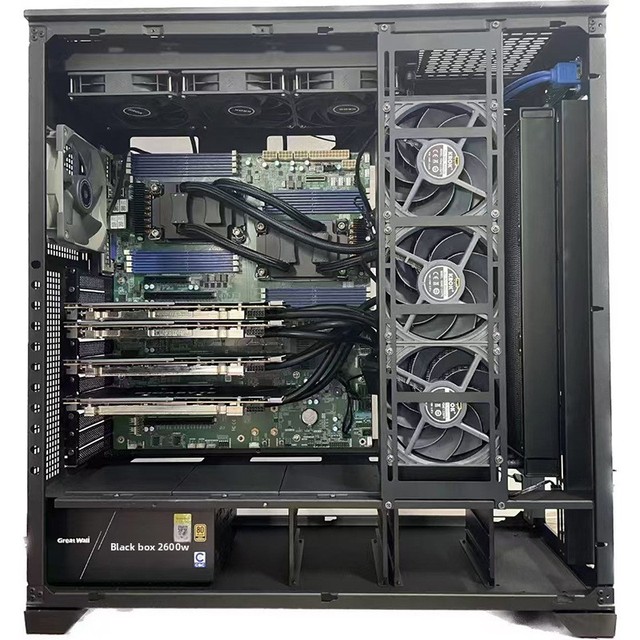
Nvidia Gpu Workstation Rtx 6000 Ada Blackwell H100 B200
Products · 3 lists

Deep Dive · Full Report
Full Market Report
1 document · Live-fetched from source
Related Searches
Explore more sourcing topics & related categories
Sources & References
19 sources cited · Verified industry data & reports
Graphics Processing Unit (GPU) Market Size, Trends, Share & Industry ...
www.mordorintelligence.com
The Graphics Processing Unit (GPU) Market worth USD 144.83 billion in 2026 is growing at a CAGR of 15.39% to reach USD 296.34 billion by 2031. NVIDIA Corporation, Advanced Micro Devices Inc., Intel Corporation, Apple Inc. and Samsung Electronics Co. Ltd. are the major companies operating in this market. Note: Market size and forecast figures in this report are generated using Mordor Intelligence’s proprietary estimation framework, updated with the latest available data and insights as of January 2026. The GPU Market Report is Segmented by Integration Type (Integrated GPUs, and Discrete GPUs), Device Application (Mobile Devices and Tablets, Pcs and Workstations, Servers and Datacenter Accelerators, Gaming Consoles and Handhelds, Automotive and ADAS, and Other Embedded and Edge Devices), and Geography. The Market Forecasts are Provided in Terms of Value (USD) Image © Mordor Intelligence. Reuse requires attribution under CC BY 4.0. The GPU market size is expected to increase from USD 128.17 billion in 2025 to USD 144.83 billion in 2026 and reach USD 296.34 billion by 2031, growing at a CAGR of 15.39% over 2026-2031. Integrated GPUs improved materially in 2026, which widened their role in client AI systems and lower-cost inference setups. AMD’s Ryzen AI 400 Series combined up to 60 TOPS of NPU compute with integrated Radeon 800M Series graphics, and the Ryzen AI Halo platform extended that model with stronger graphics capability and large unified memory pools. That progress made local inference more practical for professional notebooks, developer systems, and workstation-class devices that need lower cost and tighter power envelopes.
Nvidia Stock Analysis 2026: $1 Trillion AI Demand Forecast & ...
intellectia.ai
Key risks include high valuation multiples that assume continued perfect execution, intensifying competition from AMD and custom AI chips, geopolitical export restrictions limiting China market access, and potential cyclicality in AI capital expenditure. Additionally, any slowdown in hyperscaler spending or technological disruption could impact growth. Investors should also consider concentration risk, as data center revenue now dominates Nvidia's business. ... Subscribe now and receive handpicked financial news, insights, and trending topics. Sign up for Intellectia.AI and access AI-powered stock analysis, real-time market insights, and professional-grade research tools. Nvidia's position at the center of the AI revolution is unquestioned, and the company's $1 trillion demand forecast through 2027 provides concrete evidence of the massive opportunity ahead. Fiscal 2026 demonstrated that Nvidia can deliver exceptional growth at scale, with revenue increasing 65% to $215.94 billion while maintaining industry-leading profitability. For fiscal year 2026, Nvidia delivered record-breaking revenue of $215.94 billion, representing a remarkable 65% year-over-year increase that validates the company's dominant position in the AI infrastructure market. The investment thesis for Nvidia in 2026 rests on three foundational pillars that show no signs of weakening. First, the company's Blackwell GPU architecture has achieved such overwhelming demand that systems are completely sold out through the middle of the year, creating a massive order backlog from hyperscalers including Microsoft, Meta, Amazon, and Google. However, Nvidia maintains an 80-90% market share advantage, bolstered by its CUDA software ecosystem that creates significant switching costs for customers. Blackwell is Nvidia's latest GPU architecture that delivers 2X attention-layer acceleration and 1.5X more AI compute FLOPS than previous generations. As of April 2026, Blackwell systems are sold out through mid-year, with each GPU commanding approximately $40,000.
Graphics Card Price Trends 2025: What to Expect in 2026
www.accio.com
Detailed Non-reference Graphics Card Market Analysis 2026-2033: Market Size, Share, Trends, and Revenue Growth with a Projected CAGR of 6.4%.Read more ... The GPU Market, valued at USD 78.1B in 2025, is projected to reach USD 989.79B by 2034, growing at a 32.6% CAGR. ... GPU price tracking 2026: Lowest price on every graphics ... GPU price tracking 2026: Lowest price on every graphics card from Nvidia, AMD, and Intel today — here are the best deals during the AI-driven ...Read more Why GPUs may not be the hottest AI trend for 2026. Nvidia's early move into the AI chip market has paid off big time for the company. Multi-display GPU Best Quality Dual-Fan Gaming Graphics Card... ... Min. order: 100 pieces ... Colorful GeForce GTX1050Ti Shark 4G GDDR5 Gaming Graphics Ca... ... Min. order: 2 pieces ... For business buyers, professional workstation graphics cards offer long-term value and stability, aligning with potential market shifts. High-End Gaming Graphics Card Market: Valued at $55.59 billion in 2024, this market is projected to reach $214.03 billion by 2034, demonstrating a CAGR of 22.3% during the forecast period 5. Dominant Players: NVIDIA and AMD collectively hold over 85% of the high-end gaming GPU market share 5.
NVIDIA Facts and Statistics (2026) - Investing.com
www.investing.com
Gaming Dominance: NVIDIA holds over 80% market share in discrete GPUs used for gaming, reflecting its dominance in the sector. Expansive Partner Ecosystem: NVIDIA collaborates with more than 20,000 companies and organizations globally, ensuring broad adoption of its GPU technology and AI solutions. AI and Cloud: NVIDIA GPUs power more than 90% of cloud-based AI workloads, highlighting its critical role in data processing and computational tasks. Founder’s Insight: Co-founder and current CEO Jensen Huang has steered the company since its inception, consistently ranking among the top visionary leaders in tech. The company still sells GPUs for the PC and workstation markets. However, the growing application of these chips in new segments such as data centers, automotive, cryptocurrency mining, and digital twins has opened a large profitable market for NVIDIA. Apple Inc: Apple’s custom silicon, such as the M1 and M2 chips, indirectly compete with NVIDIA by offering integrated GPUs in personal computing devices, appealing to consumers and creative professionals. It’s important to note that while NVIDIA retains its leadership, the tech industry is highly competitive, with rapid innovation and shifting market shares defining the landscape. As the technology industry advances, several key trends have emerged. But analysts predict that the disposition of power in the GPU market might begin to change. Understanding NVIDIA’s market share is crucial for investors as it reflects the company’s competitive position and potential for growth in the high-demand graphics and AI sectors. This section provides a snapshot of NVIDIA’s market share in comparison to its main competitors, AMD and Intel, over the years. By analyzing these trends, investors can gauge NVIDIA’s market strength, strategic advancements, and its capacity to maintain leadership in a rapidly evolving industry.
GPU Pricing Trends 2026: What to Expect in the Year Ahead - Silicon ...
www.silicondata.com
The 2026 GPU rental landscape is characterized by a wide range of available hardware and more mature pricing patterns across both established and next-generation models. As users evaluate options, understanding the differences in performance, pricing, and availability across GPUs is more important than ever. Demand remains strong for the NVIDIA A100, H100, and Blackwell B200 series. As newer GPUs reach the market, older generations continue to decline in price, making high-performance computing more accessible. Success in this landscape depends on understanding market trends, evaluating actual workload needs, and deploying resources strategically. By staying informed and adaptable, organizations and developers can extract strong value from the evolving GPU ecosystem throughout 2026 and beyond. Your guide to 2026 GPU pricing trends, market drivers, hardware changes, and cost strategies. The disruptions that affected the GPU market in past years have largely subsided. Manufacturers and data center operators now benefit from stronger logistics, more consistent production capacity, and steadier component availability. This has reduced volatility and allowed both users and providers to plan with greater certainty. The arrival of next-generation GPUs, most notably NVIDIA’s Blackwell series, is reshaping the pricing landscape.
NVIDIA Data Center GPU Specs: A Complete Comparison Guide | ...
intuitionlabs.ai
Market and deployment insights (e.g. NVIDIA’s ~80–92% AI accelerator market share as of 2025, with quarterly data center revenue surpassing $51.2B ([4])) are interwoven. Special attention is given to future directions: the Blackwell Ultra (B300/GB300) platform shipping H2 2025, the upcoming Vera Rubin architecture (H2 2026) with HBM4 and 3.6 ExaFLOPS per rack, and the April 2025 H20 licensing requirement for exports to China and NVIDIA’s RTX Pro 6000D/B40 product ([5]), scaling to trillion-parameter models, and infrastructure changes (e.g. Based on current trends and sources, we conclude that NVIDIA will maintain its leadership into the next decade through both iterative performance gains (Vera Rubin in 2026, Rubin Ultra in 2027, Feynman in 2028) and strategic ecosystem partnerships. NVIDIA’s fiscal year 2026 revenue of $215.9 billion — with data center as the primary driver — demonstrates the extraordinary scale of this platform’s adoption. The company's full fiscal year 2026 revenue reached $215.9 billion (+65% YoY). NVIDIA is estimated to consume 77% of all wafers used for AI processors in 2025 ([8]), reflecting an AI accelerator market share of roughly 80–92% depending on the analyst methodology. Custom Silicon Outlook: Custom ASIC shipments from cloud providers are projected to grow 44.6% in 2026, while GPU shipments are expected to grow 16.1%. Custom silicon is expected to capture 15–25% of the total AI accelerator market — primarily for internal inference workloads at hyperscalers — increasing pressure on NVIDIA’s market share in the long term ([38]).