Satellite Stabilizer

Overview
Product sourcing insights & recommendations


The term 'satellite stabilizer' typically refers to two distinct product categories depending on the business context: Attitude and Orbit Control Systems (AOCS) for the satellites themselves, and Gyroscopic Antenna Stabilizers for ground-based receivers on mobile platforms like ships or vehicles SanlabRand.
Market Trends and 2026 Outlook
By 2026, the global market for satellite antenna technology is projected to reach $6.0 billion, driven primarily by the expansion of Low Earth Orbit (LEO) constellations like Starlink and OneWeb Fortunebusinessinsights.
* Miniaturization & SmallSats: In space-based systems, there is a dominant shift toward compact reaction wheels and magnetic torquers specifically designed for CubeSats and nanosatellites MarketresearchfutureStackexchange.
* AI-Integrated Control: By 2026, leading manufacturers (e.g., Airbus, Lockheed Martin) are expected to fully integrate AI-driven control algorithms into stabilizers to reduce fuel consumption and enable autonomous orbital maneuvers Marketresearchfuture.
* Electronically Steered Arrays (ESA): A significant transition is occurring from traditional mechanical parabolic dishes to flat-panel phased array antennas, which offer faster signal re-acquisition for LEO satellites on the move Fortunebusinessinsights.
Consumer & B2B Insights
* Maritime Dominance: The highest demand for external stabilizers currently comes from the maritime sector, where 2-DOF and 3-DOF platforms are essential to compensate for ship roll and pitch (up to ±15°) to maintain a high-speed signal lock SanlabWatson-Gyro.
* Starlink Connectivity: The rapid adoption of Starlink Mini and similar kits has created a surge in demand for specialized suction cup and magnetic stabilization mounts for road trips and fleet management AlibabaAlibaba.
* Key Industrial Suppliers: Major manufacturing hubs in China, such as Guangdong and Zhejiang, are focusing on high-precision 9DOF attitude sensor modules (e.g., BNO055) and heavy-duty carbon steel mounting hardware to support the global SATCOM infrastructure AlibabaAlibaba.
The satellite stabilizer market is shifting towards AI-integrated and phased array systems. You can continue with:
Low Earth Orbit Leo Satellite Signal Tracking Stabilizer Mount
Products · Top picks & verified manufacturers
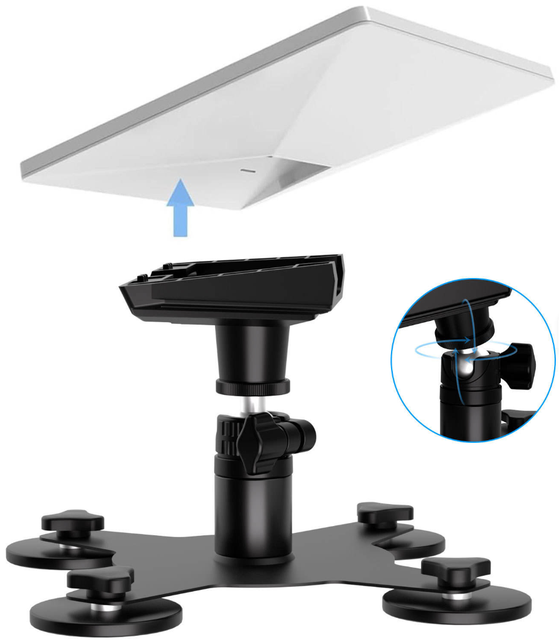
Heavy-Duty Iron Suction Cup Mount Starlink Mini Satellite Dish Stable Signal Holder for Cars Family Road Trips
 Guangzhou Chuangze Digital Technology Co., Ltd.verified🇨🇳CN4 yrs
starlink mini kit mount accessories case car de magnetic support stand adapter magnet flat pole tripod portable handle
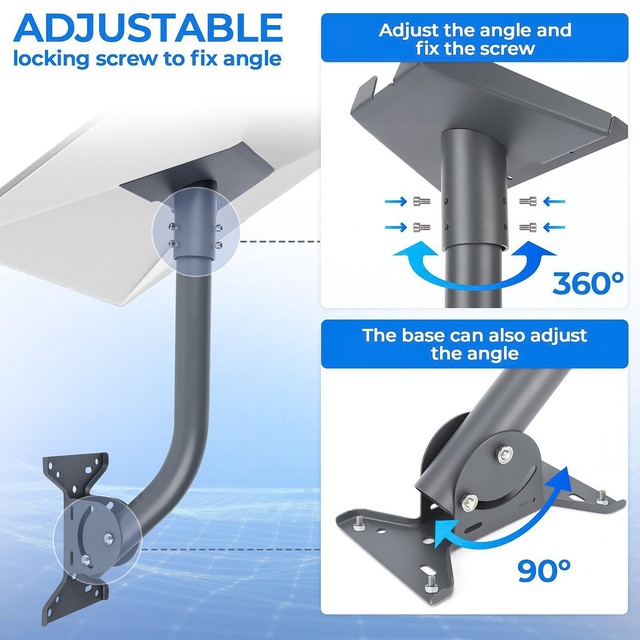
OEM Heavy Duty Carbon Steel Starlink Gen 3 V4 Long J-Pole Mounting Kit Satellite Bracket
 Shenzhen Changrongfa Technology Development Co., Ltd.🇨🇳CN4 yrs
Related Searches
Explore more sourcing topics & related categories
Sources & References
27 sources cited · Verified industry data & reports
Satellite Stabilizer
SANLAB Simulation
Satellite Stabilizer ensures continuous antenna alignment with low orbit satellites by compensating pitch and roll motion, enabling stable and efficient.
CA2224919A1 - Satellite dish stabilizer
Google Patents
The satellite dish stabilizer consists of a steel rod which connects the satellite dish to the mounting surface through the use of a surface mounting flange and ...
Dynamic Analysis of a Passive Satellite Stabilization ...
RAND
A satellite can be designed so that gravity alone will keep it approximately stabilized.

Wobble of a spin stabilized satellite with cross products ...
ScienceDirect.com
Spin stabilization is reliable concept that is used since the launch of the first American satellite Explorer-I. Tiros-II satellite (launched November 23, 1960) ...

Satellite Communications Antenna Stabilization
Watson Industries, Inc.
Satellite antennas in such applications require gyro stabilization in order to accurately receive or transmit data.

Attitude Stabilization of a Satellite Having Only ...
MDPI
Attitude stabilization can be achieved by applying external torque on the satellite, which is described via Euler's equations [2].