Satellite Transceiver Module

Overview
Product sourcing insights & recommendations


Market Trends and Insights
The satellite transceiver module market is undergoing a structural shift from traditional Geosynchronous (GEO) systems to massive Low Earth Orbit (LEO) constellations, which are projected to grow from 35% to 70% of the total satellite market by 2029 Qorvo.
Key Market Drivers:
* 5G Integration (NTN): Adaptation of 3GPP Release 17 allows direct-to-device connectivity between satellites and mobile/IoT devices, leveraging 5G economies of scale QorvoLinkedin.
* Spectrum Evolution: A clear transition from Ku-band toward higher frequency Q/V and E bands to meet increasing demand for multi-gigabit throughput Qorvo.
* Software Defined Radios (SDR): Modern payloads increasingly favor SDRs to provide operational flexibility and high-speed communications in dynamic space environments Qorvo.
Technological Landscape: LEO, MEO, and GEO
Satellite transceiver requirements vary significantly by orbit altitude:
| Orbit | Altitude | Primary Advantage | Transceiver Tech Focus |
|---|---|---|---|
| LEO | 160 – 2,000 km | Low Latency (~30x faster than GEO) | Phased arrays, rapid beam handover, and mesh networking QorvoAnywaves. |
| MEO | 2,000 – 35,786 km | High timing precision | GNSS (GPS) signal accuracy and moderate power stability Anywaves. |
| GEO | ~35,786 km | 24/7 fixed coverage | High-power transponders and large directional parabolic antennas QorvoAnywaves. |
Product and Supplier Insights
The B2B market for satellite transceiver modules is diverse, ranging from ground station terminals to specialized space-grade components for CubeSats.
Product Availability and Pricing:
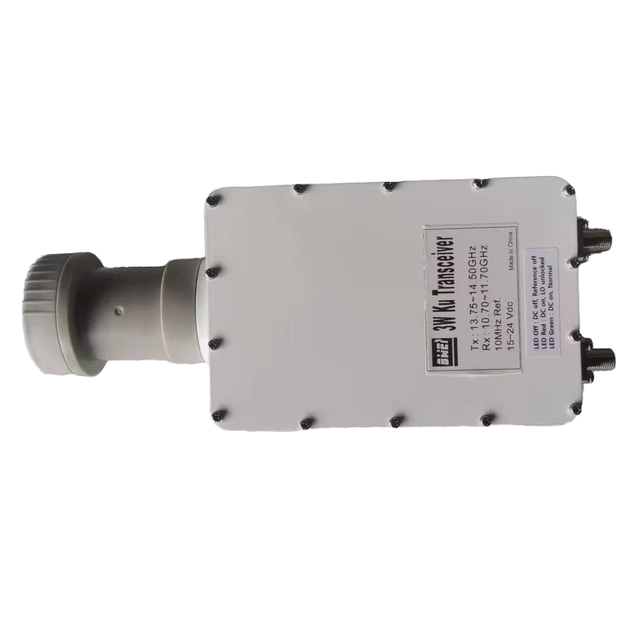
* Commercial Ku-Band Transceivers: Standard 3W Ku-band modules for ground terminals are priced between $300–$800/unit, often with low MOQs of 1–2 pieces AlibabaAlibaba.
* RF Frontend Components: Smaller integrated transceiver functions (e.g., SPX-20107) are available at significantly lower price points (~$15–$25) for mass-market electronic applications AlibabaAlibaba.
Key Suppliers:
* Specialized Space Manufacturers: Companies like Qorvo, Anywaves (RF payloads), Collins Aerospace, and Comtech lead in high-reliability SATCOM transceivers QorvoAnywavesSatnow.
* B2B Sourcing Options: Suppliers such as Shaanxi Academy Of Aerospace Technology Application Alibaba and Nanjing Shinewave Technology Alibaba specialize in RF modules and terminal components for small satellites and ground stations.
Based on these market findings, you can continue with:
Satcom Rf Transceiver Module Rf Front End For Satellite
Products · 2 lists

Related Searches
Explore more sourcing topics & related categories
Sources & References
28 sources cited · Verified industry data & reports
Optical Transceiver Market Trends 2026: AI to 1.6T - FB-LINK
100gmodules.com
The optical transceiver market in 2026 is being reshaped by AI data centers, 800G adoption, early 1.6T planning, and tighter supply of high- ...
Optical Transceiver Market Size, Growth Drivers
Mordor Intelligence
The Optical Transceiver Market worth USD 15.42 billion in 2026 is growing at a CAGR of 13.67% to reach USD 29.26 billion by 2031.

Multi-Mode Optical Transceiver Market 2026 Market Trends ...
Strategic Market Research
The global multi-mode optical transceiver market is valued at USD 9.4 billion in 2025 and is projected to reach USD 16.8 billion by 2032.

Optical Transceiver Market Size, Share, and Growth Analysis
SkyQuest Technology
Optical Transceiver Market size was valued at USD 10.62 Billion in 2024 and is poised to grow from USD 12 Billion in 2025 to USD 31.91 Billion by 2033,

Optical Transceiver Market Size and Forecast – 2026 to 2033
Coherent Market Insights
The CAGR of the Optical Transceiver Market is projected to be 12.4% from 2026 to 2033. What are the major factors driving the market growth?

Global High Speed Optical Transceiver Modules Market ...
is projected to expand at a robust CAGR of 6.4% from 2026 to 2033. of 11.2% from 2026 to. Projected at 7.7% CAGR from