Sensor Decoder

Overview
Product sourcing insights & recommendations
The term "sensor decoder" refers to a technical component or software layer that interprets raw data from sensors into usable information. In 2026, the global sensor market is projected to reach approximately $258.47 billion Fortunebusinessinsights, driven by the transition toward software-defined decoding and ultra-low-power architectures for IoT networks NihCnfx.
Core Product Insights
* Hardware Decoders: These are physical modules or ICs (e.g., LDPC decoders) that perform analog-to-digital (ADC) conversion or error correction at the physical layer. They are essential for Wireless Sensor Networks (WSN) to extend battery life by reducing transmission energy NihCnfx.
* Software/Script Decoders: In LoRaWAN and BACnet systems, decoders are often JavaScript scripts that parse hexadecimal payloads into human-readable metrics like temperature, moisture, or pressure NihMultitech.
* Specialized Applications:
* Industrial IoT: High-durability decoders for RS485/Modbus communication in harsh environments (-40°C to +125°C) Cnfx.
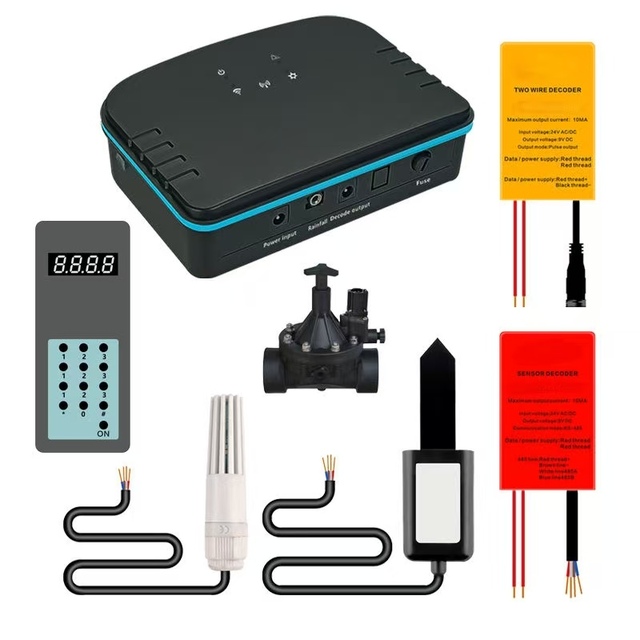
* Smart Irrigation: 2-wire decoders used to control flow meters, soil moisture sensors, and pressure gauges across professional landscapes Twl-IrrigationHunterirrigation.
2026 Market Trends
* Interoperability: Increased adoption of standardized sensor definition files (JSON) is enabling plug-and-play compatibility across different industrial brands NihCnfx.
* Ultra-Low Power: Development is shifting toward fully serial decoder architectures optimized for low-throughput IoT devices (≤250 kb/s), reducing silicon area and energy consumption Nih.
* Growth Drivers: Mobility, AI-driven robotics, and 6G connectivity are cited as major trends pushing the market toward a $500B+ valuation by the mid-2030s IdtechexFuturemarketinsights.
The market shows a significant spike in search interest peaking around August 2025 , indicating a strong upcoming cycle for industrial and agricultural automation upgrades. Detailed product listings for industrial converters and irrigation decoders are available in the attached files.
Based on the market growth in 2026, would you like to:
2 Wire Irrigation Sensor Decoder Flow Moisture Pressure
Products · 4 lists

Related Searches
Explore more sourcing topics & related categories
Sources & References
28 sources cited · Verified industry data & reports
Adding Custom Decoders and Sensor Definitions to BACnet Reference ...
multitech.com
To create an account and submit a support case directly to our technical support team, visit: https://support.multitech.com. ... To read the warranty statement for your product, visit https://www.multitech.com/legal/warranty. ... Multi-Tech Systems, Inc. ... S000825 Rev. 1.0 ... 1 – Adding Custom Decoders and Sensor Definitions to BACnet .............................................................................. To create an account and submit a support case directly to our technical support team, visit: https://support.multitech.com. Warranty · To read the warranty statement for your product, visit https://www.multitech.com/legal/warranty. World Headquarters · Multi-Tech Systems, Inc. 2205 Woodale Drive, Mounds View, MN 55112 · USA · CONTENTS · Adding Custom Decoders and Sensor Definitions to BACnet Reference Guide · The MultiTech products are not designed, manufactured or intended for use, and should not be used, or sold or re-sold for use, in connection with · applications requiring fail-safe performance or in applications where the failure of the products would reasonably be expected to result in personal injury or Applications is at the user’s sole risk and liability. MULTITECH DOES NOT WARRANT THAT THE TRANSMISSION OF DATA BY A PRODUCT OVER A CELLULAR COMMUNICATIONS NETWORK WILL BE
Encoder/Decoder Component – Computer, Electronic and Optical ...
cnfx.com
An encoder/decoder (codec) is a critical electronic component within Physical Layer (PHY) interfaces that performs analog-to-digital conversion (ADC) and digital-to-analog conversion (DAC) functions. It transforms continuous electrical signals from sensors or actuators into discrete digital data for processing by controllers, and converts digital commands back to analog signals for actuator control. In industrial applications, it ensures reliable data transmission across noisy environments while maintaining signal integrity and timing synchronization. Commonly used trade names and technical identifiers for Encoder/Decoder. industrial encoder decoder PHY interface component analog-to-digital converter signal conversion industrial communication data acquisition ADC DAC module Encoder/Decoder Encoder/Decoder in Computer, Electronic and Optical Product Manufacturing "The Encoder/Decoder we sourced perfectly fits our Computer, Electronic and Optical Product Manufacturing production line requirements." "Found 37+ suppliers for Encoder/Decoder on CNFX, but this spec remains the most cost-effective." "The technical documentation for this Encoder/Decoder is very thorough, especially regarding technical reliability." Trigger: Mechanical vibration in production lines Failure: Solder joint fatigue leading to intermittent connections Mitigation: Use vibration-resistant mounting; apply underfill epoxy for BGA packages
What are Encoder Sensors?
www.azosensors.com
Encoder sensors are a type of mechanical motion sensor that create a digital signal from a motion. It is an electro-mechanical device that provides users (commonly those in a motion control capacity) with information on position, velocity and direction. There are two main types of encoder: linear and rotary. From an industry perspective, encoder sensors are used across the automotive, consumer electronics, medical, military, manufacturing and scientific instrument industry sectors. In terms of specific applications, encoder sensors can be found in printers, food processing, robotics, material handling, axis controllers, medical scanners, dispensing pumps, military-grade antennas, drilling machines and telescopes, to name but a few. The sensor will either detect changes in the magnetic field or magnetic position and this provides an output which represents a speed, position or directional change. Top to Bottom Services Monitors Real Estate Inspections Using Track What Matters GPS Solution · Track What Matters Launches Cloud-based Tracking Unit · FLIR Nexus: What Is It and What Tangible Gains Does It Provide in Thermography Applications? Advancements in sensor technology are crucial for predicting cardiac events, focusing on early detection of physiological changes to improve patient outcomes. Discover how GasNet remote monitoring helps reduce site downtime, improve safety, and deliver real-time visibility across your gas detection systems. ... The DryCal 1020 & 1500 primary flow calibrators are designed for gas flow measurement in laboratory, industrial, and environmental applications.
Definition of Sensor and Sensing Technology | Yokogawa Electric ...
www.yokogawa.com
Sensing technology and its various applications are constantly evolving in line with advancements in technology and business needs. Sensors are available to detect a wide variety of real-world properties–from distance to heat to pressure. Today’s products sense everything around them using sensors and they have the capacity to be extremely accurate, consume less power, and are inexpensive to install and maintain. For demanding, mission-critical industrial applications, sensors can help improve processes, and offer unmatched asset protection. These sensors offer real-time monitoring, including detection and reporting, as needed by a process. Data monitored and collected by sensors is sent for control and analysis, and any anomaly in a particular property is reported by emitting an electrical signal by that sensor. This way, sensors enhance process efficiency and product quality, while ensuring that processes comply with best practices. Yokogawa is a leading company in the field of process automation sensors. With its wide and amazing range of sensor products and analyzers, catering to diverse industrial applications, Yokogawa is a name associated with accuracy, reliability, stability, and world-class services.” Yokogawa has more than 45 years' experience in Liquid-level applications with differential pressure transmitters. Also, Yokogawa has wide line-ups of Radar, Guided Wave Radar, Ultrasonic to Level Transmitter. Learn More >> Real-time gas analysis enhances efficiency, safety, throughput, product quality, and ensures environmental compliance.
What is a Decoder? Understanding Its Functions and Applications ...
www.icdrex.com
Introduction Decoders are important electronic devices that are widely used in digital circuits and signal processing. In modern technology, the role of decoders cannot be ignored, especially in computer, communication, audio and video processing systems. This article will discuss the definition, working principle, function and application field of decoders in detail to help readers better… It can decode data sent by sensors or network nodes and provide control signals or data to other devices. For example, smart door locks use decoded signals to determine whether to unlock or lock. Automatic control system: Decoders are used in industrial control, robots, and automation equipment to control the distribution of signals to ensure that different components can work according to preset programs. For example, decoders in automated production lines can start or stop specific robotic arms or conveyor belts based on control signals. In modern technology, the role of decoders cannot be ignored, especially in computer, communication, audio and video processing systems. This article will discuss the definition, working principle, function and application field of decoders in detail to help readers better understand this basic electronic component. Simply put, a decoder is a device that converts data in one format or structure into another readable or usable format. Decoders can be used to decode analog signals and digital signals, and decoders for digital signals are more common, especially in data transmission and storage.
Sensor Technology: From Basics to Breakthroughs
www.azosensors.com
A sensor is a powerful device designed to detect and respond to inputs from the physical environment, translating various environmental phenomena such as light, heat, motion, moisture, or pressure into actionable data. This data, often converted into electrical signals, can be processed, displayed, or stored for further analysis, enabling a wide array of applications in real-time monitoring and automation.1 Pressure sensors often use silicon diaphragms, and they detect pressure changes by measuring the displacement caused by pressure differentials. These are essential in industrial automation and robotics, as well as in automotive applications like monitoring tire pressure and engine performance. Infrared (IR) sensors detect infrared radiation emitted by objects, often using thermopiles or bolometers, which convert infrared radiation into measurable heat changes. These sensors are integral in applications like motion detection, thermal imaging, HVAC systems, and night vision, and they also play a critical role in industrial systems, helping to prevent equipment overheating and improve energy efficiency.1 Biosensors are designed to detect biological substances, such as enzymes, antibodies, or microorganisms, and convert biological reactions into electrical signals. These sensors integrate a biological recognition element (such as an enzyme or antibody) with a transducer, which can be electrochemical, optical, or piezoelectric, depending on the application.1