Stretchable Holographic Display

Overview
Product sourcing insights & recommendations
Overview of 'Stretchable Holographic Display' Technology
The phrase "stretchable holographic display" refers to an emerging frontier in display technology that combines stretchable materials (like polymers and nanostructures) with holographic projection or light-field technology. Unlike traditional rigid screens, these displays can physically deform, bend, or expand while maintaining or dynamically altering a 3D image DigitaljournalIeee.
Market Trends and Growth (2025–2026)
The global holographic display market is witnessing exponential growth, with 2026 expected to be a pivotal year for commercialization in high-end sectors FortunebusinessinsightsThebusinessresearchcompany.
* Rapid Expansion: The market is projected to grow from $4.31 billion in 2025 to $5.42 billion in 2026, with some forecasts suggesting even higher valuations as adoption accelerates FortunebusinessinsightsGlobalgrowthinsights.
* Key Drivers: Integration with AI and IoT is a dominant trend, enabling real-time, interactive 3D content that reacts to user behavior PersistencemarketresearchCoherentmarketinsights.
* Sector Adoption: Automotive (AR head-up displays), healthcare (3D medical imaging), and high-end retail are leading the way MordorintelligenceThebusinessresearchcompany.
Technological Breakthroughs
Two primary research paths are currently defining "stretchable" holographic capabilities:
- 1Metasurface-Based Stretchable Holograms:
* Research: Led by the University of Pennsylvania, this technology uses a flexible polymer film (PDMS) embedded with gold nanorods Digitaljournal.
* Mechanism: Stretching the material physically changes the holographic image. It enlarges the projection and shifts the image plane (moving the 3D object closer or further) Digitaljournal.
* Goal: Developing tabletop 3D displays with 360-degree viewing access for multiple users simultaneously Digitaljournal.
- 2Flexible Holographic Smartphones (HoloFlex):
* Research: Developed by Queen's University's Human Media Lab, the HoloFlex prototype uses a flexible OLED screen layered with a 3D-printed microlens array Ieee.
* Feature: It renders 3D images without glasses. A bend sensor allows users to interact with 3D objects by physically flexing the phone (e.g., bending the device to adjust the "depth" of an object) Ieee.
Current Product Landscape
While "stretchable" displays are still largely in the R&D phase, the market currently offers flexible transparent LED films and holographic projection films that represent the closest commercial equivalents for curved or non-flat surfaces.
* Flexible Holographic LED Film: These are transparent, adhesive LED sheets that can be applied to glass or curved surfaces to create "invisible" 3D-like displays AlibabaAlibaba.
* Rear Projection Films: High-definition holographic foils that can be applied to flexible or curved acrylic for large-scale 3D effects AlibabaAlibaba.
Stretchable Transparent Led Display Screen For Wearable Devices
Products · 4 lists
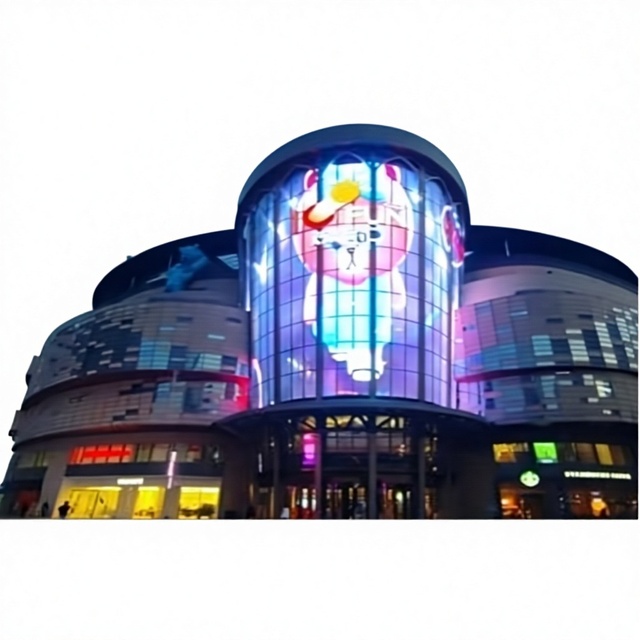
P3.91 3D Hologram LED Display High Visibility Transparent Invisible Screen HDR10 1080P Resolution Stretch Bar Sunlight Readable
 Dongguan Pro-love Beauty Tech Co., LTD.🇨🇳CN1 yr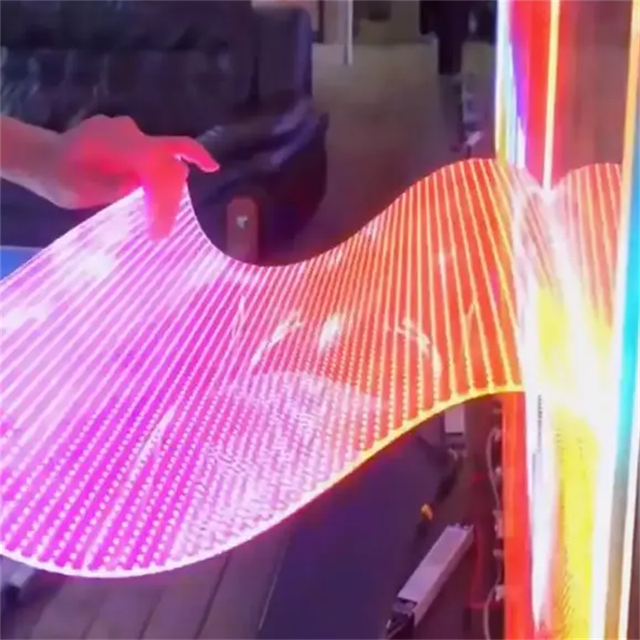
Super Slim Transparent Flexible Fullcolor LED Film Display Screen for Video Wall Elevator & Education Use
 Shenzhen Vios Electronic Technoloy Co., Ltd.🇨🇳CN10 yrs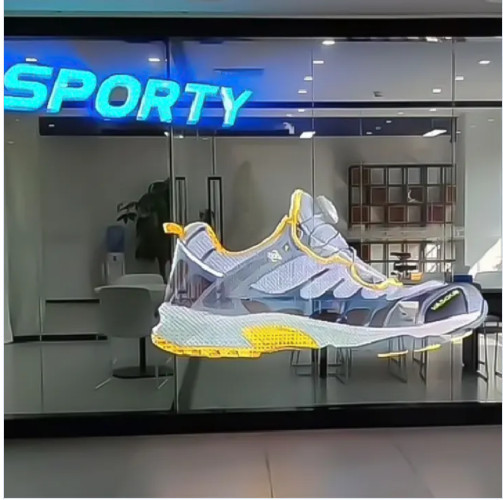
Transparent Led Screen Flexible Display
 Shenzhen APOLLOMI Technology Company Limited🇨🇳CN12 yrs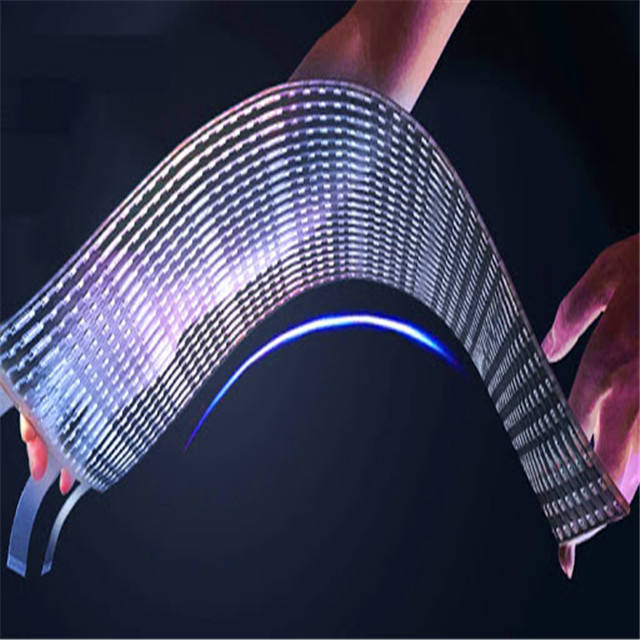
Thinnest Easiest P16 P20 P30mm Stick on Window Glass Led Screen
 Guangzhou Zongheng Technology Co., Ltd.🇨🇳CN6 yrs
Related Searches
Explore more sourcing topics & related categories
Sources & References
46 sources cited · Verified industry data & reports
Holographic Display Market Share, Size, Trend, 2034
www.fortunebusinessinsights.com
The global holographic display market size was valued at USD 4.31 billion in 2025. The market is projected to grow from USD 5.42 billion in 2026 to USD 33.36 billion by 2034, exhibiting a CAGR of 25.52% during the forecast period. Holographic displays project realistic images that enhance depth perception, spatial understanding, and visual engagement, making them highly valuable across enterprise-focused use cases. Industries such as healthcare, engineering, retail, automotive, and defense are increasingly adopting holographic display solutions for product visualization, data presentation, simulation, and interactive communication. Continuous advancements in light-field technology, projection systems, and display materials are improving image stability, resolution, and scalability, strengthening the role of holographic display market analysis, holographic display industry report insights, and holographic display market research report adoption across B2B environments. U.S.-based organizations are integrating holographic displays into medical imaging, remote collaboration, virtual product demonstrations, and defense simulations to enhance operational efficiency and decision-making accuracy. The presence of leading technology developers, research institutions, and innovation-driven enterprises supports rapid commercialization and customization of holographic display solutions.
Holographic Display Market Size, Share, Trends and Growth 2035
www.marketresearchfuture.com
As per Market Research Future analysis, the Holographic Display Market Size was estimated at 43.19 USD Billion in 2024. The Holographic Display industry is projected to grow from 47.66 USD Billion in 2025 to 127.51 USD Billion by 2035, exhibiting a compound annual growth rate (CAGR) of 10.34% during the forecast period 2025 - 2035 The Holographic Display Market is projected to grow at a 10.34% CAGR from 2025 to 2035, driven by advancements in technology, increasing demand for immersive experiences, and applications across various sectors. The expected CAGR for the Holographic Display Market during 2025 - 2035 is 10.34%. What is the expected CAGR for the Holographic Display Market during the forecast period 2025 - 2035?
Holographic Display Market Share | Growth Trends, 2033
www.persistencemarketresearch.com
It is anticipated to grow at a CAGR of 26.4% from 2026 to 2033. Holographic displays are changing how users experience digital content by using light to create 2D, 3D, and even 4D images that can be viewed from multiple angles without using special glasses or headsets. Hence, the demand for high-quality, realistic visuals is pushing the need for better holographic displays. With their ability to captivate and engage, they’re becoming a game-changer in how users consume digital content. Regional Analysis: North America is estimated to hold a 36.9% share in 2026, owing to the region's strong technological advancements and high consumer demand for innovative and interactive experiences. The retail sector is expected to account for 30.5% of total retail sales in 2026, driven by the growing adoption of immersive technologies to enhance customer engagement and the in-store experience. Artificial Intelligence (AI) is optimizing hologram generation by reducing computational complexity and enabling real-time rendering with deep learning algorithms, significantly improving image quality. Spatial light modulators (SLMs) are enhancing holographic displays by improving resolution, refresh rates, and phase modulation capabilities, leading to better depth perception and clarity. Based on technology, the market is divided into electro-holographic, touchable, laser, and piston. Among these, Electro-holographic is projected to account for nearly 71.3% of the holographic display market share in 2026.
Holographic Display Market Size, Trends Report 2026-2030
www.thebusinessresearchcompany.com
Global Outlook – By Components ( Light Modulator, Lens, Scanner, Digital Micrometer, Monitor), By Dimension ( Two-dimensional (2D), Three-dimensional (3D), Four-dimensional (4D)), By Technology ( Electro-Holographic, Laser, Touch, Piston), By End Users ( Consumer Electronics, Retail, Media And Entertainment, Military And Defense, Healthcare, Automotive, Other End-users) – Market Size, Trends, Strategies, and Forecast to 2035 · Purchase This ReportDownload Sample PDFAdd to Cart · Home>Reports Store>Electrical And Electronics>Global Holographic Display Market Report 2026 ... • Holographi The holographic display market size has grown exponentially in recent years. It will grow from $2.47 billion in 2025 to $2.99 billion in 2026 at a compound annual growth rate (CAGR) of 20.8%. The growth in the historic period can be attributed to early adoption of holography in entertainment, rising technological advancements in display systems, increased use of visualization tools in healthcare, adoption of laser based imaging, expansion of digital content consumption. North America was the largest region in the holographic display market in 2025. Asia-Pacific is expected to be the fastest-growing region in the forecast period. The regions covered in this market report are Asia-Pacific, South East Asia, Western Europe, Eastern Europe, North America, South America, Middle East, Africa. It will grow to $5.74 billion in 2030 at a compound annual growth rate (CAGR) of 17.7%. The growth in the forecast period can be attributed to growth in immersive communication demand, rising use of holographic ads in retail, increasing deployment in autonomous and smart systems, advancements in electro holographic technologies, expansion of 4d and multi dimensional display applications. Major trends in the forecast period include growing use of holographic displays in entertainment and media, rising adoption of holography for medical imaging and diagnostics, increasing demand for advanced visualization in engineering and design, expansion of holographic displays in retail and advertising, growing integration of multi dimensional holographic interfaces.
Holographic Display Market Share & Opportunities 2026-2033
www.coherentmarketinsights.com
A real-world example of AI’s growing influence is HYPERVSN’s 2025 launch of the “AI-powered holographic platform”, which allows brands to create hyper-realistic, 3D advertising content that reacts to audience presence and behavior. To learn more about this report, Download Free Sample · North America, holding an estimated share of 36.7% in 2026, in the global holographic display market asserts its dominance due to a well-established technological ecosystem, strong presence of innovative companies, and favorable government initiatives supporting advanced display technologies. The electro-holographic segment leads the market holding an estimated share of 43.3% in 2026. North America is estimated to lead the market with a share of 36.7% in 2026. Asia Pacific, holding a share of 27.6% in 2026, is projected to be the fastest growing region. Market trends indicate a strong shift towards integrating holographic displays with AI and IoT technologies, enhancing real-time data visualization and user engagement. Germany’s government provides substantial support for Industry 4.0 initiatives and digital transformation of manufacturing, fostering innovation in holographic display solutions. The country’s strategic location and trade agreements facilitate active participation in the broader European market. To learn more about this report, Download Free Sample · In May 2025, Technology leaders ZEISS and tesa joined forces to bring holography to industrial scale. By combining ZEISS’s microoptics expertise with tesa’s advanced adhesive technologies, the partnership aims to enable scalable, process-stable production of optical holographic components for integration into transparent surfaces such as glass. In May 2025, Avalon Holographics releases NOVAC, the first commercially available, true holographic table display.
Holographic Display Market Size, Share & Report Analysis, 2031
www.mordorintelligence.com
By geography, Asia Pacific controlled 36.55% revenue in 2025; the Middle East is forecast to register the fastest regional CAGR at 21.18% through 2031. Note: Market size and forecast figures in this report are generated using Mordor Intelligence’s proprietary estimation framework, updated with the latest available data and insights as of 2026. ... German luxury marques and Chinese electric-vehicle brands are integrating full-windshield holographic head-up displays to differentiate premium trims and enhance driver situational awareness. holographic display market size in 2026 is estimated at USD 5.14 billion, growing from 2025 value of USD 4.36 billion with 2031 projections showing USD 11.66 billion, growing at 17.82% CAGR over 2026-2031. Robust demand stems from automotive premium brands rolling out augmented-reality head-up displays, tier-1 U.S. The holographic display market is segmented by end-user (consumer electronics, retail, media and entertainment, military and defense, healthcare, automotive, and other end-user verticals) and geography (North America, Europe, Asia Pacific, and Rest of the world). The market sizes and forecasts are provided in terms of value (USD) for all the above segments. ... The market stands at USD 5.14 billion in 2026 and is projected to reach USD 11.66 billion by 2031, reflecting an 17.82% CAGR. Hyundai Mobis’ concept shown at CES 2025 projects navigation cues, alerts, and entertainment content across three viewing zones, and joint development with Zeiss targets mass production by 2027. Market forecasts suggest 7 million automotive units will ship by 2030, converting dashboard real estate into immersive AR canvases. [1]SPIE Europe, “Zeiss, Hyundai Mobis hook up on holographic windshield displays,” optics.org