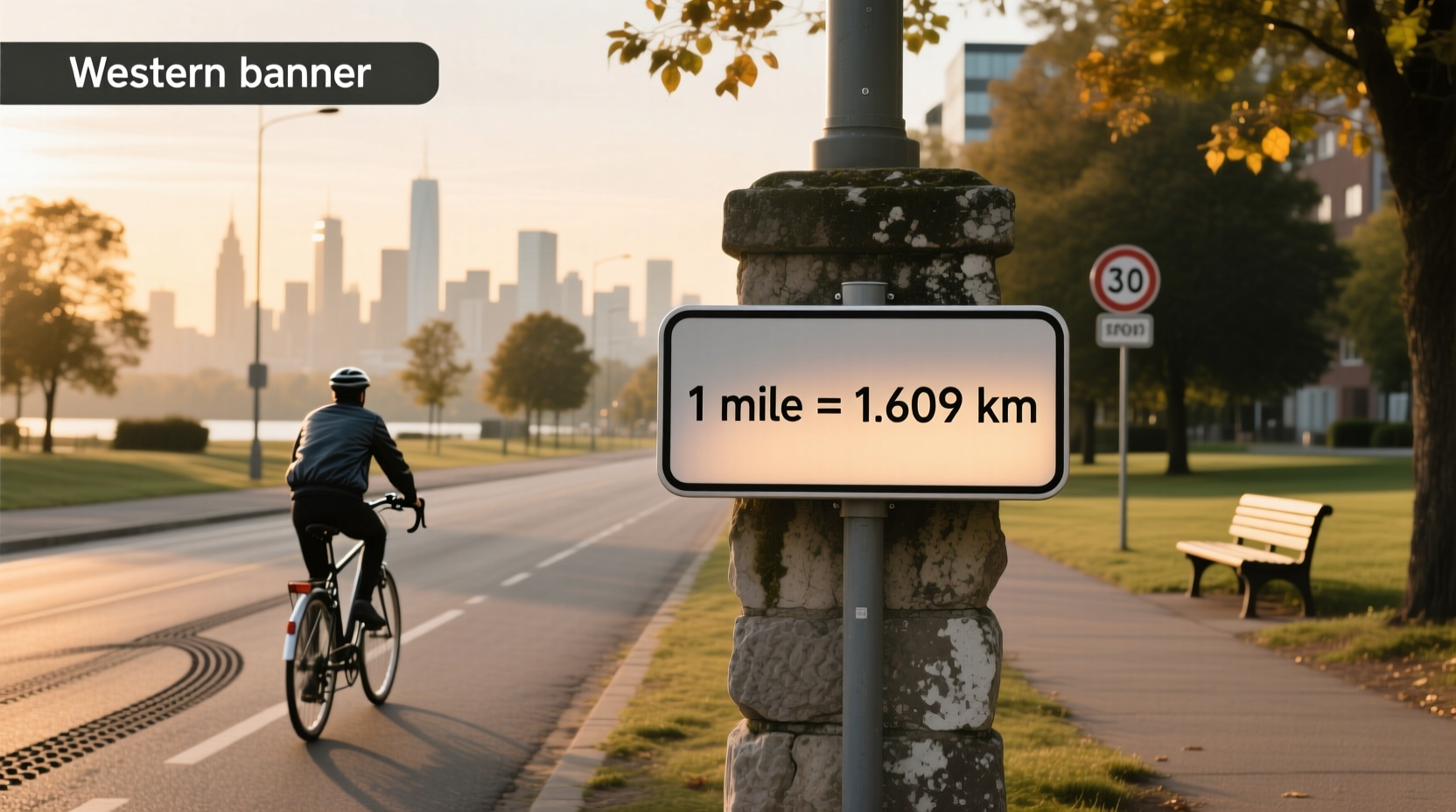
1 mile equals exactly 1.609344 kilometers — a fixed international standard used globally for distance measurement in science, athletics, transportation, and mapping. For everyday use—especially in running, cycling, or fitness tracking—a rounded value of 1.61 km per mile is both accurate enough and easy to apply1. If you’re converting race distances (e.g., a 5-mile run ≈ 8.05 km), estimating travel range (e.g., ‘my EV’s 1-mile range = ~1.6 km’), or interpreting GPS data across regions, knowing this ratio—and when approximation suffices—is essential. This guide delivers the definitive conversion, explains why confusion arises (especially around speed units like km/h), debunks frequent misconceptions, and gives you practical, field-tested methods to convert miles to kilometers instantly—no calculator required.
Why the Exact Conversion Matters: Standardization Across Systems
The mile and kilometer originate from distinct measurement traditions. The international mile, standardized in 1959 by the U.S., UK, Canada, Australia, New Zealand, and South Africa, is defined as exactly 1,609.344 meters2. The kilometer, part of the metric system adopted globally since the late 18th century, is defined as 1,000 meters. Because both units anchor to the meter—the SI base unit of length—their relationship is mathematically fixed, not variable or regional. There is no “U.S. mile” vs. “UK mile” today; the international mile supersedes historical variants (e.g., the nautical mile = 1,852 m, or the survey mile ≈ 1,609.347 m, now deprecated). This universality means that whether you’re reading a treadmill display in Berlin, analyzing split times from the Boston Marathon, or calibrating a drone’s flight log in São Paulo, 1 mile always equals 1.609344 km—no exceptions.
Breaking Down the Numbers: Precision vs. Practicality
While the exact factor is 1.609344, real-world usage favors simplification:
- High-precision contexts (engineering schematics, aviation navigation, scientific publications): Use
× 1.609344. - Fitness & sports (running apps, race signage, training plans):
× 1.61is standard—and officially adopted by World Athletics and most timing platforms3. - Mental math & quick estimation: Multiply miles by 1.6 (or add 60%: e.g., 10 miles → 10 + 6 = 16 km).
This tiered approach balances rigor with usability. For example, converting 26.2 miles (a marathon) using each method yields:
| Method | Calculation | Result (km) | Deviation from Exact |
|---|---|---|---|
| Exact | 26.2 × 1.609344 | 42.195 km | 0 km |
| Rounded (1.61) | 26.2 × 1.61 | 42.182 km | −0.013 km (−13 m) |
| Estimate (1.6) | 26.2 × 1.6 | 41.92 km | −0.275 km (−275 m) |
As shown, even the simple 1.6 multiplier stays within 0.7% error—well under the margin of error for most consumer-grade GPS devices (±3–5 m) or human pacing judgment. That’s why elite coaches and amateur runners alike rely on 1.61 km/mile without concern.
Why People Confuse Miles-to-km With Speed Units (km/h)
A recurring source of misunderstanding—evident in search queries like “Qual o valor de 1 milha em km/h?”—is conflating distance (mile, km) with speed (miles per hour, km/h). A mile is a unit of length; km/h is a unit of velocity. You cannot convert “1 mile” into “km/h”—it’s dimensionally invalid, like asking “how many apples are in a liter?”
What can be converted is speed:
- 1 mile per hour (mph) = 1.609344 km/h
- So, 60 mph = 60 × 1.609344 ≈ 96.56 km/h
The number 3.6 often appears in physics contexts because it converts meters per second (m/s) to km/h:
1 m/s = 3.6 km/h (since 1 m/s × 3600 s/h ÷ 1000 m/km = 3.6).
This has no direct relation to miles-to-kilometers conversion—but confusion arises when users see “3.6” alongside “km/h” and mistakenly link it to mile conversions. Clarifying unit dimensions prevents calculation errors in training logs, vehicle speedometer interpretation, or treadmill settings.
Running & Fitness: Where This Conversion Is Used Daily
For runners, cyclists, and triathletes, mile-to-km fluency isn’t academic—it’s operational:
- Race planning: A “5K” is 5 km ≈ 3.11 miles—not 3 miles. Misreading this leads to pacing errors (e.g., aiming for 6:00/mile pace but actually needing ~9:40/km).
- Treadmill displays: Many U.S. machines default to mph and miles; European models show km/h and km. Switching modes requires accurate conversion—not just for speed, but for programmed distance goals.
- GPS watch calibration: Devices like Garmin or Polar let users choose distance units. If your watch shows “1.00 mi” but your training plan says “1.6 km,” they match only if the conversion is applied consistently.
- VO₂ max & performance metrics: Platforms like Strava or TrainingPeaks calculate efficiency (e.g., pace per km vs. per mile). Using inconsistent units skews trend analysis over time.
Pro tip: When comparing splits, always verify the unit label—many apps auto-detect region but allow manual override. A displayed “5:30” means nothing without knowing if it’s per mile or per kilometer.
Common Pitfalls & How to Avoid Them
Based on frequent user questions and observed errors, here are top missteps—and how to sidestep them:
❌ Mistake #1: Using “1 mile = 1.6 km” for precision-critical tasks
When it’s risky: Calculating fuel economy (mpg → L/100km), land surveying, or medical gait analysis.
Solution: Use 1.609344—or better, rely on built-in unit converters in software (e.g., Excel’s CONVERT() function, Python’s astropy.units, or dedicated engineering calculators).
❌ Mistake #2: Assuming “1 mile run = 1.6 km run” implies identical physiological demand
Distance is distance—but terrain, surface, and elevation change impact effort more than unit choice. A flat 1.6 km road run ≠ a hilly 1-mile trail run. Don’t equate numbers without context.
❌ Mistake #3: Confusing nautical miles or U.S. survey miles
Nautical miles (1,852 m) are used in aviation/maritime navigation—not road running or daily life. The U.S. survey mile (1,609.347219 m) was retired in 2023 by the National Geodetic Survey. Unless working with legacy geospatial datasets pre-2023, you only need the international mile.
Quick Mental Conversion Techniques (No Phone Needed)
Three reliable, field-tested methods—ranked by accuracy and ease:
✅ Method 1: The “Add Half + 10%” Rule (99.8% accurate)
Step 1: Take miles × 1.5 = base
Step 2: Add 10% of original miles
Example: 7 miles → 7 × 1.5 = 10.5; 10% of 7 = 0.7 → 10.5 + 0.7 = 11.2 km (exact = 11.265 km; error = −0.065 km)
✅ Method 2: Fibonacci Sequence Approximation
Use adjacent Fibonacci numbers: 5 miles ≈ 8 km, 8 miles ≈ 13 km, 13 miles ≈ 21 km. Works because the ratio of successive Fibonacci numbers approaches 1.618—very close to 1.609. Best for whole-number distances up to ~55 miles.
✅ Method 3: Doubling + Halving (for 1–10 miles)
Memorize: 1 mi = 1.6 km, 2 mi = 3.2 km, 5 mi = 8.0 km, 10 mi = 16.1 km. Then interpolate: 7 mi = 5 mi + 2 mi = 8.0 + 3.2 = 11.2 km.
Regional Context: Where Mile and Kilometer Usage Differs
Although the conversion factor is universal, adoption varies:
- United States, Myanmar, Liberia: Miles remain primary for road signs, speed limits, and everyday distance talk. Kilometers appear mainly in scientific, athletic, or imported device contexts.
- Most of Europe, Canada, Australia, Japan, Brazil: Kilometers dominate road signage, weather reports, and media. Miles appear only in niche contexts (e.g., some running communities referencing historic races like the “four-minute mile”).
- United Kingdom: Hybrid usage. Road signs are in miles, but weather forecasts, nutrition labels, and most digital services use km. Dual labeling (e.g., “5 miles (8 km)”) is common in tourism materials.
This affects user experience: A U.S. runner importing a German training app may see “10 km” and instinctively think “6 miles”—but the app expects input in km. Always check unit preferences in settings.
Verifying Your Conversion: 3 Reliable Cross-Checks
Don’t trust a single source. Validate with these independent methods:
- Official NIST Publication SP 811: Lists “1 mile = 1609.344 m” definitively2.
- World Athletics Technical Rules: Specifies marathon distance as “42.195 km”, derived from 26 miles 385 yards = 26.21875 miles × 1.609344 = 42.195 km3.
- Online unit converters backed by ISO 80000-3: Such as the NIST Unit Converter (unit.nist.gov) or the BIPM SI Brochure (bipm.org/en/publications/si-brochure).
If two of these agree—and your calculator matches—you’ve confirmed correctness.
Frequently Asked Questions (FAQ)
Q1: Is 1 mile exactly 1.6 km?
No. 1 mile is exactly 1.609344 km. Rounding to 1.6 km introduces a 0.58% error—acceptable for casual use (e.g., estimating walking distance), but insufficient for technical applications like surveying or regulatory compliance.
Q2: Why do running apps sometimes show 1 mile = 1.609 km instead of 1.61 km?
It’s a precision choice. 1.609 km retains three decimal places, aligning with typical GPS positional accuracy (~3–5 m). 1.61 km is more readable for displays with limited space (e.g., smartwatches), and the difference (0.001 km = 1 meter) is negligible at race scale.
Q3: Can I convert km/h to mph using the same factor?
Yes—use the inverse: 1 km/h = 0.621371 mph. So to convert km/h to mph, multiply by 0.6214 (or divide by 1.609344). Example: 100 km/h ÷ 1.609344 ≈ 62.14 mph.
Q4: Does altitude or temperature affect the mile-to-km conversion?
No. Distance units are defined in terms of the meter, which is based on the speed of light in vacuum—a fundamental constant unaffected by environmental conditions. Altitude or temperature may affect measurement tools (e.g., tape stretch, GPS drift), but not the conversion ratio itself.
Q5: What’s the easiest way to remember the conversion?
Remember “five miles is eight kilometers.” It’s simple, memorable, and only 0.1% off (exact = 8.04672 km). From there, scale linearly: 10 miles = 16 km, 15 miles = 24 km, etc.
