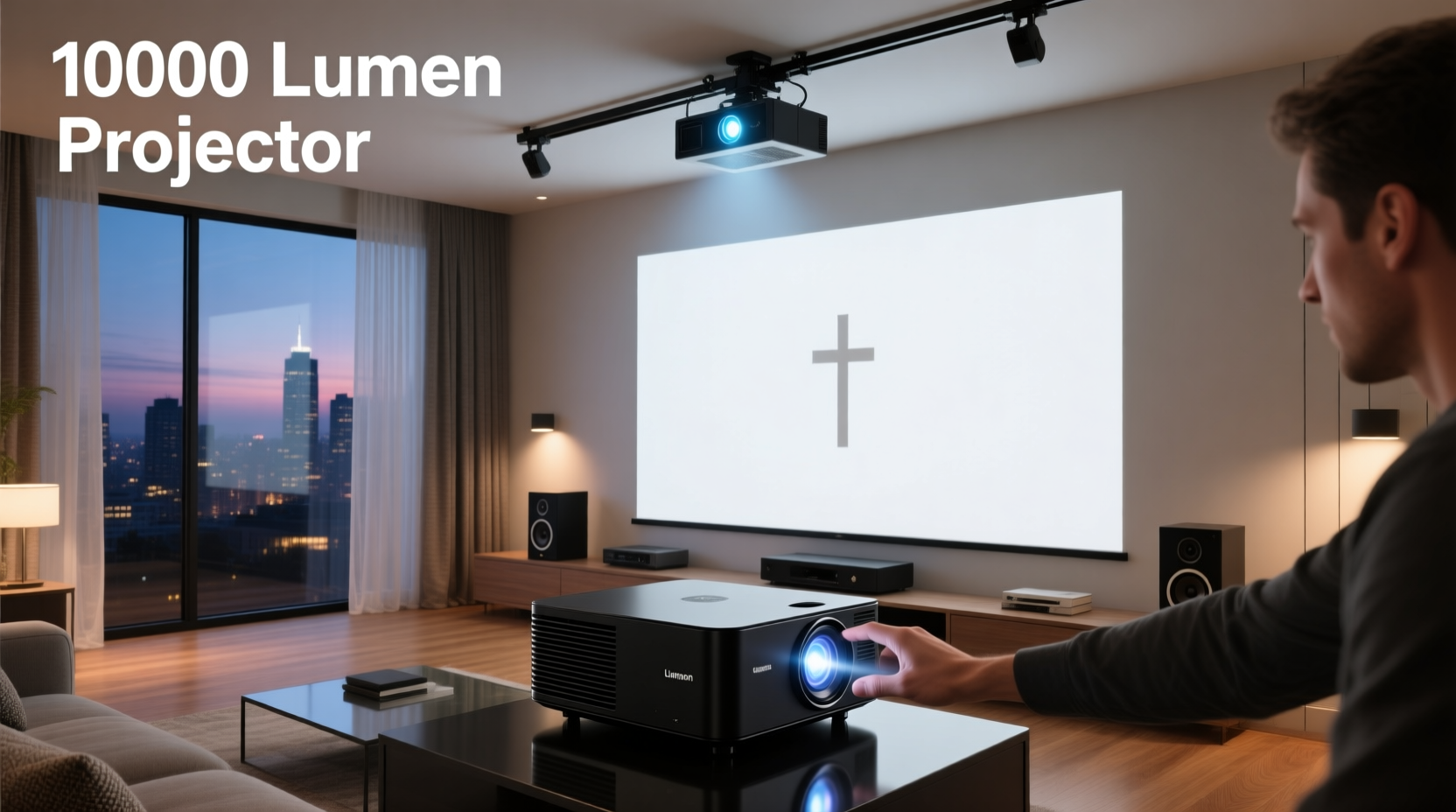
You likely don’t need a 10,000 lumen projector unless you’re projecting in a brightly lit commercial space, an open-air venue larger than 1,500 sq ft, or a permanent installation with uncontrolled ambient light — such as a corporate atrium, university lecture hall, or stadium-side event screen. This brightness level (measured in ANSI lumens) is not about 'more detail' or 'better contrast' — it’s about maintaining visible image integrity when competing with daylight, overhead fluorescents, or architectural lighting. For reference: most high-end home theater projectors range from 1,500–3,500 ANSI lumens; portable smart projectors rarely exceed 1,200. A true 10,000 lumen unit is industrial-grade equipment — physically larger, louder, more power-hungry, and significantly more expensive than consumer models claiming inflated 'LED lumens' or 'lamp lumens' without ANSI certification 1. Understanding this distinction prevents costly misalignment between expectation and real-world performance.
Why 10,000 Lumens Isn’t a ‘Better’ Number — It’s a Functional Threshold
Lumen ratings are often misunderstood as linear indicators of quality. In reality, 10,000 ANSI lumens represents a functional inflection point — not a marketing upgrade. Below 3,000 lumens, projection requires near-total ambient light control. Between 3,000–6,000, you gain flexibility for shaded patios or conference rooms with dimmed lights. At 7,000–9,000, you can sustain legible images under moderate indoor lighting (e.g., retail showrooms). Only at 10,000+ ANSI lumens does the projector reliably overcome direct sunlight exposure on reflective surfaces — like white vinyl screens outdoors at dusk, or glass-walled lobbies with noon sun penetration 2.
This isn’t theoretical: ANSI lumens are measured under strict IEC 61947-2 conditions — using a calibrated light meter across nine grid points on a fixed white screen in a dark room. No manufacturer can legally claim ANSI lumens without third-party verification. Yet many budget listings — especially on global marketplaces — advertise '10,000 LM', '10,000 LED Lumens', or '10,000 Max Lumens' without specifying measurement methodology. These figures may be up to 3–5× higher than their true ANSI-equivalent output 3. Always verify whether the spec sheet references ANSI lumens, not generic 'lumens' or 'LED lumens'.
Who Actually Uses 10,000 Lumen Projectors? Real-World Deployment Scenarios
Understanding application context is critical — because misuse leads to wasted investment, noise complaints, thermal stress, and poor image fidelity. Below are verified deployment categories where 10,000 ANSI lumens is functionally necessary:
- Large-Venue Fixed Installations: Auditoriums, convention centers, and performing arts spaces with screen widths exceeding 20 feet (6+ meters) and ambient light sources that cannot be fully blacked out — e.g., skylights, emergency exit signage, or HVAC lighting. Projectors like the Epson EB-PQ2010W or BenQ LU9915 are engineered for continuous 8–12 hour daily operation in these environments 4.
- Outdoor Daylight Events: Pop-up cinemas, festival stages, or sports bar façade projections where image must remain viewable from 100+ feet under partial cloud cover or late-afternoon sun. Note: Even 10,000 lumens won’t deliver usable contrast in full midday sun on non-optimized surfaces — screen gain, material reflectivity, and viewing angle matter more than raw brightness alone 5.
- Corporate & Education Environments: Multi-story lobbies, open-plan training facilities, or hybrid classrooms where windows cannot be covered and lighting must remain active for safety or regulatory compliance. Here, brightness compensates for lack of environmental control — not for resolution or color fidelity.
- Simulation & Visualization: Flight simulators, architectural walkthroughs, or medical imaging labs requiring edge-blended multi-projector arrays. Uniform luminance across multiple units is mandatory — and individual units must output ≥10,000 ANSI lumens to maintain consistent brightness after optical losses from lenses, filters, and overlapping geometry.
Key Technical Requirements Beyond Brightness
A 10,000 lumen rating tells only part of the story. To operate effectively in demanding environments, the projector must also meet several supporting engineering thresholds:
6| Feature | Minimum Requirement for 10,000-Lumen Use Cases | Why It Matters |
|---|---|---|
| Laser Light Source | 20,000+ hour rated lifetime; sealed optical path | Lamp-based projectors at this brightness generate excessive heat, require frequent $800+ lamp replacements every 1,000–2,000 hours, and suffer rapid lumen decay. Laser illumination maintains >80% brightness at 20,000 hours and enables instant on/off .|
| Cooling System | Dual-stage fans + heat-pipe thermal management | Sustained 10,000-lumen output generates >400W of thermal load. Inadequate cooling causes automatic brightness throttling, color shift, or premature failure. Look for acoustic ratings ≤42 dB(A) at 1m — quieter than typical office HVAC.|
| Contrast Ratio | ≥1,000,000:1 dynamic or ≥5,000:1 native | High brightness without contrast yields flat, washed-out images. True large-venue units pair high lumen output with dynamic iris, frame interpolation, and HDR tone mapping to preserve shadow detail and highlight separation.|
| Lens Flexibility | Interchangeable zoom/focus lenses (0.75–3.0x zoom ratio) | Fixed-lens units limit throw distance options. Professional installs require lens compatibility for ceiling-mount alignment, lens shift (±40% vertical/horizontal), and edge blending calibration.|
| Network & Control | RS-232, LAN, Crestron/AMX drivers, SNMP monitoring | Not optional for integrators. Enables remote firmware updates, usage logging, temperature alerts, and centralized scheduling — critical for unattended operation across campuses or venues.
Common Misconceptions — And Why They Cost Buyers Thousands
Several persistent myths drive mismatched purchases. Let’s clarify them with evidence-based reasoning:
❌ 'More Lumens = Better Picture Quality'
No. Lumen output correlates only with perceived brightness under ambient light — not resolution, color gamut, motion handling, or black level. A 10,000 lumen projector with poor native contrast (e.g., <1,000:1) will look dimmer and less immersive than a 2,500 lumen projector with 1,000,000:1 contrast in a dark room. Image quality is multidimensional — brightness is just one variable 7.
❌ 'I Can Use It Indoors Like a Home Theater Projector'
Technically yes — but practically unwise. Most 10,000 lumen units produce 45–48 dB fan noise — comparable to a refrigerator running continuously. Their minimum focus distance exceeds 3 meters, making them incompatible with standard living room layouts (<4m throw). They also lack consumer features like auto keystone correction, Android TV, or HDMI CEC — instead prioritizing RS-232 control and 24/7 reliability.
❌ 'All “10,000 Lumen” Listings Are Equal'
They are not. As shown in marketplace data, units priced below $2,500 USD claiming 10,000 lumens almost certainly report non-ANSI values — often LED or ‘peak’ lumens inflated by short-duration pulse testing. Verified ANSI-compliant models start at ~$12,000 USD (e.g., Epson EB-Z10000U) and scale to $75,000+ for cinema-grade laser phosphor units 8. Price remains the strongest proxy for legitimacy — when combined with published test reports.
How to Verify a True 10,000 ANSI Lumen Rating
Don’t rely on spec sheets alone. Follow this three-step verification protocol before procurement:
- Check for ANSI IT7.228 Compliance Statement: Legitimate manufacturers explicitly state compliance with ANSI/ISO 21118 or IEC 61947-2 standards. If absent, assume non-ANSI measurement.
- Review Third-Party Test Reports: Reputable brands publish lab reports from independent facilities (e.g., UL, Intertek, or InfoComm-certified labs). These include full spectral analysis, uniformity maps, and thermal stability graphs — not just a single-number summary.
- Request On-Site Photometric Validation: For enterprise deployments, contractually require photometric verification using a calibrated Konica Minolta CS-2000 or similar spectroradiometer — measured at the intended screen location under actual ambient conditions.
Without this validation, you risk purchasing a projector that delivers only 5,000–7,000 usable ANSI lumens after optical losses, lens attenuation, and thermal derating — resulting in unacceptable image washout during peak usage hours.
Rental vs. Purchase: When It Makes Financial Sense
For occasional use — such as annual festivals, trade shows, or temporary corporate rollouts — rental is almost always more economical. Daily rental rates for verified 10,000 lumen laser projectors range from $350–$800 USD, including delivery, setup, and technical support. Compare that to a $15,000+ purchase price, plus $2,200/year in maintenance contracts, $400/year in filter replacements, and depreciation exceeding 40% over 3 years. Rental eliminates obsolescence risk, avoids capital expenditure approval delays, and transfers liability for downtime to the vendor 9.
Purchase becomes viable only when usage exceeds ~60 days/year, integration into permanent infrastructure is required (e.g., embedded control systems), or proprietary content protection mandates on-site hardware ownership.
Frequently Asked Questions
Q: Is 10,000 lumens good for a backyard movie night?
A: No — it’s excessive and counterproductive. Ambient light control is more effective and cheaper. A 3,000–4,500 lumen projector with a high-gain screen achieves superior contrast and lower noise in residential settings.
Q: Can a 10,000 lumen projector run 24/7?
A: Yes — but only laser-based models with enterprise thermal design and redundant cooling. Lamp-based equivalents will fail within weeks under continuous duty.
Q: Do I need special mounting or ventilation?
A: Absolutely. Minimum 12-inch rear clearance, dedicated 20A circuit, and ambient air intake/exhaust paths are mandatory. Ceiling mounts require structural engineering sign-off due to weight (often 25–40 kg).
Q: Is 20,000 lumens twice as bright as 10,000?
A: Not perceptually. Human vision responds logarithmically: 20,000 lumens appears ~1.3× brighter than 10,000 — not 2×. Doubling lumens yields diminishing perceptual returns without proportional gains in contrast or resolution.
Q: What’s the difference between ANSI lumens and ‘LED lumens’?
A: ANSI lumens follow standardized measurement protocols. ‘LED lumens’ are unregulated marketing terms — often derived from single-point measurements at peak pulse, ignoring color wheel losses, thermal decay, and screen uniformity. ANSI values are typically 30–50% lower than equivalent LED lumen claims.
