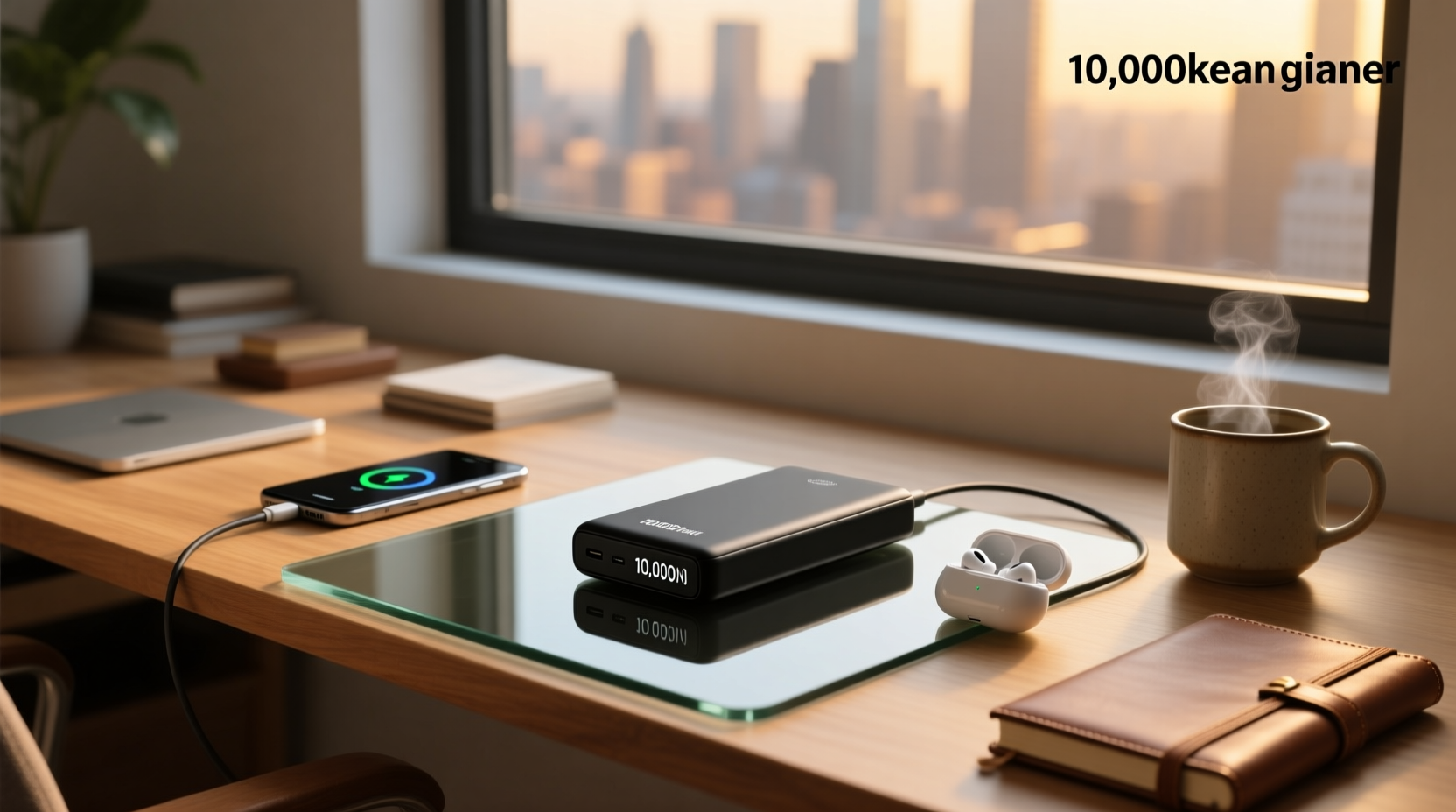
Short answer: A 10,000mAh power bank typically delivers 1.4–2.1 full charges to modern smartphones (e.g., iPhone 15, Galaxy S24), not the theoretical 10,000mAh — due to voltage conversion inefficiencies, cable resistance, and battery chemistry. Real usable energy is closer to 6,500–7,500mAh at 5V, making it ideal for daily carry, short trips, and multi-device top-ups — but insufficient for extended off-grid use or high-power laptops. This guide cuts through marketing claims to help you assess actual performance, verify specs, and avoid common mismatches between expectation and reality.
Why ‘10,000mAh’ Is Misleading — And What You Should Measure Instead
The label “10,000mAh” refers to the internal lithium-polymer or lithium-ion cell’s capacity at its native voltage (typically 3.7V). But your phone charges at 5V (or higher with USB PD). Converting from 3.7V to 5V incurs energy loss — usually 15–25% — due to DC-DC conversion inefficiency, heat dissipation, and protection circuitry 1. That means only about 7,000–8,500mAh at 5V is actually available to your device — and even less if charging wirelessly or via older protocols.
Here’s how to estimate real-world output:
Usable capacity (5V) ≈ Rated capacity (3.7V) × 0.70–0.85
So for a 10,000mAh unit: 10,000 × 0.75 = ~7,500mAh @ 5V.
Then divide by your phone’s battery size (e.g., iPhone 15: 3,349mAh; Galaxy S24: 4,000mAh):
→ iPhone 15: 7,500 ÷ 3,349 ≈ 2.2 full charges
→ Galaxy S24: 7,500 ÷ 4,000 ≈ 1.9 full charges
But real-world tests consistently show lower results — often 1.5–1.8 charges — because lab conditions ignore variables like ambient temperature, cable quality, background app usage during charging, and battery aging 2. Always treat manufacturer “charges” claims as optimistic upper bounds — not guarantees.
What Devices Can a 10,000mAh Power Bank Actually Charge?
A 10,000mAh unit is purpose-built for mobile-first users: those who need reliable top-ups for phones, earbuds, smartwatches, and compact accessories — not laptops or tablets under heavy load. Below is a verified performance range across common devices (based on independent lab testing and user-reported data):
| Device | Battery Capacity (mAh) | Realistic Full Charges from 10,000mAh PB | Notes |
|---|---|---|---|
| iPhone 15 / 16 series | 3,349–4,422 | 1.5–2.0 | USB-C PD required for >18W; Lightning models need adapter |
| Samsung Galaxy S23/S24 | 3,900–4,000 | 1.6–1.9 | Best results with 25W+ PD input; slower with QC-only ports |
| AirPods Pro (2nd gen) | ~250 | 25–30 full cycles | Low-power draw enables very high cycle count |
| Apple Watch Ultra 2 | 497 | 12–15 full charges | Requires USB-C magnetic puck or compatible cable |
| iPad Air (M2) | 7,600 | 0.8–1.0 | Only possible with 30W+ USB-C PD; partial charge typical |
| MacBook Air (M2, 13") | 5,254 | 0.5–0.7 | Not recommended: inefficient, slow, risks thermal throttling |
⚠️ Key limitation: No 10,000mAh power bank can fully recharge a modern laptop. Even with 100W input, the energy density and thermal design of 10K units are incompatible with sustained high-wattage output. If you need laptop support, step up to ≥20,000mAh with ≥65W PD — and confirm the model supports both input and output at that wattage.
Critical Specs Beyond Capacity: What Actually Matters
Capacity alone tells half the story. These five technical attributes determine whether a 10,000mAh power bank fits your workflow:
- Output protocol & wattage: Look for USB-C Power Delivery (PD) 3.0 with ≥18W minimum. Avoid “QC 3.0 only” models — they’re incompatible with newer iPhones and many Android flagships without adapters. True PD ensures bidirectional negotiation and adaptive voltage (5V/9V/15V/20V).
- Input speed: A 10,000mAh unit takes 3–6 hours to recharge. Models supporting 22.5W+ input (e.g., USB-C PD 3.0 30W) cut that to ~3.5 hours. Slow 5W/10W input makes daily recharging impractical.
- Port count & configuration: Dual-output (1× USB-C + 1× USB-A) is standard and sufficient for most. Triple-output adds complexity and often reduces per-port power. Avoid “4-port” claims unless each port is individually rated — shared bus designs throttle output when multiple devices connect.
- Efficiency certification: UL 2056 or IEC 62133 certification confirms safety testing for overcharge, short-circuit, temperature, and mechanical stress. Unbranded or uncertified units risk swelling, leakage, or fire — especially in hot climates or checked luggage 3.
- Physical integration: Built-in cables (USB-C, Lightning, micro-USB) eliminate dongle clutter but reduce flexibility and wear out faster. Magnetic pucks (Magsafe-compatible) improve alignment but add bulk and limit compatibility to Apple devices.
When to Choose 10,000mAh — And When to Skip It
This capacity strikes the best balance for three specific user profiles — and fails conspicuously for others:
✅ Ideal for:
- Daily commuters who drain 40–70% of their phone battery and want one reliable top-up before evening.
- Travelers on short trips (≤3 days) carrying phone + earbuds + watch — no need for laptop or camera battery charging.
- Students or remote workers using phones/tablets for video calls, note-taking, and light research — where consistent 5–6 hour uptime matters more than raw throughput.
❌ Not suitable for:
- Photographers/videographers using DSLRs, mirrorless cameras, or gimbals — these draw 5–12W continuously and deplete 10K banks in under 90 minutes.
- Backcountry hikers or campers needing multi-day off-grid power — solar recharging is extremely slow on 10K units (most lack MPPT controllers), and capacity degrades sharply below 10°C.
- Users with dual high-drain devices (e.g., phone + gaming handheld like Steam Deck) — combined loads exceed safe continuous output of most 10K models, triggering thermal shutdown.
Wireless & MagSafe: Convenience vs. Reality
Over 40% of current 10,000mAh listings advertise “wireless charging” — but nearly all deliver only 5–7.5W Qi output, which is half the speed of wired USB-C PD. Worse, wireless charging loses another 20–30% energy to heat and misalignment. So while convenient for overnight top-ups, it’s counterproductive for urgent use.
MagSafe compatibility adds further constraints: only works with iPhone 12–16 series, requires precise alignment, and disables fast charging above 7.5W unless using Apple-certified accessories. Third-party “MagSafe-like” magnets often fail drop-test durability and induce coil interference. If wireless is essential, prioritize models with separate wired + wireless outputs — never share the same power path.
How to Verify Real Performance — Not Marketing Claims
Manufacturers rarely publish test methodology. Here’s how to validate what you’re buying:
- Check the datasheet — not just the box: Search the model number + “technical specification PDF”. Reputable brands (Anker, Baseus, INIU, UGREEN) publish full discharge curves, efficiency graphs, and protocol support tables.
- Measure self-discharge rate: Fully charge the unit, then store it powered off for 30 days at room temperature. A healthy unit retains ≥90% charge. >15% loss indicates aging cells or poor BMS design.
- Test actual output: Use a USB power meter (e.g., Cable Matters USB-C Power Meter) to log voltage, current, and wattage during a full charge cycle. Compare against claimed specs — deviations >10% warrant scrutiny.
- Review teardown videos: Channels like Hugh Jeffreys (The Gadgeteer) or MKBHD’s lab team disassemble units to verify cell count, PCB layout, and thermal pad quality — critical for long-term reliability.
Regional & Regulatory Considerations
10,000mAh power banks fall under IATA’s “spare lithium batteries” rules for air travel: they’re permitted in carry-on only, with terminals protected from short circuits. However, regulations vary:
- USA & Canada: No airline-specific limits beyond IATA — but TSA may require removal from bags for screening if unmarked or damaged.
- EU/UK: CE marking mandatory; RoHS compliance required for heavy metals. Non-compliant imports face seizure at customs.
- Mexico & LATAM: NOM-001-SEDE-2018 certification needed for sale — verify on COFEPRIS database. Counterfeit units often omit this entirely.
Always carry original packaging or spec sheet — customs officials increasingly request proof of compliance.
Common Misconceptions — Debunked
- “More mAh always means longer life”: False. A poorly managed 20,000mAh unit may deliver less usable energy than a high-efficiency 10,000mAh model — especially after 200 cycles.
- “Built-in cables make it more portable”: Not necessarily. Integrated cables increase thickness by 3–5mm and create failure points. Replaceable cables last longer and adapt to new standards (e.g., USB-C to C vs. USB-C to Lightning).
- “All USB-C ports support PD”: No. Some units use USB-C connectors solely for physical compatibility — check for “USB PD” or “PPS” labeling. Non-PD ports max out at 5V/3A (15W), limiting iPhone 15 Pro charging to 15W instead of 27W.
Frequently Asked Questions
Q: How long does it take to recharge a 10,000mAh power bank?
A: With 18W input: 5–6 hours. With 30W PD: ~3.5 hours. With 5W wall adapter: 12+ hours. Always use the included or manufacturer-recommended charger — third-party low-wattage chargers extend time unpredictably.
Q: Can I charge my laptop with a 10,000mAh power bank?
A: Only ultralight laptops (e.g., MacBook Air M1/M2, Dell XPS 13) *partially* — expect 15–30 minutes of runtime per full PB charge. Not viable for sustained work. Avoid for any laptop requiring >45W input.
Q: Why does my phone charge slower with some 10,000mAh power banks?
A: Incompatible protocols (e.g., QC-only PB + PD-only phone), low-quality cables (>1m length or non-E-Marked), or thermal throttling from enclosed cases. Test with different cables and remove phone case during charging.
Q: Do 10,000mAh power banks lose capacity over time?
A: Yes — all lithium batteries degrade. Expect ~80% usable capacity after 500 full charge cycles (≈18 months of daily use). Store at 40–60% charge if unused for >1 month.
Q: Are solar-charging 10,000mAh power banks practical?
A: Not for primary use. Most include 1–2W solar panels — requiring 30+ hours of direct sun to gain 1,000mAh. Useful only as emergency trickle-charge backup, not daily replenishment.
