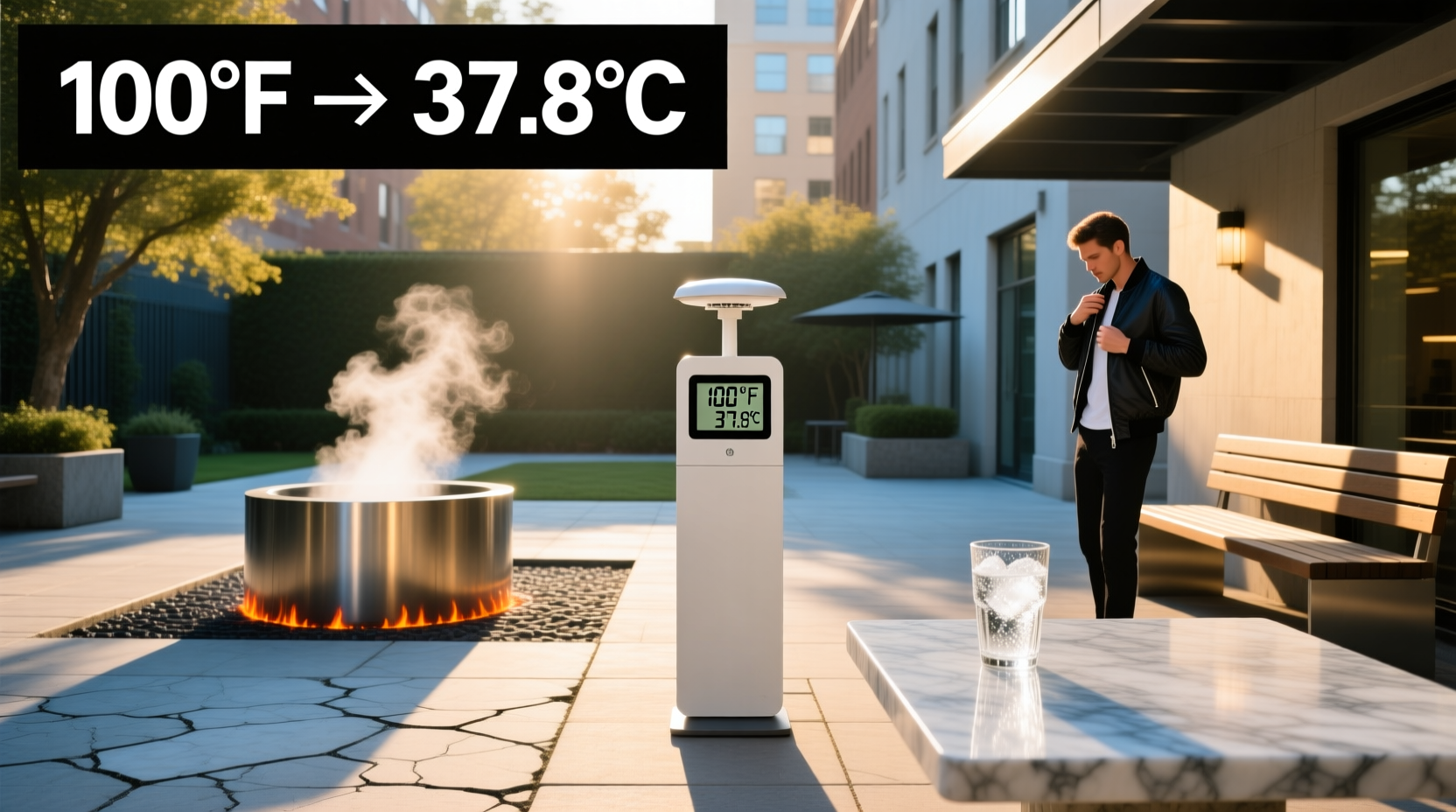
100 degrees Fahrenheit equals exactly 37.778 degrees Celsius — rounded to 37.78°C for most practical purposes1. This is not just a textbook number: it sits just above normal human core body temperature (37.0°C), aligns with intense summer heat stress thresholds, and frequently appears in HVAC calibration, medical device specifications, and environmental safety guidelines. If you’re converting 100°F to Celsius for health monitoring, appliance operation, or scientific reporting, understanding both the math and the contextual implications prevents misinterpretation — especially when small decimal differences affect clinical decisions or thermal management. Below, we break down the conversion logic, verify its accuracy across standards, explain where and why this specific value matters, and address frequent points of confusion.
Why 100°F → 37.78°C Matters Beyond Arithmetic
Unlike arbitrary temperature conversions, 100°F occupies a uniquely consequential position on the Fahrenheit scale. It’s the lowest fever threshold used in many U.S. clinical triage protocols, the upper limit of safe ambient operating conditions for consumer-grade lithium-ion batteries, and a benchmark in thermal comfort studies. Yet users often miss these implications — searching only for the numeric result while overlooking why precision matters. For example:
- A wearable health tracker reporting “100°F” may display 37.8°C — but if its internal sensor has ±0.2°C drift, that reading could represent actual core temperatures ranging from 37.58°C to 38.0°C — crossing into clinically significant fever territory2.
- Consumer electronics rated for “operation up to 100°F” assume stable ambient air; however, surface temperatures inside a parked car can exceed 140°F (60°C) even when exterior air reads 100°F — making the 100°F specification misleading without context3.
This article bridges the gap between raw conversion and applied understanding — grounded in physics, measurement standards, and real-world usage patterns.
The Exact Conversion Formula — And Why It’s Not Approximate
The universally accepted formula to convert Fahrenheit (°F) to Celsius (°C) is:
°C = (°F − 32) × 5⁄9
Applying it to 100°F:
- 100 − 32 = 68
- 68 × 5 = 340
- 340 ÷ 9 = 37.777…
Rounded to three decimal places: 37.778°C. Rounded to two: 37.78°C. Rounded to one: 37.8°C. All are technically correct — but appropriateness depends on use case:
| Application | Recommended Precision | Rationale |
|---|---|---|
| Clinical thermometry | 0.01°C (e.g., 37.78°C) | Fever classification hinges on 0.1°C increments; CDC defines fever as ≥38.0°C rectal or ≥37.8°C oral2. |
| Weather reporting | 0.1°C (e.g., 37.8°C) | Public forecasts prioritize readability; NWS rounds to nearest 0.1°C for consistency. |
| Electronics datasheets | 0.001°C (e.g., 37.778°C) | Thermal shutdown thresholds are often defined at ±0.05°C tolerance; rounding affects compliance verification. |
| Education & homework | 2–3 decimals | Emphasizes understanding of fraction multiplication and repeating decimals (340/9 = 37.7̅). |
Crucially: no reputable scientific or metrological source uses “× 5/9” as an approximation. It derives directly from the fixed points of water — 32°F = 0°C (freezing) and 212°F = 100°C (boiling) — establishing a linear relationship with exact rational coefficients. There is no estimation involved.
Common Misconceptions — And Why They Persist
Despite its mathematical simplicity, the 100°F → °C conversion attracts recurring errors. Here’s what causes them — and how to avoid them:
❌ Misconception #1: “100°F is ‘about’ 40°C”
This overestimation (2.2°C too high) stems from conflating Fahrenheit with Celsius scaling. Since 180°F spans the same range as 100°C, each °F is only 5/9 ≈ 0.555…°C — not 1°C. A quick mental check: 98.6°F = 37°C, so 100°F must be only ~0.8°C higher — confirming 37.78°C, not 40°C.
❌ Misconception #2: “The formula is (°F − 32) ÷ 1.8 — and 1.8 is approximate”
While 1.8 equals 9/5, using “1.8” in calculators introduces floating-point rounding errors. For example: (100 − 32) ÷ 1.8 = 68 ÷ 1.8 = 37.777… — same result. But 1.8 is exactly 9/5; it is not an approximation. Using fractions avoids decimal propagation errors in repeated calculations.
❌ Misconception #3: “Room temperature is 100°F”
No — standard room temperature is 68–72°F (20–22°C). 100°F is equivalent to a hot desert day or a high-humidity heatwave. Confusing this leads to incorrect assumptions about device thermal limits or comfort settings.
Where You’ll Encounter 100°F — And What It Means Contextually
Knowing the number is only half the task. Interpreting it requires domain-specific awareness:
🌡️ Human Physiology & Health Monitoring
Oral temperature ≥100°F (37.78°C) is widely adopted as the lower bound for fever screening in outpatient settings2. However:
- Rectal readings run ~0.5°C higher than oral — so 100°F oral ≈ 38.3°C rectal.
- Temporal artery thermometers may read 0.2–0.3°C lower than core temperature.
- Environmental factors (hot drinks, exercise) cause transient oral spikes unrelated to infection.
Thus, a single 100°F reading warrants confirmation — not immediate action.
☀️ Weather & Environmental Safety
The U.S. National Weather Service issues Heat Advisories when the heat index (combined temperature + humidity) reaches 100°F4. At this point:
- Risk of heat exhaustion rises significantly for outdoor workers and elderly populations.
- Asphalt surfaces can exceed 150°F (65.5°C), posing burn risks to bare skin or pet paws.
- Relative humidity above 40% at 100°F reduces evaporative cooling efficiency by >30%.
Note: Heat index is not a direct Fahrenheit-to-Celsius conversion — it’s a calculated apparent temperature. 100°F dry-bulb air at 0% RH feels like 100°F (37.78°C); at 70% RH, it feels like 127°F (52.8°C).
🔌 Consumer Electronics Thermal Ratings
Many smartphones, laptops, and power banks list “operating temperature: 0°C to 35°C” or “up to 100°F”. But:
- “Up to 100°F” usually means ambient air temperature, not device surface temperature.
- Lithium-ion cells degrade 2–3× faster above 35°C (95°F) — so sustained operation near 37.78°C accelerates capacity loss5.
- UL/IEC safety standards require devices to shut down before internal components exceed 70°C — far above 37.78°C, but ambient limits prevent reaching that point.
Always check whether a spec refers to ambient, case, or junction temperature — mixing these up invalidates thermal assumptions.
How to Verify Your Conversion — Step-by-Step
Don’t rely solely on online converters. Validate manually and cross-check:
- Use the fraction form: (100 − 32) × 5 ÷ 9 = 68 × 5 ÷ 9 = 340 ÷ 9.
- Confirm division: 9 × 37 = 333 → remainder 7 → 7/9 = 0.777… → 37.777…
- Check against known anchors:
– 32°F = 0°C ✔
– 212°F = 100°C ✔
– 98.6°F = 37.0°C ✔ → so 100°F must be ~0.78°C higher. - Compare with NIST reference tables: The National Institute of Standards and Technology lists 100°F as 37.7778°C in its official temperature conversion database6.
If your calculator or app returns “37.8°C”, it’s correctly rounded — but if it shows “38°C”, it’s over-rounded for technical use.
Regional & Standardization Notes
While the conversion formula is universal, implementation varies:
- United States: Fahrenheit remains dominant in daily life, weather, and medical screening — but scientific publications and engineering specs increasingly use Celsius or Kelvin.
- International Standards (ISO 80000-5): Mandates Celsius for all scientific temperature reporting; Fahrenheit may be included parenthetically if audience requires it.
- Medical Devices (FDA/IEC 60601): Require dual-unit labeling (°F and °C) with Celsius as primary; tolerances must be specified in SI units.
- Calibration Labs: Use fixed-point cells (e.g., gallium melt at 29.7646°C) traceable to SI definitions — not interpolation from 32°F/212°F.
No jurisdiction disputes the arithmetic — but regulatory expectations for rounding, labeling, and uncertainty reporting differ.
When Precision Isn’t Enough — Understanding Uncertainty
Even with perfect math, real-world measurements have uncertainty. Consider:
- A digital thermometer with ±0.1°F accuracy converts to ±0.056°C uncertainty — meaning 100.0°F could represent 37.72°C to 37.83°C.
- Mercury-in-glass thermometers have ±0.1–0.2°C uncertainty due to parallax and calibration drift.
- Non-contact IR thermometers measure surface emissivity — a 5% error in emissivity setting yields ~0.5°C error at 37.78°C.
Best practice: Report converted values with appropriate significant figures. If input is “100°F” (3 sig figs), output should be “37.8°C” (3 sig figs) — not “37.778°C”.
Frequently Asked Questions (FAQ)
- Is 100°F considered a fever in adults?
Yes — oral temperature ≥100°F (37.78°C) is commonly used as a fever threshold, though clinical evaluation considers symptom duration, other vitals, and measurement method. - What is 100°F in Kelvin?
310.928 K. Convert via: K = °C + 273.15 = 37.778 + 273.15. - Does altitude affect the 100°F to °C conversion?
No — temperature unit conversion is independent of pressure or elevation. However, boiling point changes with altitude, which affects calibration references. - Can I use 100°F = 38°C for quick estimates?
Only for non-critical approximations. In health or engineering contexts, the 0.22°C difference impacts classification and safety margins. - Why do some sources say 100°F = 37.8°C while others say 37.78°C?
Difference is rounding convention: 37.777… rounded to nearest 0.1°C is 37.8°C; to nearest 0.01°C is 37.78°C. Both are correct per context.
