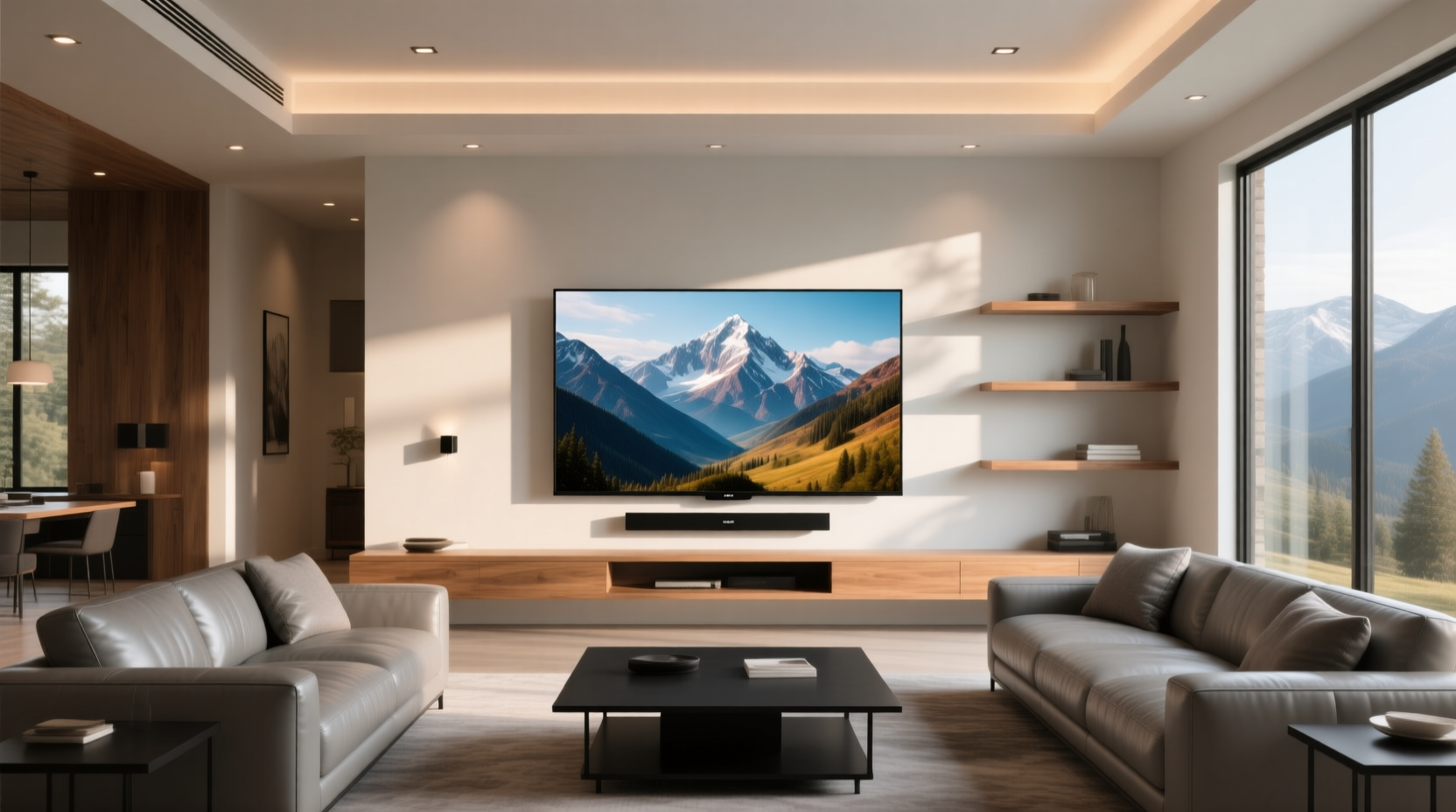
If you’re searching for a 100 inch flat screen TV, you’re likely weighing cinematic impact against practical reality—and that’s smart. As of early 2026, true 100-inch class flat-panel TVs (measured diagonally, ~87.8–90 inches wide) are widely available from Samsung, LG, Hisense, TCL, and Philips—but they’re not all equal in performance, usability, or value. The most critical insight? A 100-inch display requires at least 12–15 feet of optimal viewing distance, a structurally sound wall or dedicated stand, and careful evaluation of panel type (QLED vs. Mini-LED vs. OLED), local ambient light, and HDMI 2.1 readiness for gaming. Price ranges span $1,200–$5,000+, with the sweet spot for balanced performance falling between $1,400–$3,000. Skip the ‘largest TV’ hype—focus instead on whether your room, setup, and usage justify the scale.
Why 100 Inches Is a Threshold—Not Just a Number
A 100-inch flat screen TV sits at a functional inflection point. Below 98 inches, most living rooms accommodate standard mounts and viewing angles without major compromise. At 100 inches and above, physics and human perception shift meaningfully:
- Viewing distance minimum: For comfortable 4K resolution perception (where pixels aren’t visible), RTINGS recommends ≥12.5 ft (3.8 m) for a 100-inch screen1. Sitting closer invites eye strain; farther away diminishes immersion.
- Wall load capacity: Most 100-inch flat-panel TVs weigh 85–125 lbs (39–57 kg) without stands. VESA-compliant full-motion mounts must support ≥130 lbs and be anchored into wall studs—not drywall alone2.
- Room reflectivity: In bright rooms, even high-brightness QLEDs (1,500–2,500 nits peak) can suffer glare washout. OLEDs, while offering perfect blacks, typically max out at ~800 nits—making them less ideal for sunlit spaces unless heavily shaded3.
Panel Technology Breakdown: What Each Delivers (and Where It Falls Short)
Not all 100-inch flat screen TVs use the same underlying display tech—and confusing marketing terms like “QNED,” “Neo QLED,” or “RGB Mini-LED” obscure real differences. Here’s how core technologies compare objectively:
LED/LCD (Entry Tier)
Found in budget models like the Insignia F50 Series ($1,200), these use edge-lit or basic direct-lit backlights. Pros: lowest cost, wide availability. Cons: poor local dimming (halos around bright objects), limited contrast (<5,000:1), narrow viewing angles (~140°), and peak brightness rarely exceeds 400 nits. Best for secondary rooms or very controlled lighting—not primary home theaters.
QLED (Mainstream Standard)
Used by Samsung, Hisense, and TCL in mid-tier 100-inch models (e.g., Hisense U70, Samsung DU9000), QLED adds quantum dot enhancement to LCD panels. This improves color volume (especially red/green) and boosts brightness (up to 1,800 nits in premium units). However, it still relies on a backlight—so black levels remain grayish in dark scenes, and off-axis viewing shows noticeable color shift. Ideal for bright living rooms where HDR pop matters more than shadow detail.
Mini-LED (Performance Sweet Spot)
Now standard in top-value 100-inch TVs like the Hisense U8, LG QNED85A, and TCL QM8K, Mini-LED uses thousands of tiny LEDs behind a diffuser layer, enabling hundreds of local dimming zones. Result: deeper blacks, tighter highlights, better contrast (>1,000,000:1), and improved uniformity. Real-world trade-offs include slight blooming in high-contrast static scenes and thicker panel depth (often 2.5–3.5 inches). If you watch movies, sports, and play games in varied lighting, Mini-LED delivers the best balance today.
OLED (Premium Exception—But Not Yet at 100")
True OLED panels don’t yet scale economically to 100 inches. LG’s largest consumer OLED is 97 inches; Sony’s is 83 inches. While some retailers list “100-inch OLED” models, these are either mislabeled, prototype units, or projection-based hybrids (e.g., LG’s OLED + laser projector combos). So—if you see a “100-inch OLED flat screen TV,” verify specs: if it lists response time <0.1 ms, infinite contrast, and pixel-level dimming but lacks official LG/Sony model numbers (e.g., M3, G4, A95L), it’s likely not native OLED. Don’t pay OLED premiums for non-OLED tech.
Key Specs That Actually Matter—And Which Ones Are Overhyped
Manufacturers highlight dozens of features—but only a handful determine real-world performance for a 100-inch flat screen TV. Prioritize these:
✅ Must-Verify: Input Lag & HDMI 2.1 Support
Gamers need sub-15 ms input lag at 4K/120Hz. Not all 100-inch TVs deliver this—even high-end models may cap 120Hz at 1080p only. Confirm native 4K/120Hz with VRR and ALLM over HDMI 2.1 ports (minimum two). Hisense U6/U7 series and Samsung QN80F pass this; entry QLEDs often do not4.
✅ Must-Verify: Viewing Angle & Color Accuracy (dE <3)
At 100 inches, seating is rarely centered. Panels with wide viewing angles (≥170°) maintain color fidelity and contrast when viewed from 30° off-axis. QLEDs typically drop saturation sharply past 20°; Mini-LEDs fare better. Check professional reviews for dE (delta E) measurements: values <3 indicate imperceptible color error; >6 means noticeable shifts. LG’s webOS Mini-LED models and newer Hisense U8QG score dE <2.5 in SDR/HDR3.
⚠️ Overrated: “8K Resolution”
No mainstream 100-inch flat screen TV sold in 2026 has a native 8K panel. Even Samsung’s flagship QN90F 115-inch model is upscaled 4K. Human vision cannot resolve 8K detail beyond ~10 feet on a 100-inch screen—and no consumer streaming service (Netflix, Disney+, Apple TV+) offers native 8K content. Save money: 4K (3840×2160) remains the functional, future-proof standard.
⚠️ Overrated: “AI Upscaling” Claims
All major brands now tout “AI Vision,” “Neural Processor,” or “Deep Learning Upscaling.” These algorithms improve SD/HD upconversion—but gains are marginal beyond 4K sources. RTINGS testing shows most AI-upscaled 1080p content still reveals softness and artifacting versus native 4K5. Don’t let AI marketing inflate your budget.
Realistic Budget Planning: What You’ll Actually Pay (and Why Prices Vary)
Search results show prices from $1,199 to $5,000+—but the variance reflects tangible engineering differences, not arbitrary markup. Here’s how to map price tiers to capability:
| Price Range | Typical Panel Tech | Local Dimming Zones | Peak Brightness (HDR) | Real-World Use Case |
|---|---|---|---|---|
| $1,100–$1,500 | Basic QLED / LED | 16–64 zones | 500–800 nits | Secondary bedroom, low-light family room, casual streaming |
| $1,500–$2,500 | Mid-tier Mini-LED | 200–500 zones | 1,200–1,800 nits | Main living room, mixed lighting, gaming + movies |
| $2,500–$4,000 | High-end Mini-LED | 1,000+ zones | 2,000–2,500 nits | Dedicated theater room, bright open-plan space, competitive gaming |
| $4,000+ | Flagship Neo QLED / RGB Mini-LED | 2,000+ zones | 2,500–4,000+ nits | Commercial-grade installations, ultra-bright environments, prosumer calibration |
Note: “Refurbished” or “open-box” 100-inch TVs (e.g., Best Buy Restored U8 at $1,500) offer strong value—but verify warranty coverage (minimum 90 days), return policy, and whether backlight uniformity was tested. Avoid third-party sellers without verified refurbishment standards.
Installation Reality Check: What Retailers Won’t Tell You
Buying a 100-inch flat screen TV is only step one. Installation introduces hard constraints:
- Doorway & elevator clearance: A 100-inch TV box measures ~92″ × 42″ × 8″ (234 × 107 × 20 cm). Standard interior doors are 30–36″ wide. Measure every path—including turns, stair landings, and elevator cabs—before purchase.
- Mount compatibility: Most 100-inch TVs use VESA 600×400 or 800×400 patterns. Generic “universal” mounts rated for 100 lbs may flex under a 115-lb unit. Use mounts certified to UL 2442 (TV Mounting Systems) with ≥150 lb capacity.
- Power & signal routing: HDMI 2.1 cables longer than 10 ft require active fiber optics (e.g., Cable Matters Active Fiber HDMI). Standard copper cables fail at 4K/120Hz beyond 6 ft. Plan conduit or raceway for clean, future-proof wiring.
Common Misconceptions—Debunked
“Bigger always means better picture quality.”
False. A poorly calibrated 100-inch LED TV looks worse than a well-tuned 75-inch OLED. Scale amplifies flaws: motion blur, backlight bleed, and color inaccuracy become more obvious. Prioritize panel quality over size.
“All 100-inch TVs fit standard wall mounts.”
No. Some high-end models (e.g., Samsung QN80F) use proprietary mounting brackets. Verify VESA pattern and screw thread depth (M6 or M8) before ordering hardware.
“You need a special sound system because the TV is huge.”
Not necessarily. Many 100-inch Mini-LEDs include 60W+ speaker systems with Dolby Atmos decoding and upward-firing drivers (e.g., LG QNED85A). Test built-in audio first—add a soundbar only if dialogue clarity or bass extension falls short.
Where to Buy—and What to Avoid
Authorized retailers (Best Buy, Abt Electronics, Crutchfield) provide certified installers, extended warranties, and return windows aligned with manufacturer terms. Avoid marketplace sellers listing “100-inch flat screen TV” without clear model numbers, country of origin, or regulatory markings (FCC ID, ENERGY STAR). Counterfeit units may use recycled panels, lack firmware updates, or omit safety certifications. Always cross-check model numbers against brand websites: e.g., Hisense U70 Series should match U70H1 or U70N1 suffixes—not generic “U70.”
Frequently Asked Questions (FAQ)
- Can a 100-inch flat screen TV be mounted on drywall?
No—drywall alone cannot safely support 85–125 lbs. Mounts must be anchored into at least two wood studs (16” apart) or concrete/masonry using appropriate toggle bolts. Hire a structural inspector if unsure. - What’s the difference between “100-inch class” and exact 100-inch diagonal?
“Class” means nominal sizing; actual diagonal measurement is typically 99.5–100.3 inches. All major brands use “class” labeling per FTC guidelines—it’s not misleading, just standardized rounding. - Do I need special HDMI cables for a 100-inch 4K TV?
Yes—for 4K/120Hz, VRR, or HDR10+ signals. Use Ultra High Speed HDMI (certified to 48 Gbps) cables. Passive copper works up to 6 ft; beyond that, active fiber-optic cables are required. - Is a 100-inch TV too big for a 12x12 ft room?
Yes—if seated 8–10 ft away. Minimum recommended viewing distance is 12.5 ft. In smaller rooms, consider a 85–90 inch model or a high-quality 100-inch projector screen (which offers similar size with different trade-offs). - How long do 100-inch flat screen TVs last?
LED/QLED panels typically retain >80% brightness after 60,000 hours (≈15 years at 11 hrs/day). Backlight failure is the most common end-of-life issue—not pixel burn-in (unlike OLED). Keep brightness settings at 70–80% for longevity.
