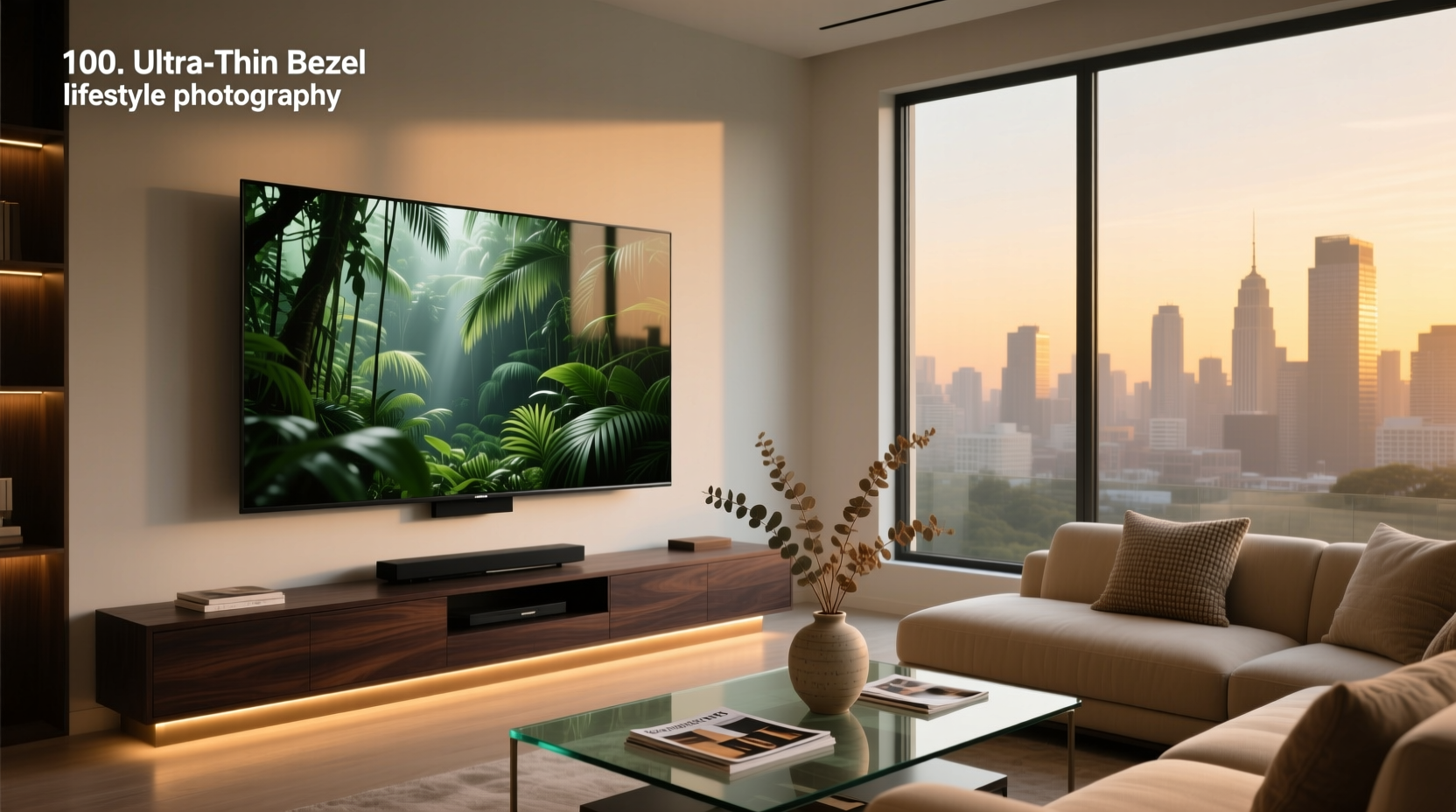
Choosing a 100 inch big screen TV means stepping into premium home theater territory—and it introduces practical considerations most shoppers evaluate carefully. As of early 2026, the best 100-inch TVs deliver true cinematic immersion with 4K resolution, Mini-LED or QLED backlighting, AI-enhanced upscaling, and robust gaming features—when matched to appropriate room dimensions, wall structure, viewing habits, and budget. This guide helps clarify: Is a 100-inch TV right for your space? Which models balance performance and value? What installation considerations support long-term satisfaction? And how do you verify specs like actual screen dimensions, weight, and HDR capability before ordering?
Why Size Alone Doesn’t Define a Good 100-Inch TV Experience
A 100-inch diagonal measurement sounds impressive—and it is—but it’s only the starting point. The physical footprint of a 100-inch TV is approximately 87.8 inches wide × 49.4 inches tall (without stand), with depth ranging from 1.2 inches (ultra-slim Neo QLED) to over 3.5 inches (some Mini-LED or laser TV variants)1. That’s nearly 7.3 feet across—more than double the width of a standard 55-inch set. If your wall is narrower than 92 inches, or your ceiling height under 8 feet, visual overflow or awkward framing becomes a factor to plan for.
Weight is equally consequential: most 100-inch models weigh between 125–165 lbs (57–75 kg), with some high-end units exceeding 180 lbs. Wall-mounting requires structural anchoring into studs—not drywall anchors. Standard TV mounts rated for 85-inch sets (<120 lbs) are insufficient and unsafe. You’ll need an UL-listed, full-motion or low-profile mount certified for ≥200 lbs, installed by a professional unless you have verified stud spacing and torque calibration tools2.
Realistic Viewing Distance & Room Suitability
Contrary to common belief, “bigger is better” doesn’t scale linearly. The Society of Motion Picture and Television Engineers (SMPTE) recommends a minimum viewing angle of 30° for immersive content. For a 100-inch 4K TV, that translates to a minimum viewing distance of 7.5–9 feet (2.3–2.7 m). Sitting closer may reveal fine pixel structure during static scenes; sitting farther reduces peripheral engagement while preserving clarity for general viewing.
More critically: ambient light control determines how consistently your investment delivers impact. A 100-inch screen reflects more ambient light than smaller panels. In rooms with large windows or uncontrolled overhead lighting, even top-tier QLED or Mini-LED TVs (peaking at 1,500–2,500 nits) benefit from thoughtful placement and light management. OLED options remain rare at this size (none widely available as of Q2 2026), so brightness and contrast trade-offs are part of the category’s technical landscape. If your room lacks blackout capability, prioritize models with anti-glare coatings, local dimming zones ≥600, and peak brightness ≥2,000 nits—not just marketing claims of “HDR10+” or “Dolby Vision”3.
Key Technical Dimensions That Actually Matter
When comparing 100-inch TVs, don’t stop at “4K” or “Smart TV.” Focus on these five measurable, verifiable criteria:
- Backlight Architecture: LED/LCD dominates this size tier. Mini-LED (e.g., LG QNED evo, Hisense U7/U8, Samsung QN80F) offers enhanced contrast vs. standard LED by dividing the backlight into hundreds of independently controlled zones. Models labeled “QLED” may vary in implementation—confirm whether they include Mini-LED or FALD (Full Array Local Dimming) for optimal black level performance.
- Input Lag & Gaming Features: Critical for console or PC gamers. Look for sub-15ms input lag at 4K/120Hz, HDMI 2.1 bandwidth (48 Gbps), VRR (Variable Refresh Rate), and ALLM (Auto Low Latency Mode). Not all 100-inch models support 120Hz native refresh—verify per model, not just “Gaming Mode” branding.
- Processor Capabilities: “AI Upscaling” varies across platforms. Samsung’s Vision AI, LG’s α11 Gen6, and Hisense’s ULED X engine differ in noise reduction, motion interpolation, and SDR-to-HDR conversion fidelity. RTINGS testing shows variance in real-world upscaling accuracy—even among same-brand 2025 models4.
- Audio Output Limitations: Built-in speakers on ultra-large TVs rarely exceed 20W total output and lack bass extension. Expect flat, directionally balanced sound. Plan for external audio—either a soundbar (≥5.1.2 channels) or full surround system—for enriched listening experiences.
- OS Ecosystem & Long-Term Support: Google TV, Roku TV, Fire OS, and Tizen all offer app access—but update frequency, voice assistant integration, and third-party app availability vary. Check manufacturer support pages for confirmed OS upgrade paths beyond 2026 (e.g., “Tizen 9.0 supported through 2028”).
Price Reality: What $1,000–$4,000 Actually Buys You
Search results show prices from $1,199 to over $5,000—but value reflects feature alignment. Below $1,500, most 100-inch TVs use mature panel generations, limited local dimming (<200 zones), and efficient processors. These are well-suited for casual streaming and everyday entertainment.
Between $1,800–$2,800 sits the current “sweet spot”: models like the Hisense QD6/QD7 series (2025), TCL QM7K, and LG QNED85A deliver 600+ local dimming zones, 144Hz native refresh, HDMI 2.1 across ≥2 ports, and verified 2,000+ nits peak brightness. Independent lab tests confirm they retain >85% of their rated brightness at 50% screen area—supporting sustained HDR highlights5.
Above $3,500, enhancements become more refined: expanded color volume (DCI-P3 coverage >95%), deeper blacks via advanced Mini-LED layering, or integrated soundbars (e.g., Samsung QN80F + Q-Series 11.1.4 system). These configurations suit dedicated theater environments or users seeking incremental refinements across multiple sensory dimensions.
Installation & Logistics: The Hidden Cost of Going Big
Delivery and setup are non-trivial. Most 100-inch TVs ship in boxes measuring ~94″ × 56″ × 8″ and weighing 150–190 lbs. Standard freight carriers (e.g., UPS/FedEx Ground) do not deliver oversized items inside dwellings. You’ll need white-glove service—including unboxing, wall-mount prep, and debris removal—which adds $150–$350. Some retailers bundle this; others charge separately post-purchase.
Doorway and stairwell clearance must be verified before ordering. A 94-inch box won’t fit through a standard 32-inch interior door—even diagonally. Measure your path from curb to final location, including turns, railings, and elevator dimensions. If access is constrained, consider a laser TV alternative: Hisense L5/L10 series project 100-inch images from a compact 20-inch unit placed 12–18 inches from the wall. Trade-offs include lower peak brightness (~1,200 nits), ambient light sensitivity, and fixed throw distance—but installation flexibility is unmatched.
Common Misconceptions—And Why They Matter
Misconception #1: “100-inch = 4K resolution is overkill.”
False. At typical living room distances (8–12 ft), the human eye resolves detail up to ~20/20 acuity—meaning 4K provides tangible sharpness improvement over 1080p on screens >75 inches. RTINGS’ side-by-side testing confirms visible texture, text clarity, and motion stability advantages at 100 inches2.
Misconception #2: “All ‘Neo QLED’ or ‘QNED’ TVs are equal.”
Not true. “Neo QLED” refers to Samsung’s quantum dot + Mini-LED architecture—but implementation differs. The 2025 QN80F uses 2,000+ dimming zones and 16-bit processing; earlier QN90B models used 1,000 zones and 12-bit. Similarly, LG’s QNED evo (2025) adds dynamic color tuning absent in base QNED models. Always verify generation year and specific model number—not just series name.
Misconception #3: “Outdoor-rated 100-inch TVs exist for residential patios.”
Technically yes—but impractical. Commercial-grade outdoor TVs (e.g., 100-inch QLED units listed at $18,699) require active cooling, IP65+ weatherproofing, and 5,000+ nits brightness. Consumer-grade “outdoor” models are rebranded indoor TVs with basic UV-resistant coatings. None survive prolonged rain, temperature swings, or dust exposure. For covered patios, a standard 100-inch TV behind glass or under deep eaves remains safer and more cost-effective.
How to Verify Claims Before You Buy
Manufacturer specs often omit critical context. Cross-check with independent sources:
- Brightness: Look for full-screen sustained brightness (not “peak 1% window”) measured in nits. RTINGS and HDTVTest publish lab results—not press releases.
- Dimming Zones: Confirm “local dimming zones” count refers to physical LEDs, not software partitions. Some brands inflate numbers using virtual zone mapping.
- Gaming Specs: Check HDMI port labeling—only ports marked “HDMI 2.1 (48G)” support 4K/120Hz with VRR. “HDMI 2.0b” ports max out at 4K/60Hz.
- Dimensions & Weight: Download the official spec sheet (PDF) from the brand site—not retailer listings, which often omit depth or shipping weight.
Frequently Asked Questions
- Can I mount a 100-inch TV on drywall alone?
No. Drywall cannot safely support 125+ lbs without stud reinforcement. Use a stud finder to locate ≥2 vertical studs spaced ≤24 inches apart, and install lag bolts directly into wood framing. - Is a 100-inch TV too big for a 12×15 ft living room?
It depends on seating distance. With primary seating 10 feet from the wall, a 100-inch TV occupies ~40° horizontal field of view—within SMPTE’s recommended 30–40° range for immersion. Ensure no furniture or fixtures obstruct the lower third of the screen. - Do any 100-inch TVs support Dolby Vision IQ?
Yes—Hisense U7/U8 (2025), LG QNED85A, and Samsung QN80F all list Dolby Vision IQ, which dynamically adjusts brightness based on ambient light sensor input. Effectiveness can be optimized with consistent room lighting conditions and proper sensor placement. - Are there 100-inch OLED TVs available?
Not commercially viable as of mid-2026. OLED manufacturing yields drop sharply above 83 inches due to substrate limitations. Sony’s 100-inch XR100X92 uses LED-backlit LCD, not OLED. True OLED at this size remains a prototype technology. - What’s the difference between ‘100-inch class’ and exact size?
“Class” indicates rounding—the actual diagonal measures 99.5–100.5 inches. Physical width/height vary slightly by bezel design. Always consult the product’s dimensional drawing, not the class label.
