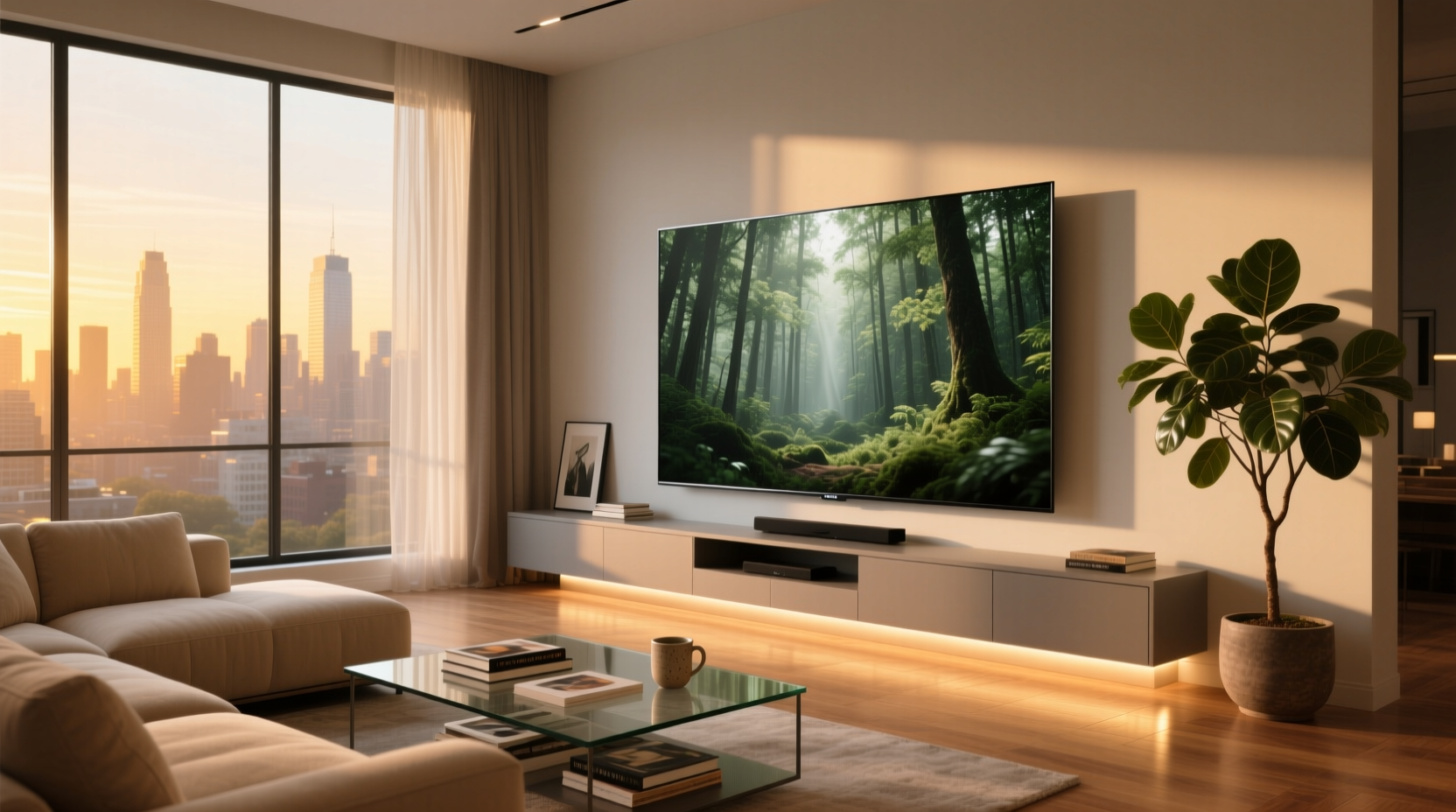
Buying a 100-inch TV isn’t just about upgrading screen size — it’s a spatial, technical, and ergonomic decision that impacts immersion, usability, and long-term satisfaction. As of early 2025, 100-inch class TVs (technically ~99.5–100.3 inches diagonal) are widely available from Hisense, Samsung, LG, TCL, and JVC, with prices ranging from $1,299 to over $10,0001. The most common configuration is 4K UHD resolution (3840 × 2160), HDR support (HDR10, Dolby Vision), and smart platforms like Google TV or Tizen. But unlike smaller sets, a 100-inch display demands deliberate planning: minimum viewing distance, wall or stand compatibility, power and HDMI 2.1 readiness, and ambient light management. This guide cuts through marketing claims to deliver actionable, measurement-backed advice — whether you’re outfitting a dedicated home theater, a high-ceiling living room, or evaluating outdoor or commercial use cases.
Why 100 Inches Is a Threshold — Not Just a Number
A 100-inch TV sits at a functional inflection point. Below 98 inches, most mainstream models use edge-lit LED or basic direct-lit backlights. At 100 inches, manufacturers shift to Mini-LED backlighting, advanced thermal management, reinforced chassis, and wider color gamut panels — all required to maintain uniformity, contrast, and brightness across such a large active area. This explains why even mid-tier 100-inch models (e.g., Hisense U70/U6 Series) often outperform premium 75–85 inch sets in local dimming precision and peak luminance2. It also means weight increases significantly: most 100-inch TVs weigh between 110–155 lbs (50–70 kg), requiring structural wall anchoring or heavy-duty floor stands — not standard TV mounts.
Key Decision Factors — Ranked by Real-World Impact
1. Viewing Distance & Room Dimensions
The Society of Motion Picture and Television Engineers (SMPTE) recommends a viewing angle of 30°–40° for cinematic immersion. For a 100-inch 16:9 screen (width ≈ 87.2 inches / 221 cm), this translates to an optimal seating range of 6.5 to 9 feet (2.0–2.7 m). Sitting closer risks visible pixel structure and motion blur; sitting farther diminishes resolution benefits and weakens presence. Crucially, many users overlook minimum depth clearance: a 100-inch TV with a 3-inch-deep panel still needs ≥12 inches (30 cm) behind it for ventilation, cable routing, and IR sensor access. In rooms under 12 ft wide or with low ceilings (<8 ft), a flat-panel 100-inch TV may dominate visual space disproportionately — making a 100-inch ultra-short-throw (UST) laser TV (e.g., Hisense L9H or L10) a viable alternative, as it projects from ~12–24 inches away and uses a separate ALR screen.
2. Panel Technology: QLED vs. Mini-LED vs. OLED vs. Laser
No consumer 100-inch OLED TV exists as of 2025. LG’s largest production OLED is 97 inches; Samsung’s QD-OLED maxes at 83 inches. Thus, all current 100-inch TVs use LCD-based architectures — primarily QLED (quantum dot-enhanced LCD), Mini-LED (with thousands of individually controllable backlight zones), or RGB Mini-LED (e.g., Hisense UX series, rated up to 8,000 nits peak brightness). Here’s how they compare:
| Technology | Typical Contrast Ratio | Peak Brightness (SDR/HDR) | Viewing Angle Stability | Response Time (GTG) | Notes |
|---|---|---|---|---|---|
| Standard QLED (e.g., Hisense U70) | ~5,000:1 | 600–800 nits | Moderate falloff beyond 30° | 8–12 ms | Cost-effective entry; good for bright rooms with limited budget |
| Mini-LED (e.g., Samsung QN80F, LG QNED85A) | ~20,000:1 | 1,200–2,000 nits | Better than QLED, but still narrower than OLED | 4–6 ms | Superior local dimming; best balance of price and performance for most users |
| RGB Mini-LED (e.g., Hisense UX100) | ~35,000:1 | 4,000–8,000 nits | Best-in-class for LCD; near-OLED consistency | 2–4 ms | Commercial-grade thermal design; ideal for sunlit spaces or retail environments |
| UST Laser TV (e.g., Hisense L9H) | ~1,500,000:1 (with ALR screen) | 2,400–5,000 ANSI lumens | Narrow (±15°) | Variable (depends on source) | Zero bezel, no wall load; requires dedicated dark/light-controlled screen placement |
Importantly, brightness matters more than resolution at 100 inches. A dim 4K image on a massive screen looks washed out in daylight; conversely, a 1,500-nit Mini-LED panel delivers punchy HDR highlights even with ambient light. If your room has uncontrolled windows or recessed lighting, prioritize peak nits over panel type.
3. Mounting, Installation & Structural Requirements
A 100-inch TV is not plug-and-play. Standard VESA patterns (e.g., 600 × 400 mm) apply, but weight distribution changes everything. Most units require VESA-compatible full-motion mounts rated for ≥165 lbs — and those mounts must be anchored into wall studs (not drywall anchors). Stud spacing in North America is typically 16 inches on-center; a 100-inch TV’s width (~87 inches) spans at least five studs. If your wall has insulation, plumbing, or electrical behind it, professional assessment is strongly advised before drilling. Floor stands are safer but occupy significant floor space: typical 100-inch TV stands are 72–84 inches wide and 24–30 inches deep. Also verify ceiling height: a 100-inch TV’s height is ~49.5 inches; add 6–12 inches for base or stand clearance — meaning minimum ceiling height should be ≥9 feet for comfortable sightlines.
4. Connectivity & Future-Proofing
All current 100-inch TVs include at minimum four HDMI ports, but only select models (Samsung QN80F, LG QNED85A, Hisense U8/U7) offer HDMI 2.1 on all inputs — essential for 4K@120Hz gaming, VRR, and eARC audio passthrough. Older HDMI 2.0 ports cap at 4K@60Hz and lack dynamic metadata support for Dolby Vision IQ. Also check USB port version: USB 3.0+ is needed for high-bitrate media playback from external drives. Wi-Fi 6 (802.11ax) is now standard, enabling stable 4K streaming without buffering — especially critical when multiple devices share the same network. Bluetooth 5.2 or higher ensures reliable audio device pairing (e.g., soundbars, headphones).
5. Smart Platform & Ecosystem Fit
Google TV dominates the 100-inch segment (Hisense, TCL, JVC), followed by Samsung’s Tizen and LG’s webOS. While interface aesthetics differ, core functionality is similar: voice search, app stores (Netflix, Prime Video, YouTube), and casting. However, platform longevity matters: Samsung and LG guarantee OS updates for 5 years; Hisense and TCL typically provide 3 years. If you rely on specific apps (e.g., Plex, Apple TV+, or niche fitness services), verify availability *before* purchase — some regional variants omit key titles. Also note: built-in assistants (Google Assistant, Alexa, Bixby) vary in accuracy and third-party device control scope. None fully replace a dedicated hub like Home Assistant for complex automations.
Common Misconceptions — What You Should Ignore
- “Bigger always means better picture” — False. A poorly calibrated 100-inch TV with inaccurate gamma, oversaturated colors, or motion interpolation artifacts degrades viewing more than a well-tuned 75-inch set. Always prioritize calibration-ready models (with CMS, 2-point/20-point white balance) if image fidelity is critical.
- “100-inch TVs need 8K content” — Unnecessary. No mainstream broadcast, streaming, or disc format delivers native 8K. Upscaling engines (Samsung’s Neural Quantum Processor, LG’s α11 AI) vary in quality — but 4K Blu-ray and streaming remain the practical ceiling. Save 8K for future-proofing only if budget allows.
- “Outdoor-rated = weatherproof” — Misleading. True outdoor TVs (e.g., Titan S100, SunBriteTV) carry IP65/IP66 ratings and operate from −24°C to 50°C. Most “outdoor-capable” 100-inch models are merely sunlight-readable (800–1,000 nits) and lack sealed electronics — they’re for covered patios only.
- “All ‘100-inch class’ TVs measure exactly 100 inches” — Not precise. “Class” refers to rounding: actual diagonals range from 99.5 to 100.3 inches. Always verify exact dimensions (W × H × D) in product specs — especially if fitting into cabinetry or custom enclosures.
Price-to-Performance Tiers (Early 2025)
Based on independent testing data from RTINGS.com and user-reported reliability trends3, here’s how 100-inch TVs break down by value:
- Budget Tier ($1,200–$1,600): Hisense U70, QD6, and U6 Series. Solid 4K HDR with decent local dimming (128–240 zones), but limited brightness (<800 nits) and average black levels. Ideal for controlled-light living rooms where cost is primary.
- Mid-Tier ($1,800–$3,200): Samsung QN80F, LG QNED85A, Hisense U7/U8. Full-array Mini-LED with 1,000+ dimming zones, 1,200–2,000 nits peak, and robust gaming features (VRR, ALLM). Best all-around choice for most households.
- Premium Tier ($3,500–$10,000+): Hisense UX100, Samsung QN100QN80F, Sony X92. RGB Mini-LED or dual-layer quantum dot stacks, 4,000+ nits, near-reference color volume, and commercial-grade thermal systems. Justified only for dedicated theaters, showrooms, or extreme ambient light conditions.
When NOT to Buy a 100-Inch Flat Panel
Consider alternatives if any of these apply:
- Your primary use is daytime sports/news in a south-facing room with uncovered windows → A 100-inch UST laser TV with an ambient light rejecting (ALR) screen delivers superior contrast and glare resistance.
- You lack wall structural integrity or ceiling height → A 98-inch model (e.g., Samsung DU9000) reduces width by ~1.8 inches and weight by 8–12 lbs — easing installation constraints.
- You plan multi-user gaming (PS5/Xbox Series X + PC) → Verify HDMI 2.1 bandwidth per port. Some 100-inch models allocate 2.1 only to HDMI 4, forcing compromises in input routing.
- You need true off-axis viewing (e.g., wide L-shaped sofa) → OLED remains unmatched here. Wait for 100-inch microLED or consider dual-projector setups.
Frequently Asked Questions
- What is the exact width and height of a 100-inch TV?
For a 16:9 aspect ratio, diagonal = 100 inches → width ≈ 87.2 inches (221.5 cm), height ≈ 49.1 inches (124.7 cm). Depth varies: LED/QLED models range from 1.2 to 3.5 inches (3–9 cm); Mini-LEDs average 2.5–3.2 inches due to thicker backlight stacks. - Can I mount a 100-inch TV on drywall without studs?
No. Drywall alone cannot safely support >50 lbs. Use a stud finder to locate and anchor into at least four wood or metal studs. If studs don’t align, install a plywood backing board secured across multiple studs first. - Do I need special HDMI cables for a 100-inch TV?
Yes — for 4K@120Hz, VRR, or Dolby Vision, use certified Ultra High Speed HDMI cables (HDMI 2.1 spec). Passive cables over 3 meters (10 ft) often fail; active optical cables are recommended for longer runs. - Is a 100-inch TV worth it over a projector?
For consistent brightness, zero setup time, and ambient light tolerance — yes. Projectors require complete light control and regular maintenance (lamp replacement, lens cleaning). A 100-inch flat panel delivers superior color accuracy, contrast, and motion handling out-of-the-box. - Which brands offer the longest warranty on 100-inch TVs?
Samsung and LG provide 1-year limited warranties covering parts/labor; extended plans (up to 5 years) are available. Hisense offers 1 year standard but includes free in-home service for major components in the first 2 years on select models sold via authorized channels.
