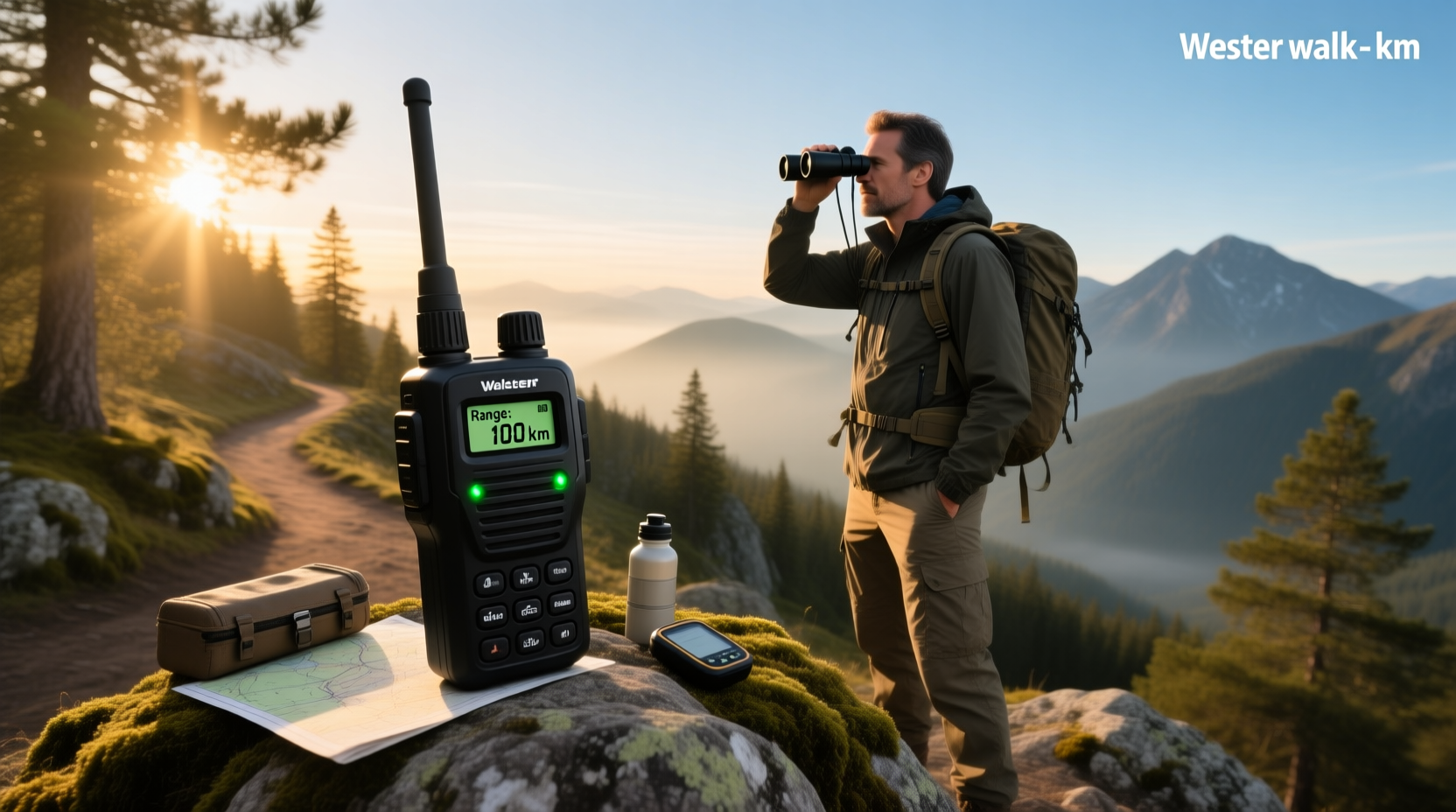
Short answer: Yes—some handheld devices advertise and can achieve effective 100 km communication range, but not via traditional two-way radio signals. Instead, they use 4G LTE / PoC (Push-to-Talk over Cellular) technology or high-power (up to 100W) licensed VHF/UHF radios with optimal antenna placement. Real-world performance depends entirely on network coverage, licensing status, terrain, and correct setup—not just marketing specs. If you’re evaluating a ‘100 km walkie talkie’ for security, logistics, off-grid coordination, or emergency response, this guide explains exactly how those distances are achieved, what trade-offs exist, and how to verify claims before deployment.
Why '100 km Range' Is Misleading—And Why It Matters
The phrase “100 km range walkie talkie” triggers immediate assumptions: direct, license-free, line-of-sight radio communication across 100 kilometers—like a supercharged version of consumer FRS/GMRS radios. But that’s physically impossible for handhelds operating under standard regulatory limits (e.g., FCC Part 95 in the U.S. or ETSI EN 300 113 in Europe). A typical 5W UHF handheld, even in ideal flat terrain with zero obstructions, rarely exceeds 5–8 km real-world range 1. So how do manufacturers claim 100 km?
The answer lies in technology convergence: modern devices labeled as ‘100 km walkie talkies’ are rarely pure radios. They’re hybrid communication terminals—often running Android OS, embedding SIM slots, GPS chips, and cellular modems. Their ‘range’ isn’t radio propagation distance; it’s network-assisted reach—functionally identical to making a voice call over mobile data. As long as both units have active cellular service (and the same PoC platform subscription), they can communicate across continents—not just 100 km.
Two Distinct Technical Pathways to 100 km+ Communication
There are two fundamentally different architectures behind advertised 100 km capability. Confusing them leads to costly misdeployments—especially in remote or infrastructure-poor areas. Let’s break them down:
✅ Pathway 1: 4G LTE / PoC Radios — Network-Dependent, Scalable, Practical
How it works: These devices (e.g., QYT Android 4G models 2, Kirisun GP700 3) operate like smartphones with push-to-talk buttons. They connect to local 4G/LTE networks, route audio via cloud-based PTT servers (e.g., Zello, TeamSpeak, or proprietary platforms), and deliver near-instant group calls across any geography with compatible cellular coverage.
Key facts:
- ✅ True 100+ km reach is possible—even globally—if both endpoints have signal and valid data/SIM service.
- ❌ No communication without cellular coverage. In dead zones (mountains, forests, deserts, underground), these devices fall silent—even with full battery.
- ⚠️ Requires ongoing data plan or platform subscription (e.g., $5–$15/month per device for Zello Enterprise or OEM cloud services).
- 🔧 Supports advanced features: GPS location sharing, text messaging, Bluetooth headset pairing, OTA firmware updates, and encrypted group channels.
✅ Pathway 2: High-Power Analog/Digital Radios — Radio-Only, License-Required, Niche Use
How it works: Devices like the KT780 Plus 4 or professional-grade base/mobile stations (not handhelds) use high RF output—up to 100W—and specialized antennas (e.g., 10 dBi Yagi or repeater-linked systems) to extend true over-the-air range. This method *does* use VHF/UHF bands—but only under strict regulatory conditions.
Key facts:
- ✅ Truly radio-based—no cellular dependency. Works during network outages or in regions with no mobile infrastructure.
- ❌ Not legal for unlicensed use in most countries. In the U.S., 100W transmission requires an FCC Part 90 license; in the EU, it falls under CEPT ERC/DEC/(99)25 and national spectrum authorities (e.g., Ofcom UK, BNetzA Germany). Unauthorized operation risks fines and interference penalties.
- ⚠️ Effective range remains highly situational: 100 km is only plausible with elevated antenna sites (e.g., hilltop repeaters), clear Fresnel zone, and minimal atmospheric absorption—not from handheld-to-handheld on flat ground.
- 🔧 Often includes analog FM + digital DMR/NXDN modes, GPS telemetry, and ruggedized enclosures (IP67/IP68 rated).
What ‘100 km’ Actually Means in Practice: Contextual Reality Checks
Marketing copy rarely clarifies context—yet real-world usability hinges on it. Below are verified operational scenarios and their realistic outcomes:
| Scenario | 4G/PoC Device Performance | 100W Licensed Radio Performance | Verification Method |
|---|---|---|---|
| Urban area with strong 4G coverage | ✅ Reliable 100+ km group comms; sub-500 ms latency | ⚠️ Limited to ~3–5 km due to building reflection/multipath; repeater needed for city-wide coverage | Test with speedtest.net + live PTT call to remote SIM-enabled unit |
| Rural highway, moderate terrain | ✅ 80–100 km if continuous LTE exists; drops at coverage gaps | ✅ 20–40 km line-of-sight (with 10W handheld + 5m mast); up to 100 km with repeater | Use coverage maps (e.g., OpenSignal, carrier-provided GIS layers) |
| Mountainous forest, no cell towers | ❌ No function—device shows ‘No Service’ | ✅ 5–15 km depending on elevation, antenna height, and band choice (VHF better for foliage penetration) | Conduct site survey with RF field strength meter (e.g., Aaronia Spectran) |
| Off-grid campsite, 50 km from nearest town | ❌ Unreliable unless satellite backup (e.g., Iridium + LTE failover) is integrated | ✅ Feasible with portable repeater or high-gain directional antenna | Validate using terrain analysis tools (e.g., HeyWhatsThat, Google Earth LOS) |
Five Critical Evaluation Criteria Before You Buy
Don’t rely on headline specs. Use this checklist to separate viable solutions from misleading claims:
🔍 1. Confirm the Underlying Technology
Ask: “Does this require a SIM card and active data plan—or does it transmit directly on VHF/UHF without infrastructure?” If the answer is ambiguous, request the device’s type acceptance ID (e.g., FCC ID, CE RED number) and look it up in official databases. Legitimate 100W radios will list ERP (Effective Radiated Power) and frequency bands explicitly 1.
🔍 2. Verify Licensing Requirements
In the U.S.: Any transmitter > 5W on business bands (e.g., 150–174 MHz VHF, 450–470 MHz UHF) requires an FCC Part 90 license. In the EU: Check national allocations (e.g., Germany’s BNetzA frequency usage plans). Unlicensed operation risks enforcement action—and voids insurance coverage in commercial deployments.
🔍 3. Test Battery Life Under Real Load
Advertised 3000+ mAh batteries sound impressive—but PoC radios drain faster due to constant LTE scanning and GPS polling. Independent tests show average runtime drops to 8–12 hours with continuous PTT use and location reporting 2. Always test with your intended duty cycle—not just standby time.
🔍 4. Assess Environmental Ratings
‘Rugged’ isn’t standardized. Look for IP67 or IP68 certification (tested per IEC 60529), not just ‘water resistant’. MIL-STD-810H certification adds drop/shock/vibration validation. Avoid units citing only ‘IP54’ or vague ‘military grade’ language without third-party reports.
🔍 5. Audit Platform Lock-In & Data Control
Many PoC radios tie you to proprietary cloud services. Ask: Can I self-host the PTT server? Is voice traffic encrypted end-to-end (AES-256)? Can logs be exported in standard formats (CSV/JSON)? For security, transport, or government use, vendor lock-in and opaque data routing may violate compliance policies (e.g., GDPR, HIPAA).
Common Misconceptions—Debunked
Let’s address recurring myths found in user queries and product listings:
- ❌ “1000 km walkie talkies exist.” No consumer or commercial handheld achieves 1000 km via radio waves. Even high-power base stations with 500W amplifiers and 30m antennas rarely exceed 300–400 km in ideal tropospheric ducting conditions—and that’s unpredictable, weather-dependent, and illegal in most jurisdictions.
- ❌ “100 miles = 100 km—same thing.” While numerically close (100 miles ≈ 161 km), regulatory power limits differ by region. FCC allows higher power in certain business bands than ETSI permits in EU harmonized bands—so a ‘100 mile’ claim may reflect U.S.-only testing.
- ❌ “GPS makes range longer.” GPS only provides location—it doesn’t extend RF propagation. It enables geofencing and emergency SOS, but adds no transmission capability.
- ❌ “More watts always mean more range.” Beyond ~25W, diminishing returns set in. Antenna gain, height, polarization match, and receiver sensitivity matter more than raw power. A well-tuned 10W radio with 12 dBi antenna often outperforms a 50W unit with rubber duck.
When to Choose Which Type—Decision Framework
Match your use case to the right architecture:
- Choose 4G/PoC if: You operate primarily within cellular coverage (e.g., delivery fleets, event security in cities, warehouse logistics). You prioritize scalability (100+ users), feature richness (location tracking, dispatch integration), and low upfront licensing overhead.
- Choose licensed high-power radio if: You work in infrastructure-limited areas (mining, forestry, maritime patrol) where network reliability is unacceptable. You already hold spectrum licenses or can obtain them. You need guaranteed, deterministic, low-latency voice without internet dependencies.
- Avoid both if: You expect plug-and-play 100 km range in remote wilderness without planning, infrastructure, or regulatory preparation. Neither type replaces satellite comms (e.g., Garmin inReach, Iridium GO!) for true global, off-grid assurance.
Alternatives Worth Considering
If 100 km is a hard requirement but neither pathway fits, consider these technically grounded options:
- Vehicle-mounted mobile radios: Typically 25–50W output, larger antennas, and stable power sources. Achieve 2–3× the range of handhelds in same band—without needing 100W or cellular dependency.
- Repeaters + dual-band handhelds: Install a licensed repeater on elevated terrain. Handhelds then access extended coverage passively—no extra monthly fees, no SIM needed.
- Hybrid satellite-cellular units: Emerging category (e.g., some Garmin and Zoleo models) offering automatic failover: uses LTE when available, switches to satellite when signal drops. Adds cost and bulk—but delivers true resilience.
Frequently Asked Questions (FAQ)
Q: Can a 100 km walkie talkie work without cell service?
A: Only if it’s a licensed high-power radio (e.g., KT780 Plus in repeater mode) — not a 4G/PoC device. Most ‘100 km’ handhelds stop working without LTE/4G coverage.
Q: Do I need a license for a 100 km range walkie talkie?
A: Yes—if it transmits above 5W on business/public safety bands (U.S.) or exceeds ETSI power limits (EU). 4G/PoC devices using cellular networks do not require radio licenses—but do require a valid SIM/data plan.
Q: Why do some 100 km walkie talkies cost $200 while others cost $800?
A: Price reflects certified hardware (IP68, MIL-STD), supported encryption standards (FIPS 140-2), certified cellular modem modules (e.g., Quectel BG96), and validated PTT platform integration—not just range claims.
Q: Is there a walkie talkie that reaches 1000 miles?
A: No handheld or portable radio achieves 1000 miles (1609 km) via RF. That distance requires satellite relay (e.g., Iridium Certus) or HF skywave propagation—neither fits ‘walkie talkie’ form factor or usability.
Q: Can I use a 100 km walkie talkie internationally?
A: 4G/PoC models can—provided local carriers support the device’s LTE bands (B1/B3/B7/B20/B28) and you have roaming/data agreements. Licensed radios require country-specific frequency authorization; operation without it is illegal.
