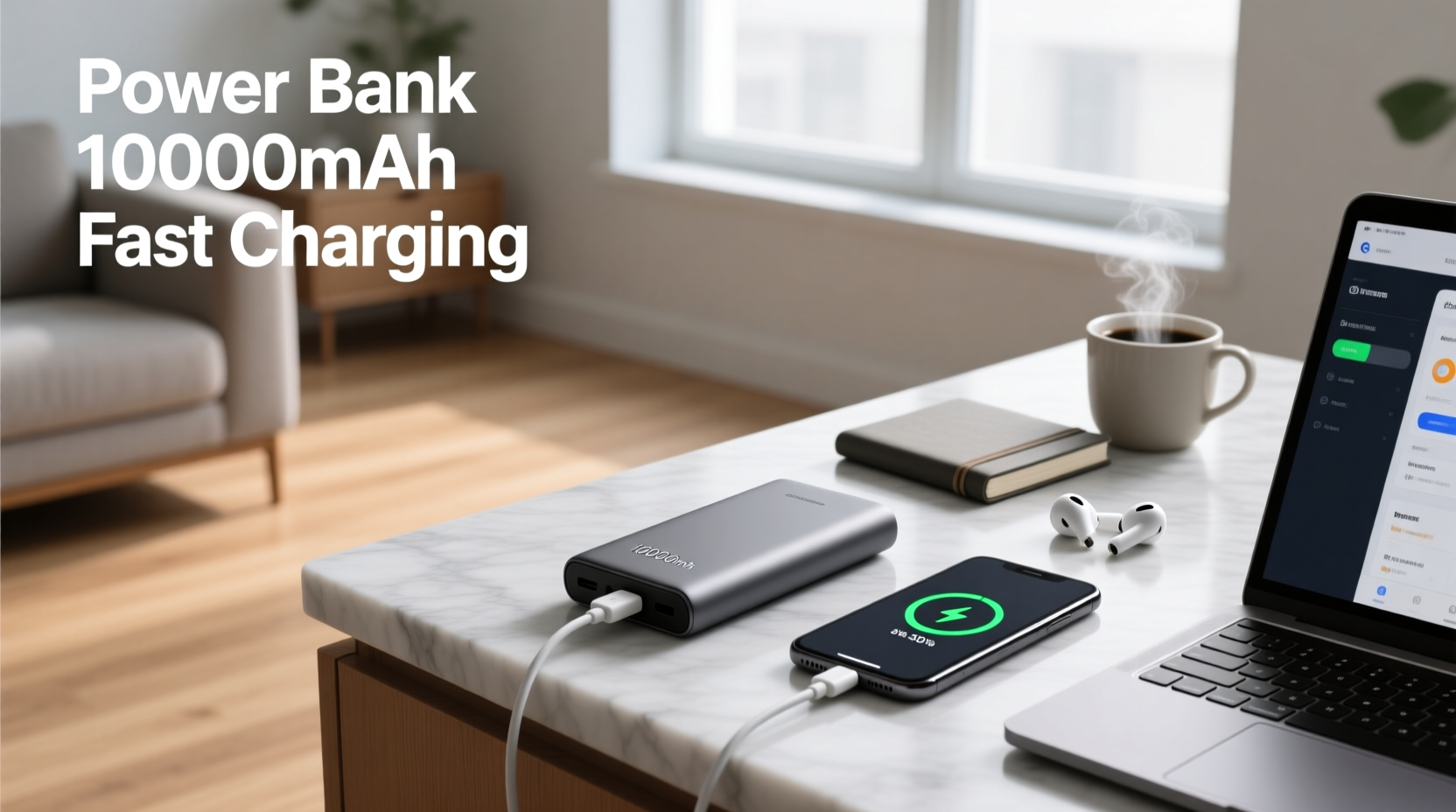
When you search for power bank 10000mah fast charging, you’re not just comparing specs—you’re trying to solve a real-world problem: Will this actually get my iPhone or Android from 15% to 80% in under 30 minutes while I’m commuting—or will it drain slower than my phone? The short answer: A well-designed 10,000mAh power bank with true USB-C Power Delivery (PD) 3.0 or Qualcomm Quick Charge (QC) 4+ can deliver ~65–75% of its rated capacity to modern smartphones, and achieve 0–50% charge in 22–32 minutes—if your device supports the negotiated voltage/current and you use the correct cable. This depends on three non-negotiable factors: (1) actual output wattage (not just "fast charging" labeling), (2) battery cell quality and conversion efficiency (typically 60–75%), and (3) whether your phone accepts PD PPS or QC adaptive profiles—not just peak wattage numbers.
Why “10000mAh Fast Charging” Is Misleading—And What It Really Means
The term power bank 10000mah fast charging appears in over 9 million Google results—but most listings conflate marketing language with engineering reality. A 10,000mAh rating refers to the internal lithium-ion cell capacity at 3.7V, not the usable energy delivered to your device. Due to voltage conversion (3.7V → 5V/9V/12V/20V), circuit losses, and thermal throttling, only 6,200–7,500mAh is typically available at the USB port 1. That’s why a 10,000mAh unit rarely delivers two full charges to an iPhone 15 Pro (4,422mAh battery)—it usually provides 1.4–1.7 full cycles 2.
“Fast charging” adds another layer of ambiguity. Many units list “22.5W fast charging” but only sustain that for the first 10–15 minutes before dropping to 12–15W due to heat buildup or battery SOC (state of charge) management. True sustained fast charging requires active cooling, high-grade GaN components, and firmware that dynamically adjusts voltage based on device negotiation—not just static labels.
How Much Power Can You *Actually* Get? Capacity vs. Usable Output
Here’s how to estimate real-world performance:
- iPhone 15/16 series: With USB-C PD 3.0 + PPS support, expect ~22W sustained input (0–50% in ~25 min). A 10,000mAh power bank with 20W PD output delivers ~6,800mAh effective capacity—enough for ~1.5 full charges.
- Samsung Galaxy S24/S25: Supports 25W wired charging, but most external power banks max out at 22.5W (e.g., Samsung’s own 10,000mAh model). Real-world delivery: ~1.3–1.6 full charges.
- Android mid-range (e.g., Pixel 8, OnePlus Nord): Often limited to 15–18W without proprietary protocols. Expect ~1.1–1.4 full charges—and slower top-off (last 20%) due to reduced current.
- iPad Air / Mini: Higher voltage requirements (15–20V) reduce efficiency. A 10,000mAh PD 30W unit may deliver only ~4,000mAh equivalent—less than one full charge.
This discrepancy arises because energy transfer isn’t linear: conversion efficiency drops as battery state rises. Most power banks operate at ~65–70% end-to-end efficiency (cell → device), compared to ~85% for wall chargers 3. Always check if the manufacturer publishes real-world discharge test data (not just “up to” claims).
USB-C PD vs. QC vs. Proprietary Protocols: Which One Matters for Your Device?
Not all “fast charging” is compatible. Here’s what works where:
| Protocol | Max Output (Typical) | iPhone Support | Android Support | Key Limitation |
|---|---|---|---|---|
| USB-C Power Delivery (PD) 3.0 | Up to 100W (but 10,000mAh units usually cap at 20–30W) | ✅ Full support (iOS 15.2+, USB-C models) | ✅ Wide adoption (Galaxy S22+, Pixel 7+, many Xiaomi/OPPO) | Requires certified USB-C cable (E-Marker chip for >60W) |
| Qualcomm Quick Charge (QC) 4+ | Up to 28W (but often 18–22.5W on 10,000mAh models) | ❌ No native support | ✅ Strong on Snapdragon devices (S21, Note 20, older Pixel) | Doesn’t negotiate voltage below 5V—inefficient for low-SOC charging |
| Xiaomi Mi Turbo Charge / Huawei SCP | Up to 165W (Xiaomi 10,000mAh model) | ❌ Incompatible | ✅ Only with matching Xiaomi/Huawei phones & cables | Proprietary; disables fast charging if non-OEM cable used |
| PPS (Programmable Power Supply) | Part of PD 3.0 spec; enables fine-grained voltage control | ✅ Required for fastest iPhone charging | ✅ Supported on Galaxy S23+/S24+, Pixel 8 Pro | Few 10,000mAh power banks implement PPS correctly—verify firmware version |
If your phone supports PPS (most 2023+ flagships do), prioritize PD 3.0 + PPS-certified units—even if labeled “20W” instead of “22.5W.” PPS reduces heat and extends battery lifespan by avoiding fixed 9V/12V steps 4. Avoid “QC-only” banks unless you own a legacy Snapdragon phone.
Physical Design & Portability: Slim ≠ Efficient
Many listings emphasize “ultra-slim” or “credit-card thin” 10,000mAh designs. While convenient, extreme miniaturization often sacrifices thermal headroom and cell quality. High-density lithium-polymer (Li-Po) cells run hotter and degrade faster than standard lithium-ion (Li-ion) under sustained load. Independent teardowns show slim units frequently throttle output after 8–10 minutes at >18W 5. If portability is critical, verify: (1) whether it uses Li-ion (safer, longer cycle life), (2) presence of passive aluminum heatsinking, and (3) whether output remains stable at 20°C–35°C ambient temperature.
Weight and dimensions also impact usability. A true 10,000mAh unit should weigh 220–280g. Units under 200g likely use lower-capacity cells or inflated ratings. Check product certifications: UL 2056 (US), CE (EU), or CCC (China) indicate third-party safety validation—not just “CE” stickers printed on packaging.
Air Travel & Safety: What Airlines Actually Allow
All major airlines permit 10,000mAh power banks in carry-on luggage—because their energy rating is ≤37Wh (10,000mAh × 3.7V = 37Wh). This falls well below the IATA 100Wh limit. However, you must keep it in your carry-on; checked baggage bans all spare lithium batteries. Some carriers (e.g., Emirates, Lufthansa) require the power bank to be switched off and protected from short-circuit (e.g., original packaging or plastic bag). No declaration is needed for ≤100Wh units—but always confirm with your airline 72 hours pre-flight, as policies vary by region and aircraft type.
Counterfeit units pose real risk: uncertified cells can swell, overheat, or ignite. Look for explicit mention of UL/IEC 62133 certification—not just “safe materials.” Avoid units with no visible brand, missing model numbers, or inconsistent labeling across packaging and device.
Charging Time: How Long to Recharge the Power Bank Itself
A common oversight: how long does it take to recharge the power bank? A 10,000mAh unit with 22.5W input takes ~4.5–5.5 hours using a compatible wall charger and cable. PD 3.0 input cuts this to ~3.5–4 hours—but only if the unit supports bidirectional PD (input/output on same port). Many budget models use separate micro-USB input (max 5V/2A = 10W), stretching recharge time to 8–10 hours. Always verify input specs—not just output.
Temperature matters: charging below 0°C or above 45°C degrades cells faster. If you live in a hot climate, avoid leaving the unit in direct sun—even when powered off.
When to Choose 10,000mAh Over 20,000mAh (or Vice Versa)
Despite similar price points, these capacities serve different needs:
- Choose 10,000mAh if: You commute daily, travel light, need one-device priority charging, or value pocketability. Ideal for iPhone users, students, or remote workers with one laptop + phone.
- Choose 20,000mAh if: You’re on multi-day trips without reliable outlets, charge multiple devices simultaneously (phone + earbuds + tablet), or use power-hungry accessories (portable SSDs, gaming handhelds). Note: 20,000mAh units exceed 100Wh in some configurations—requiring airline approval.
Don’t assume higher mAh means better value. A poorly engineered 20,000mAh unit may deliver less usable energy than a premium 10,000mAh model—and weigh twice as much. Prioritize efficiency (Wh/kg), not just capacity.
Red Flags to Avoid When Buying
These indicators suggest inflated specs or safety risks:
- “165W output” on a 10,000mAh unit: Physically impossible for sustained delivery. 165W requires >4,000W thermal dissipation—unachievable in this form factor. This is either a misprint or a proprietary handshake limited to one phone model.
- No input/output voltage/current breakdown: Legitimate brands list exact specs (e.g., “Input: USB-C PD 3.0, 5V/3A, 9V/3A, 12V/3A, 15V/3A, 20V/2.25A”). Vague terms like “smart IC chip” or “intelligent charging” mean nothing without test data.
- Priced under $25 USD with “45W fast charging”: Manufacturing cost alone exceeds this. Likely uses recycled cells, lacks overvoltage protection, or falsifies capacity.
- Missing safety certifications: No UL, CE, or PSE mark visible on device or packaging. Avoid units sold only via unverified marketplaces without traceable brand support.
How to Verify Real Performance Before You Buy
Don’t rely on listing text. Do this instead:
- Search YouTube for “[brand] [model] teardown” or “[brand] [model] discharge test”—reputable reviewers (e.g., MrWhoseTheBoss, Dave2D) measure actual mAh delivered at 5V/9V/12V loads.
- Check the manufacturer’s whitepaper or technical datasheet—not the Amazon bullet points. Look for graphs showing output stability over time and temperature.
- Read reviews filtering for “bought 6+ months ago”—to assess long-term degradation (capacity loss >20% in 12 months indicates poor cell quality).
- Confirm USB-IF certification ID (for PD units) at usb.org/usb-certification. Enter the model number—if no result, it’s not officially PD-compliant.
Frequently Asked Questions
Q: How long does a 10000mAh power bank last before losing significant capacity?
A: With proper care (avoiding full discharges, storing at 40–60% charge, keeping below 35°C), most quality units retain ≥80% capacity after 500 full charge cycles (~18–24 months of daily use).
Q: Can I charge a MacBook with a 10000mAh power bank?
A: Yes—if it supports USB-C PD 30W+ output and your MacBook has a USB-C port. But expect only ~0.5–0.7 full charges for a 13-inch M1/M2 MacBook Air (52.6Wh battery), due to conversion losses.
Q: Why does my “22.5W” power bank charge my phone slower than its wall charger?
A: Wall chargers deliver power directly; power banks add conversion loss and thermal limits. Also, many phones restrict input speed when battery temp exceeds 35°C—common during portable use.
Q: Do magnetic (MagSafe) power banks work with non-Apple devices?
A: MagSafe-compatible units use Qi2 wireless charging (15W max). They’ll charge any Qi2-certified Android (e.g., Galaxy S24 Ultra, Pixel 8 Pro) at 10–12W—but alignment and case thickness affect performance.
Q: Is USB-C the only port I need on a 10000mAh power bank?
A: For future-proofing, yes—USB-C PD handles all modern devices. But if you still use older accessories (micro-USB headphones, Bluetooth speakers), a dual-port (USB-C + USB-A) model offers flexibility without sacrificing speed.
