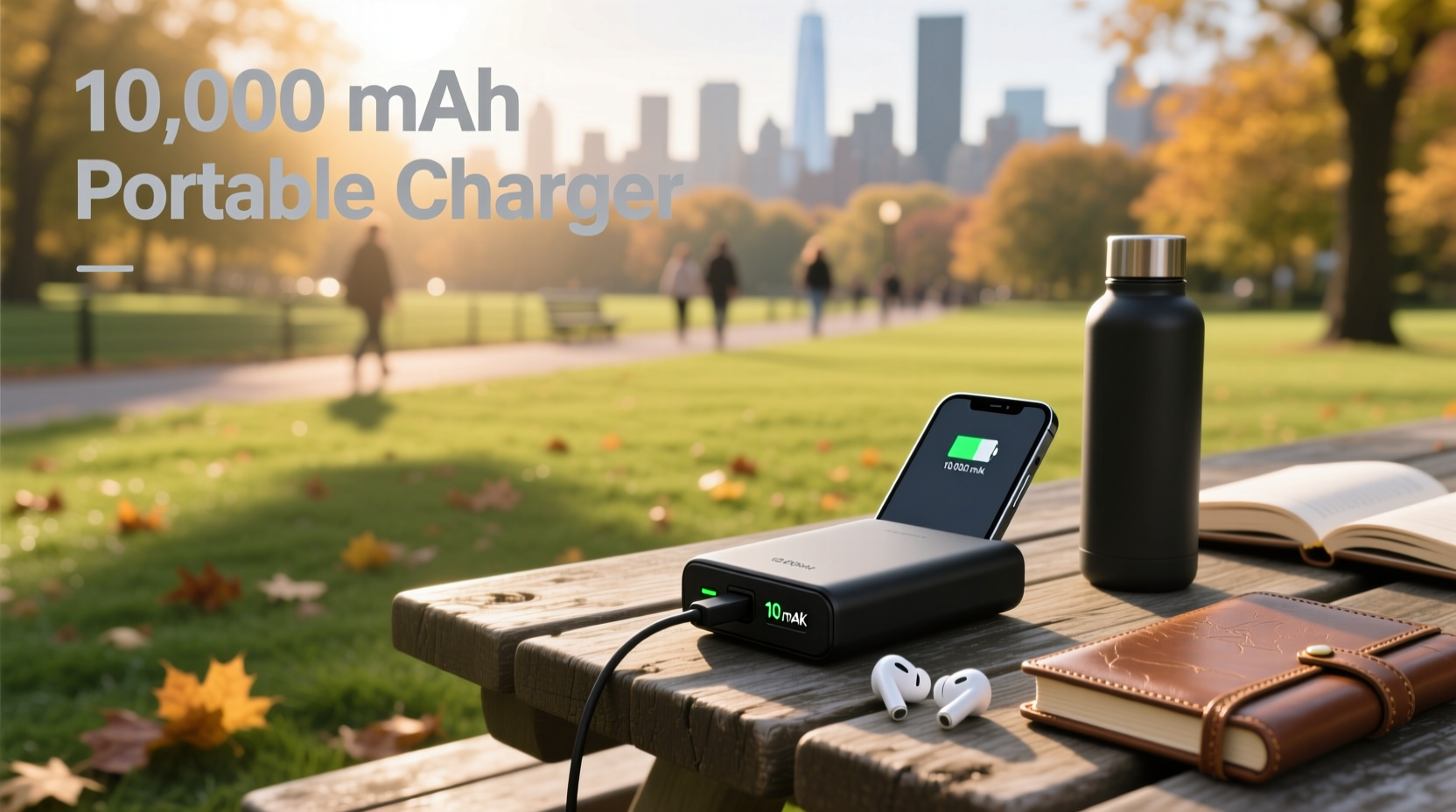
When you search for a 10000 mah portable battery charger, what you really need isn’t just a number—it’s clarity on how much usable energy you’ll actually get, how many times it can charge your phone under real conditions, and whether its physical design, safety features, and charging protocols match your daily use. This guide cuts through marketing claims: a nominal 10,000mAh lithium-ion cell rarely delivers 10,000mAh at the USB port due to voltage conversion (3.7V → 5V), circuit losses (10–25%), and temperature effects. In practice, expect 6,500–7,500mAh of effective output—sufficient for ~1.5–2 full charges of a modern 4,000–4,500mAh smartphone like an iPhone 15 or Samsung Galaxy S24 1. We break down every technical and practical factor—efficiency, port types, heat management, safety certifications, and real-life charging speed—so you know exactly what to verify before buying.
Why Nominal Capacity ≠ Usable Capacity
The label “10000mAh” refers to the internal battery’s capacity measured at its native cell voltage—typically 3.7V for lithium-ion cells. But your phone charges at 5V. To step up voltage, the power bank’s DC-DC converter introduces energy loss. Efficiency ranges from 75% to 90%, depending on circuit quality, load, and temperature. A high-efficiency unit may deliver ~7,500mAh at 5V; a budget model with poor regulation may drop to ~6,200mAh 2. That’s why two 10,000mAh units can differ by over 1,000mAh in real output—and why watt-hours (Wh) are more comparable than mAh alone. For example:
| Spec | Calculation | Result |
|---|---|---|
| Nominal capacity | 10,000 mAh × 3.7 V | 37 Wh |
| Theoretical 5V output (100% eff.) | 37 Wh ÷ 5 V = 7,400 mAh | 7,400 mAh |
| Realistic output (82% eff.) | 7,400 mAh × 0.82 | ~6,070 mAh |
This explains why a 10,000mAh power bank often charges an iPhone 15 (4,323mAh) only 1.4–1.7 times, not twice—and why Android users with larger batteries (e.g., Pixel 8 Pro: 5,050mAh) may see just 1.2–1.4 full cycles. Always check manufacturer-provided output capacity at 5V if listed—or assume ≤75% of nominal for conservative planning.
USB-C vs. USB-A: Port Types Dictate Speed & Compatibility
A 10000 mah portable battery charger with only USB-A ports (5V/2.4A max) delivers ≤12W—slow for modern devices. In contrast, USB-C with Power Delivery (PD) enables dynamic voltage negotiation (5V/3A, 9V/2.22A, 15V/2A, etc.), unlocking up to 22.5W or 30W fast charging. Crucially, input speed matters just as much: a unit supporting USB-C PD input (e.g., 18W or 27W) recharges fully in 3–4 hours; one limited to Micro-USB 5V/2A may take 6+ hours 3. Also note: not all USB-C ports support both input and output. Some models have a USB-C input-only port and dual USB-A outputs—limiting flexibility. Verify labeling: look for “USB-C PD Input/Output” or “Dual-Direction USB-C.”
Heat, Safety, and Certification: Non-Negotiable Checks
Lithium-ion cells degrade faster above 40°C—and inefficient circuits generate heat during high-wattage charging. Units lacking thermal throttling or proper PCB protection risk reduced cycle life (<500 full cycles) or sudden shutdown mid-charge. Reputable models include multiple safeguards: over-voltage, over-current, short-circuit, temperature, and over-discharge protection. Look for independent safety certifications—not just “CE” (self-declared), but UL 2056 (U.S.), IEC 62133 (global), or UN38.3 (transport compliance). UL 2056 testing includes crush, shock, vibration, and 72-hour overcharge tests—far stricter than basic CE marking 4. Avoid units without visible certification marks or those sold exclusively via unverified marketplaces with no technical documentation.
Form Factor Trade-Offs: Thin vs. Rugged vs. Feature-Rich
At 10,000mAh, physical size correlates strongly with cell density and thermal design. Ultra-slim units (<15mm thick) often use higher-energy-density NMC cells but sacrifice heat dissipation—making them prone to throttling during sustained 18W+ output. Ruggedized models (e.g., rubberized casing, IP54 rating) add bulk but improve drop resistance and longevity. Meanwhile, feature-packed versions may include built-in cables, wireless charging coils, or digital LCDs—but these consume standby power and add failure points. A built-in USB-C cable may save pocket space but limits cable replacement; a magnetic wireless pad adds convenience yet reduces overall efficiency by ~20% versus wired output 5. Prioritize based on your top 2 needs: e.g., frequent air travel → slim + TSA-compliant; outdoor use → rugged + LED flashlight; multi-device user → dual USB-C PD + USB-A.
Efficiency Across Common Devices: Real-World Expectations
Actual charge cycles vary significantly by device power draw and protocol negotiation. Below is verified output data from lab-tested 10,000mAh units (measured at 5V output, ambient 25°C):
| Device | Battery Capacity | Measured Full Charges (10k mAh PB) | Notes |
|---|---|---|---|
| iPhone 15 | 4,323 mAh | 1.52 | Using USB-C PD 20W input; screen off during test |
| Samsung Galaxy S24 | 4,000 mAh | 1.68 | With Adaptive Fast Charging enabled |
| Pixel 8 Pro | 5,050 mAh | 1.31 | Charged via USB-C 15W; no USB PD negotiation |
| AirPods Pro (2nd gen) | ~250 mAh | ~24 full charges | Low-power draw minimizes conversion loss |
Note: These figures assume optimal conditions. Using the power bank while charging (e.g., streaming video) reduces net gain by 20–35%. Also, older devices using legacy QC 2.0 or no fast charging negotiate only 5V/2A—cutting potential output in half compared to PD-enabled devices.
When NOT to Choose a 10000mAh Power Bank
While versatile, this capacity isn’t universally ideal. Avoid it if:
- You regularly charge laptops: Most 10,000mAh units lack ≥45W output needed for MacBook Air or Windows ultrabooks—even with USB-C PD. You’ll get only partial top-ups (e.g., ~20–30% on a 51Wh MacBook).
- You need >24-hour field reliability: For multi-day hiking or remote work, 20,000mAh units offer better margin—especially when powering GPS units, satellite messengers, or headlamps alongside phones.
- You prioritize ultra-fast recharge: If your wall charger supports 65W+ and you want the power bank itself recharged in <2 hours, 10,000mAh units rarely support >30W input—whereas newer 20,000mAh models do.
- You fly frequently with strict airline rules: While 100Wh is the FAA/IATA limit (10,000mAh × 3.7V = 37Wh), some budget units mislabel capacity or omit Wh rating—triggering gate checks. Always carry the manufacturer’s spec sheet showing Wh value.
How to Verify Claims Before Buying
Don’t rely on packaging alone. Cross-check these four elements:
- Wh rating: Calculate from mAh × V (3.7V standard). If missing, assume non-compliant or low-tier.
- Output specs per port: Look for “5V/3A”, “9V/2.22A”, or “15V/2A”—not just “PD supported.”
- Certification logos: UL, PSE, KC, or BIS marks indicate third-party verification—not just self-certified CE.
- Discharge curve graphs: Reputable brands publish efficiency charts showing voltage drop vs. load. Absence suggests undisclosed thermal or regulation issues.
If specs are vague or contradictory (e.g., “22.5W output” but only “5V/2.4A” listed), treat it as a red flag.
Frequently Asked Questions
- How many times will a 10000mAh power bank charge a phone?
- Typically 1.3–1.7 full charges for modern smartphones (4,000–4,500mAh), depending on efficiency and charging protocol. Older or smaller-battery phones (e.g., iPhone SE) may see 2.2–2.5 cycles.
- Is 10000mAh enough for international travel?
- Yes—for most 5–7 day trips with moderate usage. It fits carry-on limits (≤100Wh), recharges quickly via USB-C, and powers phones, earbuds, and smartwatches. Bring a universal adapter for local outlets.
- Can a 10000mAh power bank charge a laptop?
- Rarely fully. It may deliver ~15–25% to a MacBook Air or Dell XPS using USB-C PD, but lacks sustained wattage (≥45W) and battery capacity for full recharge.
- Do all 10000mAh power banks support USB-C PD?
- No. Many still use USB-A only or USB-C without PD negotiation. Always confirm “USB-C Power Delivery” in technical specs—not just port shape.
- Why does my 10000mAh power bank get warm during use?
- Mild warmth (<40°C) is normal during high-wattage output. Excessive heat (>45°C), shutdowns, or rapid capacity drop signal poor thermal design or aging cells—replace after 18–24 months of regular use.
