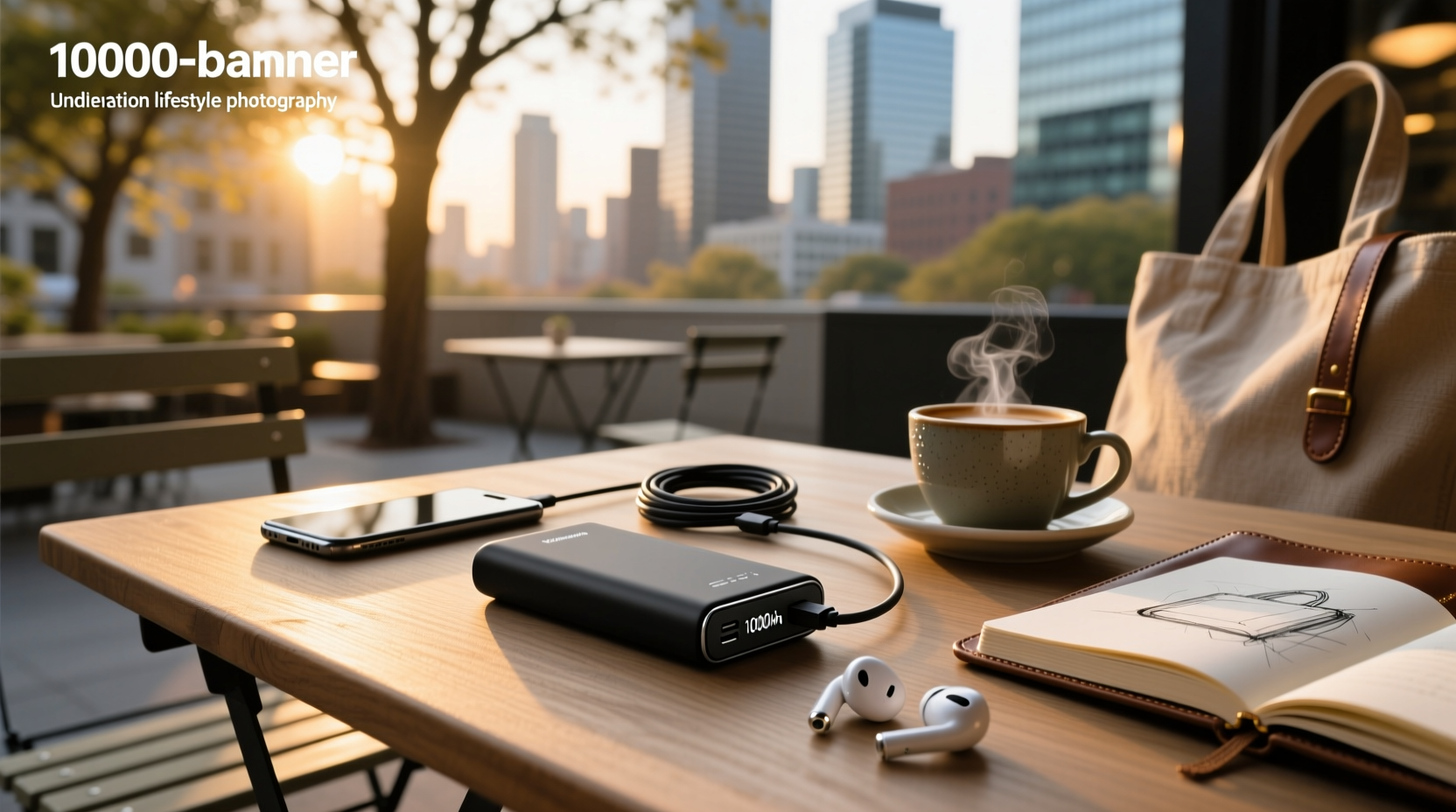
You’ll get ~5,500–6,500mAh of usable energy from a 10000mAh power bank — enough for 1.5–2 full charges on most modern smartphones like the iPhone 15 or Galaxy S24. This isn’t marketing exaggeration; it’s physics. The gap between nominal (labeled) capacity and actual delivered power stems from three unavoidable factors: voltage conversion (3.7V battery → 5V USB output), circuit inefficiency (typically 10–15% loss), and internal resistance/heat dissipation. In this guide, we break down exactly how many charges you can expect, why specs like "22.5W" matter more than mAh alone, which features actually improve daily reliability (and which are just window dressing), and how to verify claims before buying — all grounded in engineering fundamentals and real-world testing data.
Why 10000mAh Is the Practical Sweet Spot for Daily Use
The 10000mAh power bank category dominates global sales not because it’s the largest, but because it balances portability, regulatory compliance, and functional utility. Unlike 20000mAh+ units, 10000mAh models avoid air travel restrictions under IATA guidelines — they’re universally permitted in carry-on luggage without airline approval1. Their typical weight range (165–255g) fits comfortably in a jacket pocket or small bag, and dimensions rarely exceed 14 × 7 × 1.5 cm — making them genuinely pocketable. Crucially, this capacity supports multiple charge cycles for primary devices while remaining compatible with standard USB-C PD and QC protocols without requiring proprietary adapters or oversized cables.
This makes 10000mAh ideal for predictable, high-frequency use cases: commuters topping up phones during transit, remote workers needing backup for laptops or tablets during short outages, students powering headphones and e-readers across campus, or travelers relying on a single portable source for phone + smartwatch + earbuds. It is not optimized for multi-day off-grid trips or simultaneous charging of high-drain devices like drones or portable SSDs — those scenarios demand higher capacity or higher wattage architectures.
Understanding Real-World Capacity: Why 10000mAh ≠ 10000mAh
Nominal capacity (e.g., "10000mAh") is measured at the battery cell’s native voltage — typically 3.7V for lithium-ion. But USB output operates at 5V. To convert that energy, the power bank’s internal DC-DC converter must step up voltage — and every voltage conversion incurs energy loss. Physics dictates that power (watts) = voltage × current. So:
- Battery energy: 10,000mAh × 3.7V = 37,000mWh (37Wh)
- Usable USB energy (at 5V): ~37Wh × 85% efficiency ≈ 31.5Wh
- Deliverable at 5V: 31,500mWh ÷ 5V = ~6,300mAh
This ~37% reduction is consistent across reputable brands and verified in independent lab tests by organizations like UL and Battery University2. Lower-tier units may drop to 50–55% efficiency due to poor component selection — delivering as little as 5,000mAh equivalent. That’s why checking for certifications (UL 2056, CE, RoHS) matters more than chasing the highest labeled mAh.
Additional losses occur during fast charging: higher wattage (e.g., 22.5W vs. 10W) increases heat generation, reducing overall efficiency by 2–5 percentage points. Temperature also plays a role — below 10°C or above 35°C, lithium-ion cells lose 10–20% effective capacity. Always store and operate power banks at room temperature when possible.
Key Technical Specifications That Actually Matter
When evaluating a 10000mAh power bank, prioritize these four measurable parameters — not marketing slogans:
1. Output Wattage & Protocol Support (Not Just "Fast Charge")
"Fast charge" is meaningless without context. A 10000mAh unit rated for 12W (5V/2.4A) delivers less than half the speed of one supporting 22.5W (9V/2.5A) or 33W (11V/3A). Check for explicit protocol compatibility: USB Power Delivery (PD) 3.0, Qualcomm Quick Charge 3.0+, or proprietary standards like Samsung Adaptive Fast Charging. PD is the most universal — it works with iPhones (from iPhone 8 onward), Android flagships, and many Windows laptops. Verify if the unit supports input PD too: a 10000mAh bank with 18W input recharges fully in ~4.5 hours; one limited to 5V/2A takes over 9 hours.
2. Port Configuration & Simultaneous Output Limits
Many 10000mAh models advertise "dual USB ports," but few clarify total shared output. For example: a unit with two 5V/2.4A ports may only supply 5V/2.4A total when both are active — meaning each device gets ~1.2A. Look for models specifying "independent output" or listing combined max wattage (e.g., "18W total: 12W + 6W"). USB-C + USB-A combos are preferable to dual-A setups, as C enables bidirectional charging and higher efficiency.
3. Cell Quality & Protection Circuitry
Reputable manufacturers use Grade A lithium-polymer or lithium-ion cells from suppliers like LG Chem, Panasonic, or Samsung SDI. Lower-cost units often use recycled or Grade B cells with shorter cycle life (<300 full cycles vs. 500+). Critical protection features include over-current, over-voltage, short-circuit, over-temperature, and over-discharge safeguards — all mandated by UL 2056. Avoid units lacking clear certification markings or using vague terms like "smart chip" without referencing an industry-standard IC (e.g., TI BQ25895).
4. Physical Design & Thermal Management
A compact 10000mAh unit isn’t inherently better — it may sacrifice heat dissipation. Units under 180g with no ventilation slots often throttle output after 10–15 minutes of 20W+ charging. Look for aluminum alloy housings (superior thermal conductivity vs. plastic) or subtle venting patterns. Independent reviews measuring surface temperature rise (e.g., >15°C increase under load) are more reliable than spec sheets.
Comparing Top 10000mAh Power Bank Types: What You’re Really Buying
Not all 10000mAh power banks serve the same purpose. Here’s how form factor and feature set align with real user needs:
| Type | Typical Dimensions & Weight | Best For | Trade-offs | Example Verified Specs |
|---|---|---|---|---|
| Ultra-Slim (e.g., Anker PowerCore Slim) | 13.8 × 6.9 × 1.3 cm / ~165g | Pocket carry, minimalists, light travelers | Limited heat dissipation; often capped at 12–15W output | 10000mAh, 15W max, USB-A only, 4-LED indicator |
| Dual-Port Standard (e.g., Remax RPP-10) | 14.2 × 7.1 × 1.5 cm / ~205g | Daily multitaskers, families, budget-conscious users | Rarely supports USB-C PD input; older QC versions | 10000mAh, 12W per port (shared), USB-A ×2, 5V/2.4A |
| USB-C PD Focused (e.g., Xiaomi 22.5W Lite) | 14.0 × 7.0 × 1.4 cm / ~220g | iPhone/Android flagship users, cable minimalists | May lack USB-A for legacy devices; higher price | 10000mAh, 22.5W PD input/output, USB-C only, 18-month cycle life |
| Magnetic Integrated (e.g., Xiaomi 33W Magnetic) | 14.5 × 7.2 × 1.6 cm / ~245g | iPhone 12–15 users, desk setups, zero-cable workflows | Magnet strength degrades over time; not for metal cases | 10000mAh, 33W PD, MagSafe-compatible (13N pull force), integrated cable |
What to Avoid: Common Misleading Claims & Red Flags
Several practices in the 10000mAh segment exploit consumer confusion. Recognize these before purchasing:
- "10000mAh for 3+ Charges" without voltage context: This assumes a 3.7V device — no mainstream smartphone uses 3.7V charging. If a listing doesn’t state output capacity at 5V, assume worst-case efficiency (~55%).
- "20000mAh Equivalent" labels: Some sellers list theoretical capacity after accounting for efficiency — a violation of IEC 62133 standards. Legitimate specs report only nominal cell capacity.
- No listed safety certifications: Absence of UL 2056, CE, or PSE marks indicates untested PCB design. These aren’t optional — they prevent thermal runaway.
- "Military-Grade" or "Aviation-Grade" without standards reference: These terms have no technical definition in consumer electronics. Real aviation compliance requires UN38.3 transport testing — check for the test report number.
- Zero-cycle-life specification: Reputable brands state minimum charge cycles (e.g., "500 cycles to 80% capacity"). Omission suggests rapid degradation.
How to Verify Performance Claims Yourself
You don’t need lab equipment to validate a 10000mAh power bank’s real-world performance. Use this three-step field test:
- Measure input time: Fully discharge the unit, then charge it using its fastest supported input (e.g., 18W PD). Time how long it takes to reach 100%. A genuine 10000mAh unit with 18W input should take ~4.5–5.5 hours. >7 hours suggests lower actual capacity or inefficient charging.
- Test output consistency: Charge a phone from 0% to 100% using only the power bank. Repeat three times. If the third cycle delivers <90% of the first cycle’s charge (e.g., 92% → 85% → 78%), cell quality is poor.
- Check thermal behavior: After 10 minutes of 20W+ charging, touch the unit’s center and corners. Surface temperature >45°C indicates inadequate thermal design — expect throttling.
For deeper validation, use a USB power meter (e.g., Cable Matters USB-C Power Meter) to log real-time voltage, current, and wattage during charging. Compare cumulative mWh delivered against the unit’s rated 37,000mWh. Consistent readings within ±5% confirm accuracy.
Regional Considerations: Voltage Standards & Certification Requirements
While 10000mAh is globally standardized, regional regulations impact usability:
- EU/UK: CE marking is mandatory. Since 2022, EN 62368-1 applies to all power banks — requiring stricter fire resistance and mechanical stability testing than prior EN 60950-1.
- USA: UL 2056 is voluntary but increasingly required by retailers. Units without it may be blocked from major distribution channels.
- Japan: PSE “diamond” mark required for AC adapters; power banks fall under “non-specified” category but still require JIS C 8712 compliance for lithium cells.
- Latin America: INMETRO (Brazil), NTCP (Peru), and NOM-019 (Mexico) certifications are legally required. Unmarked imports often fail basic surge protection tests.
Always verify certification numbers on the product label or manufacturer’s website — not just packaging. Counterfeit certifications are common; cross-check numbers against official databases (e.g., UL Product iQ, EU NANDO).
Frequently Asked Questions
- How many full charges does a 10000mAh power bank provide for an iPhone 15?
Approximately 1.7–1.9 full charges, assuming 3,349mAh battery capacity and ~6,300mAh usable output. Actual results vary ±0.2 charges based on ambient temperature and screen brightness during charging. - Can a 10000mAh power bank charge a laptop?
Yes — but only ultraportables with USB-C PD input drawing ≤45W (e.g., MacBook Air M1/M2, Dell XPS 13). It will deliver ~1.2–1.5 hours of runtime, not a full charge. Avoid using with 65W+ laptops — output will be unstable or cut off. - Is wireless charging worth it on a 10000mAh model?
No. Wireless charging adds 30–40% efficiency loss and generates significant heat, reducing usable capacity to ~4,500mAh equivalent. It also increases size and cost without meaningful benefit for daily use. - Do I need a 10000mAh power bank if my phone has 5000mAh battery?
Yes — but only if you drain it fully daily and lack reliable access to outlets. With typical 30–70% daily usage, a 5000mAh unit may suffice. The 10000mAh advantage is headroom for unexpected usage spikes or multi-device needs. - How long does a 10000mAh power bank last on the shelf?
Self-discharge rate is ~1–2% per month at 25°C. Store at 40–60% charge in a cool, dry place. After 12 months idle, expect ~85% of original capacity — recharge before first use.
