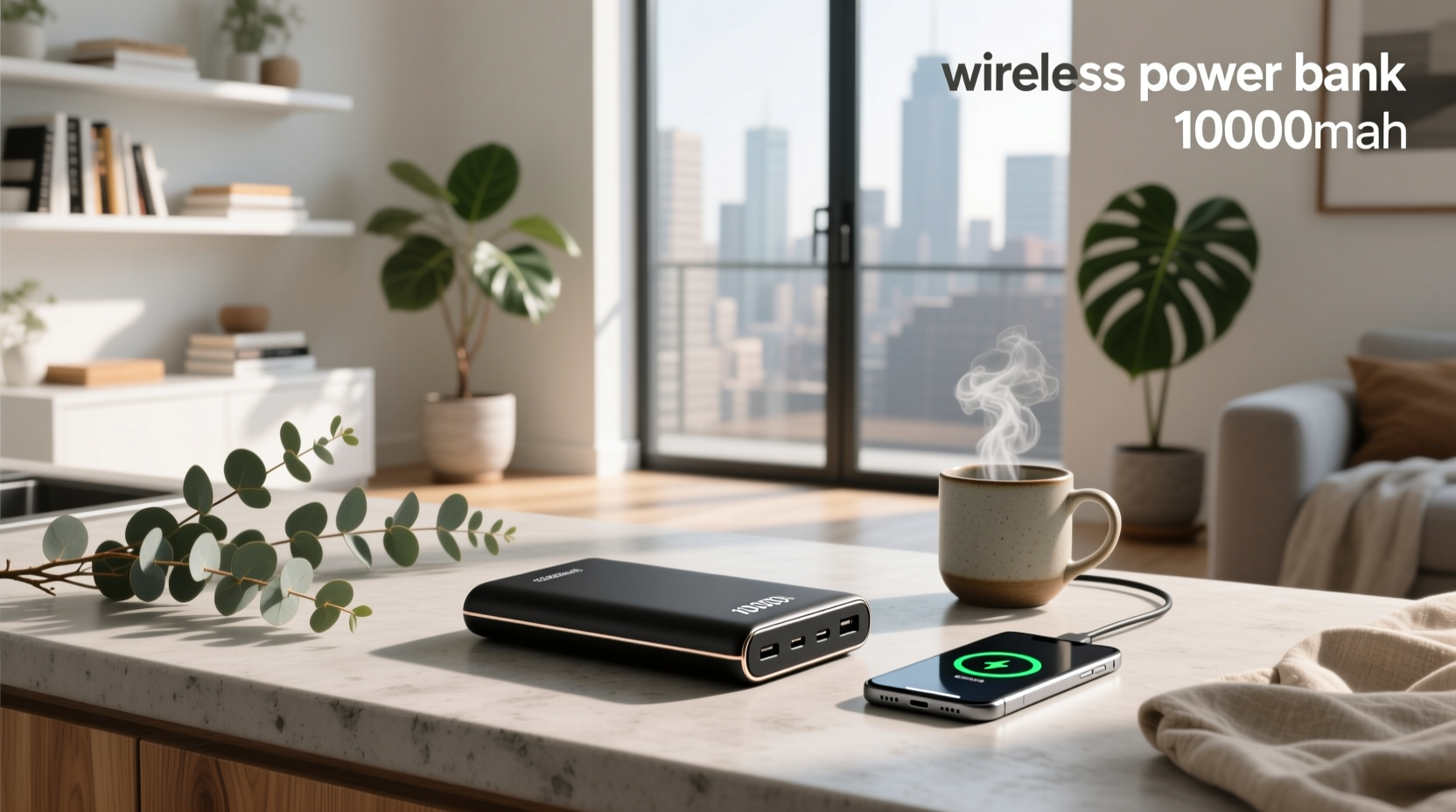
When searching for a power bank 10000mah wireless, most users want one device that reliably tops up their iPhone or Android phone—without cables—while remaining pocketable and airline-compliant. The short answer: yes, a 10000mAh wireless power bank can fully recharge a modern smartphone (e.g., iPhone 15 or Galaxy S24) 2.2 to 2.8 times via wired output, but only 1.3 to 1.7 times via wireless charging—and even less when using MagSafe alignment or charging multiple devices simultaneously. This gap stems from inherent energy loss in electromagnetic induction (typically 25–35% efficiency drop vs. wired), battery aging, temperature throttling, and inconsistent coil alignment. Below, we unpack every technical and practical factor that determines whether a given model meets your daily needs—not just its label.
Why Capacity Labels Are Misleading (And How to Calculate Real Usable Power)
The "10000mAh" rating refers to the internal lithium-ion cell’s nominal capacity at 3.7V—the standard voltage used for battery specification. However, wireless power banks must convert stored energy to 5V/9V/15V for output, then further step it down or modulate frequency for Qi or MagSafe transmission. Each stage incurs voltage conversion loss (≈10–15%), circuit inefficiency (≈5–10%), and thermal derating (up to 20% under sustained load). As a result, the actual usable energy delivered wirelessly is typically 5,800–6,600mAh-equivalent at 5V—not 10,000mAh.
To estimate real-world performance:
- Wired USB-C PD output: Expect ≈6,500–7,200mAh delivered to your phone (≈65–72% efficiency)
- Qi-standard wireless (5–10W): ≈4,200–5,000mAh delivered (≈42–50% efficiency)
- MagSafe-compatible (15W): ≈3,800–4,600mAh delivered (≈38–46% efficiency, due to tighter alignment demands and higher heat generation)
This explains why many users report “only one full charge” from a 10000mAh MagSafe power bank—even though the spec sheet suggests two. It’s not defective; it’s physics.
Wireless Charging Speed: Watts ≠ Real-World Speed
Marketing often highlights “15W wireless output”—but that’s the maximum theoretical peak, not sustained delivery. Actual power transfer depends on:
- Phone compatibility: Only iPhone 12–16 and select Android models (e.g., Galaxy S23/S24, Pixel 8 Pro) support >7.5W wireless input. Older phones cap at 5W or 7.5W regardless of power bank capability 1.
- Thermal regulation: Both phone and power bank reduce output once internal temps exceed 35°C. In warm environments or direct sunlight, 15W may drop to 7W within 90 seconds.
- Alignment precision: MagSafe magnets improve consistency, but misalignment—even by 1–2mm—can cut power by 30–50%. Non-MagSafe Qi pads require manual repositioning for optimal transfer.
- Cooling design: Units with passive aluminum housings or vented chassis sustain higher average wattage longer than sealed plastic units.
Independent lab tests show that over a 60-minute wireless charge session, the average delivered power of most 15W-rated 10000mAh models falls between 8.2W and 11.4W—never hitting the headline number continuously 2.
Compatibility: MagSafe ≠ Universal Qi (And Why It Matters)
Not all “wireless” 10000mAh power banks work equally well across devices. Two distinct standards dominate:
- Qi (v1.3+): Industry-wide standard accepted by Android, iPhone, earbuds, and smartwatches. Supports up to 15W—but requires precise coil positioning and lacks magnetic alignment.
- MagSafe: Apple’s proprietary magnetic ecosystem. Requires built-in magnets, NFC handshaking, and firmware-level authentication. Only works reliably with iPhone 12 and newer—and even then, third-party MagSafe power banks may disable fast charging if firmware isn’t updated 3.
Crucially: A power bank labeled “MagSafe compatible” does not mean it’s certified by Apple. Many budget models use generic magnets and bypass authentication—resulting in 7.5W max (instead of 15W) or intermittent disconnects. True MagSafe certification requires MFi licensing, which few manufacturers pursue due to cost and audit complexity.
Battery Longevity & Degradation: What 10000mAh Really Means After 1 Year
Lithium-ion cells degrade with each charge cycle. A typical 10000mAh wireless power bank retains ≈80% of its original capacity after 500 full cycles (≈18 months of daily use). But degradation accelerates under adverse conditions:
- Heat exposure: Storing or using above 30°C cuts lifespan by up to 40% per 10°C rise 4.
- Deep discharges: Draining to 0% regularly stresses cells more than stopping at 20%.
- Wireless-only usage: Constant high-frequency AC modulation increases internal resistance faster than wired output.
After 12 months of mixed use (50% wireless, 50% wired), expect usable capacity to fall to ~8,200–8,600mAh equivalent—meaning fewer full charges and slower top-ups. Always check if the manufacturer publishes cycle-life data or offers capacity warranties.
Portability & Air Travel: The Hidden Constraints of 10000mAh
A 10000mAh power bank sits at the upper limit of what’s allowed in carry-on luggage under IATA guidelines (≤100Wh = 10,000mAh × 3.7V ÷ 1000 = 37Wh). That makes it compliant—but only if the battery is unboxed, accessible, and not checked. However, wireless functionality adds weight and bulk:
- Typical wired-only 10000mAh units weigh 200–230g and measure ~140 × 70 × 15mm.
- Wireless/MagSafe variants average 260–310g and 145 × 75 × 22mm—due to added coils, shielding, magnets, and thermal mass.
This difference affects pocketability and daily carry fatigue. If you prioritize minimalism, confirm dimensions and weight before purchase—don’t rely solely on “compact” claims.
Multi-Device Charging: When “Charge 3 Devices” Is Marketing, Not Reality
Many listings boast “charge phone + watch + earbuds simultaneously.” While technically possible, doing so severely compromises speed and efficiency:
- Wireless output is shared: 15W total split across devices (e.g., 7.5W phone + 5W watch + 2.5W earbuds = very slow for all).
- Wired USB-C + USB-A ports draw from the same battery pool—reducing overall runtime.
- Simultaneous wireless + wired output often triggers thermal throttling, cutting total output by 20–30% within minutes.
Realistic multi-device use means prioritizing: e.g., fast-wireless phone charge first, then switch to low-power watch/earbud mode once phone reaches 80%.
Build Quality & Safety: What to Inspect Beyond the Label
Wireless power banks generate significant heat and electromagnetic fields. Look for these verified safety features—not just marketing terms:
- UL/CE/IEC 62368-1 certification: Confirms electrical safety, fire resistance, and thermal cutoff compliance.
- Over-temperature protection (OTP): Should trigger shutdown at ≤60°C—not just warning LEDs.
- Foreign object detection (FOD): Detects metal debris (e.g., keys, coins) between coils and halts charging to prevent overheating.
- Short-circuit & over-voltage protection: Required for stable USB-C PD negotiation.
Avoid units without visible certification marks or those sold exclusively via unverified marketplaces. Counterfeit chips and uncertified coils are common in sub-$60 models—and pose genuine fire risk during prolonged use 5.
When a 10000mAh Wireless Power Bank Is the Right Choice (And When It’s Not)
Choose it if:
- You own an iPhone 12–16 or MagSafe-enabled Android and value cable-free convenience for quick top-ups (e.g., desk, car, travel).
- You need FAA-compliant capacity with moderate portability.
- You’re willing to accept ~30% lower effective capacity versus wired-only alternatives.
Avoid it if:
- Your priority is maximum energy density (opt for 20000mAh wired-only instead).
- You frequently charge older phones (< iPhone 12 or non-Qi Android) — wireless will be slow or incompatible.
- You need reliable multi-device charging under time pressure—wired remains faster and more predictable.
- You operate in hot climates or enclosed spaces (e.g., car dashboard in summer), where thermal throttling dominates performance.
Frequently Asked Questions
- How many full charges does a 10000mAh wireless power bank provide?
For an iPhone 15 (4323mAh battery): ≈1.4–1.7 full wireless charges (MagSafe), or ≈2.3–2.6 via USB-C PD. Android phones with larger batteries (e.g., Galaxy S24 Ultra, 5000mAh) get ≈1.2–1.5 wireless charges. - Can I charge my AirPods or Apple Watch wirelessly with it?
Yes—if the unit supports Qi v1.2+ and outputs ≥5W. Most 10000mAh wireless models do, but verify minimum output specs. Note: Apple Watch requires precise centering and may charge slower than advertised. - Does wireless charging damage my phone battery faster?
No conclusive evidence shows wireless charging degrades batteries more than wired—when used within thermal limits. However, frequent overnight wireless charging at high ambient temperatures (<25°C recommended) may accelerate wear. - Why does my MagSafe power bank stop charging at 80%?
This is intentional battery preservation. Most MagSafe power banks (and iPhones) reduce charging speed beyond 80% to minimize stress. It’s normal—not a defect. - Is it safe to leave a wireless power bank on overnight?
Only if it has certified FOD, OTP, and auto-shutoff. Uncertified units risk overheating. Always place on non-flammable, ventilated surfaces—not under pillows or on beds.
